

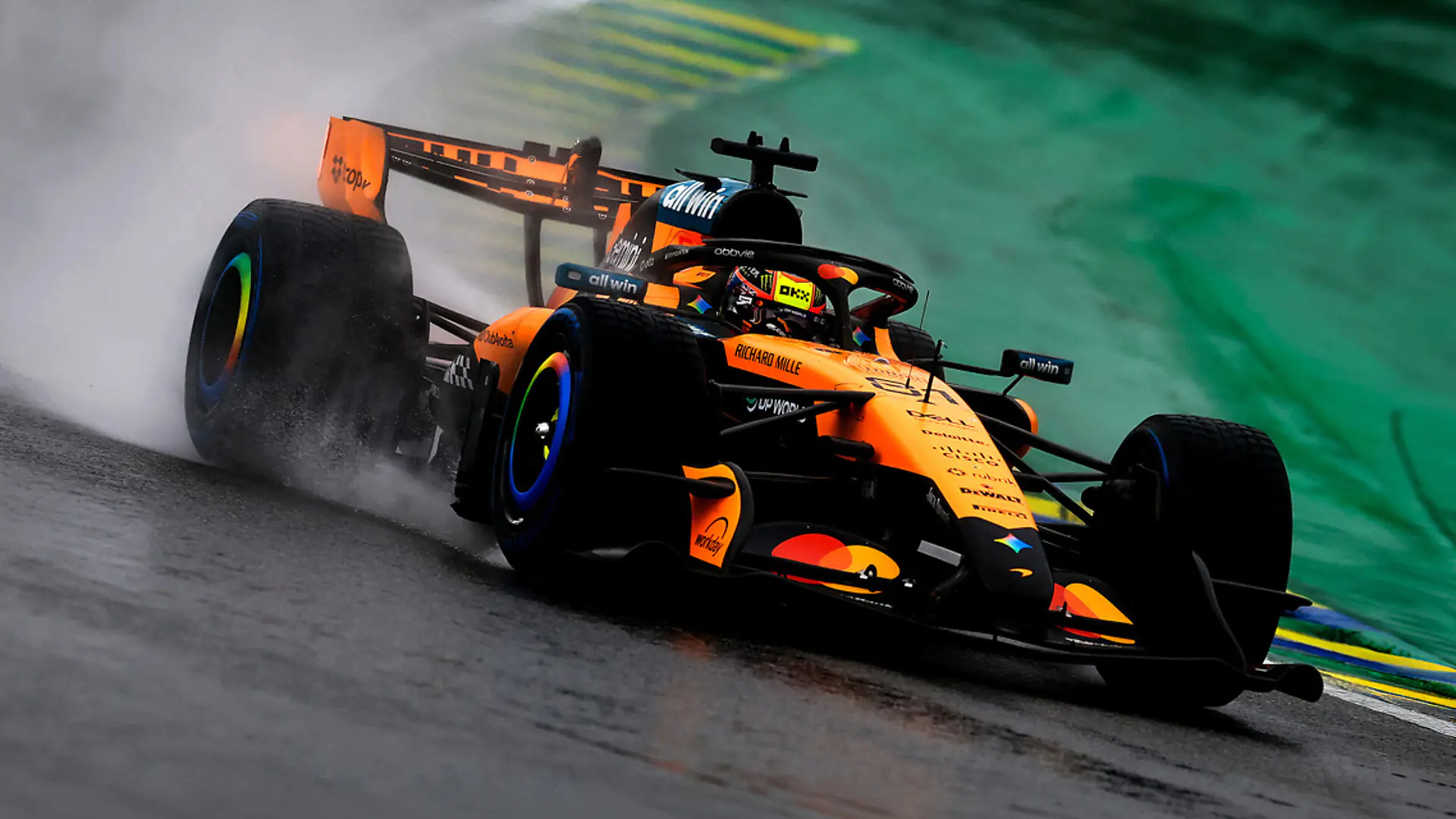
When McLaren put five of its own historic Grand Prix cars up for sale, we argued that the provenance was the product. The team’s next sale tests that idea at its outer limit. On December 9, RM Sotheby’s will offer a 2027 McLaren Mastercard Formula 1 Team MCL41 in Abu Dhabi: a car that has not been revealed, has not turned a wheel in competition, and will not reach its buyer until the end of 2029. The estimate is $9 million to $11 million.
This is the second time McLaren has done it. Last December the same partnership sold a 2026 MCL40A for $11.48 million, a lot RM Sotheby’s presented as the first future race car ever offered publicly at auction. What makes the sequel worth watching is that the market now has something it lacked a year ago: a season. And the season did not go to plan.
The year the provenance didn’t arrive
The MCL40A was bought from reigning champions. McLaren had just won its 10th Constructors’ Championship and Lando Norris the Drivers’ title. Whoever paid $11.48 million was, in effect, buying the chance that the 2026 car would extend that run into a new rulebook.
The new rulebook had other ideas. Mercedes has controlled 2026, and McLaren spent the first half of the year chasing both Mercedes and Ferrari before a mid-season upgrade turned the MCL40 into a winner. Norris took the Hungarian, Dutch and Brazilian Grands Prix. That is a respectable record. It is not a championship, and in this market that distinction carries real money. Michael Schumacher’s Monaco-winning Ferrari F2001 is worth what it is because of a specific race in a title-winning year, not because it was a contemporary Ferrari.
Set against that, the MCL41’s low estimate sits roughly $2.5 million beneath what the MCL40A achieved. Estimates are agreed between consignor and auction house rather than discovered by bidders, so this is not yet a market verdict. But it reads as a correction: an acknowledgment that what is being sold is a probability, and that probabilities have prices.
What the buyer actually owns
Strip away the occasion and the terms are precise. The winning bidder chooses Norris’s or Piastri’s chassis at the moment the hammer falls, a decision made months before either driver has sat in it. The car comes with a 2027-specification 1.6-litre turbocharged hybrid V6 built by Mercedes AMG High Performance Powertrains. It is sold on a bill of sale only. Once delivered, it may be run at designated demonstrations and track days, supported by McLaren Racing engineers and mechanics, and only within requirements set by McLaren, Mercedes AMG HPP, the FIA and the FIA’s common suppliers.
That last condition is the one serious buyers should dwell on. A 1990s Grand Prix car can, with the right specialist, be run independently. A modern hybrid car cannot. The catalogue itself notes that very few operational turbo-hybrid F1 cars, the formula in use since 2014, have ever passed into private hands. Ownership here means a permanent relationship with the factory, and any future owner inherits that relationship. It protects the car; it also narrows the pool of people who can ever sensibly buy it.

There is a subtler documentation question too. Teams typically build more than one monocoque per season and rotate them after damage, so “Norris’s car” is not a single object across a whole year. The value of an F1 chassis rests on which Grands Prix that particular tub started and finished. The MCL41’s provenance will be compiled by McLaren itself over 2027, and a buyer should expect, and ask for, a race-by-race record for the specific chassis delivered. As we found with Senna’s Williams FW16B and with the Mansell and Hill helmets at Broad Arrow, the paper trail is what the market ultimately prices.
Three years, structured like a forward contract
The delivery date is the most revealing number in the listing. McLaren will hand over the MCL41 at the end of the fourth quarter of 2029, which RM Sotheby’s attributes to F1 regulations restricting the sharing of intellectual property. That is roughly three years from hammer to handover. The MCL40A, sold in December 2025, is due at the end of the first quarter of 2028, a wait of about 27 months. The interval has grown by most of a year.
The payment terms make the structure plain. RM Sotheby’s collects the full buyer’s premium, plus VAT, and 25% of the hammer price on the night. McLaren invoices the balance directly at delivery, together with any VAT, duties or taxes, which depend on where the car is delivered and imported. Buyers should take tax advice before registering, not after; the lot notes put that responsibility squarely on them. A non-running show car may be available on lease in the interim.
In financial terms this is closer to a forward contract than a car purchase: a deposit today, the balance on settlement, and the value of the underlying asset decided by events in between. Those events are 2027 race results that no bidder can influence.
One more detail deserves attention. The MCL40A package granted its buyer a first right of refusal on a future McLaren F1 car, should one be offered. The MCL41 is being offered publicly, and its listing carries no such clause. Whether last year’s buyer declined, or the right was never meant to work that way, is not public. Either way, the perk has quietly disappeared from this year’s terms.
The experiences are not a footnote
The package is generous: the buyer and five guests meet Zak Brown, Norris and Piastri and tour the McLaren Technology Centre in Woking before the season, attend the 2027 launch and two Grands Prix including Monaco with premium hospitality and pit garage access, and gain access to the Le Mans 24 Hours and the Indianapolis 500. In 2027 McLaren will contest all three Triple Crown events in a single year, which it says no team has done before.
For some bidders that calendar is the purchase and the car is the receipt. Last year’s “Triple Crown” sale makes the point by contrast. The F1 car fetched $11.48 million, the 2027 WEC hypercar $7,598,750, and the Arrow McLaren IndyCar $848,750, for a combined $19,927,500. The IndyCar came with comparable access and delivery terms, yet brought less than a thirteenth of the F1 price. That gap is the Formula 1 brand premium in its purest form, and it is the real asset being auctioned.
Collectible or sponsorship package?
It is both, and the proportions will be settled by the 2027 season. Consider the company it keeps in Abu Dhabi. The same sale includes an Aston Martin Valkyrie estimated at $2.8 million to $3.2 million and a Gordon Murray Automotive T.50 at $5.5 million to $6 million, cars with finished stories that their owners can drive tomorrow. That a bidder will pay well above both for an unseen car with a three-year wait shows how differently this buyer thinks. As we noted when the modern exotic market began sorting rather than rising, scarcity alone does not set values. Story does.
There is also the matter of who writes the scarcity rules. Like Mercedes-Benz with its first C 111 sale, McLaren is consigning its own property and setting its own conditions. Selling a current car every year turns a pre-race F1 car from an unrepeatable first into a recurring product. The first one carried the premium of novelty; the second has to stand on what it may become.
Collectors usually pay for history that has already happened. With the MCL41 they pay first and let the history be written afterward, by Norris or Piastri, over a season they cannot control. The MCL40A showed that the result is not included in the estimate. The lower number on the MCL41 suggests McLaren and RM Sotheby’s have absorbed that lesson. Whether bidders have will be known on December 9.
Sources
- RM Sotheby’s: 2027 McLaren Mastercard Formula 1 Team MCL41, Abu Dhabi 2026 lot listing
- RM Sotheby’s: 2026 McLaren Formula 1 Team MCL40A, Abu Dhabi 2025 lot and result
- RM Sotheby’s: 2027 McLaren United AS WEC Hypercar Team, Abu Dhabi 2025 lot
- RACER: McLaren raises $19.9 million with “Triple Crown” auction in Abu Dhabi
- The Race: McLaren to sell 2027 F1 car before it races
The collector car market, every weekday morning.
Auction results, price moves and what’s crossing the block, read in four minutes. Free, from Modern Car Collector.
No spam, unsubscribe in one click. Or read more about the Brief.
Related Posts:
- Two T.50s Have Sold at Auction, $2.4 Million Apart.…

- Record Ferraris, Rare Icons and 15,000 RPM: The Week…

- Dan Gurney's Eagle Chassis 103 Didn't Win at Spa.…
- A €5.2M LaFerrari, a Valkyrie With a Haircut, and…
- A €5.2M LaFerrari, a Valkyrie With a Haircut, and…
- The $402,000 Corvette ZR1X Isn't a Collector-Car…

 Kyle Matthews