

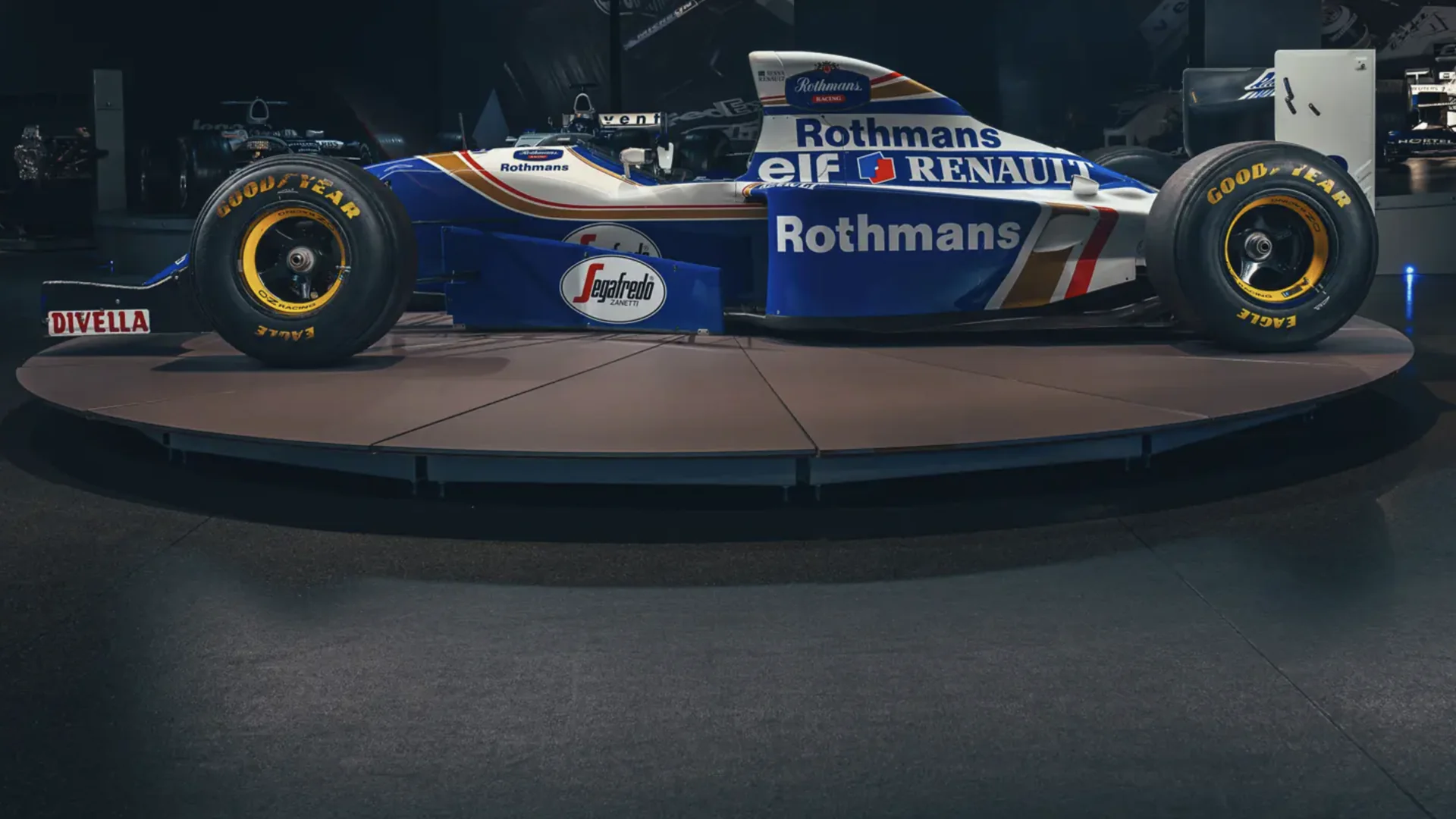
The most interesting thing about Ayrton Senna’s Williams FW16B is not a lap time. It is a clause in his contract.
RM Sotheby’s will offer chassis 01 as lot 1 of The Now & Contemporary Evening Auction in New York on November 16, with an estimate of $4 million to $6 million. The car is unrestored, has not been publicly offered before, and stayed with the Senna family from the end of 1994 until 2024. The catalog calls it one of two surviving Williams grand prix cars Senna drove that season. Those are the facts. The argument is that this is a sale about custody, not competition.
A Williams Without a Result
Senna started three races for Williams in 1994, took pole position at all three, and finished none. He led in Brazil until a pit stop let Michael Schumacher through, retired on lap 55, was hit from behind in the Pacific Grand Prix, and did not finish at San Marino. There is no victory attached to any Williams he drove, and nothing in this chassis’s race history changes that: the catalog’s record for 01 contains no Senna race start.
What it does contain is work. Senna drove 01 in the Sunday morning warm-up at Interlagos, where he lapped faster than the eventual race winner. A week later it went to Jerez, where Senna and Damon Hill shared roughly 842 kilometers across three sessions, with the test sheets surviving. That is the kind of documentation that moves a race car from “associated with” to “used by,” and it is the reason the car was chosen for what happened next.
The Clause
According to the catalog, Senna’s contract entitled him to a chassis from the season if Williams won the championship. Williams won the Constructors’ title and honored the arrangement, giving FW16B-01 to the Senna family because he had tested it extensively and driven it at Interlagos.
Most race cars leave a team by sale, by loan to a museum, or by quiet dispersal. This one left through a clause in a driver’s contract. For collectors that distinction matters, because it produces the shortest and cleanest chain a Formula 1 car can have: the team, the driver’s family, and one subsequent owner, who acquired it through RM Sotheby’s in 2024, the thirtieth anniversary of Senna’s death. Race cars are notorious for foggy histories, with chassis numbers reused, tubs rebuilt, and identities argued over for decades. A car handed over under a contractual entitlement is a different animal.
Three Champions, One Development Chassis
Chassis 01 was never the hero car. It was a working chassis, and that is part of its credibility. Hill ran it at the Silverstone and Jerez tests and as the spare, or T-car, at Monaco, the European Grand Prix, Japan and Australia. David Coulthard raced it in Spain, where he qualified ninth and retired, then to fifth in Canada and fifth again at Silverstone. Nigel Mansell drove it in the French Grand Prix and retired on lap 45 with gearbox trouble. Three world champions, then, in a single tub, plus Coulthard’s points.
It was also updated to FW16B specification after the British Grand Prix, so it carries the mid-season evolution that defined the car’s year: the higher front wing, taller endplates, shorter sidepods and the revised airbox that followed the rule changes after Imola. It is a record of how Williams developed the car under pressure, in a season that none of the people involved would remember as ordinary.
Reading the Estimate
Set the $4 million to $6 million range beside the Lotus 98T Senna drove in 1986, estimated at $9.5 million to $12 million, and the pattern is plain. That Lotus raced to two victories and five poles in Senna’s hands. The Williams has none of that. RM’s estimate is less than half, which suggests the house is pricing provenance rather than results.
We made the same argument about the red NSX in London, where the estimate priced the paperwork, not the car, and the result, £871,250, arrived on the back of a Honda fax. The same logic runs through the Broad Arrow helmet sale, where documentation outran fame. The FW16B is the strongest test yet of whether that holds for a full car, one with a genuine entitlement trail and a famous name but no famous result. Williams material has been through the market before, as with the 1998 FW20 offered in Paris, but not with this chain of custody.
What Serious Buyers Should Weigh
The listing is bill of sale only, which is normal for a car that was never meant for the road. Preservation is the asset here, and it cuts both ways. The car has been untouched for three decades apart from the addition of Senna’s personal seat, which is arguably the most meaningful non-original element on any Formula 1 car in private hands and deserves its own documentation. Beyond that, a buyer should establish what the sale includes in terms of the Renault RS6 V10, gearbox and spares, and what a sympathetic return to running would require, because an unrestored car of this era is a preservation decision before it is a driving one.
Then there is the other surviving car. The catalog does not say which it is or where it lives. If scarcity is part of the price, the buyer should know exactly what it is being compared to.
The Real Significance
Strip the estimate from this story and the lesson survives. Racing cars usually earn their value on the circuit. This one earned it on paper, through a contract, a test log and an unbroken line of ownership, which is why it reads more like a document than a trophy. It sits first in a New York evening sale, in a room built for objects whose value rests on authorship and provenance. That is the right place for a car whose entire argument is that the story is the object.
For registration and lot details, see RM Sotheby’s lot page. Image via RM Sotheby’s.
The collector car market, every weekday morning.
Auction results, price moves and what’s crossing the block, read in four minutes. Free, from Modern Car Collector.
No spam, unsubscribe in one click. Or read more about the Brief.
Related Posts:
- A €5.2M LaFerrari, a Valkyrie With a Haircut, and…
- Dan Gurney's Eagle Chassis 103 Didn't Win at Spa.…
- Ayrton Senna’s Honda NSX Heads to RM London. The…
- McLaren Senna in Fina Colours: A Rare Commission…
- Cadillac's Junkyard Dream Car Returns to Auction.…
- The First Auburn 851 Speedster Heads to Hershey. Its…
 Shawn Henry