


When Charles Leclerc took delivery of his Ferrari Purosangue in Monaco in April 2024, it was the least exotic car in his garage, parked alongside the 488 Pista, the 812 Competizione A and the Daytona SP3. Two and a half years and 33,000 kilometres later, it is the one people are talking about. Autohaus Blöchl, the family-owned Ferrari service partner in Osterhofen, Lower Bavaria, has bought the car directly from Leclerc, driven it roughly 1,000 kilometres north from Monte-Carlo, and offered it for sale with no published price.
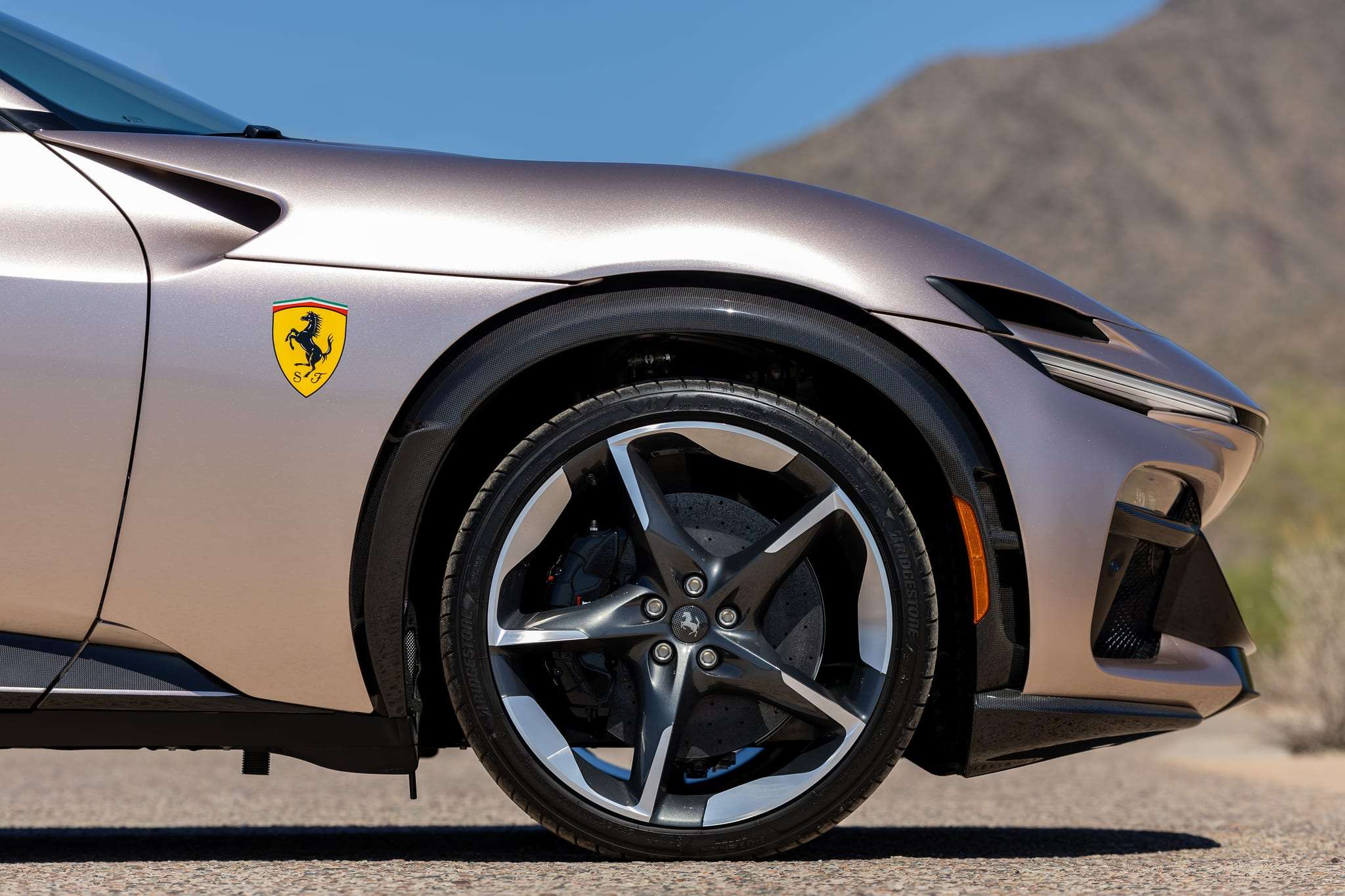
Leclerc’s name gets the clicks. The dealer’s decision is the interesting part. The front bumper carries marks, the wheels are scuffed, a fender is scratched, and Blöchl says all of it stays. On a used Ferrari, that is close to heresy. On this one, it may be the smartest decision anyone has made about the car.
A car a dealer would normally walk away from
Blöchl has been unusually candid. In the Instagram video announcing the purchase, the dealer concedes this is not a car a dealer would ordinarily buy. It lists the reasons itself: disclosed previous damage, wheel rash, mileage it calls high for a car of this age, use in summer and winter, and a dog (Leclerc’s dachshund, Leo) as a regular passenger. In Germany, where previous damage has to be declared to a buyer and reliably drags on value, each of those points would normally be marked down.
Blöchl’s own inventory provides the benchmark. Its Ferrari dealer site currently lists an unrelated black 2024 Purosangue with 9,750 kilometres at €419,900. Sold anonymously, Leclerc’s car, with more than three times the distance and cosmetic damage on the nose, would sit meaningfully below that. Whatever Blöchl eventually achieves, the gap between that anonymous value and the final number is the market price of Charles Leclerc’s name. Collectors rarely get so clean an experiment.
Why the damage is the paperwork
In September 2024, days after Leclerc won the Italian Grand Prix at Monza, a bystander filmed him rolling his silver Purosangue into the back of a Volkswagen in traffic at the Monaco hairpin, the same corner he takes on race weekends. We covered the incident at the time, and the clip travelled around the world. Blöchl confirms that this is the car.
On a modern production car, celebrity provenance is hard to prove and easy to claim. The Purosangue is not a limited series. Ferrari capped it at roughly a fifth of its annual output, which still means thousands of cars, many of them in silver with red calipers. What separates this example is a chain of evidence: a Ferrari service book, Monegasque registration papers, a direct purchase from the owner, delivery footage from April 2024, and a widely shared video of the same car touching another vehicle. Polish out the marks and you remove the one physical feature linking the car to the public record. Leave them in place and the bumper corroborates the paperwork.
That is not proof that every mark dates from that afternoon. Nobody can establish that, and the dealer hasn’t claimed to. But the principle holds: on a modern car, celebrity provenance is worth only what can be proven, and sometimes the proof is a scratch.
Celebrity ownership is not the same as a moment in history
The collector market pays most reliably for cars tied to moments, as Steve McQueen’s NART Spider showed, where originality and a place in a life drove the result. It pays, more selectively, for a famous driver’s personal road car when the documentation is airtight. With Michael Schumacher’s Carrera GT, the paperwork mattered more than the name. And the market has shown repeatedly that honestly documented use does not destroy a car’s story. Sometimes the use is the story.
A daily-driven SUV belonging to an active driver is still a different proposition. Leclerc is 29, has not yet won a world championship, and signed a new multi-year Ferrari contract in June, so this sale says nothing about his future at Maranello, whatever some headlines have implied. The car commemorates no race, no record and no title. It commemorates a commute.
That is not nothing. Leclerc was born in Monte-Carlo, has won his home Grand Prix in a Ferrari, and is arguably the closest thing Maranello has to a lifelong driver in the modern era. If he one day delivers a championship in red, the car he used around the Principality becomes a different object. If he doesn’t, it remains a well-documented curiosity whose premium is most visible to its first buyer and likely to thin with each sale after that. A buyer should only pay for the first scenario if they are content to own the second.
The car underneath the name
Strip away the provenance and the Purosangue is still a significant Ferrari. It was the company’s first four-door, four-seat production car, and Ferrari gave it the naturally aspirated 6.5-litre V12 instead of a hybrid V8: 725 cv (715 hp), mounted front-mid, driving through a rear transaxle, with active suspension that does away with conventional anti-roll bars. That decision is a large part of why traditional Ferrari clients accepted the car, and why the order books closed within weeks of its 2022 reveal.
Leclerc’s car is finished in Argento Nürburgring with two-tone wheels and red calipers. According to the dealer, the equipment includes carbon-fibre interior trim, leather upholstery, a panoramic glass roof, heated, ventilated and massaging seats front and rear, the lift system, a 360-degree camera and the upgraded audio system. It’s a sensible specification that should be easy to resell. It is not a Tailor Made statement in the way that this bespoke Purosangue offered on Bring a Trailer was, and color and personalization will matter more to this model’s long-term desirability than they do on Ferrari’s mid-engined cars.
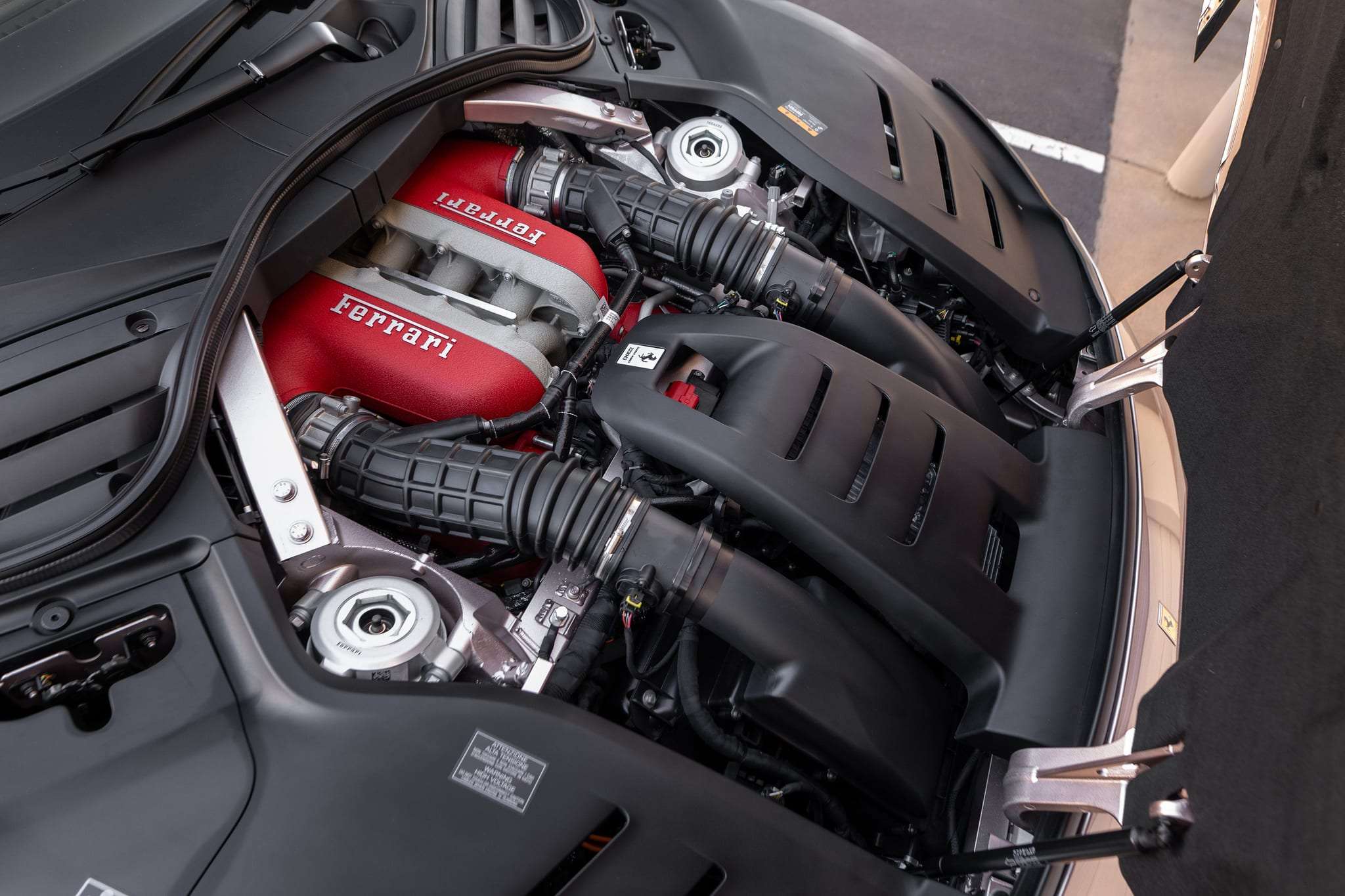
The wider market is worth keeping in view. Used Purosangue values have settled since the first cars arrived and early buyers looked to flip them. American dealers are asking roughly $515,000 to $690,000 for low-mileage examples, while 2024 cars have changed hands at British auctions this year for around £300,000. The model is desirable, but it is not scarce. Without Leclerc’s name, this car would be valued on mileage and condition like any other.
Before You Pay for the Scuffs
- Chain of title. Ask for the bill of sale from Leclerc to Blöchl and the original Monegasque registration, and match the VIN to every document. The provenance has to survive the sale, not just the Instagram post.
- Ferrari records. Check the service book against the Ferrari network’s own records, and confirm how much factory warranty and scheduled maintenance coverage remains from the April 2024 start date.
- Independent inspection. The marks are only charming if they are cosmetic. Get a paint-depth survey and a structural inspection of the front end before you treat the damage as provenance.
- Tax treatment. A car bought from a private individual is often resold in Germany under the margin scheme, which can mean no reclaimable VAT. That matters to company buyers within the EU. Buyers outside the EU should plan for export and homologation costs.
- The next buyer. Put together a documentation file that a future buyer will accept without needing social media posts that may not still exist in ten years.
Leave the Marks On?
The Leclerc Purosangue is not an investment-grade collector car, and nobody serious should present it as one. It is a well-documented, honestly presented and well-used example of a production Ferrari, attached to a driver whose story is not finished. Most of the used-Ferrari business goes into making cars look as though nothing ever happened to them. Blöchl is betting the opposite on a bumper marked at the Monaco hairpin. Would you pay extra for those scuffs, or have them polished out the day the car arrived? Be honest.
Sources: Autohaus Blöchl’s purchase announcement on Instagram and official Ferrari dealer site; the original September 2024 video from Monaco; Ferrari’s Purosangue technical specifications; and Formula 1’s report on Leclerc’s contract extension.
The collector car market, every weekday morning.
Auction results, price moves and what’s crossing the block, read in four minutes. Free, from Modern Car Collector.
No spam, unsubscribe in one click. Or read more about the Brief.
Related Posts:
- Ferrari Daytona SP3 Value Jumped 168% in Ten Months.…
- One-of-One Ferrari 488 Pista Heads to Monterey…
- Restored 1937 Cord 812 Supercharged Phaeton For Sale…
- No Reserve: Tailor Made 2026 Ferrari Purosangue For…
- The Ferrari Daytona SP3 That Journalists Drove Hard…

- Alfa 8C Competizione Value: Delivery-Mile Spiders…
 John Lloyd
 Kyle Matthews