

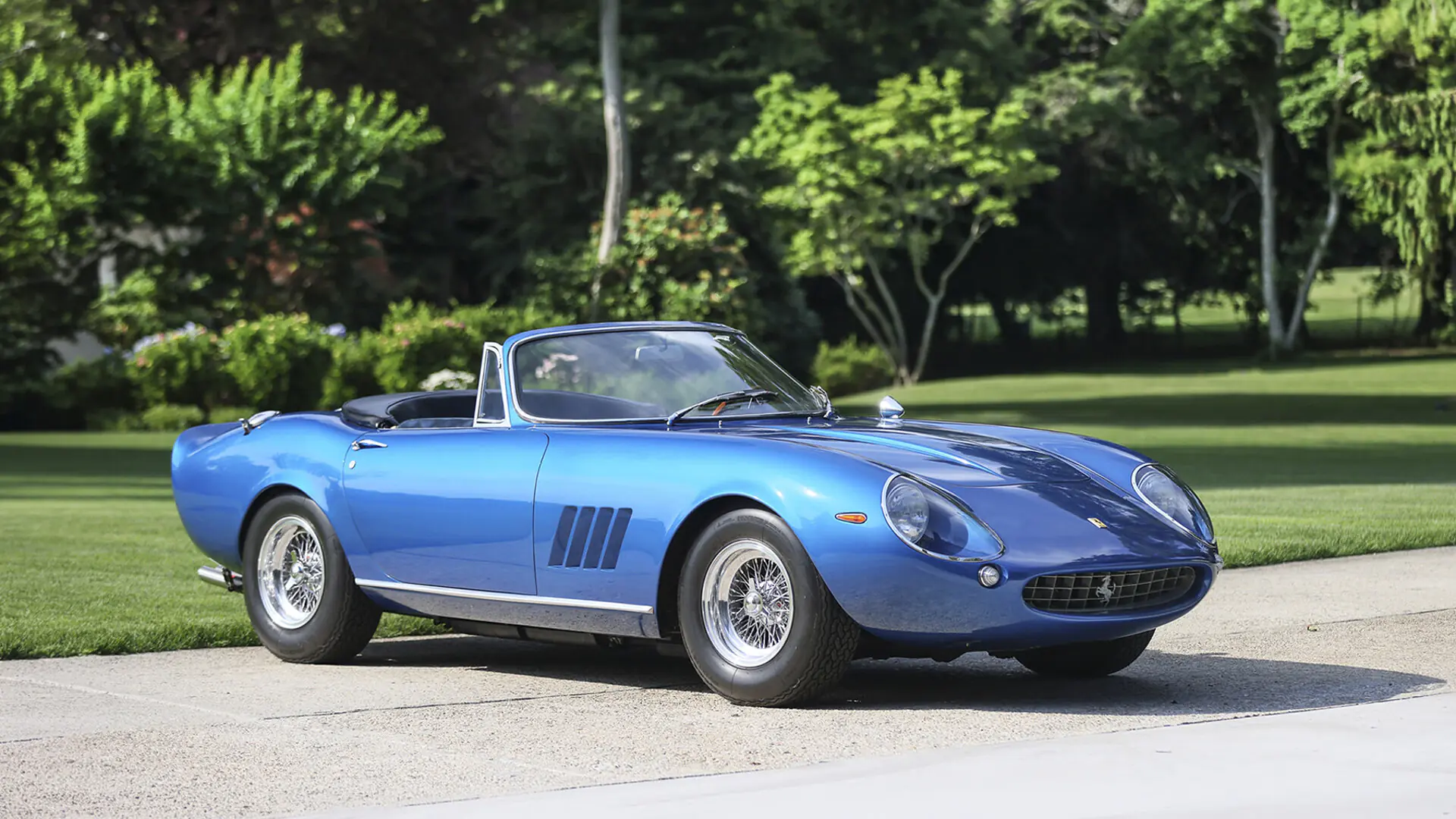
For nearly six decades, the most interesting thing about Ferrari chassis 10453 has been what Steve McQueen did to it. On Friday, November 20, at the Javits Center, the 1967 Ferrari 275 GTB/4*S NART Spider he bought new crossed the block as the headline lot of Gooding Christie’s first auction at Rétromobile New York and sold for $18,925,000 including buyer’s premium, inside its $15 million to $20 million estimate.
It will be filed as a McQueen price. That reading misses the point. What the room paid for was not a celebrity’s name attached to a rare Ferrari. It was a rare Ferrari that three successive owners chose not to correct.
Ten cars, and a reason they exist
The NART Spider was Luigi Chinetti’s idea, not Maranello’s. Ferrari’s American distributor saw that the four-cam 275 GTB/4 had no open counterpart—the factory’s convertible offering was the plusher 330 GTS—and argued that his clients wanted the berlinetta’s chassis and engine with the roof removed, much as the 250 GT California Spider had done for the previous generation. Ferrari authorized a short series executed by Scaglietti.
Only ten were built. The first two had aluminum bodies; the remaining eight began life as steel berlinettas and were converted to spider form, and all but one went to American customers. That is fewer than a tenth of the combined long- and short-wheelbase California Spider run, which is the comparison every serious Ferrari collector reaches for first.
Chassis 10453 was the sixth. Ferrari historian Marcel Massini’s records, reproduced in Gooding Christie’s catalogue, show it completed in September 1967 with Scaglietti body no. A0202, invoiced to Luigi Chinetti Motors with a surcharge for the berlinetta-to-spider conversion, and finished in Blu Sera over black Connolly leather—the first of only two NART Spiders specified in that color. Build sheets record Borrani wire wheels and U.S. instrumentation.
What McQueen changed
McQueen bought the car through Chic Vandagriff’s Hollywood Sport Cars, and he did not leave it alone. The bumpers came off. An external quick-fill fuel cap and a rally-style mirror went on. A radio console and concealed power antenna were fitted, Tony Nancy retrimmed the seats, and the factory blue was replaced with a darker metallic blue of McQueen’s choosing.
Then the car was rear-ended on the Pacific Coast Highway. It was repaired at Hollywood Sport Cars, and Hershel “Junior” Conway—later of House of Color fame—refinished it in dark metallic blue. The flip-tail and flared rear fenders the car wears today are generally credited to Conway’s work. While the Spider was off the road, McQueen bought a 275 GTB/4 berlinetta, chassis 10621, to fill the gap; that car sold at RM Sotheby’s Monterey in 2023 for $5,395,000.
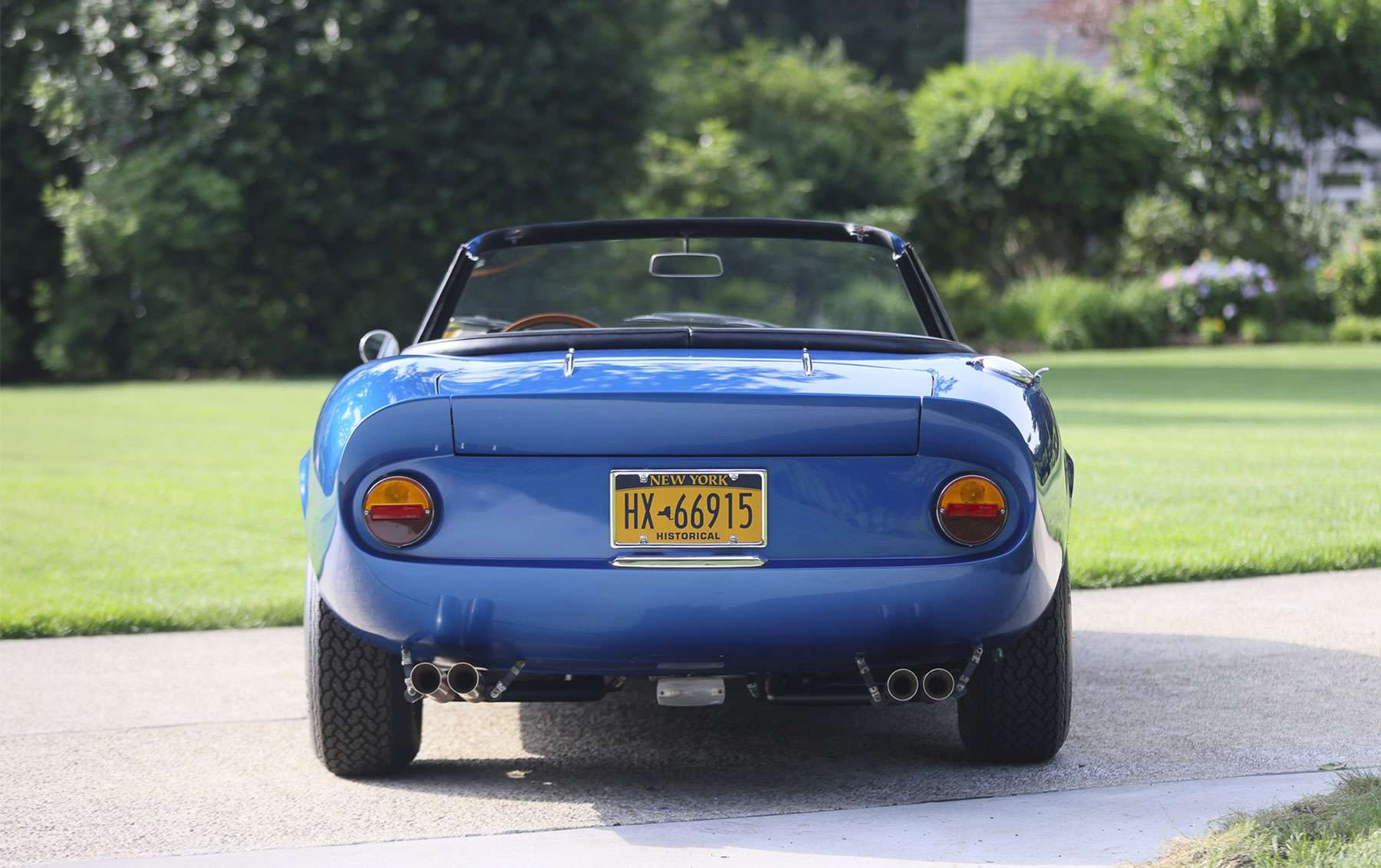
By the standards of a concours judge, almost none of this is correct. By the standards of a collector, nearly all of it is the point. These are period changes, made by the owner who gives the car its significance, carried out by named craftsmen and supported by photography—including a 1971 image of the car on California plate ZSW 815. Modifications with that kind of attribution stop being deviations from factory specification. They become the specification.
The restoration that never happened
The more important decisions were made by the people who came after McQueen. By 1971 the car belonged to J. David Kopf of Tujunga, California, the instrument maker who also owned the ex-Agnelli 365 P “Tre Posti.” Kopf kept it for roughly fifteen years and rarely showed it. Long Island Ferrari dealer Grand Prix SSR acquired it in 1985, and its most recent owner bought it in 1986 and held it for four decades. Public appearances were scarce: Le Cercle Concours d’Elegance at the Hollywood Bowl in 1971, the Louis Vuitton Classic at Rockefeller Center in 1996, and the Chrysler Museum of Art’s La Bella Macchina exhibition in 2003.
Through those years, the prevailing instinct in the Ferrari world was to return important cars to factory condition. A restorer could easily have argued for Blu Sera paint, reinstated bumpers and a stock tail. That work would have produced a beautiful sixth NART Spider and quietly erased the McQueen car. Instead, 10453 arrived in New York preserved rather than restored, on its original Scaglietti body with its matching-numbers engine and transaxle, still substantially as McQueen and Conway left it.
A generation ago, the bumpers might have gone back on. Today their absence is the provenance.
It is the same question bidders faced when Reggie Jackson’s green Ferrari 250 GT Lusso came to market: whether a famous owner’s taste is a flaw to be restored away or a record to be protected. At this level, with this documentation, the market has given its answer.
Reading the number
The useful comparison is chassis 10709, the single-owner-from-new NART Spider RM Auctions sold at Monterey in 2013 for $27,500,000, which remains the public benchmark for the model. McQueen’s car finished roughly $8.6 million below it. A sale that leaned on celebrity alone would have been expected to chase that record. This one did not, and that is a sign of a disciplined room rather than a soft one.
Two things explain the gap. The 2013 result came near the top of a Ferrari market that has since cooled and become more selective. And 10709 is original in the factory sense, while 10453 is original in a historical sense—a distinction the most experienced Ferrari buyers price separately. Bidders paid squarely within Gooding Christie’s range for a documented, preserved artifact; with a reported hammer of $17.2 million, they did not pay a multiple for a famous name.
The longer view is just as instructive. Gooding & Company sold the first NART Spider built, alloy-bodied chassis 09437, for $3,960,000 at Pebble Beach in 2005. The model was blue-chip long before this sale, with or without McQueen. His ownership did not create the value here; the decision to keep his ownership visible preserved it.
The car also comfortably led a sale whose other marquee consignments, including the 300 SL Alloy Gullwing we previewed ahead of the auction, brought strong but far smaller numbers. For an auction house launching a new venue, a celebrity Ferrari selling within estimate on opening night is the kind of result that brings consignors back.
What serious buyers should take from it
First, owner modifications are only as valuable as their documentation. McQueen’s changes carry weight because they are period, attributable and photographed. The same alterations without that record would be a liability on any other NART Spider.
Second, paperwork can travel on its own. The car’s original Ferrari Bulletin de Garantie was offered as a separate lot immediately after the car itself. Anyone buying at this level should confirm which documents convey with a vehicle, and which have been separated from it.
Third, supply is the real constraint. Ten NART Spiders exist, and this one had not been offered publicly in forty years. Cars like this surface roughly once a generation, which is why the most consequential decision its new owner faces is not where to show it, but whether to resist the temptation to “improve” it.
Collectors rarely pay for a famous owner alone. They pay for the evidence that he was there—and in 10453, nobody painted over it.
Sources: Gooding Christie’s, Lot 33 catalogue and result; Gooding Christie’s consignment announcement, September 10, 2026; RM Auctions, Monterey 2013, chassis 10709; RM Sotheby’s, Monterey 2023, chassis 10621; Gooding & Company, Pebble Beach 2005, chassis 09437.
The collector car market, every weekday morning.
Auction results, price moves and what’s crossing the block, read in four minutes. Free, from Modern Car Collector.
No spam, unsubscribe in one click. Or read more about the Brief.
Related Posts:
- Rétromobile’s New York Debut Is a Bet on the Salon,…
- Gooding Christie’s Delivers a Triumph at Retromobile…
- This NART Spider's Real Value Isn't Its Rarity. It's…
- This NART Spider Isn't Valuable Because Steve…
- Gooding Christie’s to Offer Steve McQueen’s Ferrari…
- Gooding Christie’s Offers Two 1937 Rolls-Royce…
 Kyle Matthews
 Shawn Henry