


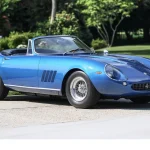
Gooding Christie’s has named a 1967 Ferrari 275 GTB/4*S NART Spider as the headlining lot of Rétromobile New York’s inaugural auction this November, and the number attached to chassis 10453 — a presale estimate of $15 million to $20 million — will dominate most of the coverage. It shouldn’t dominate the analysis. Buried in the auction house’s own account of the car is a detail more interesting than the estimate: almost as soon as Steve McQueen took delivery in 1967, he had it repainted, its seats retrimmed, and its details altered to suit him. In a market that usually rewards strict factory originality above nearly everything else, that fact isn’t a caveat. It’s the reason this particular Ferrari matters more than its production number suggests.
Only ten NART Spiders were built, and Ferrari never planned to build them at all. The open-top variant of the 275 GTB/4 existed because Luigi Chinetti — Ferrari’s longtime North American importer and the founder of the North American Racing Team the car is named for — persuaded Enzo Ferrari that American buyers wanted a topless version of Maranello’s V-12 berlinetta. Carrozzeria Scaglietti built the small run essentially by hand, and Chinetti’s own dealer network placed most of them directly with American clients rather than European collectors. This car, the sixth of the ten, was invoiced to Chinetti Motors in September 1967 and delivered to McQueen through Hollywood Sport Cars; it was also one of only two NART Spiders originally finished in Blu Sera, a deep evening blue Ferrari rarely used.
That platform strength extends well beyond this single car. A well-preserved 275 GTS by Pininfarina, the closed, factory-bodied sibling to the NART Spider’s open-top rarity, recently changed hands in a private sale for $1.89 million — proof that even the model’s more common variant carries real, self-sustaining demand. Rarity, in other words, was already fully priced into the 275 platform before McQueen ever climbed into this car. It is not what separates a $15 million estimate from a $2 million or $3 million one.
The NART Spider Modification That Isn’t a Flaw
What separates this NART Spider from its nine siblings is what happened after McQueen bought it. He repainted the car in a darker metallic blue than the factory shade, had the seats retrimmed with a distinctive stitching pattern, and made other cosmetic changes that resulted, in Gooding Christie’s own words, in “a NART Spider like no other.” Following an accident on Pacific Coast Highway, McQueen had the car repaired by Junior Conway rather than returned to a factory-authorized shop. None of that would typically help a collector car’s value. In the world of matching-numbers originality, a car that left the factory one way and now presents differently is usually a car with something to explain.
This one doesn’t need much explaining, because the changes were made by the man the car is famous for, not by an anonymous later owner chasing fashion or covering up damage. The distinction matters enormously to serious collectors, who have learned to separate two ideas that casual buyers often confuse: originality, meaning a car left exactly as the factory built it, and authenticity, meaning a car whose present condition truthfully reflects everything that actually happened to it. McQueen’s alterations fail the first test and pass the second decisively. The engine and transaxle remain numbers-matching to the car’s factory build, and the Scaglietti body is unmodified structurally, so the mechanical originality that matters most to authentication experts was never in question. What changed was cosmetic, documented, and performed at the direction of the one owner whose fingerprints add value rather than subtract it.
Forty Years in One Collection
The ownership record after McQueen is just as important as the McQueen years themselves, and considerably rarer in this category. By 1971 the car had passed to J. David Kopf of Tujunga, California, and in 1986 it entered its current owner’s collection through Grand Prix SSR, a Long Island Ferrari dealer. It has stayed there for four decades, appearing publicly only twice: at the 1996 Louis Vuitton Classic at Rockefeller Center, and in the 2003 exhibition La Bella Macchina: The Art of Ferrari at the Chrysler Museum of Art. Rétromobile New York will be the first opportunity in the car’s history for the international collecting community to bid on it at public auction.
An unbroken, well-documented chain of ownership is worth more in practice than most collectors assume, because provenance disputes remain one of the most expensive risks in the high-value Ferrari market. Gooding Christie’s has attached the name of Marcel Massini, among the most widely trusted Ferrari chassis historians working today, to the car’s history: the kind of third-party validation that functions less like marketing copy and more like a title search. For buyers weighing a $15 million to $20 million commitment, that validation is arguably worth as much as any individual styling detail.
Why Rétromobile Chose New York
The setting matters too. Rétromobile has spent nearly five decades as one of Europe’s defining classic car events, and this November marks its first expansion into North America, staged at the Javits Center on November 20 and 21. Gooding Christie’s stepping in as the official auction house, and placing a car of this stature at the top of the docket, signals confidence that a Manhattan sale can support headline money without borrowing an audience from Monterey or Scottsdale. It is also a bet on geography: a meaningful share of the world’s serious Ferrari buyers, including family offices and finance-sector collectors, are based on the East Coast and have historically had to travel for a sale of this caliber. A comparable bet played out this past summer with a 2023 Ferrari Daytona SP3, where two careful owners and 227 recorded miles did most of the persuading at auction rather than the car’s production number. Both results point to the same underlying principle: collectors are increasingly paying for a fully accountable story, not simply for a low build count.
What This Means for Collectors
For buyers evaluating celebrity-owned cars generally, and McQueen’s cars specifically continue to command outsized attention, as a Husqvarna motocrosser he once raced demonstrated when it sold for $40,000 this year, the lesson from this NART Spider is worth remembering the next time a modified example comes up for sale. The right question is never simply whether a car has been changed from factory specification. It is who changed it, when, and how well that change is documented. Originality tells you what a factory intended. Authenticity tells you what actually happened. Collectors who confuse the two routinely overpay for the wrong story and pass on the right one. Whatever this Ferrari brings at the Javits Center this November, the more durable lesson is already sitting in the catalog description: sometimes the most valuable version of a car is not the one that never changed, but the one that changed in a way worth telling.
The collector car market, every weekday morning.
Auction results, price moves and what’s crossing the block, read in four minutes. Free, from Modern Car Collector.
No spam, unsubscribe in one click. Or read more about the Brief.
Related Posts:
- This NART Spider's Real Value Isn't Its Rarity. It's…
- 18 Steve McQueen Cars and Motorcycles That Have Sold…
- Today on MCC: Everything You Missed Yesterday
- Record Ferraris, Rare Icons and 15,000 RPM: The Week…

- The Collector Car Market Paid Up for Certainty This…
- On a Ferrari 308 GTB, the Vetroresina Body Is Only…
 Shawn Henry
  Kyle Matthews
  Eve Nowell