
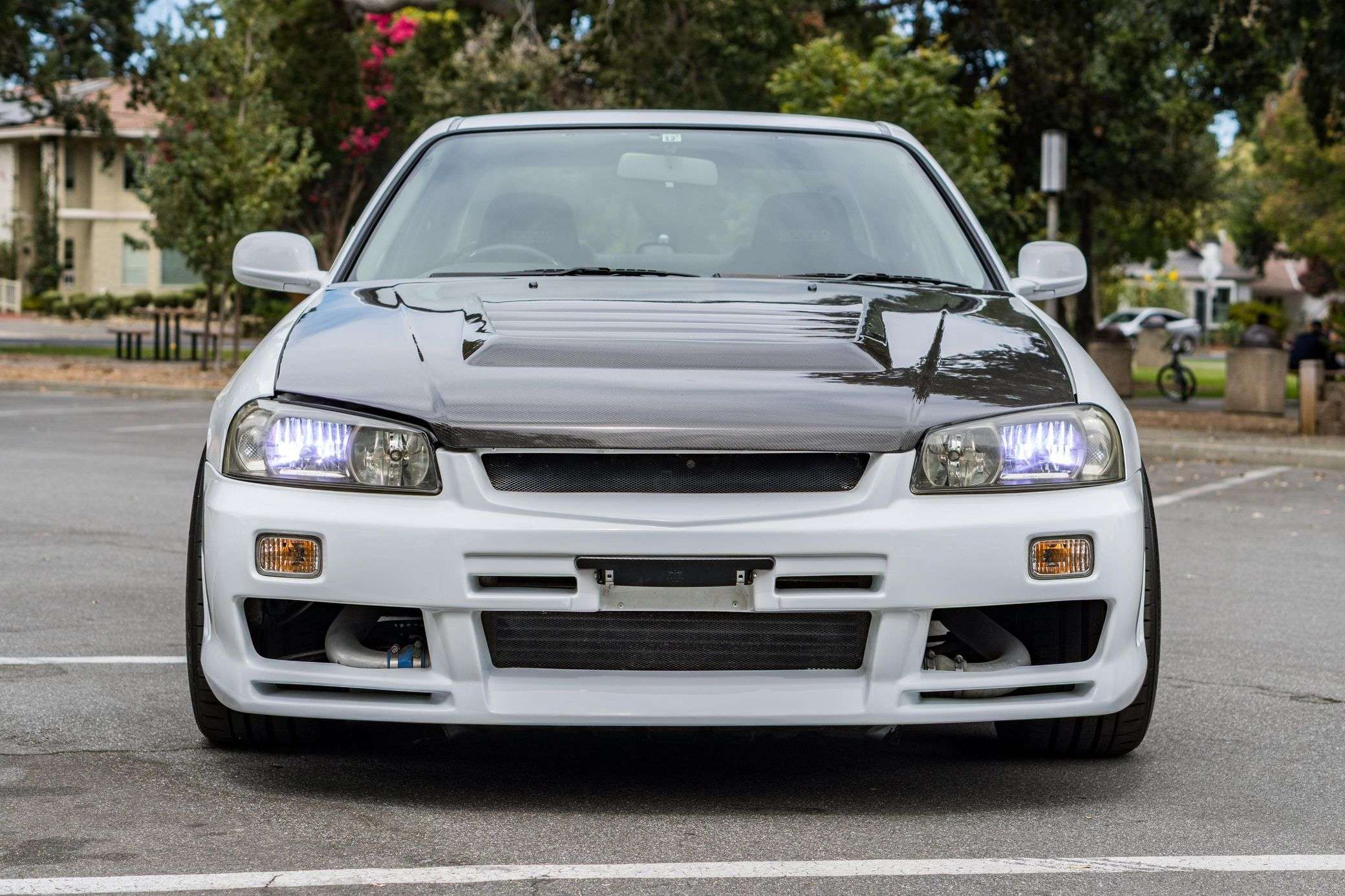
A 1998 Nissan Skyline GT-T Sedan is currently listed on Cars & Bids, chassis ER34000759, sitting in Sunnyvale, California on a clean Montana title. It wears 18-inch RAYS Nismo LMGT4 wheels, a Seibon carbon fiber hood, Sparco seats, and a five-speed manual transmission that Nissan never bolted to this car on the assembly line. As of this writing, twelve bids have pushed it to $3,800, with a few days left on the clock. That number will not make headlines, and it shouldn’t. The real story here isn’t the price. It’s what this unassuming sedan reveals about how the Skyline legend actually distributes value, and where, precisely, that legend stops paying dividends.
Start with the chassis code, because it tells you more than any modification list can. “ER34” isn’t marketing shorthand; it’s the factory designation stamped into the car’s own identity, and it separates this car immediately from its more famous relative. The R34-generation Skyline, built from 1998 to 2002, spawned several drivetrain variants sharing the same body architecture. The ENR34 code belongs to the GT-R, Nissan’s twin-turbo, all-wheel-drive halo car built around the RB26DETT engine and the ATTESA E-TS Pro system that made it a touchstone of 1990s Japanese performance engineering. The ER34, by contrast, denotes the GT-T: a rear-wheel-drive, single-turbo car powered by the RB25DET Neo inline-six, rated at roughly 276 horsepower in factory trim. It is, in every meaningful mechanical sense, a different car wearing a related name.
That distinction matters enormously to how the market has begun pricing R34s in the United States. Skyline GT-Rs, and increasingly their rarer NISMO variants, have moved decisively into blue-chip territory. We’ve covered that trajectory in this publication, from the seven-figure emergence of the Nismo 400R to the steady climb of clean R33 GT-Rs at auction. The GT-T sedan sitting on Cars & Bids right now occupies the opposite end of that same family tree: mechanically related, visually similar at a glance, but separated from GT-R money by a drivetrain, a badge, and roughly two decades of collector mythology that never attached itself to the sedan the way it did to the coupe.
Timing explains why cars like this one are surfacing in volume. Under U.S. import law, a vehicle becomes eligible for legal entry twenty-five years after its date of manufacture, and the R34 generation has only recently started crossing that threshold year by year. A 1998 example like this one became importable a couple of years ago, and the current wave of Montana-titled, JDM-spec R34s appearing on domestic auction platforms is a direct consequence, not a sign of newfound rarity, but of newfound access. The seller’s own notes underline the practical reality of that access: the car carries a clean Montana title, is registered to an LLC, and, because it was never certified for U.S. emissions, may not pass inspection in every state. None of that is unusual for a grey-market import. All of it is worth knowing before anyone bids.
What separates a genuinely collectible R34 from a merely interesting one isn’t the chassis code alone, it’s what has happened to the car since it left Japan. This particular GT-T has been extensively reworked: a factory automatic swapped for a five-speed manual, TEIN coilovers, an aftermarket clutch, a carbon fiber hood, Sparco seating, and a stack of RAYS wheels and gauges that reflect a very specific strain of 1990s and 2000s Japanese tuner culture. That’s an honest, well-documented build, and the seller deserves credit for disclosing the transmission swap, the repainted bumper, and the clutch noise rather than burying them. But every one of those changes also moves the car further from the specification Nissan actually built, which is precisely the specification that collectors, as opposed to enthusiasts, tend to pay a premium for.
This is the distinction that matters more than the auction result. Originality in the JDM import market behaves the same way it does in any other segment of the collector world: it compounds. A numbers-correct RB25 sedan with its original automatic, its original hood, and full service history will, over time, separate itself from cars like this one, not because the modifications are unwelcome, but because unmodified survivors are the ones getting scarcer while modified drivers keep multiplying. Japan’s domestic tuning culture means genuinely stock R34s were never common to begin with, and every swapped transmission or vinyl-wrapped trim piece narrows that pool a little further.
None of this makes the car on Cars & Bids a bad buy. At current money, it reads as an honest, usable RB25-powered Skyline sedan for someone who wants the R34 driving experience without GT-R money attached to it, which is exactly the role sedans like this one should play in the market. The mistake would be treating it as a proxy for where R34 values are headed generally. GT-Rs and clean, unmodified GT-Ts are answering a different question than this car is.
The lesson for serious buyers watching this segment is straightforward: the Skyline name is doing a lot of work right now, but it isn’t doing all of the work. Chassis code, drivetrain, and originality still decide where a given R34 lands on the value spectrum, and no amount of period-correct tuner parts changes that math. The GT-R turned the Skyline into a legend. Cars like this GT-T sedan are what happens when that legend starts pulling everything else along behind it, at a respectful distance.
The collector car market, every weekday morning.
Auction results, price moves and what’s crossing the block, read in four minutes. Free, from Modern Car Collector.
No spam, unsubscribe in one click. Or read more about the Brief.



 EL Puckett
  Kyle Matthews