

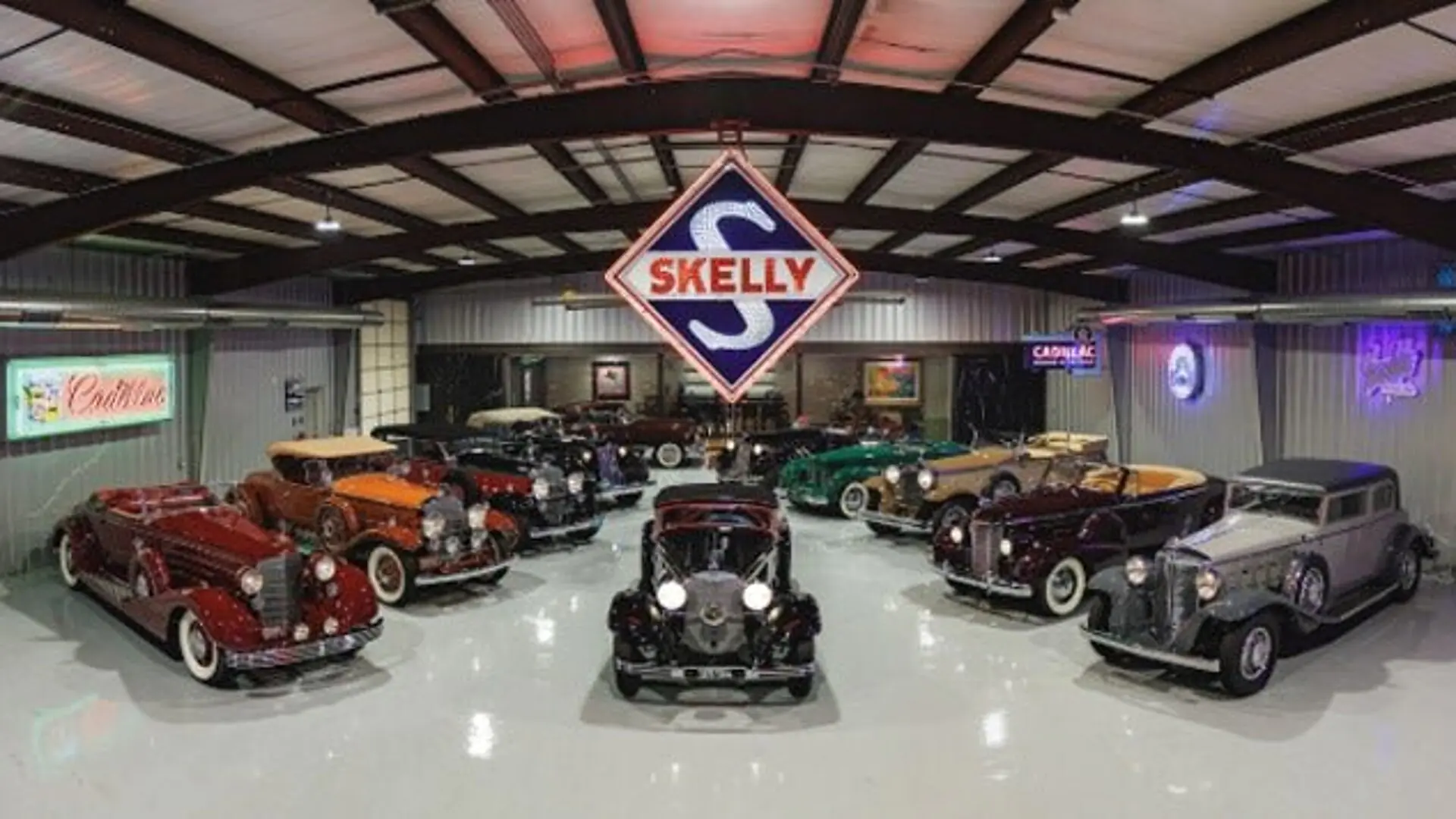
When RM Sotheby’s opens the 2027 collector-car season at the Arizona Biltmore on January 28–29, the headline lot will be a Mercedes-Benz. The more revealing part of the consignment is what surrounds it: thirteen cars from the late John D. Groendyke of Enid, Oklahoma, most of them American, most of them pre-war, and nearly all of them chosen for a reason that has little to do with the badge on the hood.
That is the thesis of this collection. Groendyke did not collect marques. He collected specific answers to a specific question: which exact body, on which exact chassis, represents the best surviving example of what a Full Classic could be?
A collector RM already knew well
This is not a first introduction. In 2019, RM offered seven Cadillac V-16s from his holdings at the January 2020 Arizona sale, all without reserve, describing a client and friend who had collected since the early 1990s and had assembled seventeen V-16s covering significant body styles and model years. RM also noted that the cars were well maintained and often driven on tours, and that they had earned awards at Pebble Beach, Amelia Island and the Concours of America.
Read the 2020 offering closely and the method is already visible. One car was the sole known survivor of its style. Another was one of seven built. A third carried a documented line of named owners. Those are not the credentials of a trophy hunter chasing the biggest number. They are the credentials of someone building a reference library in metal.
The Mercedes leads, the Cadillacs explain
According to RM’s announcement, the lead car is a 1935 Mercedes-Benz 500 K Cabriolet A by Sindelfingen, one of 33 built, later upgraded to 5.4-liter 540 K specification and delivered new to the violinist Adolf Busch. It later passed to Millicent Rogers, was found on a French farm around 1960, has been shown twice at Pebble Beach and completed the 1,000-mile Colorado Grand. Few supercharged pre-war Mercedes-Benz roadsters arrive with a story that coherent, and it will draw the international bidders.
But the Cadillacs are the collection’s spine. A 1936 V-16 Convertible Coupe by Fleetwood, restored by Steve Babinsky’s Automotive Restorations, took first in class at the 2019 Pebble Beach Concours. A 1930 V-16 All-Weather Convertible Sedan is a one-off by Pasadena coachbuilder Murphy, bought new by Charles S. Howard Jr. and later part of the Mozart and Andrews collections. A 1933 V-16 Convertible Coupe is the 117th of 126 V-16s built for that model year and is believed to be one of two surviving examples of its body style; its first owner was the inventor Theodore W. Case. A 1930 Roadster, a 1938 Convertible Coupe and further V-16s round out the group.
The V-16 rewards this kind of attention. Cadillac offered 54 body styles on the chassis, every one built by Fleetwood, which means the engine and the badge are constant while the coachwork is the variable. Anyone can own a V-16. Owning the right body on a V-16 is a different discipline, and it is the one Groendyke practiced. For a related example of how much that distinction matters in the room, see our report on the 1930 V-16 Sport Phaeton offered at Indy this year.
Beyond Cadillac: the rest of the argument
The supporting cast keeps the same logic. A 1936 Auburn 852 Supercharged Speedster is described as retaining its original body, frame, engine and firewall serial tag, with Auburn Cord Duesenberg Club Category One certification. A 1937 Cord 812 Cabriolet is a concours restoration from Brian Joseph’s ACD specialists, also Category One and a CCCA Full Classic. A 1932 Marmon Sixteen Victoria Coupe by LeBaron and a 1929 Rolls-Royce Phantom I Ascot Tourer in the style of Brewster extend the pre-war theme.
The final three are the quiet surprises: a 1956 Ford Thunderbird, a 1949 Cadillac Series 62 Club Coupe and a 2006 Maybach 57S. They suggest a man who owned cars he liked as well as cars he studied, and the lack of a conventional modern-supercar shelf says as much about his taste as the V-16s do.
What this means for the market
The pre-war American Full Classic category has spent several years in a more selective phase, with buyers separating the best-documented, best-restored cars from the rest. Our recent look at the Clark Gable Duesenberg and at the Buck Jones Cadillac at RM’s Hershey sale reached a similar conclusion from different directions: provenance and presentation now do much of the work that rarity alone once did. Single-owner collections like this one are useful precisely because they remove the guesswork. Every car has been chosen, maintained and documented by the same hand.
That also explains why the certifications matter. CCCA Full Classic status and ACD Club Category One designation are not decoration; they are the shorthand by which serious buyers confirm that a Cord, Auburn or Cadillac is what it claims to be. Concours results and restorer pedigree, whether Babinsky or an ACD specialist, serve the same function. Where a car is unrestored or older in its restoration, the discussion shifts from perfection to honesty, which a different group of collectors will prefer.
Collectors with an appetite for this era will also want to study how comparable institutional groups have been assembled. The Nethercutt Collection remains the benchmark for what a restoration-led approach to the same cars can produce.
What to watch in Scottsdale
RM’s Arizona page did not yet list the lots when we reviewed it, and no estimates have been published. Those numbers, when they arrive, will matter less than the sequence in which bidders react to them. Watch the one-of-two 1933 Convertible Coupe and the Murphy One-Off Convertible Sedan first. If bidders pay for specificity there, the Groendyke thesis will have been confirmed by the market he spent three decades studying.
A badge tells you what a car is. A body style tells you what it was for. John Groendyke collected the second, and the cars heading to Phoenix are the evidence.
The collector car market, every weekday morning.
Auction results, price moves and what’s crossing the block, read in four minutes. Free, from Modern Car Collector.
No spam, unsubscribe in one click. Or read more about the Brief.
 Eve Nowell
 EL Puckett