
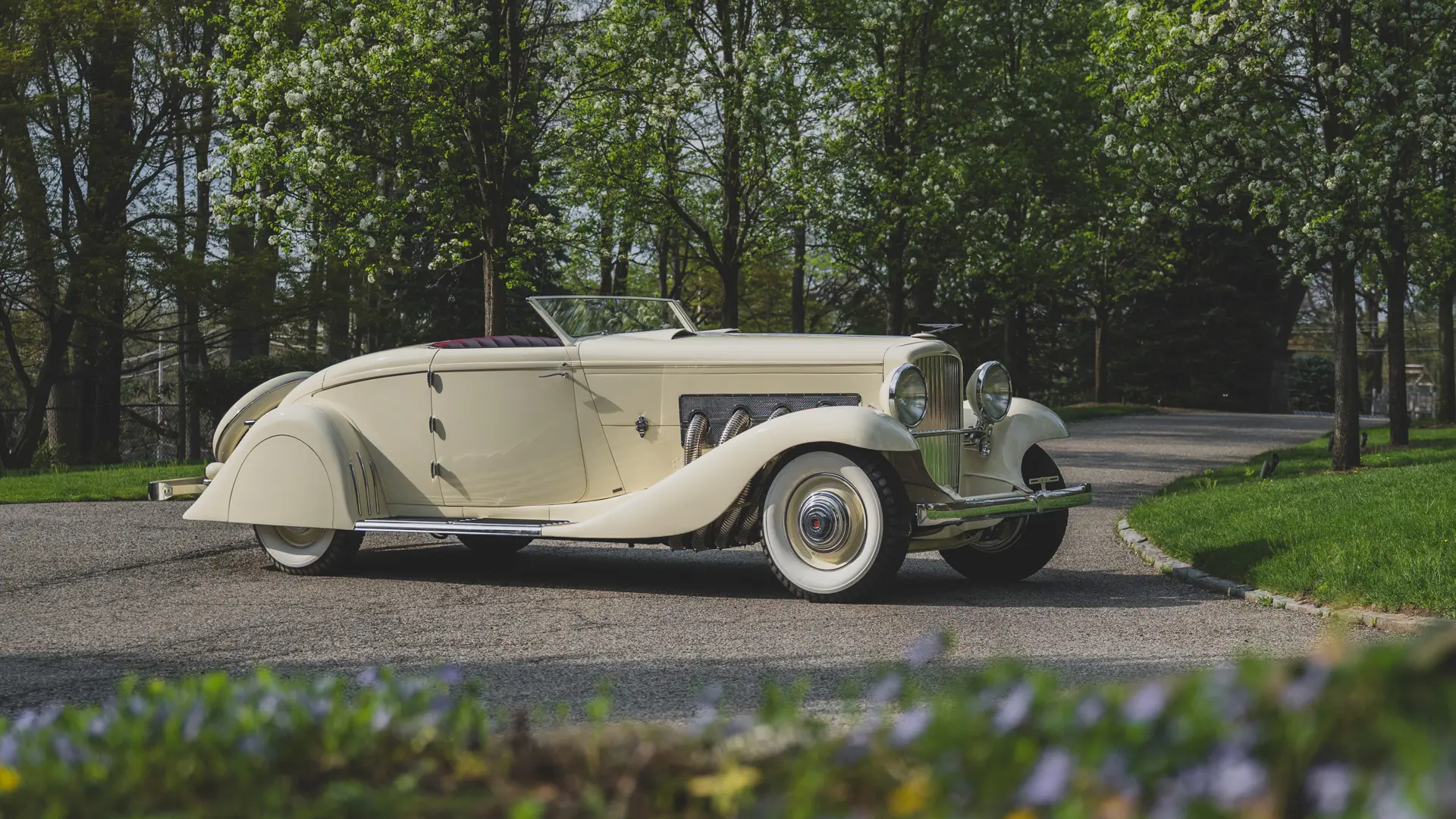
Most movie stars in the 1930s ordered a Duesenberg the way the rest of us order a sensible crossover: pick the body, sign the check, wait for the truck. Clark Gable was not most movie stars. When his 1935 Model JN reached the coachbuilder, he pulled up a chair next to the designer and started drawing. That car — firewall and chassis number 2585, engine J-560 — is the headline lot of the Sam and Emily Mann Collection at RM Sotheby’s Monterey sale, August 13–15, carrying a $5.75 to $8 million estimate.
Before you drown in the Gable-and-Lombard romance the auction copy leans on so hard, it’s worth understanding what the JN actually was. By 1935 the Model J was seven years old and the company building it was running out of runway; Duesenberg would be gone by 1937 when E.L. Cord’s empire came apart. The JN was the facelift. Rollston’s Herbert Newport dropped the bodywork lower over the frame rails, swapped the old 19-inch wheels for 17s, and skirted the fenders to modernize an aging silhouette. Only a small run was built, and per the RM catalog, just four wore convertible coupe coachwork. Gable got the first one.
Related Articles
- Mazda’s Le Mans-Winning 787B Heads to 2026 Monterey Motorsports Reunion
- Adele Toured McLaren’s Woking HQ, and the Real Story Is the Building She Walked Through
Under that long hood sits the reason Duesenbergs still command these figures. The straight-eight displaced 420 cubic inches with twin overhead cams and four valves per cylinder — genuine race-car architecture at a time when most American luxury engines were lazy flatheads making half the output. Gooding, which sold this same car once before, lists it at 265 horsepower through a single downdraft carburetor, feeding a three-speed manual and reined in by four-wheel hydraulic drums. In 1935, this was the fastest, most sophisticated thing you could buy with a U.S. title.
Gable didn’t stop at “the fastest.” Rather than take delivery, he had the car shipped from Rollston in New York to Bohman & Schwartz in Pasadena, the shop the film colony trusted. Working with designer W. Everett Miller — and, per RM, leaving behind his own sketches still in the file — he stretched the hoodline back over the cowl, cut in cowl vents lifted from early biplanes, raked the windshield a few more degrees, and had the shop build a lower top to match. The radiator shell was painted body color to stretch the car visually, and the rear got fender skirts, twin enclosed spares, and color-matched wheel discs. This is not a man who bought a nice car. This is a man who art-directed one.
Now the part a serious bidder will actually spend an afternoon on. At this level, “matching numbers” is scored down to the individual component, and this car has a footnote. It keeps its original numbered bell-housing, J-560, but under the hood is a block that isn’t its own: a New Mexico dealer performed an engine swap around the turn of the 1950s, installing the engine from chassis J-521 while retaining the 560 housing. For a car with provenance this loud, that’s the one asterisk. The Manns’ answer was to hunt down and buy the original crankshaft, stamped 560, which is crated and going with the car. The message to buyers is clear: the path back to fully original numbered internals is open. The catch is what walking it requires — a full teardown and rebuild of a pre-war DOHC straight-eight is specialist, five-figures-and-climbing work, not a winter project. The next owner inherits a genuine fork: campaign it as the sorted, award-winning driver it already is, or commit to reuniting the numbers and chase absolute purity. Either is defensible. Both are expensive.
Related Articles
- Ferrari’s “Manual” V12 Doesn’t Actually Have a Manual Gearbox — And That’s the Interesting Part
- No Reserve: This 2,000-Mile 2023 Porsche 911 GT3 Touring Is a Future Icon On Bring a Trailer
Here’s the market context the catalog won’t hand you: this isn’t the car’s first trip to Monterey. Gooding offered it in 2012 at Pebble Beach. Since the Manns bought it in 2005 and are the ones consigning it now, the arithmetic writes itself — it didn’t make its number then, and they took it home and kept it for another fourteen years. That’s not a warning label. Six-to-eight-million-dollar pre-war cars trade in a thin pond, and a result depends on the right two bidders turning up on the right night. The provenance here is about as strong as American motoring history gets: a car the era’s biggest star styled himself, drove with Carole Lombard, and parked in front of some of the most reproduced Duesenberg photographs ever shot. But provenance is a story, and stories only cash out when two people believe them at the same moment.
One practical note for anyone fantasizing about a paddle. The hammer is only the start — budget for a buyer’s premium on top, then agreed-value collector insurance, climate-controlled storage, and a Model J specialist on retainer, because there is no AutoZone for a 90-year-old twin-cam eight. The upside is that a JN like this has already done all its depreciating; blue-chip pre-war metal tends to be the steadier corner of the collector market while newer “instant classics” bounce around.
For Sam Mann, an industrial designer who has spent decades insisting the best cars are art, letting this one go is its own kind of statement. For everyone else, it’s a chance to watch the market put a dollar figure on the most romantic what-if in American car culture — the machine a movie star drew for himself, during the best years he’d ever get. Bring a very understanding accountant.
Images Via: RM Sotheby’s
The collector car market, every weekday morning.
Auction results, price moves and what’s crossing the block, read in four minutes. Free, from Modern Car Collector.
No spam, unsubscribe in one click. Or read more about the Brief.
Related Posts:
- The First Auburn 851 Speedster Heads to Hershey. Its…
- The Gable Duesenberg Didn't Sell in 2012. This Year…
- This Murphy Duesenberg's Provenance Is First-Rate.…
- The Collector Car Market Paid Up for Certainty This…
- The Porsche Carrera GT Doubled in 2026. The $6.7…
- Ferrari F50 Value Nearly Tripled in Two Years.…
 Kyle Matthews
  Shawn Henry