

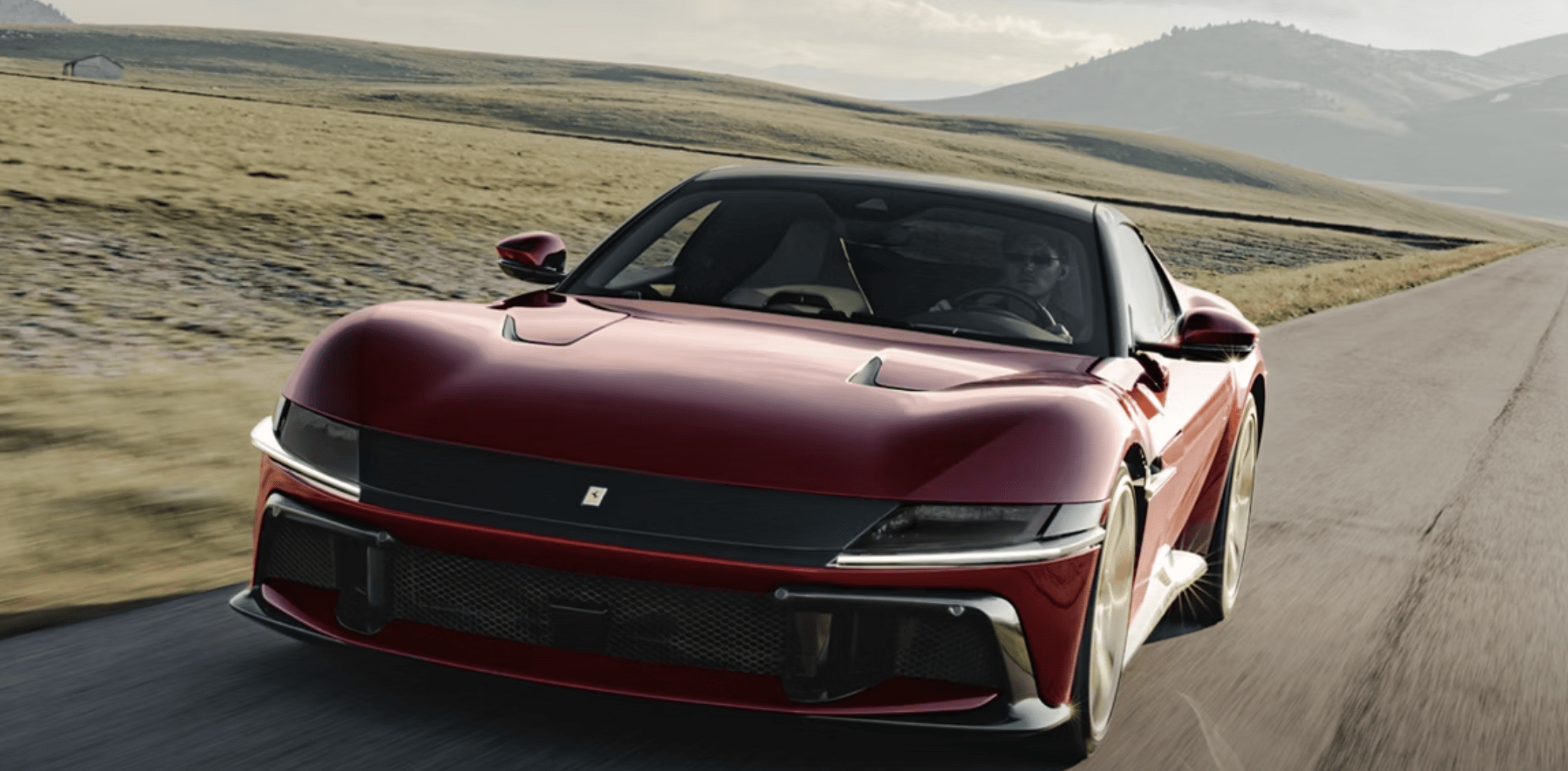
Ferrari just did something that reads like a headline from 2005: it put a clutch pedal and an open-gate shifter back in a front-engined V12. The 12Cilindri Manuale revives the metal gate, the third pedal, and the theatrical click-clack that a generation of enthusiasts thought Maranello had buried for good. But before anyone starts polishing their heel-and-toe technique, understand what’s really under the tunnel here, because it changes how you should think about this car entirely.
There is no manual gearbox in the manual Ferrari
Let’s be blunt about the mechanical reality. The transmission is the exact same eight-speed dual-clutch unit sitting across the rear axle in every standard 12Cilindri. Ferrari didn’t engineer a new gearbox. What it built is a separate module up front — a gear lever, a clutch pedal, and a control panel — that has zero physical connection to the transmission or the clutch packs. None. The lever and pedal are input devices. Two Hall-effect angle sensors read where you’ve put the stick, a sensor tracks the clutch pedal through its travel, and software translates all of that into commands the DCT executes electronically. Ferrari calls it Manuale By-Wire.
So this is a drive-by-wire automatic wearing a very convincing manual costume. Whether that offends you or delights you is a personal matter, but it’s the single most important fact about the car, and it drives everything else.
Why fake it instead of building the real thing?
This is where the engineering logic gets genuinely instructive, and it’s the part the marketing glosses over. A true three-pedal manual bolted to this engine would be a homologation and calibration nightmare. You’d have to certify a second transmission, which is expensive and slow. Worse, a real clutch introduces driveline shock, pitch, and torque interruption every time it engages — and this car’s entire chassis is built around electronics that assume smooth, predictable power delivery. The 12Cilindri runs Side Slip Control, an electronic differential, brake-by-wire, rear-wheel steering, and Ferrari’s dynamic-enhancement software. Every one of those systems is tuned around the DCT’s behavior. Hang a physical manual off the back and you’d have to re-teach the entire electronic brain how the car moves.
By keeping the DCT and faking the interface, Ferrari sidesteps all of it. The stability and traction systems never know the difference — as far as they’re concerned, it’s the same automatic transmission doing the same predictable things. It’s a clever piece of corporate problem-solving dressed up as a love letter to purists.
The clutch pedal is a machined lie, and it’s an impressive one
Here’s the part I actually respect. A clutch pedal that’s just an on/off switch would feel like garbage, and Ferrari clearly knew it. So the pedal contains a real, engineered mechanical load curve — a preloaded spring, cam, and roller assembly that reproduces the resistance, the bite point, and the progressive travel of an actual clutch, even though pressing it sends nothing but a signal. Independent reports peg the pedal weight at 15 kg, matched to the last manual Ferrari, the 599 GTB Fiorano, which the team benchmarked against.
The shifter is the same trick. Inside that gate sits a module machined from solid steel blocks, weighing under 3.5 kg, using a rotating block and eccentric rollers to generate the loads, the self-centering, and the mechanical “snick.” Ferrari even ran a dedicated development program on the sound of the gate. This is force-feedback engineering aimed squarely at your hands, and by every account it’s convincing.
Crucially, Ferrari built in consequences. Botch your clutch coordination and you’ll stall it or lurch away like a learner — there’s a programmed bite point and no auto-blip crutch. A physical solenoid locks the lever if you haven’t pressed the clutch, or if you’re about to select a gear low enough to grenade the valvetrain. So you can’t accidentally drop it from sixth to second and money-shift a 9,500-rpm V12 into oblivion. The system saves you from the one manual mistake that actually destroys engines while still letting you embarrass yourself in every survivable way.
The details worth knowing before you covet one
The engine is untouched: the 6.5-liter naturally aspirated V12, 819 hp at 9,250 rpm and 500 lb-ft at 7,250 rpm, spinning to 9,500. In manual mode you get the first six ratios plus reverse; the seventh and eighth gears are locked away for automatic-mode cruising, which is a tidy engineering tell that six forward gears is all the gate needs to feel period-correct. Ferrari claims a skilled driver matches the automatic’s 2.9-second 0–100 km/h — which, if true, quietly raises the question of what the manual is actually for beyond feel. The answer, of course, is feel. That’s the entire product.
Every one of the 1,499 units runs through Ferrari’s Tailor Made program, and the number itself is a nod — it references the displacement of Ferrari’s first V12 from 1947. It’s coupe-only, dressed with 365 GTB/4 Daytona pinstripe cues, laser-etched badging, forged five-spoke wheels, and seatbacks embossed with six grooves for the six gears. The interior’s tuning-fork center console houses the gate and the backlit knob that glows amber in manual, white in automatic.
Two practical realities for anyone daydreaming about ownership. First, this is a special series, and Ferrari special series with genuine narrative hooks — the return of the gate, a naturally aspirated V12 in an electrified era, a hard 1,499-unit cap — tend to be spoken-for before the public ever sees a configurator, and they historically hold or gain value against the standard car precisely because of that scarcity. Second, from a service standpoint, the good news buried in all this is that the mechanicals are the same proven DCT hardware the rest of the range uses. You’re not buying a bespoke, unobtainable gearbox that specialists will fear in fifteen years. The “manual” bits are a sensor-and-actuator module — more electronics to potentially fail down the road, yes, but nothing that leaves you stranded with a one-off transmission and no parts.
Ferrari will tell you this is the purest expression of driving. It’s more honest to call it the cleverest: a car that gives you the ritual of the gate and the drama of the clutch while a dual-clutch automatic quietly does the heavy lifting behind the curtain. Whether that’s soul or theater probably depends on how much you needed the mechanical connection to be real. But as a piece of engineering sleight-of-hand, it’s hard not to tip your cap.
Images Via: Ferrari
The collector car market, every weekday morning.
Auction results, price moves and what’s crossing the block, read in four minutes. Free, from Modern Car Collector.
No spam, unsubscribe in one click. Or read more about the Brief.

 John Lloyd