

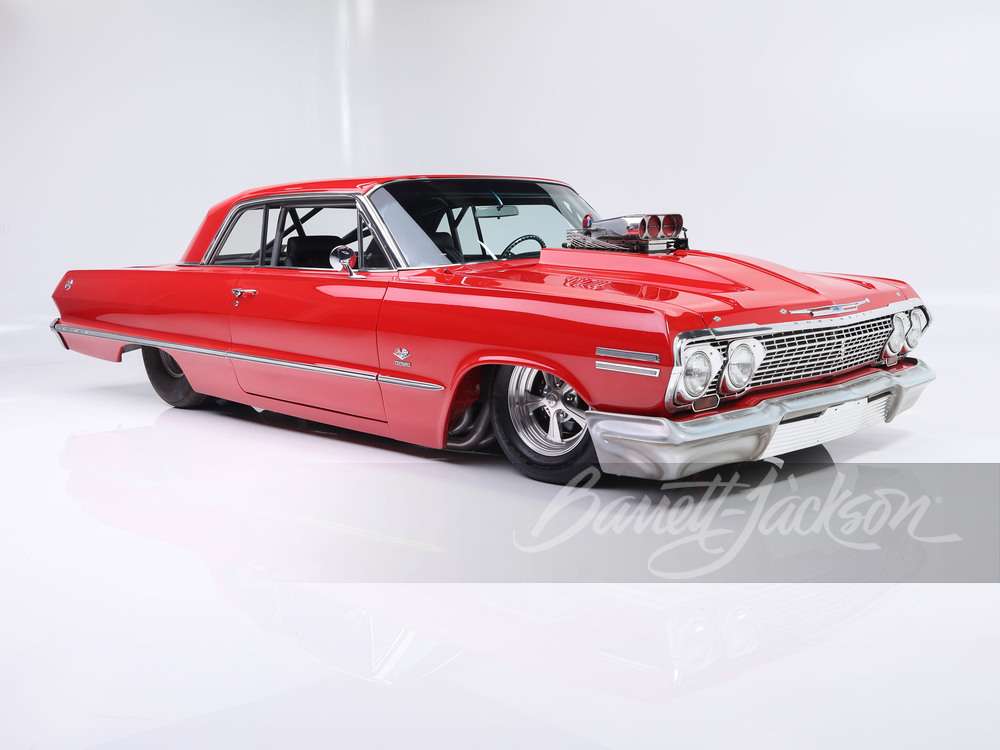
Somewhere in this Impala’s history sits a decision that matters more than any part bolted onto it since. Before the 572-cubic-inch big block, before the blower and the tube chassis and the channeled body, this 1963 Chevrolet Impala was, in Barrett-Jackson’s own description, “a completely stock, fully restored show car.” Somebody had a finished, correct, show-quality Impala sitting in front of them, and decided that wasn’t the point.
That decision, not the horsepower figure and not the no-reserve billing heading into Barrett-Jackson’s 2026 Las Vegas auction, is the actual story here. Cars like this one arrive at auction framed around specifications: displacement, induction, chassis brand, brake package. Those specifications matter, and we’ll get to them. But the more useful question for serious collectors isn’t what this Impala became. It’s what its builder was willing to give up to get there, and what that trade reveals about where money and craftsmanship are actually meeting in today’s custom car market.
The Trade Nobody Talks About
Every year, the population of clean, driver-quality 1963 Impala Sport Coupes gets smaller, not because the model is scarce in absolute terms, but because attrition, rust, and exactly this kind of transformation keep removing stock survivors from circulation. A restored, unmolested example already represents someone else’s finished labor: sourced trim, correct glass, a sorted drivetrain, the accumulated small decisions that separate a real restoration from a repaint. Starting a build from a rough shell is one kind of commitment. Starting from a completed, correct car is a different and arguably larger one, because the builder is knowingly destroying value that already exists in order to chase value that doesn’t yet.
What’s Actually Underneath It
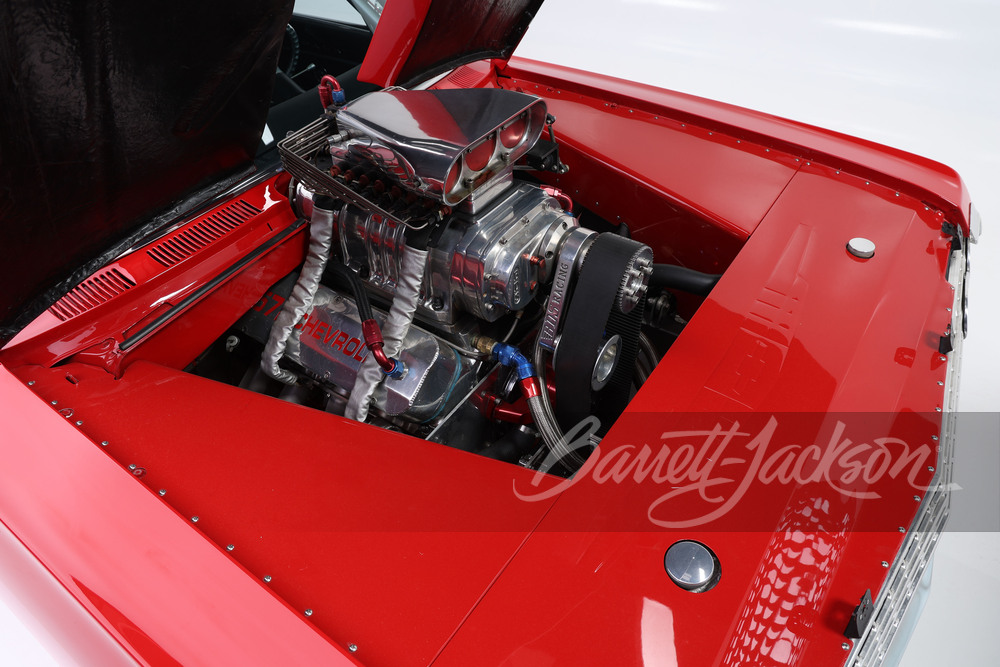
The specification sheet on this Impala reads like a wish list from the pro-street era rather than a Chevrolet build sheet. A 572-cubic-inch V-8 wears a BDS supercharger and a Bug Catcher-style EFI setup, sending power through a custom-built electronic six-speed automatic overdrive unit from Gear Vendors, a company whose overdrive units exist specifically to make big-inch domestic engines livable at highway speed rather than just quick off the line. The chassis underneath is a full-tube unit from Chris Alston, a name serious drag and pro-touring builders will recognize immediately, fitted with a four-link rear, polished front suspension, and rack-and-pinion steering that no 1963 Impala buyer would have recognized. Wilwood four-wheel disc brakes, a line lock, and a transmission brake round out a package built for hard acceleration, even though the car has reportedly never been raced.
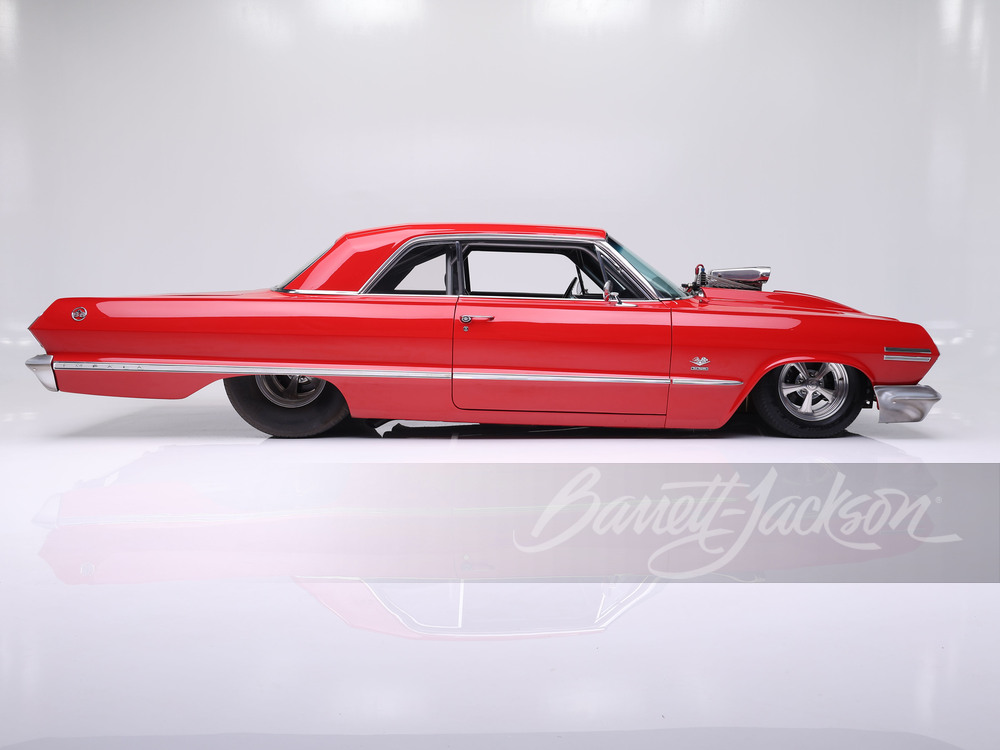
Two details matter more than the parts list itself. First, the body has been channeled down over the chassis to achieve its stance without air suspension, meaning the entire relationship between the Impala’s sheetmetal and its frame has been re-engineered, not just lowered. Second, the engine and steering column have both been moved rearward by 10.5 inches, a change that reshapes weight distribution and cabin proportions in ways that go well beyond a typical engine swap. This is not a car with new parts installed in old locations. It is a car that was substantially redesigned around a new set of goals, with the original Impala shape retained as the visual language rather than the structural reality.
Why the 1963 Impala, Specifically
Chevrolet’s full-size 1963 Impala Sport Coupe, with its distinctive fastback roofline that enthusiasts still call the bubbletop, occupies a particular place in Chevrolet lore. It was the body style most associated with the 409-cubic-inch V-8 that inspired the Beach Boys and the factory-backed drag cars that ran it, and it remains one of the most recognizable American shapes of the early 1960s. That combination of visual identity and performance heritage is exactly why the Sport Coupe has spent six decades as a favorite canvas for both restorers and customizers. Its lines read as unmistakably Impala from twenty feet away, which is precisely what makes a build this radical work: the silhouette stays legible even as everything mechanical underneath it changes.
That split path is worth keeping in view. Modern Car Collector recently covered a 1966 Chevrolet Impala SS convertible that went the opposite direction, absorbing a six-figure investment to return to exact factory condition ahead of a premier auction. Neither approach is more legitimate than the other, but they appeal to fundamentally different buyers and reward fundamentally different kinds of documentation. One car’s value is anchored to how closely it matches what left the factory. This one’s value is anchored to how well it executes a vision that never existed on any factory build sheet.
No Reserve, No Safety Net
Consigning a build this radical at no reserve is itself a signal worth reading. It tells us the consignor, and by extension Barrett-Jackson, believes the market for elite pro-street and resto-mod construction is deep enough to let bidders set the price without a floor to protect against a soft result. That confidence has precedent. Barrett-Jackson’s own Columbus debut earlier this year saw a 1967 Ford Mustang ‘Eleanor’ 25th Anniversary Limited Edition bring $550,000, proof that buyers will pay serious money for a car whose appeal rests on interpretation and execution rather than factory originality. The same dynamic has been building across the broader market: earlier this year, Modern Car Collector examined a restomod 1962 Corvette built around an LS3 crate engine and a modern tube chassis, another example of buyers rewarding thoughtful engineering over strict adherence to factory spec.
None of that guarantees this particular Impala will bring strong money. But it confirms the segment it competes in is real, active, and increasingly comfortable commanding prices that rival or exceed clean, original examples of the same model.
What Serious Buyers Should Actually Evaluate
Cars built to this level demand a different due-diligence checklist than a numbers-matching original. Provenance still matters, but it shifts from factory build sheets to build documentation: who fabricated the chassis, who tuned the EFI system, how the six-speed overdrive was integrated, and whether the work is backed by photos, receipts, and a builder willing to stand behind it. The VIN, 31847B258197, is the one part of this car that hasn’t changed since 1963, and it’s worth remembering that a heavily modified vehicle’s paper trail carries different weight than its sheetmetal does. Buyers should also weigh drivability against display. A car engineered this extensively for the street, with a transmission brake and line lock but no competition history, is built to be driven hard on public roads, and that changes how it should be inspected, insured, and valued relative to a static show build. Finally, liquidity works differently here. Original muscle cars trade against decades of established price data. Custom builds trade against the reputation of their builder and the current appetite for their particular style, which can shift faster and further than the collector market for factory-original cars.
The headline number this Impala brings in Las Vegas will get the attention. The more instructive fact already happened, back when a finished, correct, fully restored Impala was handed to a builder who looked at it and decided perfect wasn’t the goal. That is the real risk in this corner of the hobby, and increasingly, the real reward: the rarest trade in the collector car world isn’t a barn find. It’s a builder willing to sacrifice a car that didn’t need saving in order to build one that had never existed before.
The collector car market, every weekday morning.
Auction results, price moves and what’s crossing the block, read in four minutes. Free, from Modern Car Collector.
No spam, unsubscribe in one click. Or read more about the Brief.




 Eve Nowell
  Kyle Matthews