

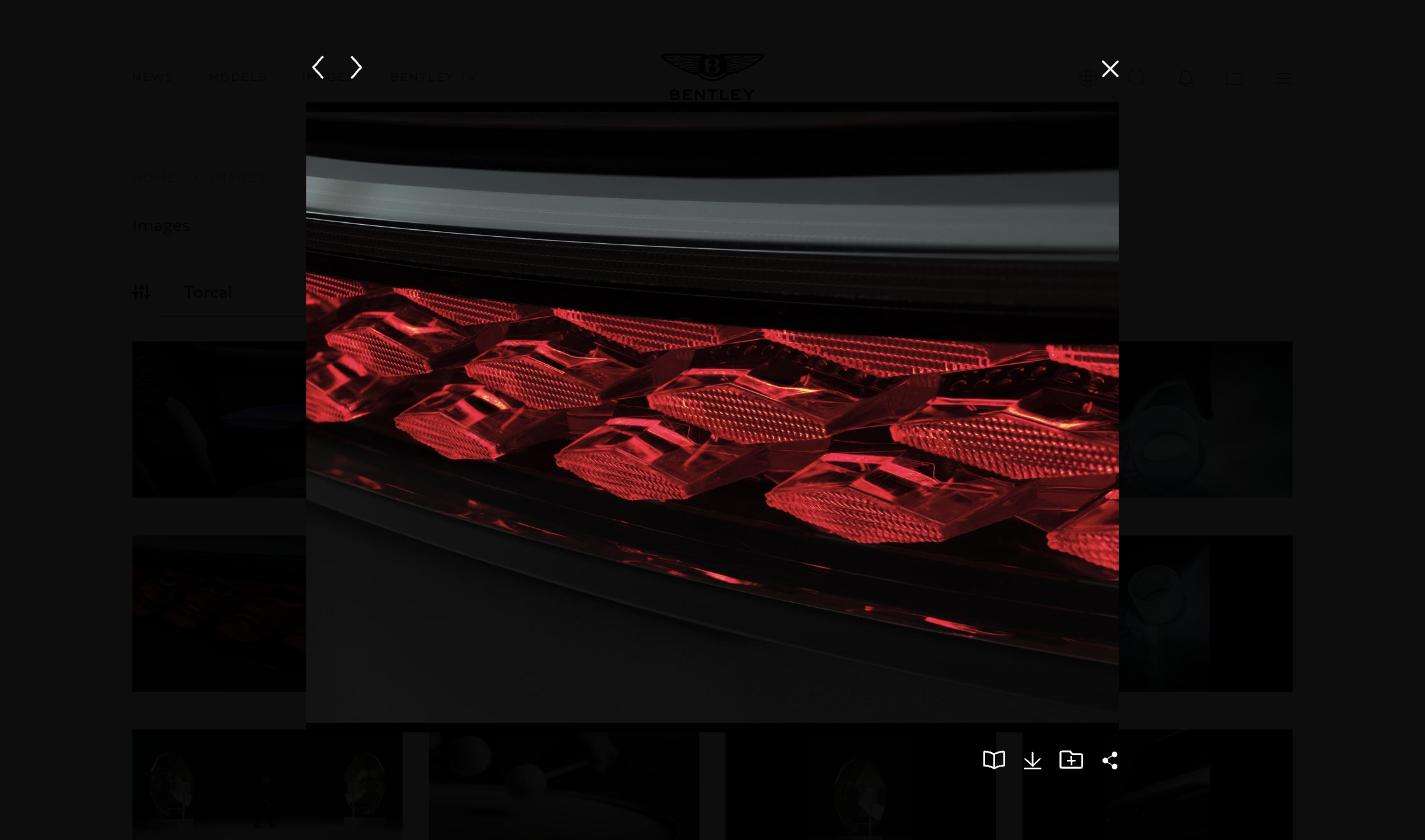
Bentley has spent 107 years building its reputation on an idea that seems almost quaint in 2026: that an engine can carry emotion. The supercharged fours of the 1930s, the languid torque of the 6¾-litre V8, the theatrical shove of the twin-turbo W12 — every era of Bentley has been defined by what happens when a mechanical, slightly imperfect object responds to a right foot. On September 23, in London, Bentley will reveal a car that has none of that, and the company is staking its entire luxury proposition on convincing serious buyers it doesn’t matter.
The car is called Torcal, and it becomes Bentley’s fourth model line alongside the Continental GT, Flying Spur and Bentayga — and, far more significantly, the marque’s first series-production electric vehicle. The name follows the naming convention established by Bentayga, Bacalar and Batur, this time drawn from El Torcal de Antequera, a dramatic stacked-limestone landscape in Andalusia. Bentley has also pointed out that Torcal shares a root with the Latin torquere, origin of the word “torque” — a detail clearly meant for collectors to notice, since torque has described every Bentley powertrain from the original 3-litre to the modern W12, and now describes one with no pistons at all. Bentley’s chairman and CEO, Dr. Frank-Steffen Walliser, has called it simply “the most considered car in our history.”
That linguistic sleight of hand is the whole story in miniature. Bentley isn’t hiding from the fact that Torcal has no engine. It is instead constructing an elaborate architecture of heritage cues designed to argue that an electric Bentley can still be an authentic one. Understanding why that argument matters — and whether collectors should believe it — is more useful right now than any spec sheet Bentley has yet published.
Manufacturing Emotion Without an Engine
The centerpiece of Torcal’s cabin is a system Bentley calls the Curation Engine, grounded in sensory neuroscience and designed to shift light, sound, climate, air quality and information flow to produce four distinct cabin states: Bentley Mode, Comfort Mode, Sport Mode, and an exclusive Refresh Mode aimed at combating fatigue on long journeys. Bentley has offered driver-adjustable comfort for decades through 22-way seats, adjustable air suspension and ambient lighting, but the Curation Engine reframes those individual preferences as inputs into something closer to a designed mood than a menu of options.
Collectors have historically cared little about infotainment systems, which tend to date faster than anything mechanical. That indifference is becoming harder to justify. As electric powertrains erase the mechanical differences that once separated a good luxury car from a great one, the cabin experience becomes one of the few remaining places where a marque can still express character. Bentley’s decision to root the Curation Engine explicitly in neuroscience, rather than in engineering, underlines how much has shifted. Fifteen years ago, a Bentley’s identity lived largely in its transmission calibration and engine note. Today, at least in part, it lives in software tuned by researchers who study how humans feel.
Even the sound of the car is manufactured rather than mechanical. Bentley’s engineers recorded and studied the 6¾-litre V8 and concluded that what made it emotionally compelling was not its tone but its rhythm — the same subtle, human imperfections that make a live drummer more compelling than a metronome. That research produced Bentley Dynamic Symphony, an original composition performed on real instruments, including drums, viola and bass guitar, that responds to driver input the way an engine once did.
This is worth sitting with. For a century, matching-numbers authenticity has been a bedrock of collector value — the correct engine, stamped with the correct serial number, installed at the factory on the correct date. Torcal has no such object to verify. Its emotional signature is a composition, not a combustion event. Whether that composition ages the way a great engine note ages, growing more desirable with distance rather than less, is a question nobody can answer yet. It is, however, the right question, and collectors who wave it off as marketing are missing what Bentley is actually attempting.
Borrowing Legitimacy From a Century of Craftsmanship
Bentley has been characteristically disciplined about anchoring Torcal to its own design history rather than to its powertrain. The car’s floating diamond grille reinterprets a motif that began in the 1920s as a practical solution — wire mesh protecting tall radiators from stone chips — before migrating to brass switchgear, diamond-stitched seats, and eventually the Bentayga’s headlamps. Inside, Torcal’s digital displays are built around bespoke hand-cut crystal commissioned from Cumbria Crystal in England’s Lake District, with real light passing through real glass rather than being rendered on a screen.
None of this is incidental detailing. It is a calculated argument that craftsmanship, not combustion, has always been Bentley’s actual value proposition, and that an electric powertrain doesn’t threaten that proposition so long as the handwork survives intact. It is the same strategy Bentley used to introduce Bacalar and Batur, two limited-production models that leaned on coachbuilding-era romance to justify their positioning before either car had proven anything on the road. Torcal is a higher-stakes version of that same bet, because unlike Bacalar or Batur, it isn’t a low-volume special commissioned for a handful of existing clients. It is meant to be a mainstream pillar of Bentley’s future lineup.
For a sense of how deeply coachbuilt heritage still shapes ultra-luxury branding today, our earlier look at a 1951 Rolls-Royce Silver Wraith is instructive: even in period, British luxury marques understood that craftsmanship, not mechanical specification, was what buyers were actually paying for.
Why This Matters More Than the Reveal Date
Bentley is not alone in wrestling with this question. Lamborghini’s decision to cancel its own EV program while Ferrari absorbed criticism over its electric debut illustrates how unsettled the ultra-luxury segment remains here. Some manufacturers are retreating toward combustion as a selling point. Bentley, by contrast, is moving toward electrification while trying to carry every emotional argument for combustion along with it: the sound, the craftsmanship, the sense of occasion. That is a considerably harder needle to thread, which is why Torcal deserves more attention from serious collectors than a routine model-line announcement would normally warrant.
History offers some guidance, though not certainty. Bentley’s past transitions — from naturally aspirated saloons to the Turbo R, from the last hand-built engines to the modern W12 era — did not initially excite collectors. Early examples of a new platform are rarely the ones that appreciate first; that distinction usually belongs to the final examples of the outgoing generation, the last of something rather than the first. This year’s Bentley and Mercedes-Benz results at Pebble Beach underscored exactly that pattern, with mid-century examples commanding attention precisely because they represent the end of a defined era rather than the start of an uncertain one.
Torcal inverts that logic in an interesting way. Because it isn’t merely a new platform but a new propulsion category for the marque entirely, it may eventually be remembered less like an ordinary model-year transition and more like a hinge point: the car that marks where Bentley’s combustion story ends and its electric one begins. Hinge points generate collector interest precisely because they are rarely recognized as significant when new. Nobody buying an early V8 Bentley in 1959 believed they were witnessing the start of a defining engine family. Long-term significance is almost always assigned retroactively.
What Serious Collectors Should Actually Watch For
None of this is a case for speculating on Torcal’s future value. Bentley has not released pricing, production figures, or final specifications, and any projection this far ahead of a September reveal would be irresponsible. What collectors should watch instead is execution: whether the Curation Engine feels considered or gimmicky in person, whether Bentley Dynamic Symphony holds up to scrutiny from people who have spent decades listening to real V8s, and whether Bentley continues building combustion-engined Continental GTs and Flying Spurs alongside Torcal or treats this as the start of a broader phase-out. That last question, more than anything said on stage in London, will determine how history eventually treats this car.
Collectors rarely pay a premium for horsepower alone. They pay for moments in history. Torcal’s importance will not be decided by how quickly it accelerates or how convincingly its speakers can imitate a V8. It will be decided by whether, twenty years from now, this is remembered as the car that proved Bentley’s craftsmanship could survive the loss of its engine, or the car that proved it couldn’t.
The collector car market, every weekday morning.
Auction results, price moves and what’s crossing the block, read in four minutes. Free, from Modern Car Collector.
No spam, unsubscribe in one click. Or read more about the Brief.


 Eve Nowell
  Kyle Matthews