

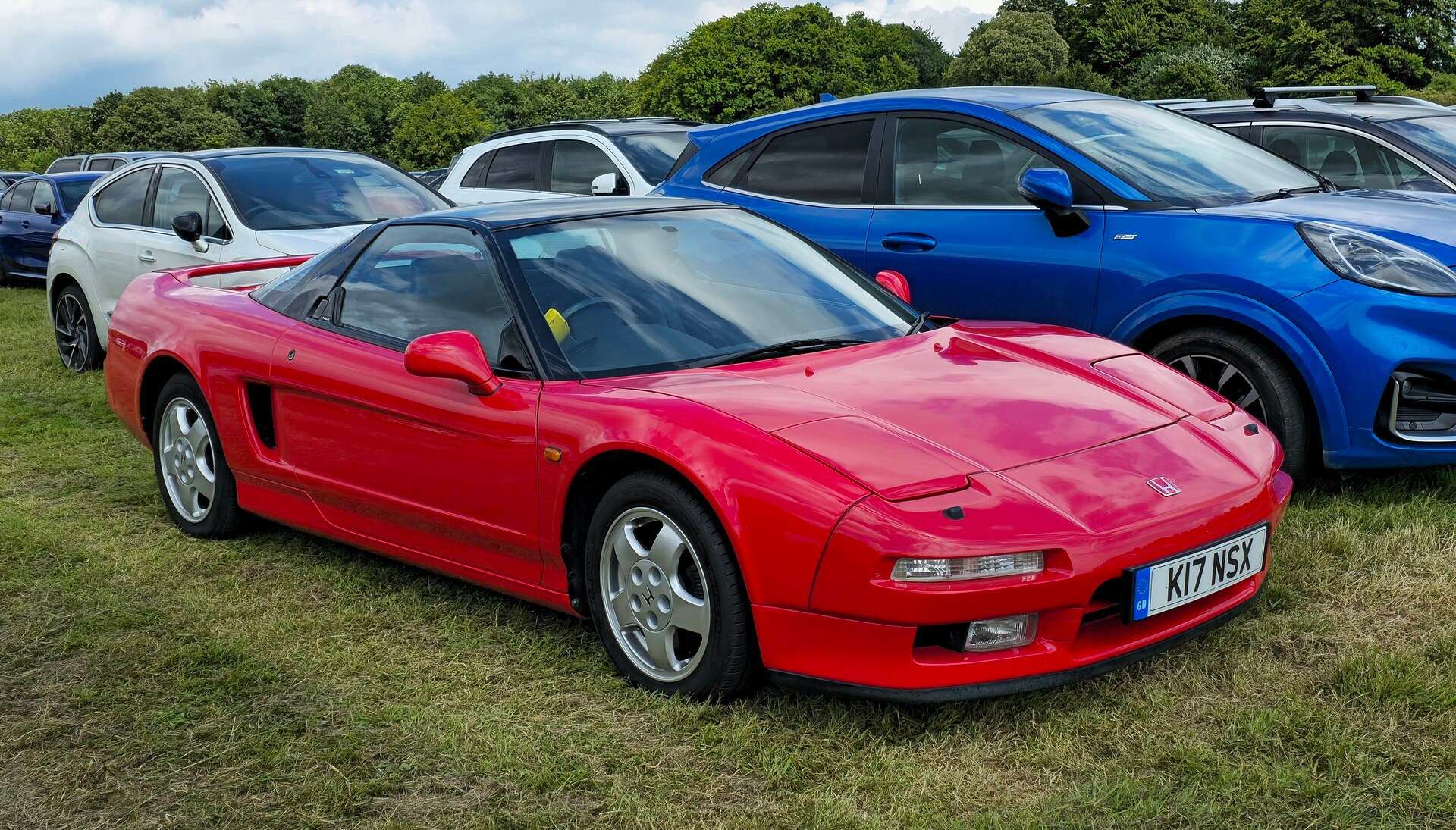
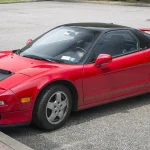
At RM Sotheby’s London Auction on 31 October, a 1991 Honda NSX with about 63,000 kilometres, a manual gearbox and an entirely ordinary specification sold for £871,250, roughly $1.17 million. That is about 10 percent above the $1.06 million paid for a 2003 NSX-R at Villa d’Este in 2025, the result that, as far as MCC’s records show, had marked the ceiling for the model.
The obvious reading is that Senna is Senna. The more useful one is narrower. Lot 155 did not sell as an NSX, and not quite as a Senna relic either. It sold as a car whose Senna connection can be demonstrated, and the evidence carrying that connection is not what most buyers would assume. The paper doing the heaviest lifting is a fax from Honda.
| Lot 155 | What RM publishes |
|---|---|
| Sale | The London Auction, 31 October 2026, Lot 155 |
| Result | £871,250 (about $1.17 million), as reported by RM |
| Estimate | £500,000–£800,000 |
| Chassis | JHMNA11500T000233; first registered in Portugal, 22 March 1991 |
| Colour and trim | Formula Red, black roof, black leather |
| Mileage and gearbox | About 63,000 km; manual (per RM’s editorial) |
| Proof of Senna link | Honda fax, reaffirmed by Honda Motor Europe; 1992 documentary; period photographs; service books |
| Sale terms | Titled as a 2025 model; UK temporary import bond |
A very good ordinary NSX
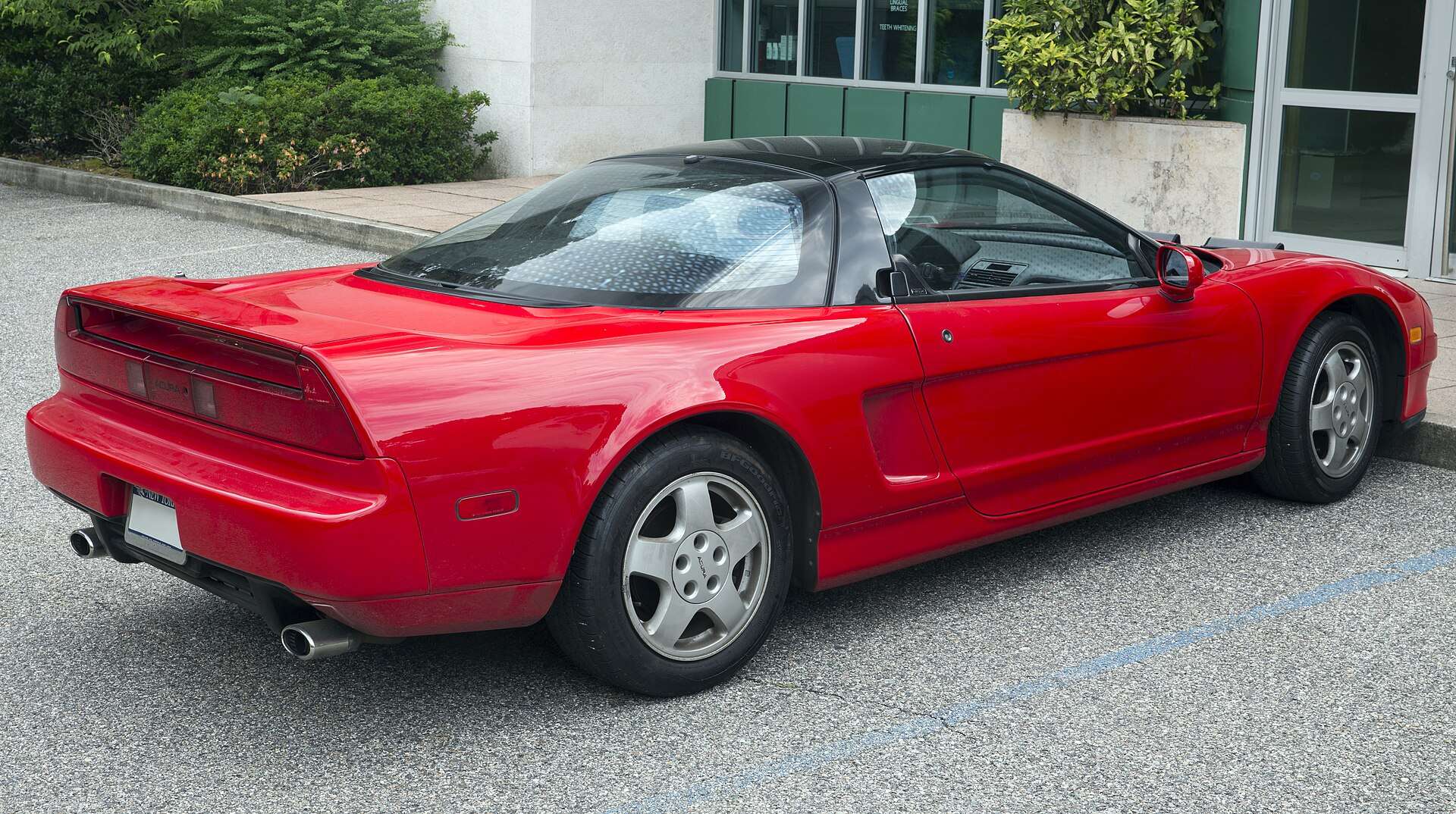
On RM’s catalogue entry, the car was imported by Honda Automobil de Portugal and registered on 22 March 1991 as SX-25-59. RM’s accompanying editorial calls it the first NSX imported into Portugal and describes a manual car with around 63,000 kilometres, a sheltered life and few owners, with the brakes the only part that shows its age. RM lists no modifications. The mileage squares with the 39,100 miles quoted in 2024, when owner Robert McFagan listed the car privately for £500,000.
Those were precisely the details the lot page left unstated when we previewed the sale, and they sharpen the question. Hagerty’s auction data, as cited in that preview, puts the highest result for a 1991 NSX at $163,411 and a typical good example near $65,900, though the dataset appears to run only to early 2025. Lot 155 made more than seven times that record and roughly eighteen times the typical figure. Nothing in the engineering explains the gap. The first-generation NSX is still an aluminium monocoque with a 3.0-litre VTEC V6, and a 1991 example without a story remains a five- or low-six-figure car. Our collector spec sheet sets out what separates one NSX from another on its merits.
Where the proof actually sits
Senna’s association with the car is well documented, though not in the way a title search would show. Under an agreement between Honda Motor Company and the driver, Honda supplied him with NSXs for personal use; RM says three. The Honda fax in the sale file, which RM says Honda Motor Europe has reaffirmed, confirms this car as one of them. He drove it to the 1991 Portuguese Grand Prix at Estoril, where he qualified third and finished second. It appears in the 1992 documentary Ayrton Senna: Racing Is in My Blood, and it is the car in the hosepipe photograph.
What the ownership chain does not contain is Senna. On RM’s account the car was imported and registered by Honda’s Portuguese distributor, stored in Lisbon and delivered to him when he was in the country, and its editorial says it went back to Honda after the 1993 season. The first registry entry the catalogue cites after that is February 1995, when Laboa Etablissement registered it in Lisbon, within a year of Senna’s death at Imola. Senna was the user, not the titled owner. That is why the manufacturer’s statement carries so much weight, and why it matters what corroborates it.
One piece of corroboration is unusually good. According to RM’s editorial, McFagan, who bought this car in 2013, also acquired a second Senna NSX, in black, in 2014. Comparing the two cars’ service books, he found entries by the same mechanic on consecutive days before the 1991 Portuguese Grand Prix. That is the kind of evidence collectors should prize: contemporaneous, created for another purpose, and hard to manufacture afterwards.
It also answers a question the sale raises, which is why this car rather than a sibling. The red car is the one that photographs and a specific race weekend place with Senna, and RM places the third NSX with the family in Brazil. Provenance is a claim. Documentation is the asset.
What the result does not include
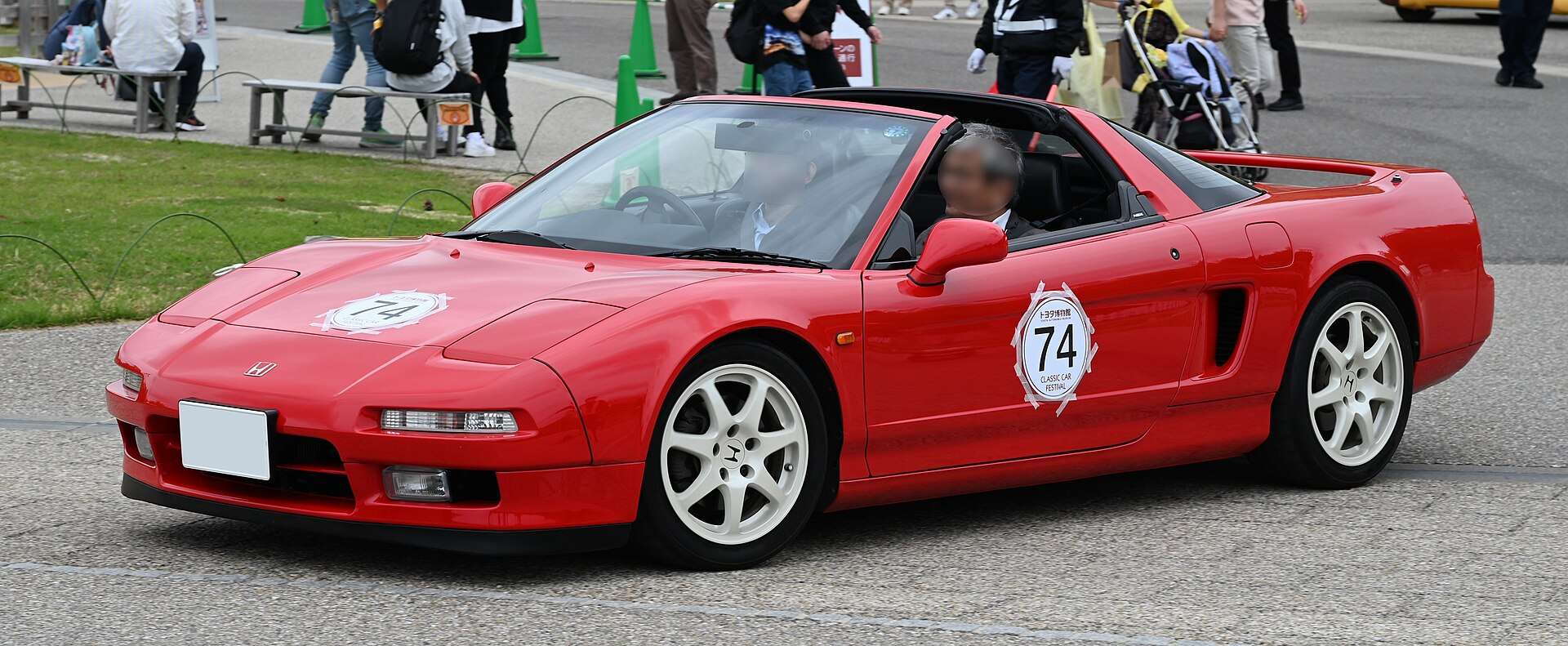
Two lines in RM’s addendum belong in any serious bidder’s arithmetic. The car is titled as a 2025 model, and it entered the UK on a temporary import bond, which must be cancelled either by exporting the car on an approved bill of lading with customs documents or by paying the applicable VAT and import duties. The registration field lists a Japanese Export Certificate, a reminder that this car travelled from Portugal to the UK, then to a consignor in Nagoya in 2024, and back to London for sale. RM does not explain the 2025 title, and MCC has not seen the underlying files.
RM publishes results inclusive of buyer’s premium, and £871,250 is not the cost of keeping the car in Britain. Import VAT and duty fall on a value in that neighbourhood, and the rate depends on the buyer’s status and how customs classify the car, which is a question for a customs adviser rather than a catalogue. A buyer who exports it avoids UK import tax but inherits shipping and the destination country’s own rules. A 1991 car titled as a 2025 model is also the kind of inconsistency that surfaces at registration, insurance or the next resale. Serious bidders should have asked how it will be reconciled.
The price history is the quiet part
MCC reported in May 2024 that McFagan had the car listed at £500,000. The Nagoya consignor acquired it that year, at a price that has not been disclosed. RM’s low estimate was £500,000, the same number as that asking price, and the result is about 74 percent above it, though estimates exclude premium and results include it. An asking price is not a transaction, so this is not a calculation of the consignor’s return. It does show how far the market’s view of a documented Senna car moved between a private listing and a public sale in a room that, as we reported from the record £36.55 million night, rewarded cars with a reason that could be checked.
What it means for collectors
This result is significant, but narrowly. It does not lift the NSX market. A standard 1991 car is still a standard 1991 car, and $1.17 million cannot be read across to an example without a story. Fame does not price itself either: the film-famous Avengers NSX we covered the same week was reported at $120,000. What moved Lot 155 was a specific association that could be proven by people with a stake in the outcome.
The practical lesson is to rank the evidence. Manufacturer records and contemporaneous workshop paperwork sit at the top, then period photographs and film, then registry history, then recollection. Lot 155 was strong on the first two and thinner on the third, which is why the original of that single Honda fax deserves more scrutiny than the chassis. Our look at why the VIN trail matters more than the plaque on an Integra Type R makes the same case from the other direction. Whoever owns the NSX will at least find running costs eased by Honda’s heritage parts programme for the first-generation car.
If the price disappeared from this story, the lesson would survive. Collectors will pay for a story. They pay most for a story that someone with a stake in it has signed.
Facts are drawn from RM Sotheby’s lot page, press release and editorial. The dollar figure is approximate. Market interpretation is MCC’s own analysis and is not investment or tax advice.
The collector car market, every weekday morning.
Auction results, price moves and what’s crossing the block, read in four minutes. Free, from Modern Car Collector.
No spam, unsubscribe in one click. Or read more about the Brief.

 Eve Nowell
 Kyle Matthews