

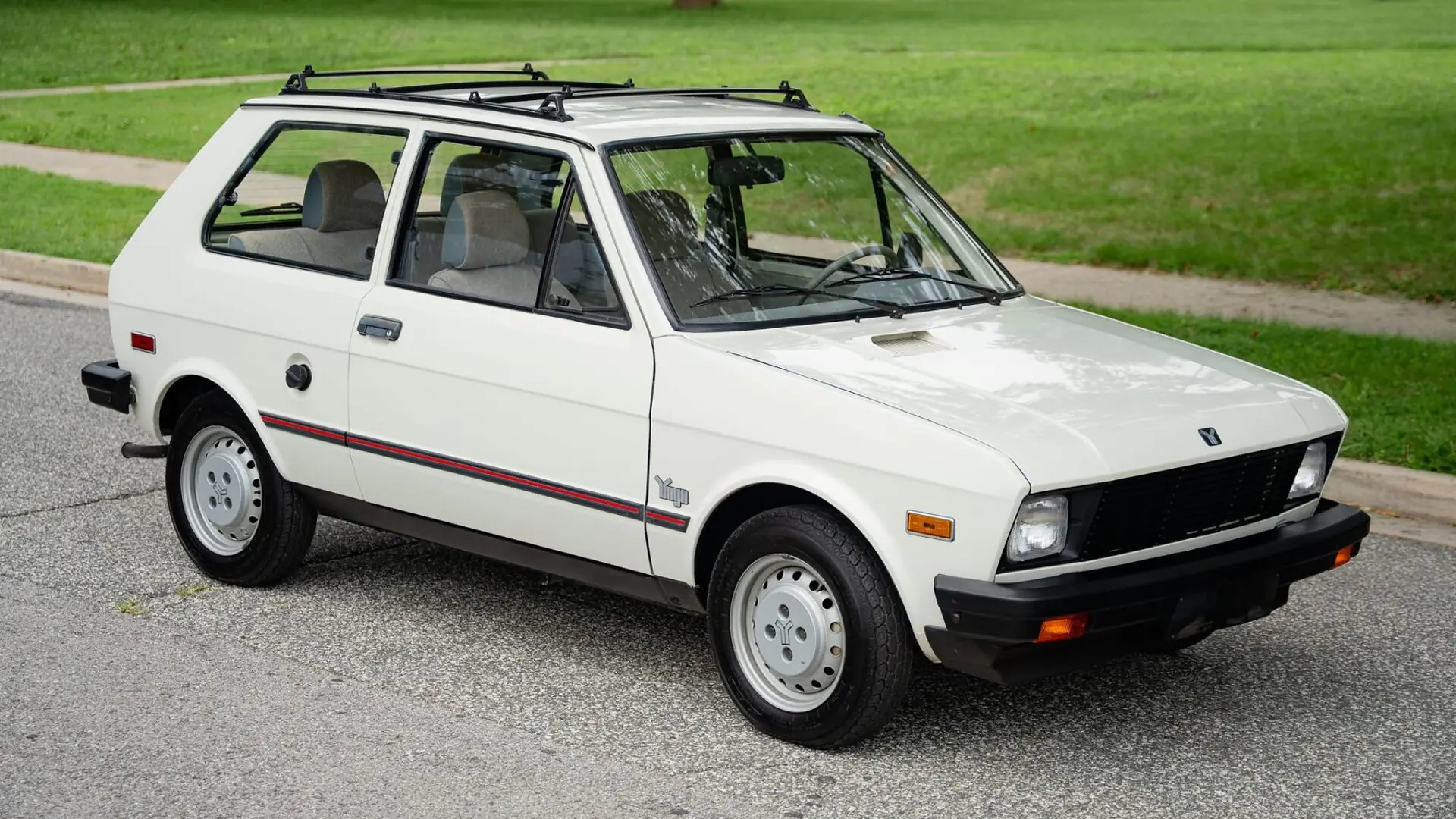
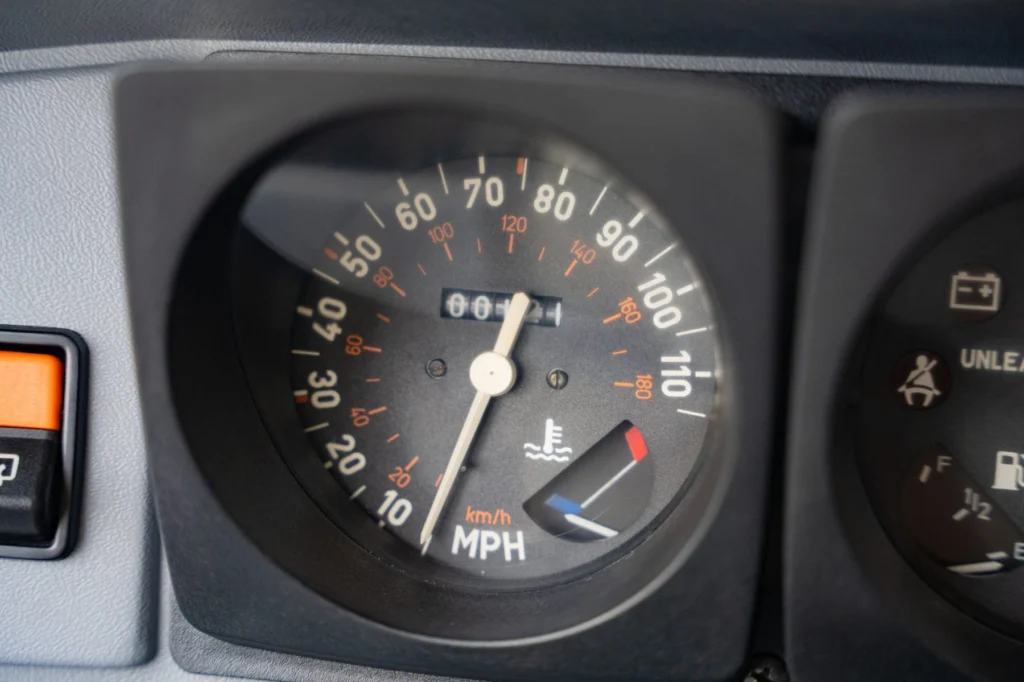
On November 17, a 1986 Yugo GV showing 121 miles sold on Bring a Trailer for $50,000 after 37 bids. It is the easiest auction result of the year to laugh at, and one of the more instructive. Anyone tracking how the modern-classic market is being defined by use rather than model year will recognize what actually happened here. Bidders were not paying for a Yugo. They were paying for the near impossibility of finding one that nobody used.
The Car, and the Man Who Kept It
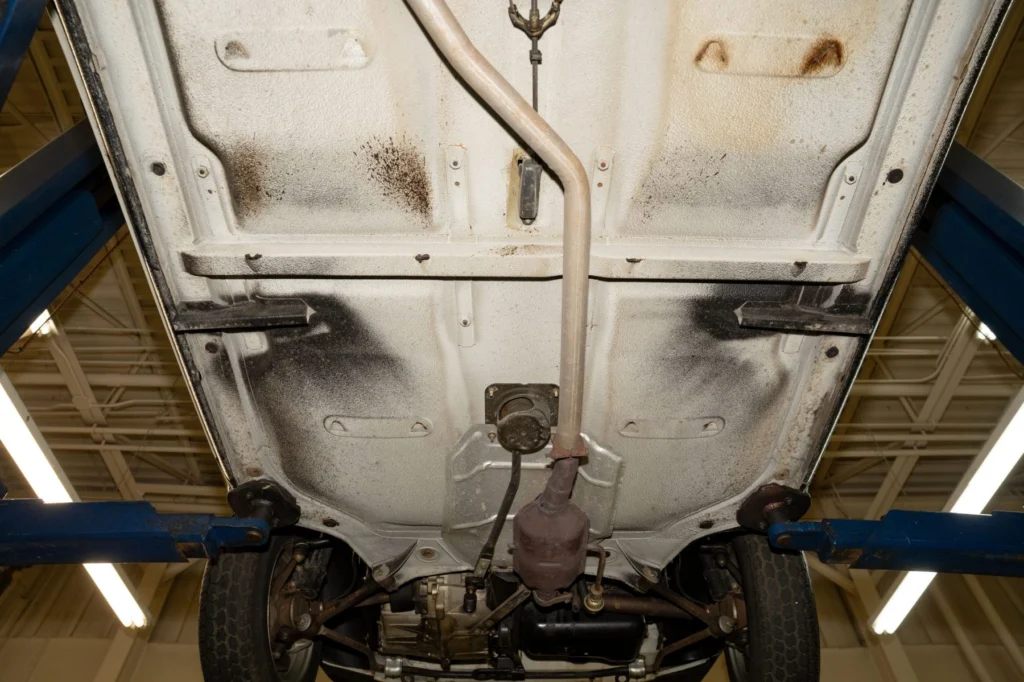
The GV came from the estate of James G. Robinson, the Baltimore-born producer who co-founded Morgan Creek Productions, the studio behind Major League, Young Guns and Ace Ventura: Pet Detective. Robinson died in February at 90. According to the listing, he acquired the car new and kept it untitled for roughly 40 years.
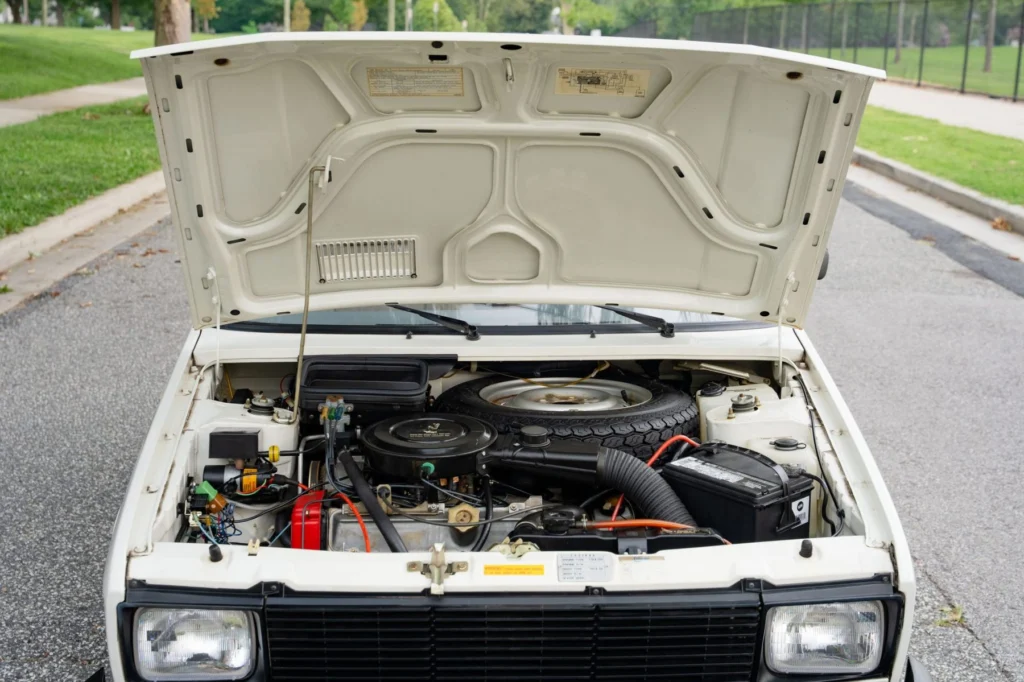
It is a thoroughly ordinary specification, which is the point. Snow White paint over gray cloth. The 1.1-liter SOHC inline-four, rated at 55 horsepower and 52 lb-ft when new, driving the front wheels through a four-speed manual transaxle. Thirteen-inch steel wheels on 145-section Tigar tires, a roof rack, a rear wiper and defroster, and an AM/FM/cassette head unit. A Frigette air-conditioning system was installed in October 1987, about a year into Robinson’s ownership. The car was offered from Dundalk, Maryland, with owner’s manuals, the A/C paperwork, a service log, a clean Carfax report and a Montana title.
The detail that gives this car its real provenance is not the celebrity name. Before Hollywood, Robinson made his money in the import-car business and was still in the Subaru trade when he formed his first production company in 1984. The Yugo reached America through Malcolm Bricklin, the same entrepreneur who had founded Subaru of America in 1968, and the first shipment of Yugos came ashore in Baltimore in 1985. This is a Baltimore car-business artifact, kept for four decades by a Baltimore car-business man. That will never appear in a price guide, but it is exactly the kind of coherent, documented story that turns a curiosity into a collectible.
The Price Isn’t the Story. The Gap Is.
The Yugo GV was advertised at $3,990 when it arrived, roughly $12,000 in today’s money. On Bring a Trailer, ordinary driven examples have spent five years in a remarkably tight band: $7,500 in 2021, $9,001 in 2022, between $8,100 and $9,500 in 2023, $6,000 in 2024 and $7,700 in early 2025. A Yugo Cabrio, the rarer convertible, brought $15,275 in September 2025.
Then the ceiling moved twice in three months. In August, a 25-mile 1990 GV Plus that had reportedly been stored in an enclosed trailer since new sold for $27,257, despite being a non-runner whose fuel system needed service before it could be started. The Robinson car has now nearly doubled that figure.
Read those results together and the conclusion is plain. The market for driven Yugos has not moved. What has moved is the price of unused Yugos, and there are almost none of them. A premium of five to six times a good driver is not a revaluation of the model. It is the market putting a price on survival.
Why Survival Costs More Than Rarity
With a Ferrari 250 GT or a Porsche 959, preservation was the default. Owners protected those cars because they were valuable from the day they were delivered. Cheap cars follow the opposite curve. They were bought to be used up, maintained to the minimum and scrapped when a repair cost more than the car was worth. Almost nobody in 1986 put a new Yugo away. Robinson, for reasons he took with him, did.
That inversion is why a car once sold by the tens of thousands can be harder to find in unused condition than many limited-production exotics. Most collector cars become rare at the factory. The Yugo became rare in the hands of its owners, who had every reason not to save one.
The same logic now runs through much of the 1980s market. It is why low-mile DeLoreans command attention, and why period mid-engine commuters like the Fiero and MR2 are being sorted by condition and documentation rather than by horsepower. Generational demand plays its part as well. Buyers who remember the Yugo as the punchline of the decade are now in a position to own the punchline in museum condition, and some of them clearly want to.
Is $50,000 a Real Number?
This is where judgment matters more than enthusiasm. Two sales in three months do not make a market. The listing drew 623 watchers and more than 20,000 views, but the money that pushed the price past $27,257 came from a very small group of committed bidders. When the depth of serious demand can be counted on one hand, the next result depends on whether those same people are in the room.
Anyone reading this as a new value for Yugos in general will be disappointed. The fair reading is narrower: $50,000 is what this specific car, with this specific story, brought on a specific Tuesday. As we argued with Reggie Jackson’s Ferrari 250 GT Lusso, celebrity provenance works best when the famous owner simply chose the car and left it alone. Robinson did exactly that, and the lack of intervention is the asset.
What Serious Buyers Should Note
- The odometer is exempt. The Montana title carries an “Exempt” odometer notation, as older vehicles are outside federal odometer-disclosure requirements. The 121 miles is supported by condition, the service log and the Carfax, not by a certified title brand. On any zero-mile car, the documentation is the mileage.
- Read the title closely. The car was kept untitled until the estate sale, and the Montana title lists the make under the code “ZCZY.” Confirm how your home state will register a Montana-titled car before bidding on anything similar.
- Rubber ages by the calendar. Pre-sale work covered an oil change, a new battery and fresh fuel. A 40-year-old timing belt, hoses, brake fluid and tires should be treated as expired regardless of mileage, and every original part replaced subtly changes what you own.
- Use is the enemy of value. Every mile added comes directly off the one attribute this buyer paid for. This is a car to preserve, display and document, not to drive.
- Period additions are part of the story. The October 1987 Frigette air conditioning is documented history, not a deviation from originality. Keep that paperwork with the car.
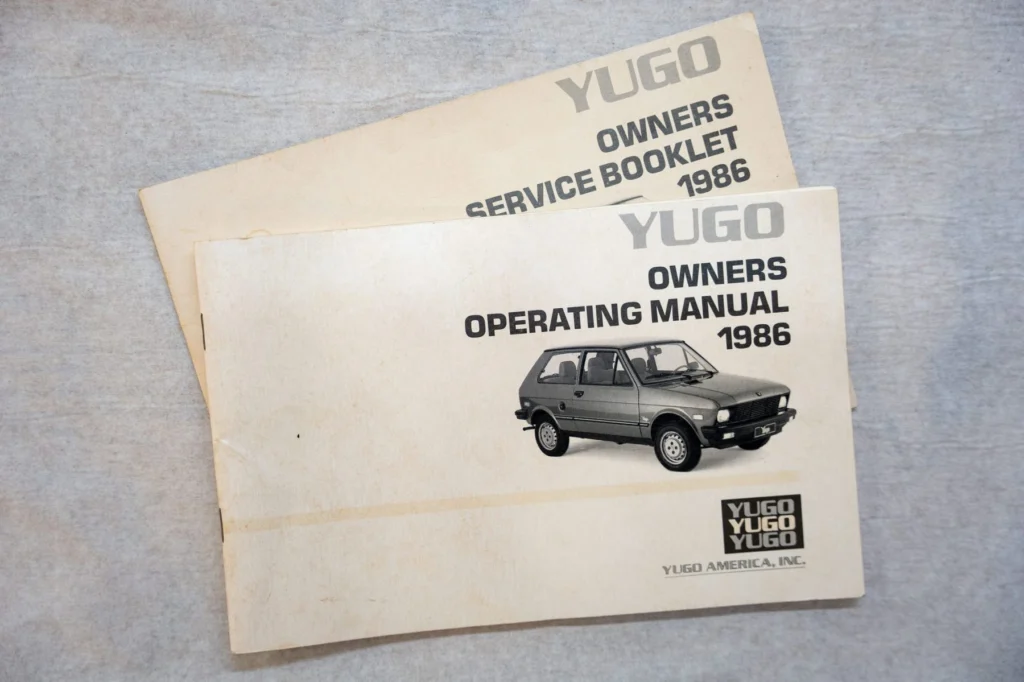
The tempting reading is that people simply have too much money. The more useful one is that the collector market has moved from valuing what a car was to valuing what happened to it. Robinson’s Yugo was never a good car. It became a significant object because, for forty years, nothing happened to it at all.
Sale details, specifications and documentation come from the Bring a Trailer listing for the 121-mile 1986 Yugo GV. Comparable sales come from Bring a Trailer’s Yugo auction results and the listing for the 25-mile 1990 Yugo GV Plus. Biographical details on James G. Robinson come from TheWrap’s obituary. Background on Malcolm Bricklin’s Subaru and Yugo ventures comes from his Wikipedia entry.
The collector car market, every weekday morning.
Auction results, price moves and what’s crossing the block, read in four minutes. Free, from Modern Car Collector.
No spam, unsubscribe in one click. Or read more about the Brief.
Related Posts:
- The Collector Car Market Paid Up for Certainty This…

- Mustang SVO Deep Dive: 9,844 Cars, a 205-HP Turbo…
- Mercedes G-Wagen Values: Hagerty Says 35% Up, but…

- Bring a Trailer Offers a Blue-and-White Arkonik Land…
- Toyota FJ60 Values Rose 10% in Hagerty’s Index.…
- Mitsubishi Eclipse GSX Values: Hagerty Says 65% Up,…
 Eve Nowell