
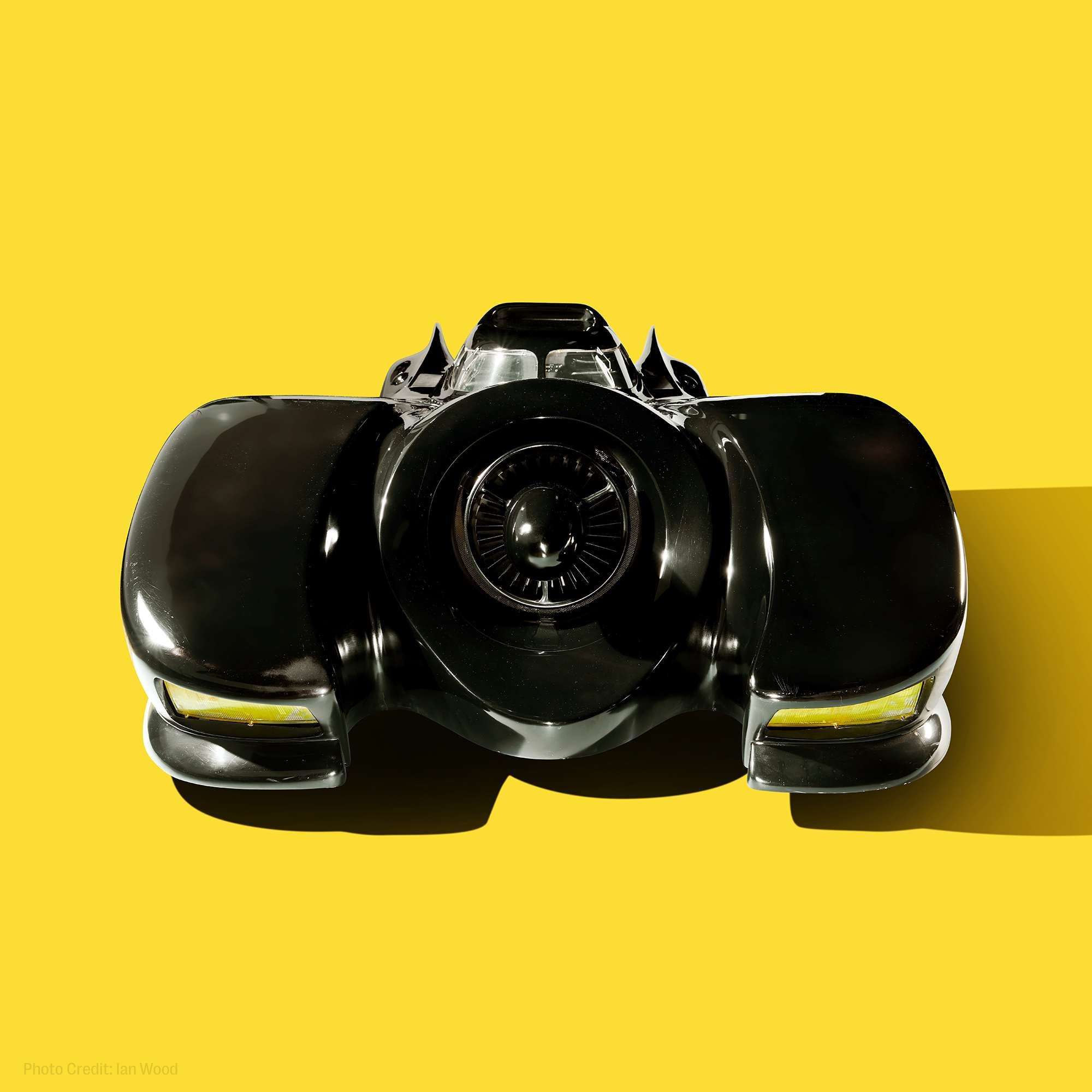
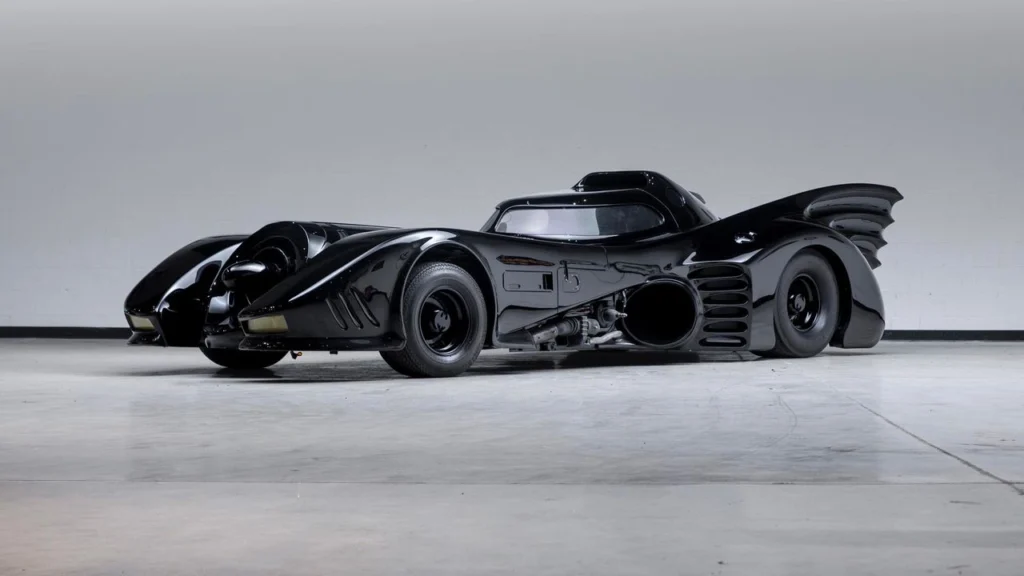
For two months, the Batman Returns hero Batmobile was discussed as a movie-car record in waiting. On Monday, in Julien’s Auctions’ saleroom in Gardena, California, it became something more useful: a data point. Bidding stopped at $3.25 million, short of the seller’s reserve and well below the $5 million to $7 million estimate, and the car left the block unsold.
Against the estimate, that is a clear miss. But the more instructive reading is that the room did exactly what a collector market is supposed to do. It priced what was actually on offer. And what was on offer was not, in the conventional sense, a car.
What the Room Was Asked to Buy
On provenance alone, the Batmobile is about as strong as screen-used vehicles get. Julien’s describes it as the “Number One Hero car,” one of three built for Tim Burton’s 1992 film and the one seen in most of its driving sequences. It had never been offered at auction. It retains its original paint, its Chevrolet V8 and the radio-controlled flame-thrower exhaust that Michael Keaton’s Batman turns on one of the Penguin’s circus thugs. After years in storage it went on display at the Marconi Automotive Museum in Tustin. Julien’s called it “one of the most recognized and important cinematic vehicles in Hollywood history,” and few would argue.

The difficulty is everything that came with it. As we detailed in our look at the Warner Bros. agreement attached to this lot, ownership is governed by terms set with Warner Bros. Consumer Products, which manages DC Comics’ intellectual property. Public exhibition requires the car to stay stationary. Appearances at special events need approval. It cannot be leased. Any future owner must sign a similar agreement before taking title. The car is not street legal, and Julien’s says its drivetrain has been run only a limited number of times since filming wrapped. Bidders had to be approved before they could raise a paddle at all.
Put plainly, the buyer was being asked to pay a record price for an object he could not drive, could not rent out, could only show on approved terms and could only sell to someone willing to accept the same conditions.
Why $3.25 Million Is a Rational Number
The comparisons Julien’s invited are revealing for what they leave out. The 1965 Aston Martin DB5 Bond car that sold for $6,385,000 at RM Sotheby’s Monterey sale in 2019 and the Bullitt Mustang that brought $3.74 million with fees at Mecum Kissimmee in January 2020 are both film icons. They are also real automobiles. A DB5 can be registered, driven, insured, shown at concours and sold to anyone. The Bullitt car was driven onto the auction block. Their screen history sits on top of an underlying collector car with its own market, its own collector base and its own floor.
The Batmobile has no such floor. Remove Batman and what remains is a fiberglass body on two Impala frames that cannot legally leave a trailer. Every dollar of its value is provenance, and that provenance is licensed rather than owned outright. Even the 1966 television Batmobile, which brought $4.62 million with fees at Barrett-Jackson in 2013, had more independence: George Barris built it from Ford’s Lincoln Futura concept, a car with a design history of its own before it ever wore a bat emblem.
That is the lesson collectors should carry away from Gardena. A collector car’s value is partly the sum of the things its owner is free to do with it. Take away the road, the lease and the open resale market, and you take away part of the price.
The Terms Are Not a Flaw. They Are a Cost.
It would be wrong to read Monday as a verdict against the agreement itself. There is a fair case that a documented arrangement with the rights holder is a benefit. Pop-culture vehicles have a way of attracting trademark disputes long after they leave the set, and a buyer who knows exactly where he stands with Warner Bros. is spared a cloud that hangs over many lesser cars.
But clarity is not free, and the room appears to have charged for it. Pre-approval narrowed the field on Monday. The transfer requirement narrows it again at every future sale. Collectors routinely discount for thin markets, and a car whose next buyer must be vetted by a licensor is, by definition, a thin market. We cannot know where the reserve sat or how many approved bidders were in play. What we can say is that the people with the money and the clearance to buy stopped well short of the estimate, and that their judgment deserves more weight than the pre-sale enthusiasm.
It is also worth remembering that $3.25 million is not a modest bid. It is a seven-figure offer for a vehicle with no mechanical, motorsport or design-history value independent of one film. The market did not reject the Batmobile. It declined to pay a hypercar premium for a licensed exhibit.
What Happens Next
A no-sale on the block is not always the end of the story. Post-auction negotiations are routine at major sales, and an unsold lot with a strong high bid often changes hands privately in the days that follow. The Associated Press reported that Julien’s had not responded to a request for comment Monday, and the seller, who has remained anonymous, has not signaled whether the reserve is negotiable. Whatever happens, $3.25 million is now the public reference for any private deal.
It will also shadow the next Batmobile to cross the block. On Jan. 28, Kruse Auctions will offer a 1992 Batman Returns exhibition car as part of the no-reserve dispersal of the Tucson Auto Museum. That car is a licensed promotional build, not a screen-used hero car, and it too is sold under special terms. Monday’s result gives that room both an anchor and a ceiling. If the hero car could not clear its reserve at $3.25 million, an exhibition car should be priced as what it is: a fraction of the original’s story.
The same reasoning applies across the category, from the Dark Knight Batpod offered by Propstore to the next studio vehicle consigned with a rights agreement attached. Screen fame draws the bidders. Ownership rights determine how much they will pay.
What Serious Buyers Should Take From This
First, price the rights before the object. With a licensed vehicle, the agreement is part of the lot, and it should be read in full, ideally with counsel, before any number is set. Second, separate the artifact from the automobile. A film car that is also a desirable car has two markets supporting it; a film-only build has one. Third, treat estimates on licensed vehicles with care. Monday showed how wide the gap can be between a house’s expectation and the bid the room will actually make.
The Batman Returns Batmobile remains one of the most important vehicles in film history, and it may yet sell, quietly and near the number the room offered. Batman Returns gave the car its fame. Monday gave it a price.
Sources: The auction result and lot details are drawn from the Associated Press report via WTOP and Julien’s Auctions’ Ultimate Batmobile Auction listing. The Bond DB5 result is from RM Sotheby’s Monterey 2019 results, and the Bullitt Mustang result from Bloomberg’s report on the Mecum sale.
The collector car market, every weekday morning.
Auction results, price moves and what’s crossing the block, read in four minutes. Free, from Modern Car Collector.
No spam, unsubscribe in one click. Or read more about the Brief.
Related Posts:
- Nobody Is Bidding on the Chevrolet: What the Batman…

- The Batmobile Comes With a Rulebook: What Warner…

- No Reserve, No Curator: What the Tucson Auto Museum…
- The Batpod Returns With a Lower Estimate and a…

- Record Ferraris, Rare Icons and 15,000 RPM: The Week…

- A €5.2M LaFerrari, a Valkyrie With a Haircut, and…
 Eve Nowell
 Kyle Matthews