

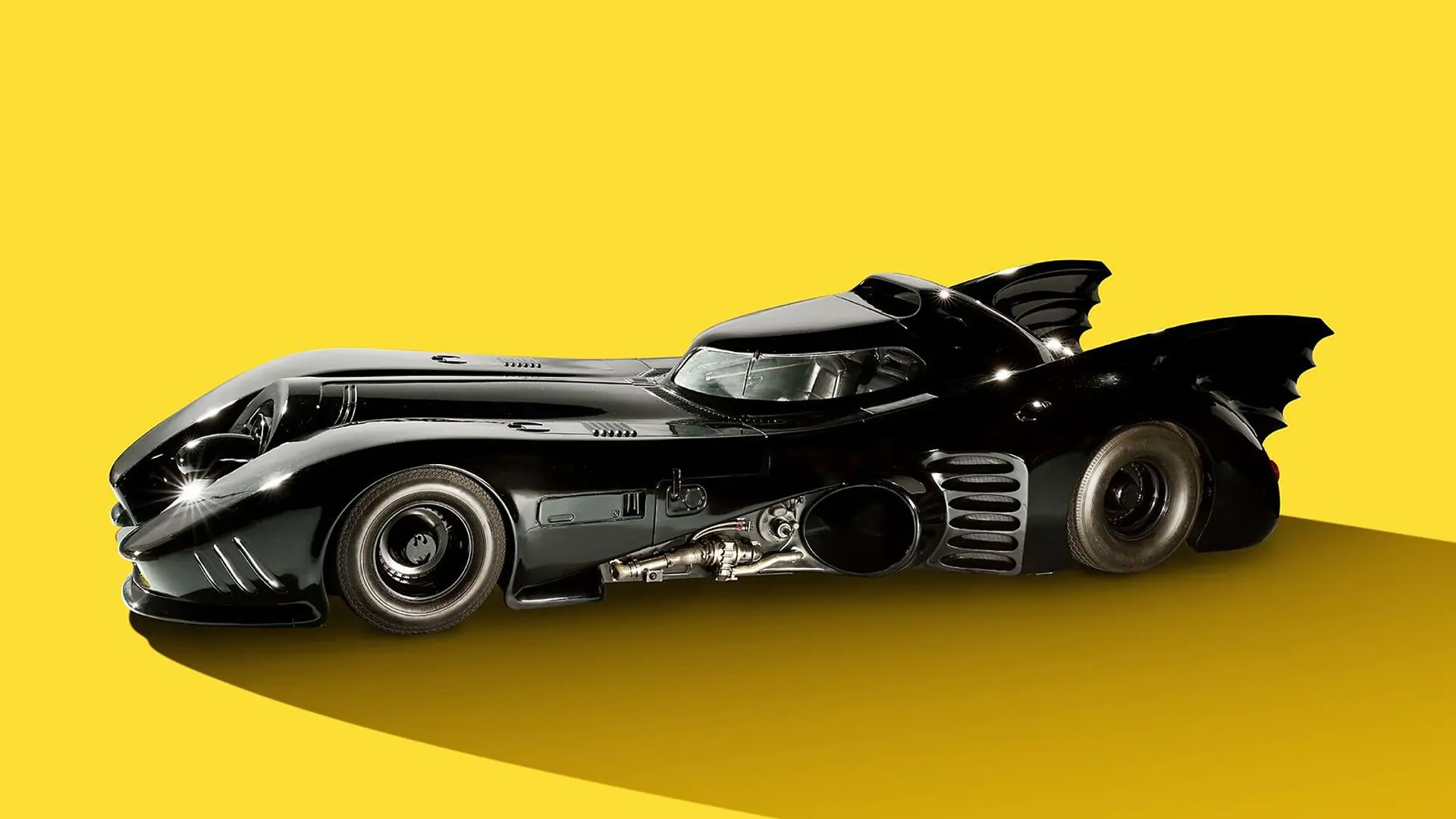
Take the body off the Batman Returns Batmobile and you are left with two Chevrolet Impala frames welded end to end, a Chevrolet V8 and a three-speed automatic. That is not a collector car. It is a parts pile. Yet on Monday, November 23, Julien’s Auctions will offer the assembled object in Los Angeles and online with an estimate of $5 million to $7 million, and if it lands inside that range it will become the most expensive Batmobile ever sold at auction.
The headline price isn’t the story. The story is who will be bidding, and what they believe they are buying. This sale is the clearest test yet of whether the generation that grew up with Michael Keaton’s Batman is ready to pay blue-chip money for its own childhood, and of how carefully that money will need to be spent.
What Is Actually Crossing the Block
According to Julien’s, the car is the screen-used hero Batmobile from Tim Burton’s 1992 sequel, and this is the first time it has been offered at auction. It was built by Carl Casper, the Louisville-based customizer and car-show promoter whose “Exotic Empress” took Top Custom at the 1961 NHRA Nationals and who later held a Warner Bros. license to build and tour Batmobiles. Casper’s Hollywood Productions built three cars for Batman Returns. This one is described as the number one hero car.
The specification is a showman’s build rather than an engineer’s: 19 feet 8 inches long, a hand-shaped fiberglass body over the spliced Impala chassis, a two-seat cockpit lined with aircraft-style switchgear. The famous exhaust flame was a pressurized blend of air and kerosene, fired by radio control. After filming, the car appeared at the premiere and a Warner Bros. backlot party, spent years in storage and went on display at the Marconi Automotive Museum in Tustin, California, in 2021. The consignor has not been named.
One detail matters more than the rest. Its black paint is reported to be unaltered since filming wrapped.

In This Market, the Paint Is the Provenance
Conventional collector cars are judged on their mechanicals and their documents in roughly equal measure. A matching-numbers drivetrain or a factory-correct restoration can rescue a car with thin history. Movie cars do not work that way. Nothing under this fiberglass is rare, and a perfect mechanical rebuild would add almost nothing to the price. The value sits entirely in the claim that this specific object was in front of the camera.
That is why the untouched paint carries such weight. On a 1960s Ferrari, an older repaint is a known and priceable deduction. On a screen car, original finish is evidence. Every scuff, panel gap and touch-up that survives from 1992 is something a specialist can compare against film frames and studio stills. Repaint it, and you erase the very thing being bought. In the movie-car market, mechanical value is a rounding error. Collectors are paying for screen time, and screen time cannot be restored.
It is also why “hero car” is not marketing language. Productions build multiples: close-up cars, stunt cars, effects cars and, in the Batmobile’s case, licensed touring cars that appeared at shows and promotions for years. Casper built Batmobiles for promotional duty as well as for the film, which makes the provenance question sharper, not softer. Serious bidders should be asking for the studio paperwork that ties this chassis to principal photography, the chain of custody through those years in storage, and independent screen-matching, not just a catalogue description. The car may well pass every one of those tests. The point is that at $5 million, the burden of proof belongs on paper.
Why the 2013 Benchmark Is Not a Straight Comparison
Julien’s frames the sale against George Barris’s 1966 television Batmobile, which sold at Barrett-Jackson’s Scottsdale auction in January 2013 for $4.62 million including premium. It is the obvious reference point, but the two cars occupy very different positions in automotive history.
The Barris car was a one-off conversion of the 1955 Lincoln Futura, a genuine Ford Motor Company show car, which gave it standing in coachbuilding and Detroit design history as well as in television history. It was the television original from which later copies were made. The Batman Returns car, by contrast, is the second-film execution of a design created for Burton’s 1989 Batman, which was styled by Julian Caldow under production designer Anton Furst and built at Pinewood Studios in England. Casper’s cars carried that shape into the sequel. They did not originate it.
That is not a knock on this car. Burton’s Batmobile is arguably the more influential design, the one that turned the car from a pop-art novelty into an instrument of menace and set the tone for every cinematic Batmobile that followed. It does mean bidders are paying for the image and the era, not for authorship of the design. Collectors should also remember that auction estimates are conventionally quoted before buyer’s premium, while the 2013 figure includes it. A hammer price near the low estimate would clear the old mark comfortably once fees are added.
The wider movie-car ceiling sits above both. The gadget-equipped Aston Martin DB5 built to promote Thunderball made $6.385 million at RM Sotheby’s Monterey sale in 2019, and the “hero” Bullitt Mustang brought $3.74 million at Mecum Kissimmee in 2020. We explored why the Bond car still anchors the genre in our history of the DB5 becoming 007’s car, and McQueen’s enduring premium in 18 Steve McQueen cars and motorcycles that have sold at auction. A Batmobile in the $5 million to $7 million band would put a purpose-built prop alongside real automobiles with real road histories. That would be a meaningful change.
Why Now: The Nostalgia Window Has Moved
Collectors rarely pay a premium for objects they did not want as children. Every major shift in the collector car market has followed a generation into its peak earning years: Brass and Nickel era cars for one cohort, postwar sports cars and muscle for the next, and more recently the analog heroes of the 1980s and 1990s. Pop-culture vehicles follow the same curve, and they move faster because they are pure memory with no driving experience attached.
Anyone who was between eight and fifteen when Burton’s films arrived is now in their mid-forties to early fifties. That is precisely the age bracket when serious discretionary capital meets a desire to own the poster that hung on the bedroom wall. The 1966 car’s 2013 buyer belonged to the Adam West generation. The Batman Returns car is the first Batmobile of this importance to be priced by the Keaton generation, a cohort whose attachment was renewed when Keaton returned to the role in 2023’s The Flash.
The demand curve is already visible further down the age ladder. When Joe Burrow paid roughly $3 million for a licensed Tumbler, as we reported, a buyer in his twenties was paying for the Nolan-era car of his own childhood. That was a newly built licensed vehicle, not a film artifact, and the gap between the two is exactly what this sale will measure. Provenance has proved decisive elsewhere, too: Paul Newman’s Mustang outsold a DB5 at Mecum Nashville for reasons that had little to do with the car itself.
The Venue Tells You Who the Buyer Is
The overlooked detail is where this car is being sold. It is not headlining Mecum, RM Sotheby’s or Barrett-Jackson. Julien’s is an entertainment-memorabilia house, and it is presenting the car in partnership with Turner Classic Movies as the centrepiece of a Batman retrospective that includes costumes, props and production artifacts, with more lots to be announced. Julien’s itself points to past Batman results such as a Keaton Batsuit and Michelle Pfeiffer’s Catwoman cowl.
That is a deliberate bet that the deepest pool of money sits with entertainment collectors, institutions and brand-minded buyers rather than with traditional car people. It is probably the right bet. It also has consequences for liquidity. Barris’s hand-built showpieces, such as the Golden Sahara II, show how thin the market for one-off custom icons can be: a handful of serious bidders and long gaps between sales. A buyer here should expect to own the car for a long time and should not assume a quick or predictable exit.
What the Winning Bidder Actually Owns
Three practical points deserve more attention than the estimate.
First, this is not a road car. It was built for the screen, not to federal lighting, safety or visibility standards, and the flame system was strictly a special effect. It runs and drives, but its natural home is a museum floor, a private collection or a carefully managed display. That suits its value, since every public mile adds risk to an irreplaceable finish.
Second, the buyer acquires the object, not the character. In DC Comics v. Towle (2015), the Ninth Circuit held that the Batmobile is a copyrightable character in its own right. Owning a screen-used car does not confer the right to reproduce it, merchandise it or exploit the image commercially. Anyone planning paid exhibition, touring or licensed tie-ins should involve counsel and the rights holders before the hammer falls, not after.
Third, preservation must come before restoration. Thirty-four-year-old fiberglass, a hand-built interior and period effects plumbing need a conservator’s approach. The temptation to “freshen” a car like this is the fastest way to destroy what makes it worth seven figures. Insurers and appraisers should be briefed on that from day one.
Our Verdict
Is the Batman Returns Batmobile significant or just expensive? It is significant, though not for the reasons a spec sheet would suggest. It is the most important surviving artifact of the Burton era likely to come to market, with an unusually clean story: hero designation, original finish, museum display and no prior public sale. Those are the qualities that sustain value in a category where the hardware is almost worthless.
The estimate is credible. Whether the car beats it will depend on two or three motivated bidders, not on any market index. The broader signal is what deserves attention. If a Casper-built prop on Impala underpinnings reaches DB5 territory, the market will have confirmed that the late-1980s and early-1990s nostalgia window is fully open at the very top, and that for the next generation of collectors, the moment matters more than the machine.
For more context on how celebrity and screen history shape value, see our coverage of Hollywood legends’ cars and motorcycles crossing the block.
Lead image: Julien’s Auctions
The collector car market, every weekday morning.
Auction results, price moves and what’s crossing the block, read in four minutes. Free, from Modern Car Collector.
No spam, unsubscribe in one click. Or read more about the Brief.


 Kyle Matthews