
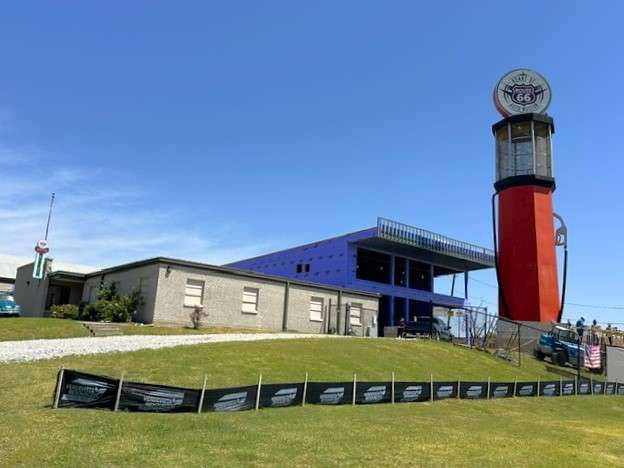
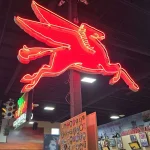
This month, Russell’s Route 66 Museum was sold off without reserve, its neon and petroliana priced one object at a time. In January, Kruse will do the same to the entire Tucson Auto Museum. Against that backdrop, a small nonprofit in Sapulpa, Oklahoma, is moving in the opposite direction. On Dec. 1, the Heart of Route 66 Auto Museum opens a nearly $1.6 million addition: a 5,000-square-foot showroom and event space, plus a new plaza wrapped around the 66-foot replica gas pump that has made the old armory on Sahoma Lake Road one of the most photographed stops on the Oklahoma stretch of the Mother Road.
The square footage is not the story. The model is. The Heart of Route 66 was never built around one founder’s collection. Its cars are almost entirely on loan from private owners, and they rotate on schedules arranged with each owner. Serious collectors tend to overlook museums like this. They shouldn’t. In a year when privately owned car museums are being emptied at auction, the museum that owns almost nothing is the one adding a wing.
What the Route 66 Auto Museum opens on Dec. 1
The new showroom is the Jon Stuart Garage, sponsored in part by the Stuart Family Foundation in honor of Jon R. Stuart, a Tulsa philanthropist and longtime museum supporter who died last year. It will be used for rotating exhibits, with room for roughly 20 cars, and it doubles as rentable event space with a catering kitchen and an events coordinator. Outside, the new Robert E. Parker Plaza surrounds the gas pump, paid for by donations made in honor of the Tulsa real estate attorney. The original gallery, the armory’s old Drill Room, now carries the name of Ronnie Watson, after former Tulsa Mayor Kathy Taylor bought the naming rights in his honor.
The financing is just as telling. Oklahoma’s Route 66 Revitalization Grant Program provided $1,080,000. The museum raised the remaining $500,000 itself. When the project was first floated in 2022, the plan called for about 7,400 square feet; what was built is smaller but finished in time to close out the highway’s centennial year, which is also the museum’s tenth. Read the list of names on the building and you are reading a ledger of local relationships. The money, like the cars, comes from people within driving distance who decided the place was worth backing.
Why “Fifties and Fins” is the right opening act
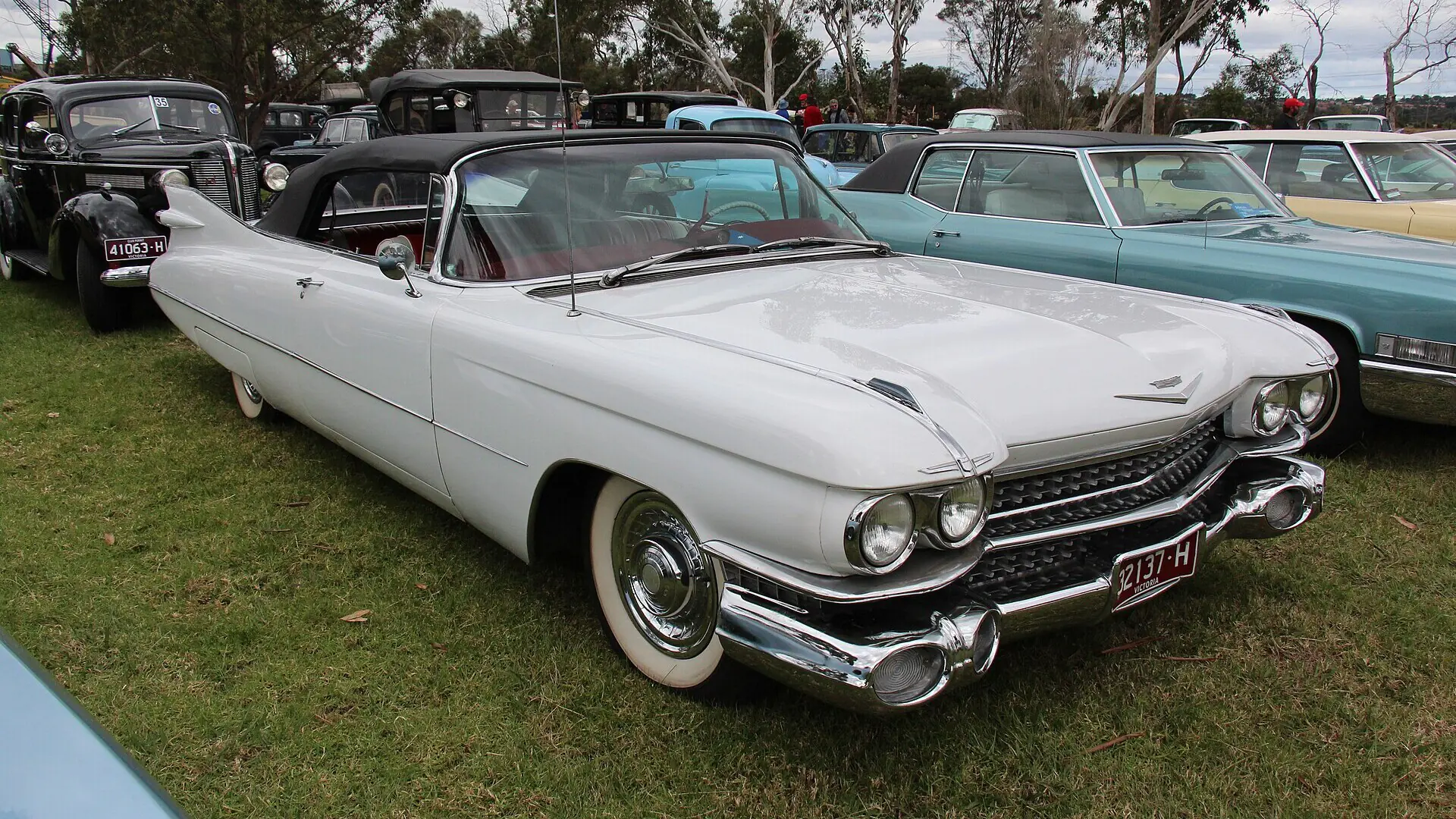
The garage opens with “Fifties and Fins,” an exhibit built around the chrome and tailfins of 1950s American design. The museum has identified a 1959 Cadillac as part of the display but has not yet published the full lineup. The Cadillac is the logical anchor. Its fins were the tallest Detroit ever put into series production, the last flourish of the jet-age styling that Harley Earl drove at General Motors before his retirement in 1958. Within a few model years, the fins were being trimmed back. The ’59 is not merely a finned car. It is the moment the idea peaked.
There is a quieter irony in the theme, and it is the most interesting thing about the exhibit. The finned car and the Interstate Highway System arrived together. The Federal-Aid Highway Act of 1956 funded the four-lane network that would eventually bypass Route 66 town by town. The cars that best embody the road’s mythology come from the same decade that began its decline. Collectors rarely pay for sheet metal alone; they pay for what a car stands for. A ’59 Cadillac parked a few hundred feet from Route 66 stands for the American road at the last moment before the interstates changed it.
The audience matters too. The museum’s executive director, Lina Holmes, has described a sharp rise in centennial-year attendance, with tour groups arriving from China, Russia and across Europe. The museum says it has now welcomed visitors from every U.S. state and more than 100 countries. For owners of finned 1950s cars, whose long-term values depend on attracting buyers who never saw these cars new, that is not a trivial point. A rotating exhibit in front of a young, international road-trip crowd is one of the few places these cars still meet people for the first time.
The loan model, and what it asks of owners
The Heart of Route 66 Auto Museum began as the idea of Tulsa attorney and enthusiast Richard Holmes, who formed an advisory board in 2012 and, after years of searching for a Tulsa site, accepted a decommissioned armory in Sapulpa. It opened in August 2016 in roughly 10,000 square feet, with three large garage doors cut into the building so cars could come and go. That detail explains the whole institution. It was designed from the start to borrow.
The range of what owners have lent is the best evidence that it works. Past displays have included a 1939 Cadillac V-16 convertible coupe, a 1938 Lincoln-Zephyr convertible, a 2000 Spyker C8 Spyder, a Singer-reimagined 1989 Porsche 911, a Chip Foose-built 1965 Chevrolet Impala and an unrestored 1960 Corvette. That is not a roadside attraction filling its floor with whatever arrives. It is a building owners trust with cars that matter.
Compare that with the private museum built around one collection. Its strength is curatorial vision; its weakness is that the collection has a single owner, and when that owner’s circumstances change, everything is for sale at once. We have argued that institutions reveal their priorities when they trade one showpiece for another, and that even a manufacturer’s own archive is defined by what it chooses to keep. A loan-based auto museum has nothing to liquidate. Its risk is different: it depends entirely on owners continuing to say yes.
For a collector weighing a loan, here or anywhere, the practical questions are the ones that protect the car. Get a written loan agreement. Settle whose insurance covers the car on site and at what agreed value. Specify who may start, move or drive it, how long it stays, how it is credited on signage, and what happens if you need it back early. Keep copies of the agreement and any exhibit materials. A documented public exhibition becomes part of a car’s history file, and well-kept history files are worth money when the car eventually changes hands.
The tax picture is often misunderstood. Lending a car to a museum produces no charitable deduction. Donating one to a 501(c)(3) such as this museum can, but how the charity uses the car determines what you may deduct; a donated vehicle that is sold or raffled, as the museum says some donated cars are after volunteer restoration, generally limits the donor to the sale proceeds. Anyone considering a significant gift should involve a tax adviser and a qualified appraiser before the title is signed.
The verdict on a Route 66 auto museum built on trust
Is this a significant collector-car event? Not if you measure significance by a single car’s value. Nothing in Sapulpa will move a price guide. But it is a meaningful signal about which kinds of car museums last. A museum that owns its cars lasts as long as its founder’s estate. A museum that borrows them lasts as long as its community’s trust. In Sapulpa, that trust just paid for 5,000 square feet.
The Heart of Route 66 Auto Museum is at 13 Sahoma Lake Road in Sapulpa, just off Route 66 west of downtown and about 15 miles from Tulsa. Admission is $9.50 for adults and free for children under 12. Centennial-year hours have been 10 a.m. to 4 p.m. Monday through Saturday and noon to 4 p.m. Sunday; check the museum’s website before traveling, as winter hours may differ. The museum’s Model T Experience, which teaches visitors to drive a restored Model T on a stretch of the old highway, resumes in June.
Sources: the museum’s website; museum announcement as reported by Public Radio Tulsa, News On 6 and KTUL; visitor figures via News On 6; The Journal Record.
The collector car market, every weekday morning.
Auction results, price moves and what’s crossing the block, read in four minutes. Free, from Modern Car Collector.
No spam, unsubscribe in one click. Or read more about the Brief.
 Shawn Henry
 Eve Nowell