

The cars left first. By July, the free museum at Exit 369 on Interstate 40, just inside New Mexico at the Texas line, had been emptied of its vehicles, leaving a dozen or so pedal cars and a marquee that still read “Free Car Museum.” What followed in October was the more revealing part: Assiter Auctioneers of Canyon, Texas, began selling the rest of Russell’s Truck & Travel Center museum with no reserves, and the bidding told a clearer story about collector priorities than any single car could.
The thesis is simple. When a private museum is dismantled, the market stops paying for the idea of the collection and starts pricing each object on its own merits. At Russell’s, the objects that carried the most conviction were not the ones most people would have named in advance. They were the glowing, branded, period-correct pieces of roadside furniture that gave the building its atmosphere.
What the first sale actually measured
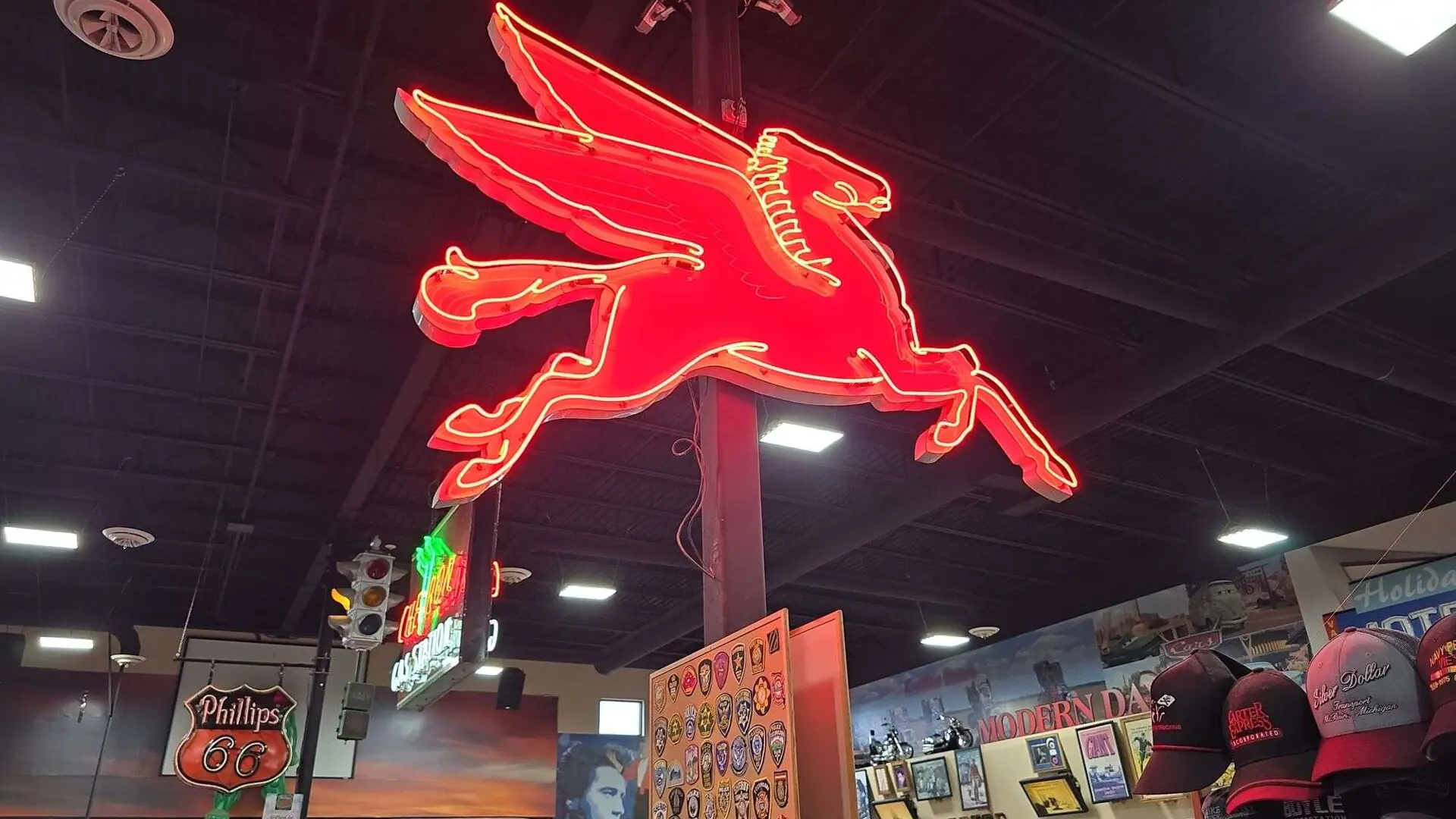
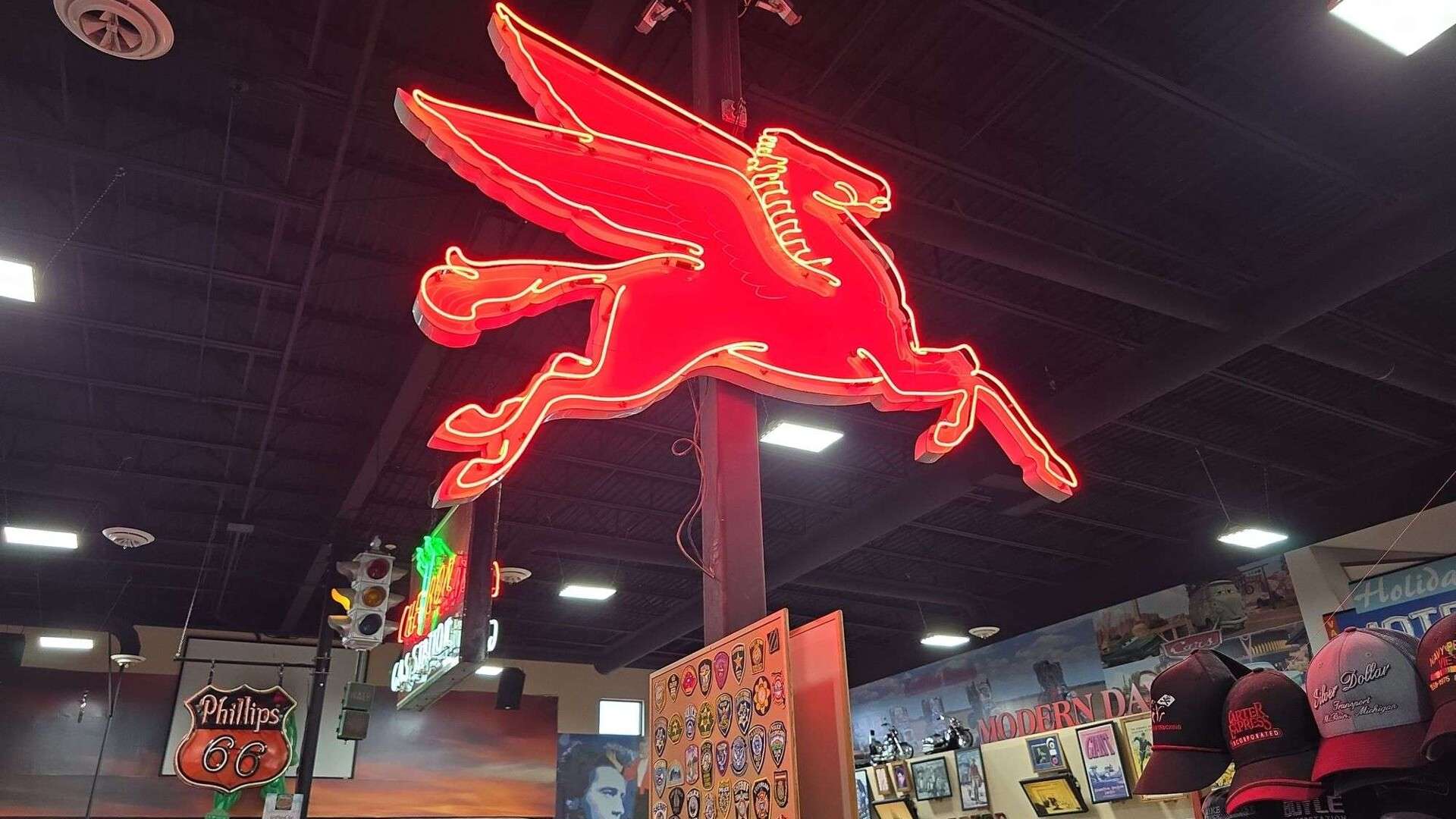
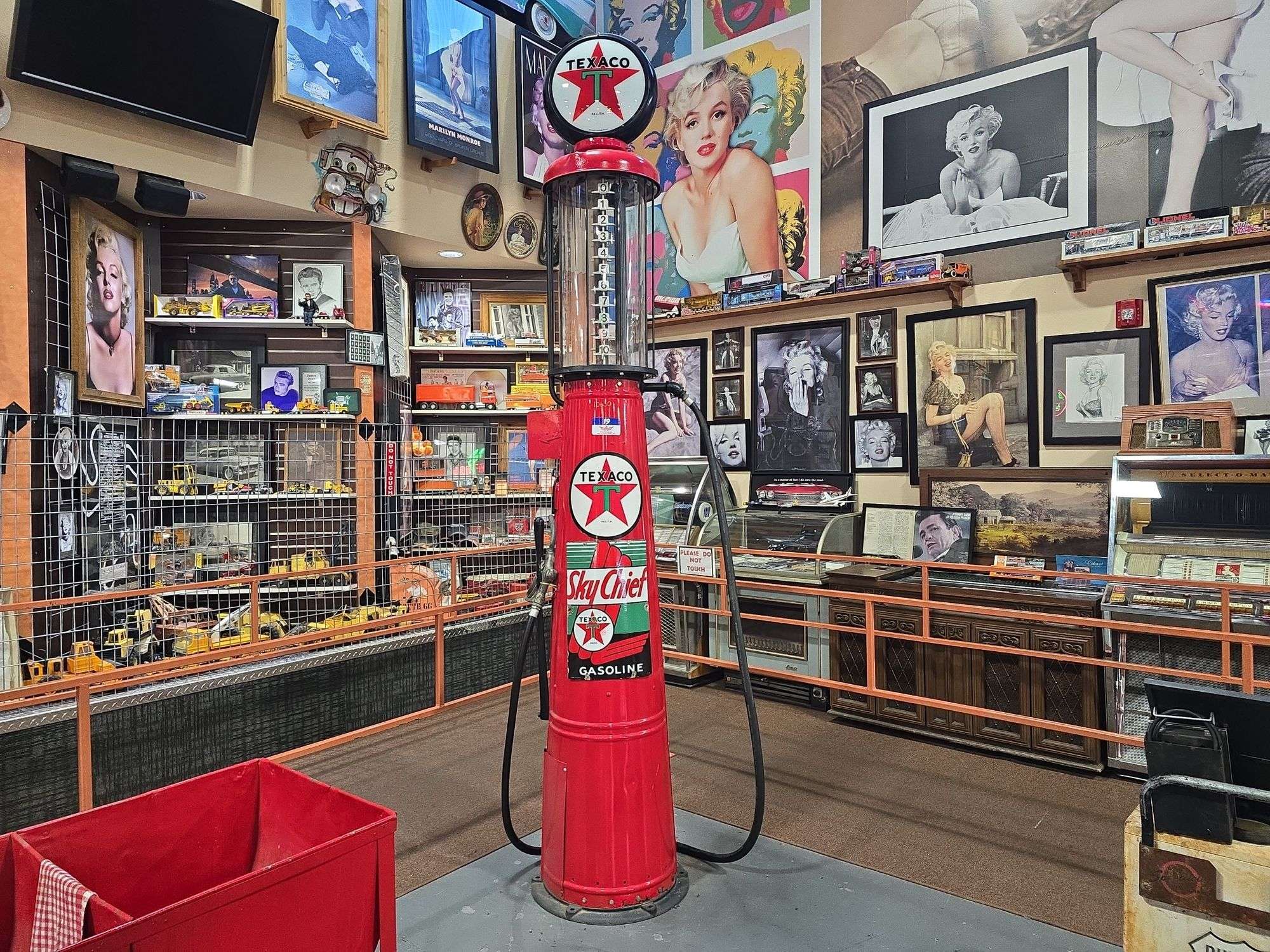
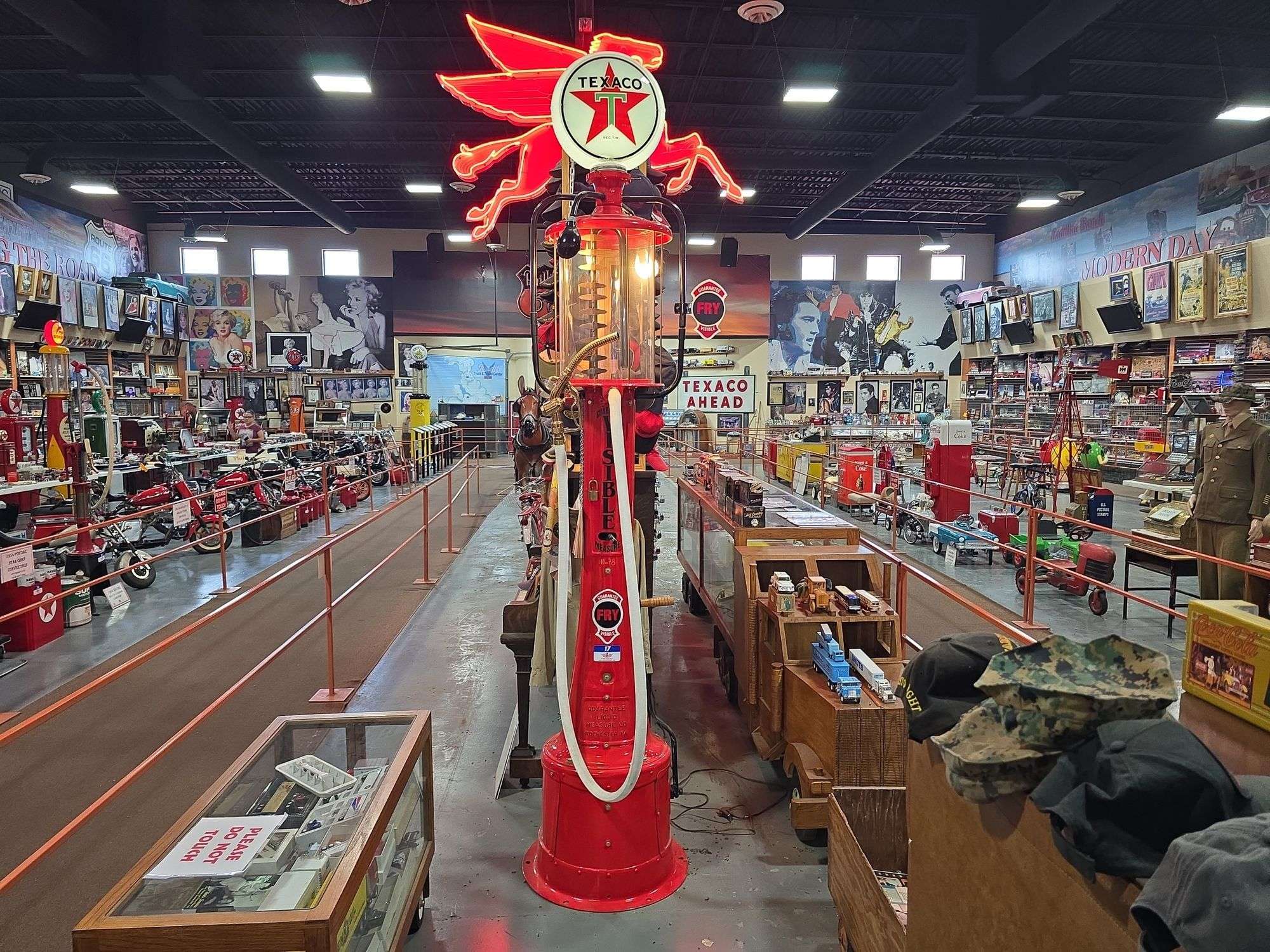
Assiter’s first online sale closed at 10 a.m. on October 10 and combined collector cars, pickups, motorcycles, Cushman scooters, a 1925 Ford fuel truck, a 1903 mule-drawn tanker wagon, gas pumps, neon, and porcelain signs. The auction house’s lot pages show where the competition concentrated. The 1940 double-sided Texaco sign, at $5,000, drew 181 bids, the most of any lot we reviewed. A reproduction Wayne Model 615 Gulf visible pump drew 171 and reached $7,600. A Gilbert & Barker Texaco Sky Chief visible pump took $11,500 on 145 bids, and the animated Mobil Pegasus neon, a full eight feet of porcelain enamel and glass tubing, closed at $13,250 after 90.
Those are listed final bids; Assiter’s pages do not state the buyer’s premium, so treat them as the floor of what buyers paid. The Chevron double-sided neon sign, catalogued as 1946-47, finished at $13,750, the highest figure among the signs and pumps, and the Phillips 66 neon from Federal Electric reached $11,250.
The detail worth noticing: a reproduction out-earned an original
Two lots share a model number. Lot 18 was an antique Wayne Model 615 in Gilmore Red Lion livery; it sold for $3,950. Lot 22 was a reproduction Model 615 in Gulf livery; it sold for $7,600. Nothing in the catalog data we reviewed describes condition, so it would be a mistake to read too much into a single pair. Still, the gap points to something petroliana buyers have long understood. Brand recognition, finish quality, and display impact often outweigh strict originality, especially for buyers furnishing a garage or showroom rather than assembling a documented archive. That is the opposite of how the same people would behave over a Ferrari or a Duesenberg, and it is a useful reminder that “original” is not a universal price driver. It matters most where a market has decided it does.
One more pattern deserves a mention. A single registered New Mexico bidder, identified only by number in Assiter’s results, took six of the sale’s top lots: the Phillips 66, Mobil Pegasus, and Chevron neon signs, the 1940 Texaco sign, the 1923-24 Fry “Mae West” Texaco visible pump at $7,500, and the Gulf reproduction. Together those lots account for $58,350 in listed bids. We do not know who that buyer is, and it would be speculation to say. What the data does show is that serious demand in this category can be concentrated in very few hands, and that a no-reserve sale gives a determined buyer a rare chance to clear a shelf in one morning.
A collection, a clause, and a calendar
The museum was the work of Emory Russell, a former truck driver who restored many of his trucks and cars and, with his wife, Barbara, opened the free museum in July 2010 beside the family’s truck stop. The site sits over the ruins of the old Longhorn II restaurant on a 1952-1980 alignment of Route 66. Barbara Russell has said her husband owns more than 200 trucks, which suggests that what visitors saw was an edit, not the whole. Admission was always free; a donation box raised more than $520,000 over roughly 15 years for food banks in Amarillo and Tucumcari.
In 2023 the Russells, both in their 80s, sold the travel center to TravelCenters of America so the family could retire. As part of that deal, TA agreed to keep the Russell’s name and keep the museum running for three years. The vehicles were gone by July, the Russell’s sign had been replaced by a TA logo, and the auction closed in October, almost exactly at the end of that window. The reporting to date includes no statement from TA about the future of the space. Collectors should notice the structure more than the outcome: a three-year commitment attached to a corporate acquisition gave a family-built museum a defined shelf life from the day it was signed.
Why it matters to collectors
Private museums are rarely endowed. Many depend on a founder’s energy and a landlord’s patience, and when either changes, the collection returns to the market. That pattern has been playing out at every scale, from the Harrah Collection to the Eendenmuseum’s 300 Citroën 2CVs. It also explains why a car that spent decades on public display, like the numbers-matching 1967 Pontiac GTO that spent 35 years in a museum, can carry a distinct kind of provenance. And it is the logic behind the Thoroughbred Motorsports Collection, which cleared 99 no-reserve lots, where the builder’s documentation mattered as much as the metal.
Two more Assiter sales were listed as coming soon after the October 20 sale of Coca-Cola machines, jukeboxes, pedal cars, and vending equipment: one built around NASCAR, Roy Rogers and Dale Evans material, toys, and military uniforms, the other around Route 66 items, movie posters, and Marilyn Monroe, Elvis Presley, and James Dean memorabilia. Those categories tilt toward entertainment and Americana rather than automotive history, and they will show how far the Russell’s name carries once the gasoline signs are gone. For buyers, the lesson from the first sale is practical. Illumination, livery, and recognizable branding pulled the deepest bidding, while condition and originality questions were priced in more quietly.
A collection holds together only as long as someone insists on it. When that stops, every object has to answer a plain question: what are you worth on your own? At Russell’s, the neon answered loudest.
The collector car market, every weekday morning.
Auction results, price moves and what’s crossing the block, read in four minutes. Free, from Modern Car Collector.
No spam, unsubscribe in one click. Or read more about the Brief.
 John Lloyd