

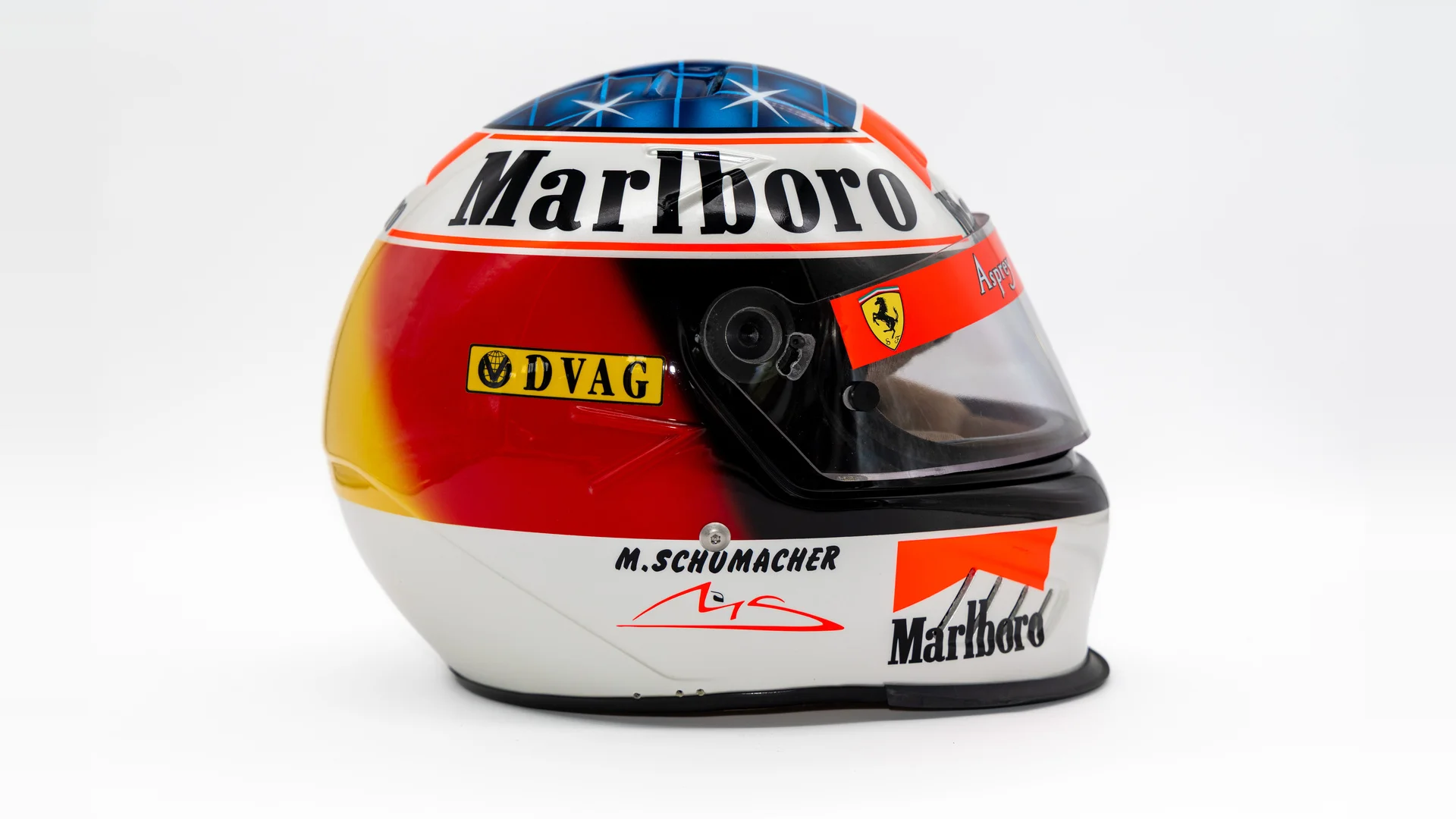
Nigel Mansell’s helmet from the 1994 Australian Grand Prix has an estimate of €60,000 to €70,000. A signed replica of Ayrton Senna’s 1988 McLaren helmet is estimated at €8,000 to €10,000. The gap between those two numbers has little to do with fame. It has to do with what each piece can prove.
That is the real subject of Broad Arrow’s Global Icons: Memorabilia Online sale, the last online auction of the house’s season. Its 207 memorabilia lots begin closing at 19:00 CET on November 22, with 98 artwork lots following the next day. The helmets lead the catalogue, and they form a useful lesson in how motorsport relics are valued: the name gets a helmet into the catalogue, but the paper decides whether it belongs there.
Why a Helmet Is the Hardest Relic to Trust
No piece of a driver’s kit is more personal, and none is easier to reproduce. A livery can be repainted, a replica can be signed, and a driver could use several helmets in near-identical colors across a season. That is why the strongest lots in this sale are the ones that arrive with documents rather than adjectives.
The Mansell helmet (Lot 148) is an Arai GP-3 painted by Mike Fairholme Designs and numbered F1 94 2. It carries the aerodynamic “ear” trims and original radio equipment from his final Grand Prix victory, his 31st, at Adelaide in 1994. Broad Arrow states that it comes with a Certificate of Authenticity from Fairholme and a copy of a letter from Mansell confirming it was used at that win. Two independent voices, the painter and the driver, point at the same object. That is what turns a famous-name helmet into a documented one.
The market has been paying attention to this particular win. In 2023, RM Sotheby’s sold a 1994 Rothmans Williams Arai helmet from Mansell’s own Legacy Collection, described as worn at the Australian Grand Prix, for £42,000. It is a useful reference point rather than a direct comparison, since a driver can use more than one helmet in a season and the two lots are separate pieces with their own documentation. It does show that buyers will pay real money for the Adelaide story when the source is the driver himself.
The Hill Helmet and the Value of a Chain of Custody
Graham Hill’s 1974 Embassy Racing helmet (Lot 127, estimate €40,000 to €60,000) offers a different kind of proof. It is a Griffin helmet, from the British maker founded by former racing driver Terry Ogilvie-Hardy, and its history reads like a ledger: displayed at the Guinness World Records Centre in Piccadilly in 1985, bought at the Guinness clearance auction in 1995, then sold by Sotheby’s in 1997 and Bonhams in 2007, according to the lot description.
Hill is the only driver to complete motorsport’s Triple Crown of the Formula 1 title, the Indianapolis 500 and Le Mans, and Broad Arrow calls the number of his helmets in circulation limited. The scarcity matters less than the continuity. Each earlier sale left a catalogue entry, a photograph, and a set of eyes that examined the object. For a buyer, a helmet that has already been scrutinized by two major houses carries a different kind of confidence than one that appears with a letter alone.
Original Versus Replica: Where the Estimates Get Interesting
The catalogue also mixes originals with official replicas and signed replicas, and the estimates blur the line more than purists might expect. Michael Schumacher’s signed 1998 Japanese Grand Prix replica Ferrari helmet (Lot 107) carries an estimate of €10,000 to €12,000, the same range as Esteban Ocon’s original 2021 Brazilian Grand Prix Alpine helmet (Lot 232). His 1996 signed promotional Ferrari helmet (Lot 123) is estimated lower still, at €6,000 to €8,000, so even within one driver and one team the house is pricing the type of object and its story, not the signature alone. Lando Norris’s original 2020 McLaren race helmet (Lot 115, €35,000 to €40,000) is a Bell painted by Jens Munser Designs and numbered LN-R-15/20, which marks it as a 2020 season race helmet, with a certificate signed by Jens Munser. The numbering gives a modern piece an unusually clear identification system, and the estimate sits well above the other contemporary originals in the sale.
The Senna replica (Lot 136) has its own paper: it was a competition prize, with a letter from News International confirming that. It also sits in the shadow of January’s sale in this series, where Broad Arrow reported that a replica of Senna’s 1988 McLaren helmet realized €55,625, well above what replica estimates typically suggest. That result shows how far a single name can stretch a category, and it is a reminder to read each lot’s paper before reading its estimate.
What the Early Bids Do and Do Not Say
Every helmet noted here is offered without reserve, and as of Monday morning the bidding sat far below the estimates: €4,500 on both the Mansell and Hill lots, €6,000 on Norris, and €20 on the Senna replica. Read that with care. In a timed sale, early bids on no-reserve lots are placeholders. Serious buyers commonly wait for the final days, and the closing window runs through November 22. The estimates are a statement of what the auction house believes the documentation can support, and the result will show whether the room agrees.
What It Means for Collectors
Motorsport memorabilia is a smaller and less liquid market than the cars it sits beside, and it rewards the same habits that serve car collectors well. Treat provenance as the asset. Ask who documented the piece and when, whether the documentation comes from the driver, the team, or the painter, and whether anything independent confirms it. The logic is familiar from the car market, and we have followed it in Broad Arrow’s recent Las Vegas results, including the $18.7 million F50 and the Daytona SP3: condition and documentation matter as much as the badge. It applies equally to celebrity and racing ephemera, from the Billy Joel motorcycle collection to a driver’s own tribute car such as the Gunther Werks Brundle Edition. For wider context on the house’s parent company, see our look at Hagerty’s third-quarter auction numbers.
A helmet is the most personal piece of a driver’s kit, which is also what makes it the easiest to imitate. The lots that will hold their value are the ones where the person who wore it, or the person who painted it, put their name to the claim.
The collector car market, every weekday morning.
Auction results, price moves and what’s crossing the block, read in four minutes. Free, from Modern Car Collector.
No spam, unsubscribe in one click. Or read more about the Brief.
 John Lloyd
 Kyle Matthews