

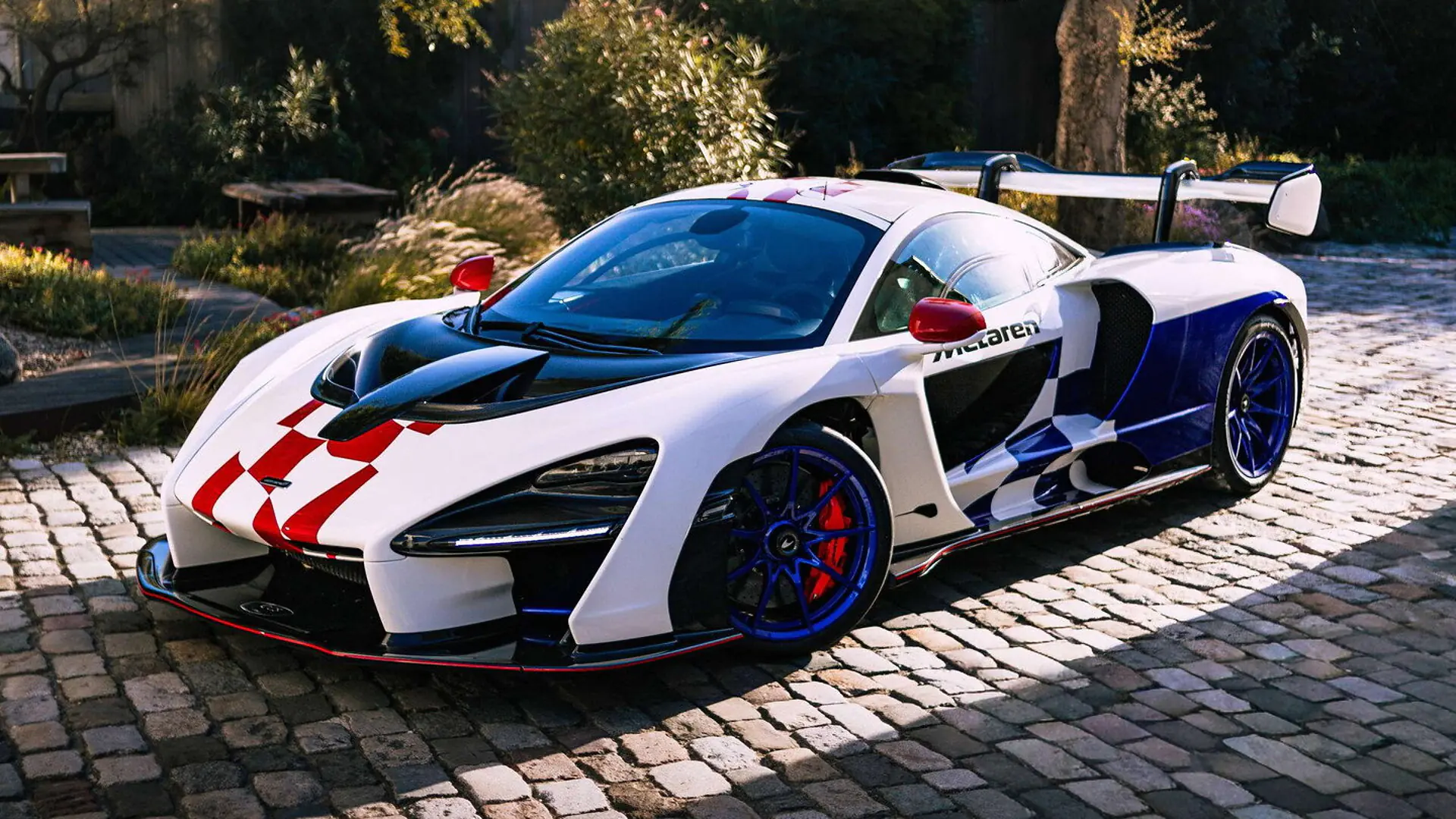
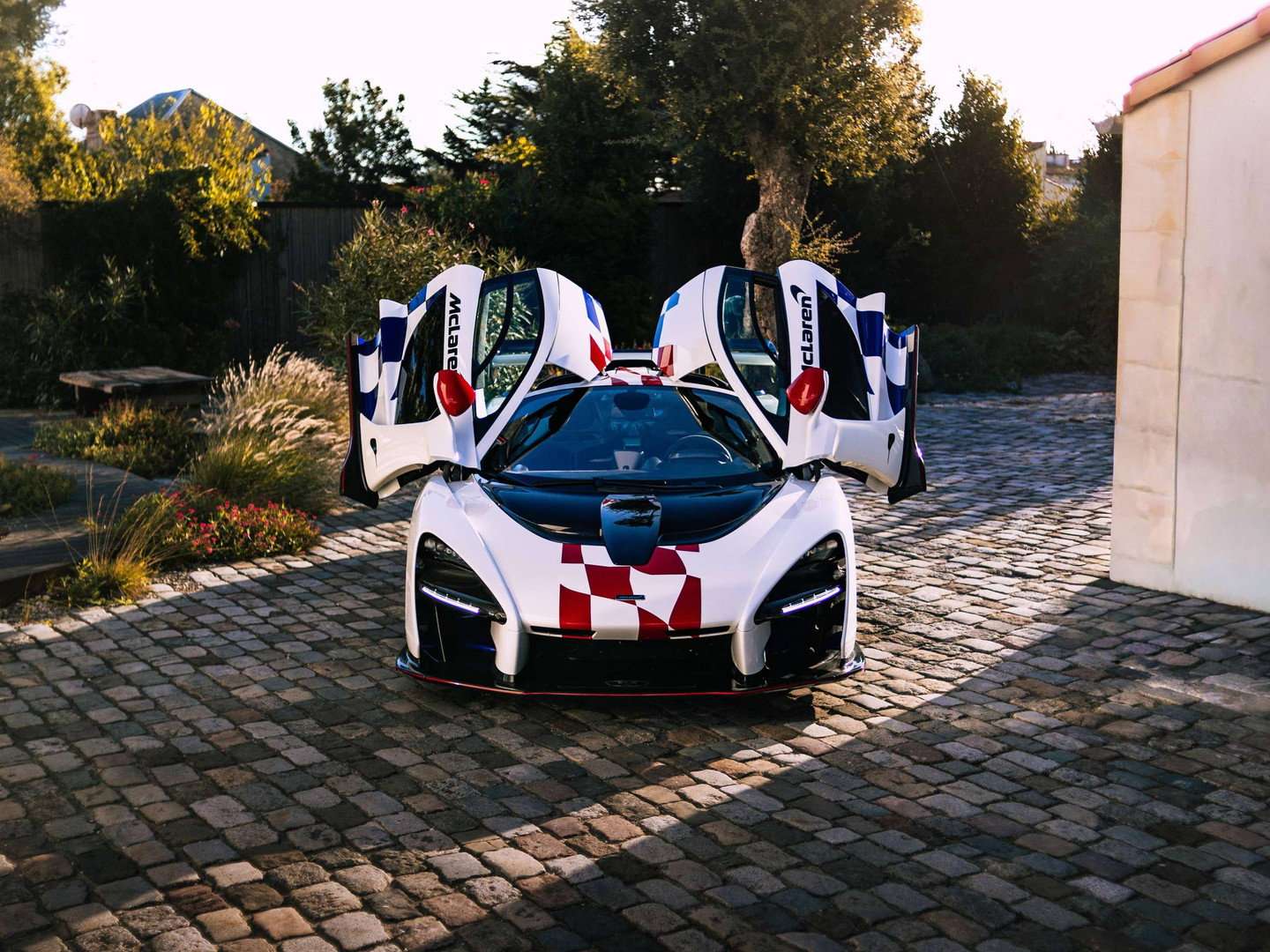
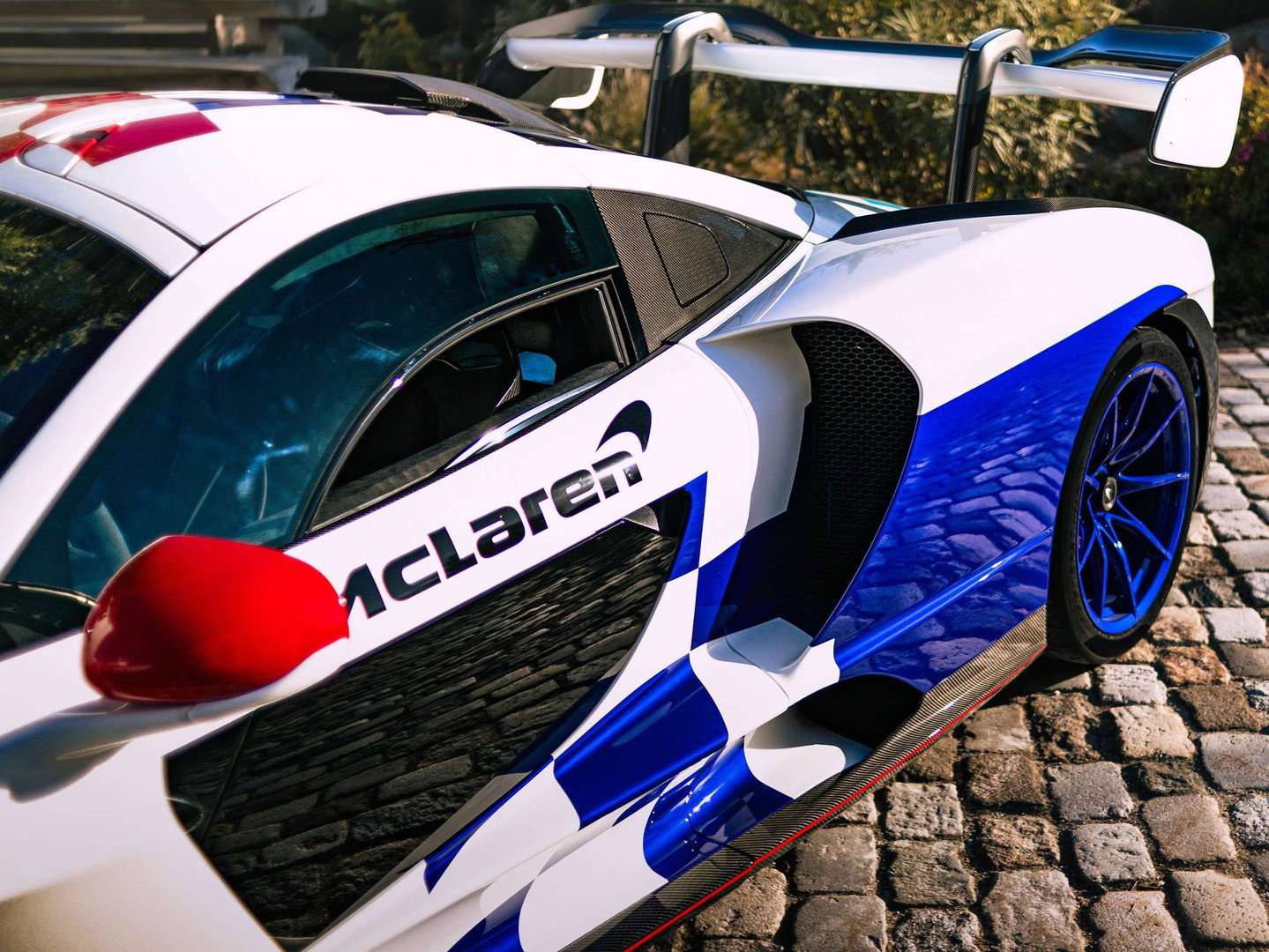
McLaren built 500 Sennas, and the arrival of another one on the market is no longer news. Chassis 027 is different, though the reason has little to do with arithmetic. According to its seller, Car Collection Sales of Sambreville, Belgium, which is offering the car at €1,520,000, it is one of three Sennas that McLaren Special Operations finished in the blue, white and red of Fina, the Belgian oil company whose colors ran on BMW-backed McLaren F1 GTRs in the mid-1990s.
Most of the attention will go to the number three. That misses the point. Scarcity is cheap in the modern hypercar business, because every manufacturer has learned how to produce it. What makes the Fina Senna interesting is which part of McLaren’s history it chooses to remember. It is a part McLaren left out of its own official tributes. And it raises the question every buyer at this level has to answer before wiring money: can the rarity actually be proven?
The Livery McLaren Didn’t Choose
When McLaren celebrated its Le Mans heritage on the Senna, it went straight to 1995. Each of the five Senna GTR LMs carries a scheme taken from one of the five F1 GTRs that ran in that year’s race, when an F1 GTR won outright on its first appearance with Yannick Dalmas, JJ Lehto and Masanori Sekiya driving. Every McLaren owner knows that story. It is the founding myth of the company’s road-car era, and it is the history Lanzante’s 95-59 is built to honour.
The Fina colours come from a messier chapter, and in some ways a more revealing one. Fina was a long-time BMW sponsor. When BMW backed Team Bigazzi’s F1 GTRs in 1996, those cars carried Fina money. For 1997 BMW Motorsport went further and entered the new longtail F1 GTRs under its own name, with Schnitzer running the programme in the FIA GT Championship. That was the closest the F1 GTR ever came to being a full works racing car. The works team, though, was BMW, not McLaren.
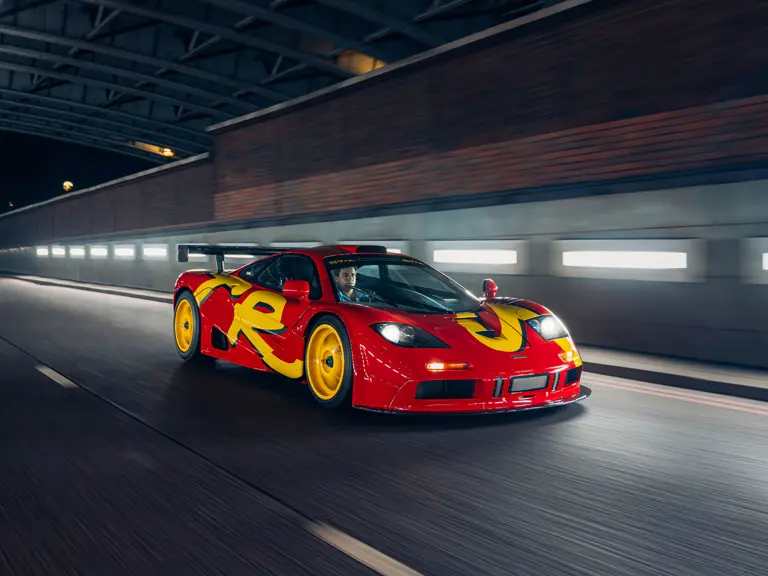
The two BMW Motorsport cars had very different races at Le Mans in June 1997. BMW’s own record shows Peter Kox, Roberto Ravaglia and Éric Hélary finishing third overall, behind the Gulf Team Davidoff longtail. The sister car of Lehto, Steve Soper and Nelson Piquet lost ground to a defect and later retired after sliding off the track. Across the season Lehto and Soper won at Hockenheim, Helsinki and Spa, but the championship went to Mercedes-Benz and its CLK-GTR.
That defeat is what gives 1997 its importance. It was the year GT1 homologation changed direction. Before it, the specials were road cars adapted for racing. After it, they were race cars sold for the road almost as an afterthought. The F1 GTR longtail was the last great racing car developed from a true road car, and the Fina-liveried BMW entries were its most serious factory effort. A Senna in those colours points to the end of that era, not the start of one.
An Edition Is the Factory’s Story. A Commission Is the Collector’s
A factory special edition tells you what a manufacturer wants remembered. A client commission tells you what one collector wanted remembered. The GTR LM set is McLaren’s official version: five cars, one race, one victory. The Fina Senna is a footnote picked by someone who plainly knew the longtail years and the BMW connection, and who was prepared to pay MSO to put that knowledge on the bodywork.
That difference will matter more in twenty years than it does today. People coming to the Senna in 2045 won’t have watched the 1997 FIA GT season. The cars that stay in the conversation will be the ones whose story fits in a sentence, and “the Senna in the colours of BMW’s works McLaren” fits. It also explains why a racing-livery tribute can earn a real premium when bespoke paint usually can’t. A one-off colour is merely scarce. A livery tied to a specific racing car is scarce and easy to explain. Collectors rarely pay for exclusivity alone. They pay for a story they can hand on to the next buyer.
It is the same reason the market has learned to read MSO-modified cars such as the P1 HDK differently from the standard production run. With modern McLarens, the significant cars are increasingly the ones Woking was asked to make different.
The Car Beneath the Colours
The livery would be a costume if the car under it were ordinary, and the Senna is anything but. Revealed in December 2017 as the new top of McLaren’s Ultimate Series and named for Ayrton Senna, it was limited to 500 examples at £750,000 each. Every one was spoken for before the public saw the car. The 500th was auctioned that December for the Instituto Ayrton Senna and raised roughly £2 million.
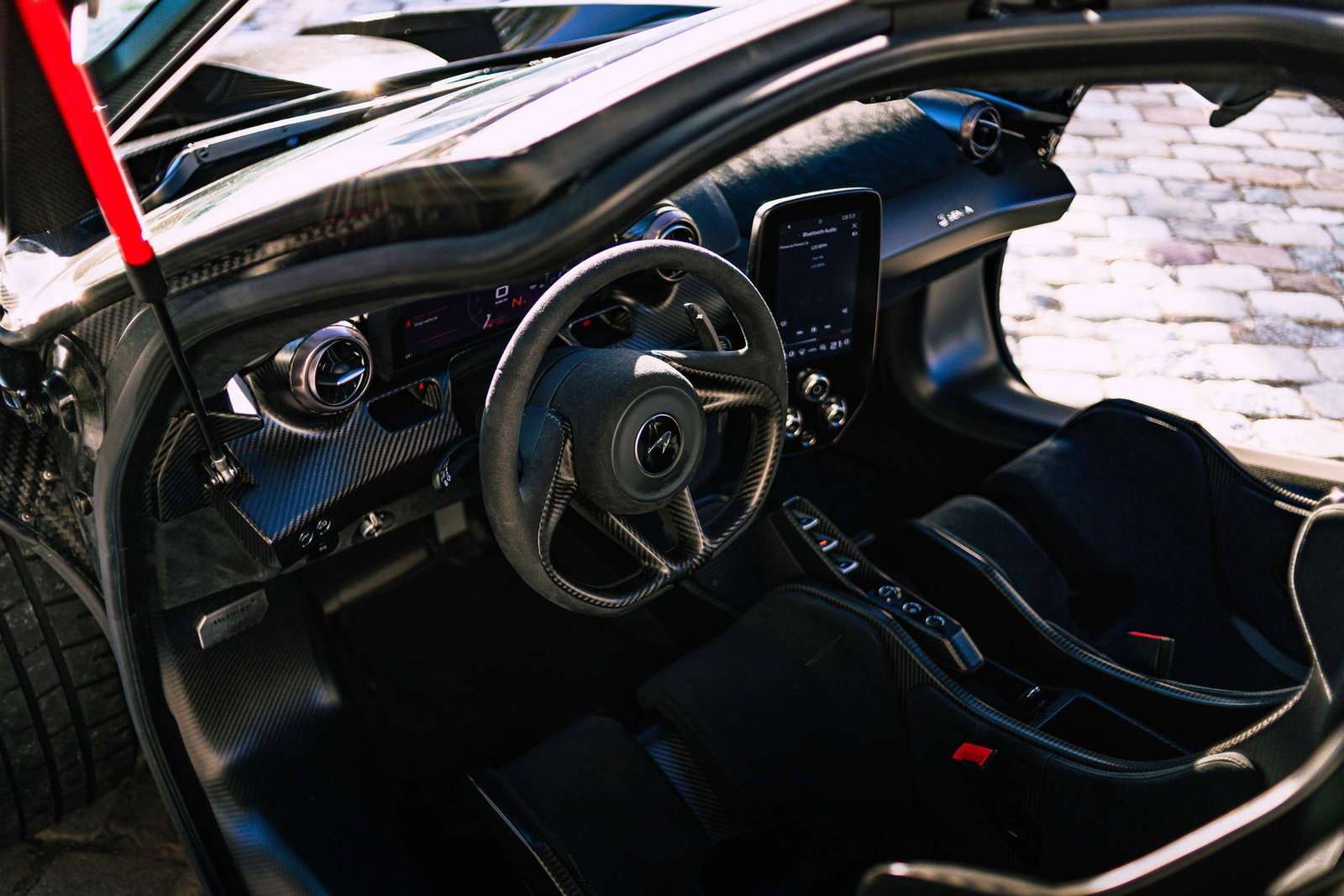
McLaren made no attempt to soften it. The 4.0-litre twin-turbo M840TR V8 makes 800 PS (789 bhp) and 800 Nm. The MonoCage III carbon tub helps keep McLaren’s claimed dry weight to 1,198 kg. The aerodynamics are active, and the car’s priorities run from lap time first to comfort a long way after. It was developed alongside the 75-car, track-only Senna GTR. From that came the five road-legal GTR LMs and the 35-car MSO Senna LM, so the Senna family already has its own rarity ladder. (We looked at how McLaren spells out rarity for the 788HS in the same way.)
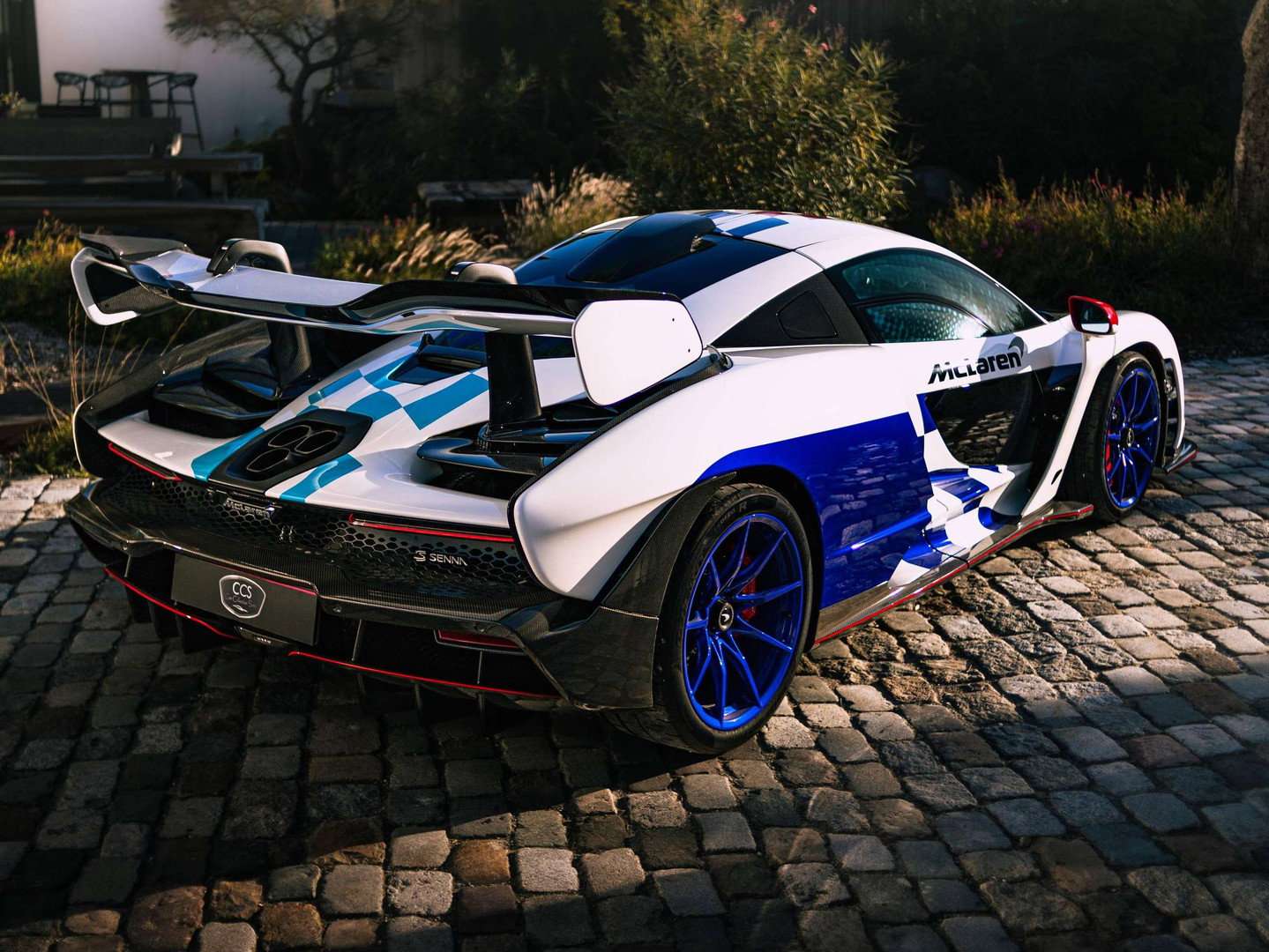
A racing livery arguably sits more comfortably on a road-registered Senna than on a GTR. A track car in historic colours can look like dressing up. A road car in those colours, driven to an event, looks like a statement. Chassis 027 is the second kind.
What the Seller Says, and What a Buyer Should Verify
According to the dealer’s listing, chassis 027, first registered in March 2019, has covered 4,800 km, has been serviced throughout by McLaren in Lugano and Monaco, and has never been repainted or crashed. Its options include the front-axle lift that makes a Senna usable on real roads, Bowers & Wilkins audio, track telemetry and ultra-lightweight wheels. Its sill plaque reads “No. 027 of 500,” consistent with the number in the listing.
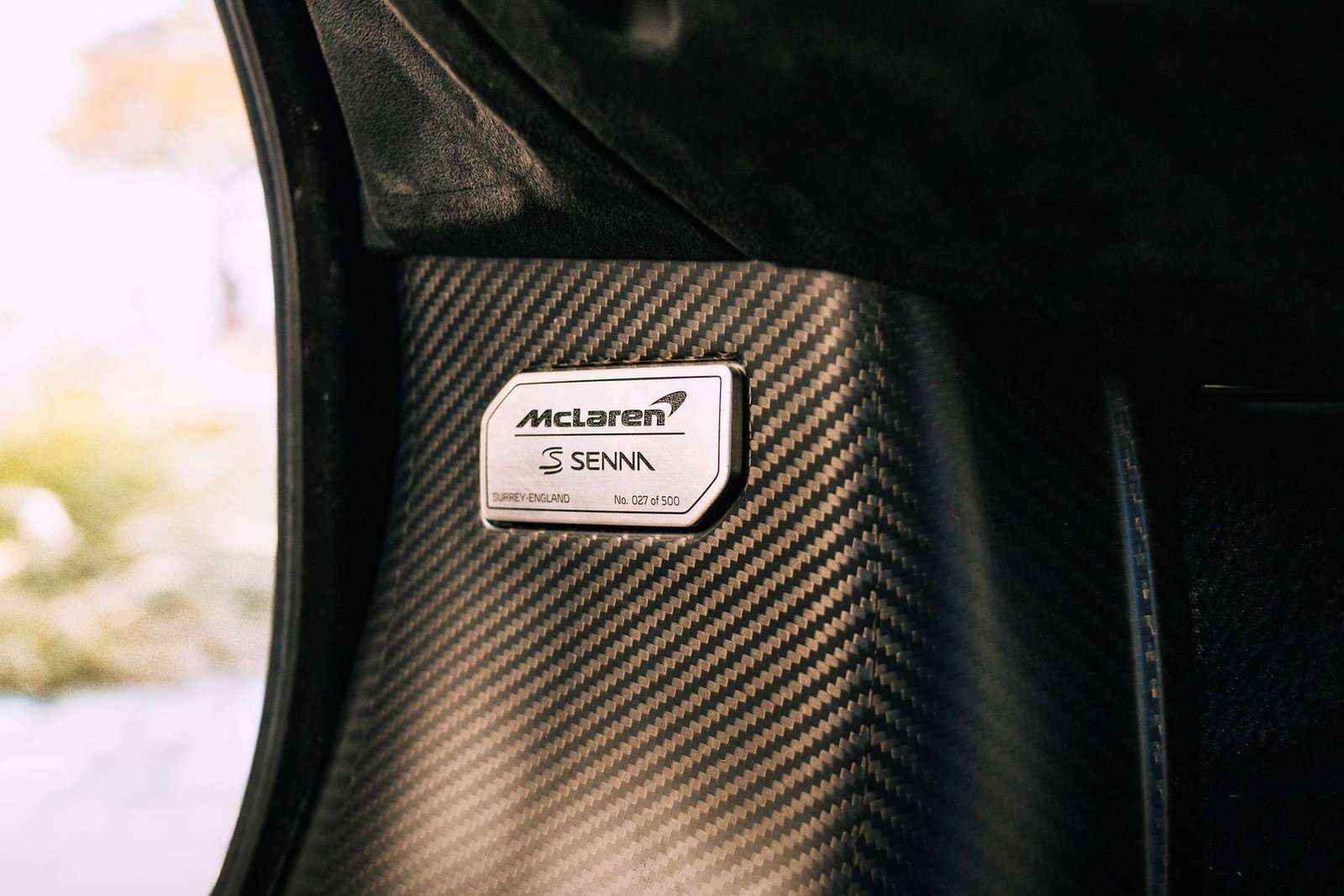
The mileage is about right. A car with 4,800 km has been used the way McLaren meant and maintained by people who had to fix whatever that use revealed. A Senna with 300 km raises a different question: whether it was ever exercised enough for its seals, fluids and electronics to stay healthy. Unlike the zero-mile T.50 market, the Senna was never a car whose value depended on going unused.
Even so, a seven-figure premium for a livery calls for documents, not adjectives. A serious buyer should establish four things:
- The MSO paper trail. McLaren does not publish counts of MSO liveries, so “one of three” currently rests on the seller’s description. The build sheet and MSO commission file should show that Woking specified the livery from new, and McLaren should be asked, through an authorised retailer, to confirm how many Fina cars it built.
- What the livery is made of. On a car of this generation, a livery can be paint, film or both. “Never repainted” is the claim that matters most, and paint-depth readings plus any protection-film records should back it up. Factory livery in original paint is the asset. Anything replaced dilutes it.
- The service record from the source. Get the dealer records directly from McLaren Lugano and McLaren Monaco, not just copies supplied with the car.
- Customs and tax status. Switzerland is outside the EU customs territory, so a car with a Swiss history needs its current customs and VAT position confirmed before a price is agreed. At this level the difference is material. American buyers should also note that a European-specification Senna is not simple to import into the United States, and this one will not reach the 25-year exemption until the 2040s.
Is €1.52 Million the Right Number?
The asking price is close to double the Senna’s £750,000 list price. Strip the livery away and a buyer is paying Senna market value plus a premium for the commission. The question is whether that premium lasts. It does if the paperwork holds up and the story continues to read clearly. It doesn’t if the provenance is vague.
Liquidity is the other consideration. The specificity that makes the car desirable also narrows the market: the ideal buyer wants a Senna, knows what the 1997 BMW Motorsport longtails were, and cares enough to pay for the reference. That pool is small but committed. A car like this is unlikely to be sold in a hurry and is more likely to change hands privately, or at a marquee sale where McLaren specialists are in the room, as Monterey Car Week showed again this year.
What This Means for Collectors
The modern hypercar market is learning to tell rarity and significance apart. With 500 Sennas in circulation, the ones that matter most a generation from now will be the ones with something to say: the 500th car, the GTR LMs, and documented commissions like this one. The same instinct explains why collectors still separate one McLaren F1 from another by history rather than specification.
The Fina Senna is not the rarest Senna, and that isn’t its argument. It remembers the year McLaren’s road car became BMW’s race car and then met a new kind of opponent. That makes it more interesting than a fourth or fifth special edition. The F1 GTR earned its provenance at Le Mans. A Senna’s provenance is written at MSO in Woking. Check that paperwork before you look at the paint.
The collector car market, every weekday morning.
Auction results, price moves and what’s crossing the block, read in four minutes. Free, from Modern Car Collector.
No spam, unsubscribe in one click. Or read more about the Brief.




 Kyle Matthews
  Eve Nowell