

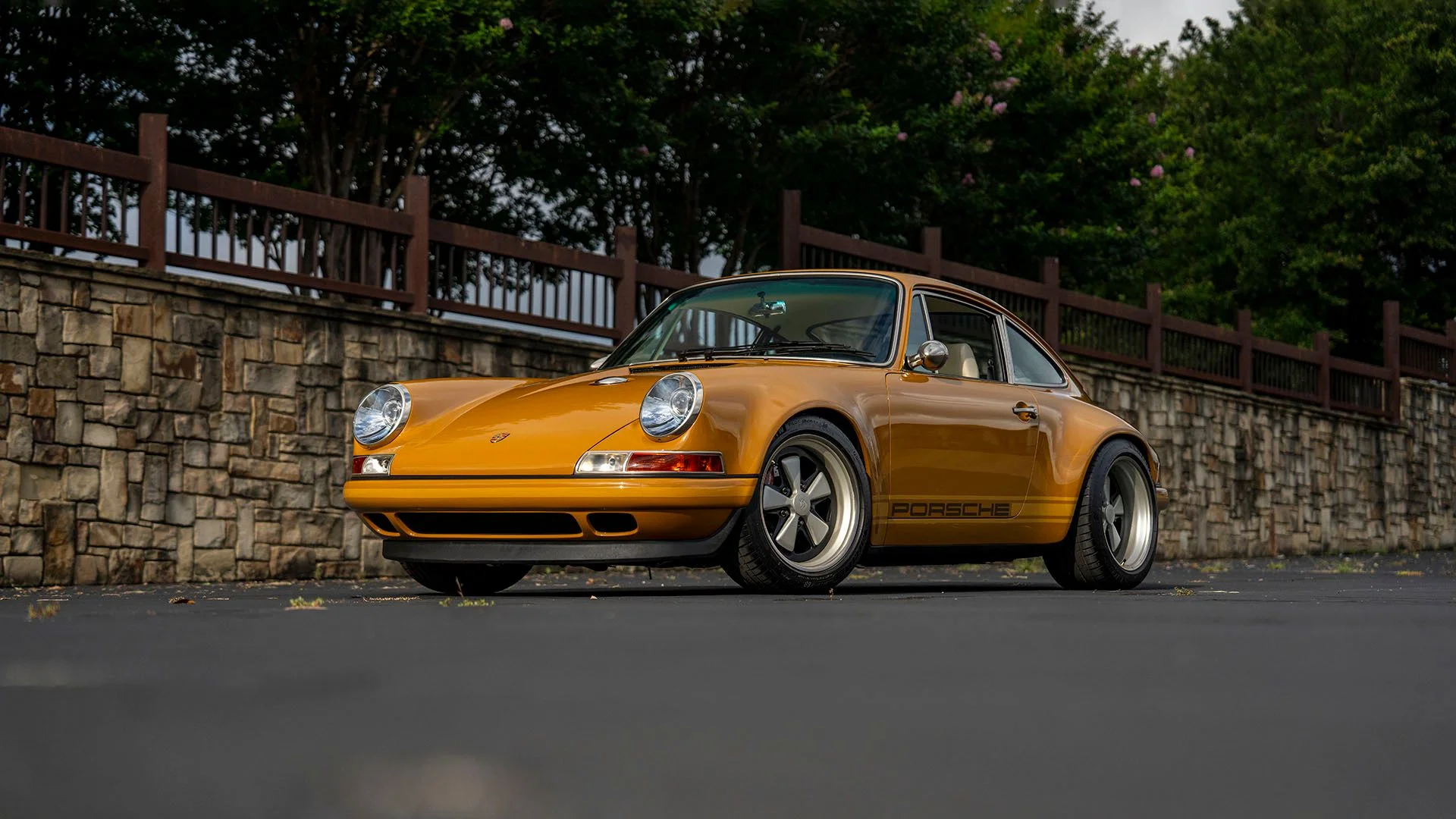
Two bespoke 964-generation Porsche 911s unveiled at Pebble Beach signal not just an extraordinary collaboration—but a fundamental shift in what collectors are actually buying.
The story everyone will tell is that Singer and Louis Vuitton built two extraordinary Porsche 911s. That’s true. The story worth telling is why it matters, and what it reveals about where the collector car market is quietly going.
Unveiled at Pebble Beach on August 12th, the pair—a 964-generation coupé and a Classic Turbo cabriolet, both reimagined through Singer’s meticulously obsessive lens—represent the first fully co-branded product in either company’s history. Not a Singer with an LV logo. Not a Louis Vuitton lifestyle piece that happens to involve a car. Something genuinely new: a unified object in which the car and the world that surrounds it were conceived as a single commission from the start.
That distinction matters enormously to anyone who thinks carefully about collector cars.
The Tambour Clock That Started Everything
The collaboration traces back to a single, specific request: a dashboard clock for a car already being reimagined by Singer, designed in the spirit of Louis Vuitton’s Tambour watch. What began as a bespoke detail—entirely within Singer’s established vocabulary of obsessive customization—expanded, as these things do when two organizations with aligned values begin to trust each other.
“This unique and remarkable adventure began with a request for a dashboard clock for a car reimagined by Singer,” explained Jean Arnault, Louis Vuitton Watch Director. The Tambour-inspired clock at the center of each build is detachable and convertible into a desk or travel timepiece—a piece of horology that travels with its owner the way the car does, moving from cockpit to hotel suite without losing context.
That detail—a clock that leaves the car and remains coherent—is the conceptual key to everything else.
Two Cars, Two Visions
The Porsche 911 Reimagined by Singer – Classic is built on a Type 964 coupé chassis, clothed in lightweight carbon fibre bodywork finished in saffron—a color present in Louis Vuitton’s archives for over 150 years—with cobalt blue accents and a speed-activated rear wing. A specially designed roof rack accommodates matched luggage built to the car’s exact proportions. Beneath the carbon skin: a 4.0-litre naturally aspirated air-cooled flat-six, six-speed manual gearbox, carbon-ceramic braking, and rear-wheel drive. Singer’s engineering brief is unchanged; only the world surrounding it has expanded.
The Porsche 911 Reimagined by Singer – Classic Turbo is Nicolas Ghesquière’s car. The Louis Vuitton artistic director—one of the most consequential figures in contemporary fashion—personally directed the Turbo cabriolet’s vision, finishing it in Calcaire Lutétien white with precious wood trim and a whale-tail rear wing. The 3.8-litre twin-turbocharged flat-six with air-to-water intercooling sits beneath bodywork that Ghesquière described as his “ideal car.” A parachute-silk driving suit, garment bag, matched luggage, and surfboard complete the picture. “Automotive design is a passion that has always lived within me,” he said.
That an artistic director of Ghesquière’s standing—someone whose runway decisions move billions in the fashion economy—personally shaped the design of a collector car is not a marketing footnote. It is the commission.
Why the 964 Remains the Right Canvas
The 964-generation Porsche 911, produced from 1989 to 1994, has become one of the most contested platforms in the air-cooled collector market. Prices for clean, original examples have more than tripled over the past decade. Singer’s reimaginations—which transform consigned 964s through thousands of hours of engineering and craft—represent the apex of what that generation can become, regularly commanding prices well north of half a million dollars and, in exceptional cases, considerably more.
Singer’s choice to work exclusively in air-cooled 911s was never arbitrary. The 964 possesses proportions that reward obsessive attention: wide enough to feel purposeful, light enough to feel alive, simple enough that every modification is visible and meaningful. Louis Vuitton’s involvement doesn’t change that engineering logic. It surrounds it with a different kind of seriousness.
What Louis Vuitton Actually Brought
This is not, it must be said, Louis Vuitton’s first engagement with the automobile. In 1897, the visionary Georges Vuitton was already designing trunks specifically for cars—before most people had ever seen one. In 1909, Pierre and Jean Vuitton, grandsons of the founder, designed flat-bottomed car trunks fitted to specific models. The relationship between the house and automotive travel is not a contemporary marketing idea. It is foundational.
What Louis Vuitton brought to these two Porsche 911s is the full weight of that history: leather cabins trimmed in signature LV material, adjustment knobs and control switches crafted in metal, leather, and lacquered wood, key folders stitched with House detailing, luggage designed to fit the car’s specific geometry, racing jackets in naturally grained leather, bespoke helmets, and custom skis for the coupé’s roof rack. The goal, as Rob Dickinson, Singer’s founder, described it: “The specifications chosen by Louis Vuitton exposed us to techniques and methods developed over decades of artisanal production—fundamentally expanding our own understanding of materials and craft.”
That is not a marketing statement. That is an admission that working with Louis Vuitton made Singer better at what Singer does.
The Real Significance for Collectors
Serious collectors understand that provenance is layered. A car is not simply its specification sheet. It is who commissioned it, who touched it, what it was designed to do, and who understood it enough to want it. The Singer × Louis Vuitton cars are the first collector cars in recent memory in which the cultural provenance rivals the automotive provenance—where the fact that Nicolas Ghesquière shaped the Turbo cabriolet matters as much to a certain collector as the twin-turbocharged flat-six beneath its hood.
This is not a criticism. It is an observation about how the collector market evolves.
The most sophisticated buyers have always known that the rarest objects sit at the intersection of disciplines: a coachbuilt Ferrari with a Scaglietti body and a Colombo V12, a Gulf-liveried GT40 with period racing history, a Zagato-bodied Aston Martin with factory documentation. The Singer × Louis Vuitton cars place themselves in a similar tradition—not because they claim motorsport heritage, but because they represent two institutions at the absolute apex of their respective crafts, working on the same object at the same moment.
What they’ve built is not a Porsche 911 with luggage. It is a new category: the lifestyle collector car, conceived as a total object from the beginning, in which every element—the clock that leaves the dashboard, the jacket that matches the interior, the luggage that fits the rack—was designed as part of a single continuous vision. Two houses that have each spent over a century refusing to let travel be merely practical have, finally, built the same object together.
Whether the collector market embraces this as a precedent or treats it as a singular curiosity will tell us something important about where the high end of that market is heading. Watch whether other fashion houses follow. Watch whether other coachbuilders invite them. The answer won’t take long to arrive.
For now, what Singer and Louis Vuitton have produced at Monterey Car Week 2026 is this: two 964-generation Porsche 911s of extraordinary individuality, wrapped in the most complete and historically coherent vision of automotive travel that either company has ever attempted. The cars will be privately sold, prices undisclosed. They will not stay private for long.
The collector car market, every weekday morning.
Auction results, price moves and what’s crossing the block, read in four minutes. Free, from Modern Car Collector.
No spam, unsubscribe in one click. Or read more about the Brief.



 Kyle Matthews
  Eve Nowell