

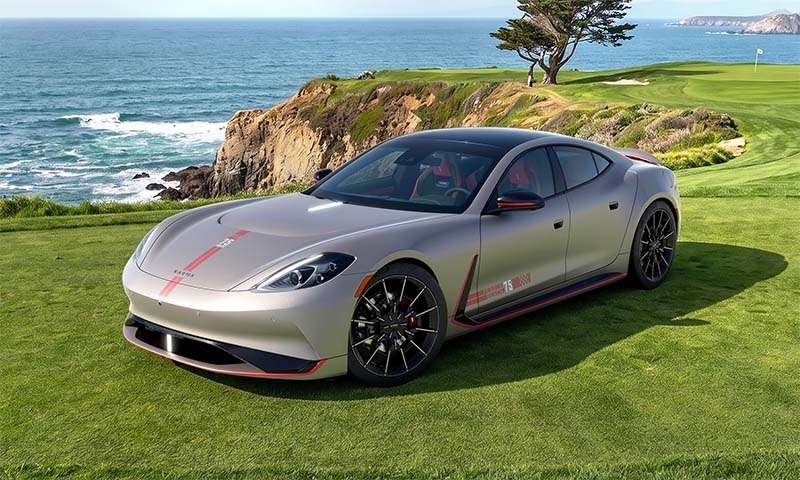
The 75th Pebble Beach Concours d’Elegance was, as it always is, a celebration of automotive history. But on the lawn at Pebble Beach this August, Karma Automotive made a different kind of statement—one aimed not at the past but at a very specific future. The California company didn’t arrive with one new car. It brought three, spanning a price range from $139,995 to approximately $400,000, and laid out a roadmap that, if executed, would culminate in something genuinely unprecedented: the first production road car ever built with solid-state battery technology.
The centerpiece of the announcement was the 2027 Karma Gyesera Grand Coupe. It is a four-seat grande coupé built on an aluminum space frame with carbon fiber-reinforced composite body panels, powered by Karma’s latest extended-range electric powertrain—the HRL15665, producing 566 horsepower and 546 lb-ft of torque, with a 0–60 time under 3.7 seconds. Deliveries to U.S. dealers commence in December 2026, with a starting price of $139,995. Orders are open now through Karma’s online configurator.
On paper, it reads like a serious car. In context, it reads like something more deliberate.
Why EREV, and Why Now
Karma has made an unambiguous bet on the extended-range electric vehicle format—a small internal combustion engine acting as a generator, with electric motors driving the wheels. Where most of the industry has oscillated between pure battery-electric and hybrid, Karma has leaned into the EREV architecture with conviction, and the Gyesera represents the clearest expression yet of that philosophy.
The reasoning isn’t arbitrary. Premium EV adoption has proven slower than the industry anticipated, and for the specific buyer Karma targets—someone for whom the Gyesera is a third or fourth automobile, driven perhaps 4,000 miles a year—range anxiety and charging infrastructure remain real concerns. The EREV solution gives collectors and GT drivers the electric experience without demanding lifestyle changes. It is, in that sense, a pragmatic decision dressed in performance clothing.
The Gyesera’s cabin reflects that same discipline. Rather than chasing infotainment maximalism, Karma has pursued a driver-focused interior: a Qualcomm 8155-based information system, wireless Apple CarPlay and Android Auto, a Master & Dynamic audio system, and a hidden wireless charging tray in the armrest. New lightweight front seats free up 15 percent more rear legroom—a meaningful upgrade for what is genuinely positioned as a touring machine for four. At Pebble Beach, the show car wore Electrum Gold over Stellar Red stripes with a Reserve Red and Black Bridge of Weir leather interior trimmed in Charcoal Alcantara—a combination that reads as confident without crossing into ostentation.
Rarity as Product
Here is the number that deserves its own paragraph: 146.
That is how many Karma vehicles were sold in 2025. Not hundreds. Not thousands. One hundred and forty-six. By comparison, Rimac’s Nevera R was limited to 50 units globally, while the Pininfarina Battista was capped at 150. Karma isn’t a struggling manufacturer chasing volume. It is, by any honest measure, one of the most exclusive automotive brands operating in the United States today—built in Moreno Valley, California, by a team of approximately 70 people, and deliberately kept that way. CEO Marques McCammon has said plainly that scarcity is the strategy: owners should know exactly which variant they have, what makes it different, and why it matters.
For the collector market, that context reframes the Gyesera entirely. A $139,995 entry price for a car with this level of material quality—aluminum space frame, carbon composite body, hand-configured interior—and production numbers this constrained places it in a different conversation than its sticker price alone might suggest. This is not a high-volume luxury coupe hunting Porsche Panamera buyers. It is something closer to a small-scale commission. The question for serious collectors isn’t whether $139,995 is reasonable. The question is whether this generation of Karma production—built in America, traceable in lineage, delivered in small numbers—will compound in value the way originality compounds in the broader collector market.
The Escalating Staircase
Karma announced two additional models at Pebble Beach, and the sequencing is intentional.
The 2028 Karma Amaris GT—a two-door grand tourer slated for Q4 2027 production—carries a more evolved version of the EREV architecture, positioned to compete with Aston Martin and Bentley at an estimated price above $200,000. Where the Gyesera is the accessible entry into the ecosystem, the Amaris GT is the step toward something more singular. Details remain limited, which is itself a statement about the brand’s approach to information management.
Then there is the Kaveya.
The 2029 Karma Kaveya Super Coupe—with a starting price around $400,000, butterfly doors, and over 1,000 horsepower—would be, if it arrives on schedule with Q1 2028 production, the first production road car ever equipped with Factorial Energy’s FEST solid-state battery technology. That is not a footnote. Solid-state batteries have been the engineering holy grail of EV development for a decade: higher energy density, faster charging, better thermal stability, longer cycle life, and the elimination of liquid electrolytes that create fire risk. Every major automaker has invested billions chasing them. Toyota, BMW, and Volkswagen have announced timelines that continue to slip. Karma and Factorial Energy formalized their production partnership earlier this year in what they describe as the first solid-state battery production program in the United States for passenger vehicles. If that claim holds through to the Kaveya’s launch, the car becomes historically significant independent of its performance numbers or price.
A Name Worth Understanding
Karma Automotive was born from the wreckage of Fisker Automotive, which collapsed in bankruptcy in 2014 after producing roughly 2,000 units of the original Fisker Karma—a car celebrated for its Henrik Fisker-penned design and undermined by battery supplier failures and quality problems. Wanxiang Group, a Chinese auto-parts conglomerate, acquired Fisker’s assets for $149 million and built Karma Automotive around them. The Fisker brand itself was excluded from the sale, which is why the original car’s model name—Karma—became the company name instead.
That history matters to collectors because it explains both the promise and the skepticism. The Fisker Karma was genuinely beautiful. It was also genuinely troubled. Karma Automotive has spent more than a decade trying to separate itself from that legacy while honoring the design DNA that made people pay attention. The Revero and Revero GT were incremental steps built on a familiar platform. The Gyesera is something more deliberate—a new-generation architecture rather than an evolution of what Fisker left behind. Whether that distinction translates into collector desirability remains a market question that won’t be answered for years. But as the crashed-and-reborn F40 LM that fetched $11 million at Monterey demonstrated, automotive history has a habit of reassigning significance long after the moment passes.
What Serious Buyers Should Watch
Karma’s three-model announcement is coherent in a way the brand hasn’t always projected. A $140,000 entry coupe, a $200,000-plus GT, and a $400,000 solid-state hypercar form a logical hierarchy—one that gives existing customers a path forward and gives new customers a reason to start at the bottom of the ladder with eyes on the top.
The delivery timeline for the Gyesera is December 2026. Early buyers at this price point and at this production volume are, functionally, charter members of a new generation. Those who configure now will receive cars before any meaningful secondary market data exists—which cuts both ways. There is no auction record to reference, no comparable resale to study. That uncertainty is precisely the risk that makes early Karma ownership either prescient or cautionary, depending on how the Kaveya story ultimately unfolds.
Karma has not publicly disclosed production numbers for the Gyesera. Given that the company sold 146 total vehicles in 2025, a similarly constrained first wave seems reasonable to expect. For collectors who understand that rarity compounds in value the way interest compounds in finance, those constraints are part of the calculus—not a warning sign.
The Pebble Beach reveal was a brand statement as much as a product launch. Karma arrived at the 75th Concours—where automotive history is honored—and introduced a decade-long vision. The Gyesera is the first chapter. Whether collectors treat the Kaveya’s solid-state milestone as genuinely historic or as an ambitious promise depends entirely on execution. For now, the car exists. The orders are open. And 146 people last year understood something the broader market has not yet caught up with.
The collector car market, every weekday morning.
Auction results, price moves and what’s crossing the block, read in four minutes. Free, from Modern Car Collector.
No spam, unsubscribe in one click. Or read more about the Brief.
Related Posts:
- The $402,000 Corvette ZR1X Isn't a Collector-Car…

- Record Ferraris, Rare Icons and 15,000 RPM: The Week…

- The Collector Car Market Paid Up for Certainty This…

- The Complete Guide to the Yenko Camaro
- The Real Story of Car Week 2026 Isn't a Car. It's a Fence.

- Spyker's C8 Preliator XXV Isn't Selling Horsepower.…

 Shawn Henry
  Kyle Matthews
  Eve Nowell