

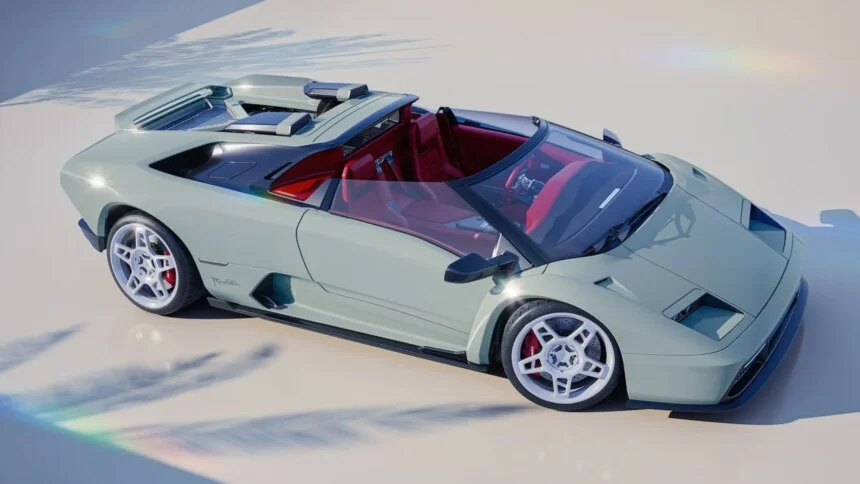
Eccentrica pulled the covers off its V12 Roadster during Monterey Car Week, a roofless reinterpretation of the Lamborghini Diablo Roadster limited to 19 examples. The San Marino-based restomod house says the car has been re-engineered around more than 3,500 unique components, wrapped in a carbon-fiber-reinforced chassis with steel and carbon bodywork. Power comes from a reworked 5.7-liter V12 producing 550 horsepower and 443 lb-ft of torque, routed through a six-speed gated manual to a top speed of 208 mph. It will make its public debut at The Quail.
None of that is the real story. The real story is timing. Eccentrica isn’t asking whether a Diablo can be made faster, Lamborghini settled that argument decades ago with the Diablo GT, the first production Lamborghini to break 200 mph. Eccentrica is asking something considerably harder: whether a restomod can earn genuine collector standing within the same decade it was built, rather than the two or three decades it typically takes an aftermarket car to shed the “modified” label and become legitimately desirable in its own right.
A Decade Is the Real Currency
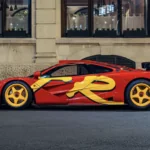
There’s a precedent, and it isn’t encouraging for anyone hoping this happens quickly. In the 1990s, Lamborghini’s own Swiss importer, Roland Affolter, commissioned a run of just 10 Diablo Evolution GTRs, reworking the aerodynamics and finishing them in liveries no factory car would have approved. It took nearly three decades of ownership history, documentation, and quiet reputation-building before one crossed the block at a major auction house carrying a six-figure estimate. Rarity alone didn’t do that work. Time did.
Not a Replica, a Rebuild
Eccentrica is trying to compress that timeline, and its approach is worth studying regardless of whether it succeeds. Unlike a kit-car builder, Eccentrica doesn’t fabricate a Diablo from scratch, each Roadster begins life as an actual Lamborghini Diablo Roadster, a donor chassis stripped down and rebuilt around its original identity rather than replicated around it. That distinction matters enormously to anyone who cares about title, registration, and the difference between a modified original and a recreation wearing its clothes.
It also matters who is doing the modifying. Founder Emanuel Colombini is a Diablo collector before he is a manufacturer; he has described the car as his childhood dream, recalling it as “shiny and red on the cover of Quattroruote.” Maurizio Reggiani, Lamborghini’s former chief technical officer through the Murcielago, Reventon, and Huracan programs, signed on to oversee the car’s re-engineering when Eccentrica first announced the V12 project in 2024. That is a materially different credibility signal than a tuning shop bolting on a wing and calling it a day.
The Math Behind ‘Only 19’
This is also where serious buyers should slow down. When Eccentrica introduced the V12 coupe in 2024, the entire program was capped at 19 units, priced around 1.35 million euros each. The Roadster is now being described, independently, as its own run of 19. Whether that means Eccentrica has doubled total production to 38 chassis, or whether Roadster and coupe simply share the same 19-car allocation with buyers choosing their bodywork, is not a trivial detail, it is the difference between two very different scarcity stories. Anyone treating “19” as an investment thesis should get that answer in writing before signing anything.
Restraint as a Design Choice
The engineering choices suggest a company that understands what collectors actually reward. Eccentrica sends power exclusively to the rear wheels, discarding the factory Diablo’s viscous all-wheel-drive system entirely, the same purity decision Lamborghini itself made with the GT. The power increase over the standard Roadster is modest by restomod standards, roughly 65 horsepower, evidence of restraint rather than a spec-sheet arms race. Semi-active suspension, hydraulic power steering, and modern brakes were added for livability, not to mask the analog character that is the entire point of owning one.
What Originality Is Already Worth
That restraint is being tested against a market that already rewards originality generously. A 25-year-old Diablo VT 6.0 with under 6,000 miles sold this year for $804,000, a result driven almost entirely by its unmolested condition. Eccentrica’s Roadster isn’t really competing with new supercars on price. It’s competing with pristine, numbers-matching Diablos on the question of what collectors actually want to own thirty years from now: originality, or a more usable interpretation of the same idea.
The Diablo has become, quietly, the most reinterpreted analog Lamborghini of its generation. Another Japanese tuner recently rebuilt one into a widebody track weapon, and Eccentrica is far from the only shop chasing this particular car. That’s not a coincidence. The Diablo was the last Lamborghini built before turbochargers, hybrid assistance, and electronic driver aids became inevitable, which makes it the last one that lets a restomodder sell purity as the product rather than an apology for what the factory left out.
Whether the Eccentrica V12 Roadster earns a place beside the Evolution GTR and the GT, genuinely significant rather than simply expensive, won’t be decided at Monterey. It will be decided the way it always is in this market: slowly, at auction, a decade or two from now, by buyers who never met Emanuel Colombini and don’t care how the car felt at its unveiling. Restomods don’t inherit their donor cars’ history. They have to earn their own.
The collector car market, every weekday morning.
Auction results, price moves and what’s crossing the block, read in four minutes. Free, from Modern Car Collector.
No spam, unsubscribe in one click. Or read more about the Brief.


 Shawn Henry
  Eve Nowell
  Kyle Matthews