
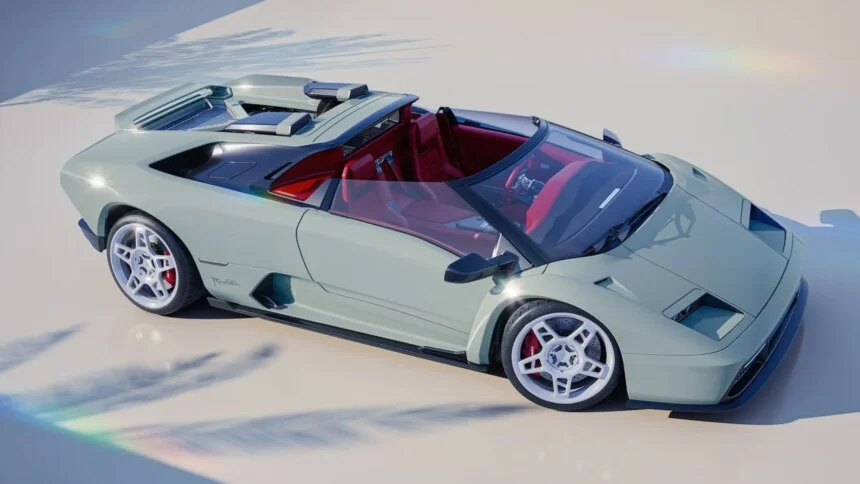
At The Quail during Monterey Car Week, Eccentrica pulled the roof off its re-engineered Lamborghini Diablo and called the result the V12 Roadster. Nineteen will be built, each beginning life as a genuine Diablo, each expected to cost north of $1.3 million before the donor car is even accounted for. The open top will get the photographs. It is not the story.
The story is what the Diablo has quietly become. For three decades it was a used supercar — loved, feared, and priced accordingly. Eccentrica is treating it as something else entirely: a platform worth some 3,500 new components and a complete re-engineering program, the way Singer treats the air-cooled 964 or Guntherwerks treats the 993. The V12 Roadster is the clearest signal yet that the Diablo has crossed from “old exotic” to canonical object. That crossing is worth more to collectors than any figure on the spec sheet — and it drags along the question the restomod era keeps raising and rarely answers cleanly: when you re-engineer an icon, do you inherit its provenance or spend it?
A deliberately analog reconstruction
The mechanical brief reads like a rebuke to everything the modern supercar has become. The 5.7-liter V12 is rebuilt to 550 horsepower and 443 lb-ft of torque, routed through a six-speed gated manual — no paddles, no dual-clutch, no electrification of any kind. Top speed is a quoted 208 mph. The chassis is carbon-reinforced steel, the bodywork carbon and steel, the track widened, the dampers semi-active, the brakes Brembo. Curb weight lands just under 3,400 pounds. Milan’s Borromeo De Silva shaped the design; Maurizio Reggiani — the former Lamborghini R&D chief who oversaw the Murciélago, Aventador, and Huracán — signs off on the engineering. This is not a wheels-and-wrap tuner exercise. It is a serious reconstruction by some of the people who built the modern Sant’Agata.
Why now: the analog moment, monetized
The timing is not accidental. Lamborghini has walked away, for now, from its all-electric supercar after finding “close to zero” buyer interest, and the manual gearbox has been extinct at Sant’Agata for more than a decade. The current V12 flagship, the Revuelto, is a hybrid that just set a Nürburgring record. Against that backdrop, a naturally aspirated, gated-manual Diablo reads less like nostalgia and more like an argument about which era of the marque was its most emotional. The Diablo is being canonized in real time as the last genuinely feral analog Lamborghini V12, and Eccentrica is selling the purest expression of that idea money can buy.
The question serious buyers should price first
Here is where discipline matters. A restomod does not inherit provenance; it spends it. Every V12 Roadster starts as a real Diablo that is then cut, reinforced, and rebodied. The finished car is more capable, more usable, and almost certainly more thrilling than the donor ever was. But it is no longer an original, unmodified Diablo, and it never will be again. The collector market has learned to hold two ideas at once: it will pay enormous sums for a Singer, and enormous sums for an untouched original — but it prices them on entirely different logic. One is valued as a bespoke modern object, the other as a preserved historical document. Eccentrica is asking buyers to accept that a re-engineered Diablo can be the former without quietly consuming the latter. With only nineteen examples, and open Diablos genuinely scarce to begin with — only a few hundred left the factory in period, out of roughly 2,900 built — that is not a trivial ask.
Can a modifier become a marque?
What the V12 Roadster really tests is whether Eccentrica can become a marque rather than a modifier — the same question now hanging over Rezvani and its Lamborghini-based Dune. The houses that minted lasting value did it by building an identity buyers trust independently of the donor. A Singer is not “a modified Porsche”; it is a Singer. Eccentrica’s wager is that “an Eccentrica” can carry that same standalone equity, underwritten by Reggiani’s credibility and a production run small enough to stay exclusive. If it works, residuals hold and the cars trade as blue-chip modern collectibles. If it doesn’t, buyers eventually re-anchor to the donor Diablo’s value and the premium erodes. History does not support a third outcome.
It is telling that the debut landed at Monterey in a week when the market keeps rewarding analog-era Sant’Agata metal — from record Miura gatherings at Pebble Beach to carbureted Countachs pushing toward $1.1 million. Demand for the Diablo’s generation is real and strengthening. Eccentrica is not manufacturing that demand; it is attempting to monetize it in a new form. Whether that form appreciates or merely impresses is the wager each of the nineteen buyers is making.
So price the open top last. The Eccentrica V12 Roadster matters because it marks the moment the Diablo stopped being a car collectors buy and became an idea collectors interpret. The roofless version simply raises the stakes on the interpretation. Restomods promise you can have the icon improved. The collector’s discipline is remembering that improvement and preservation are different assets — and that the market, eventually, always makes you choose.
The collector car market, every weekday morning.
Auction results, price moves and what’s crossing the block, read in four minutes. Free, from Modern Car Collector.
No spam, unsubscribe in one click. Or read more about the Brief.


 Kyle Matthews
  Eve Nowell