

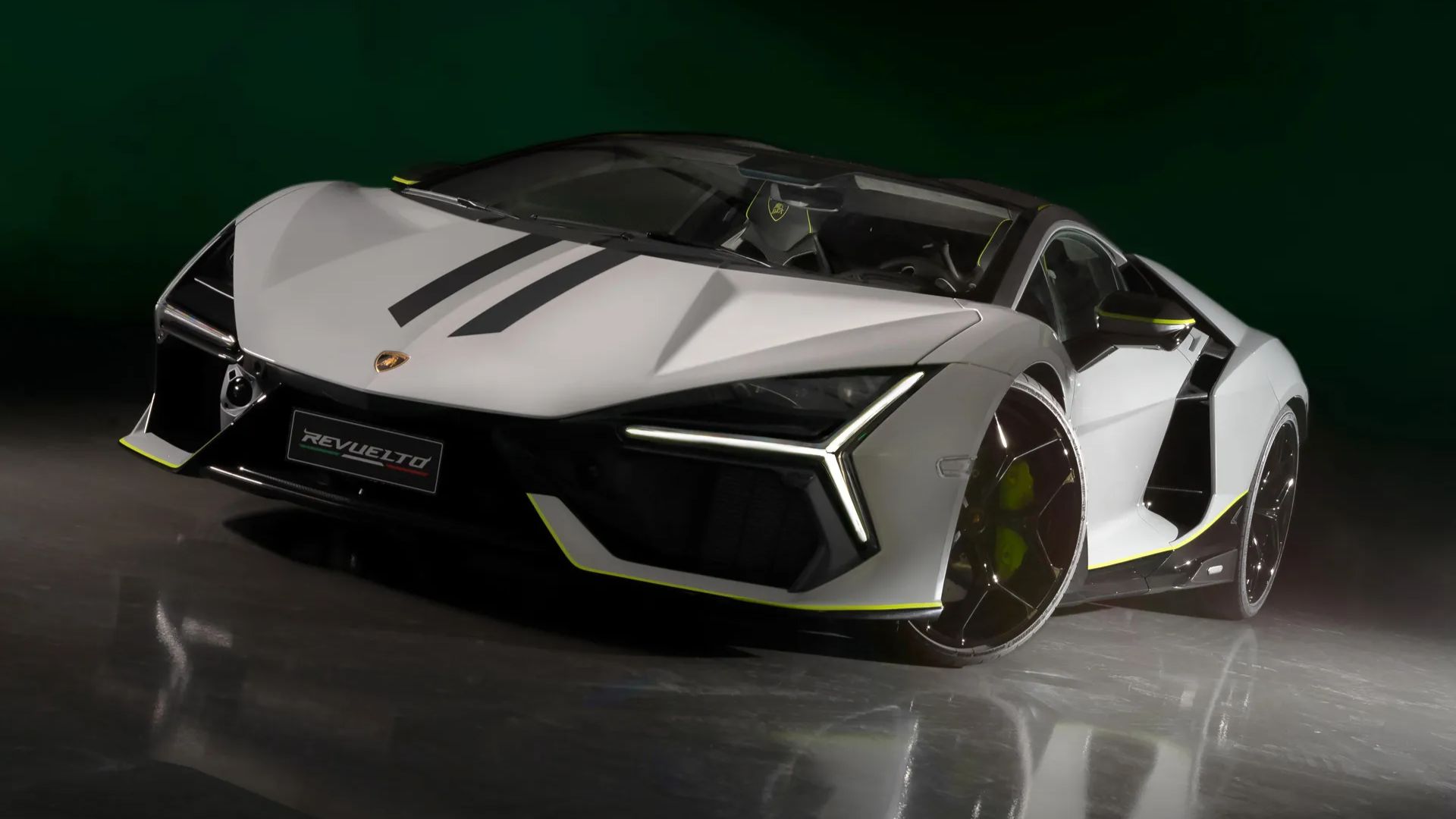
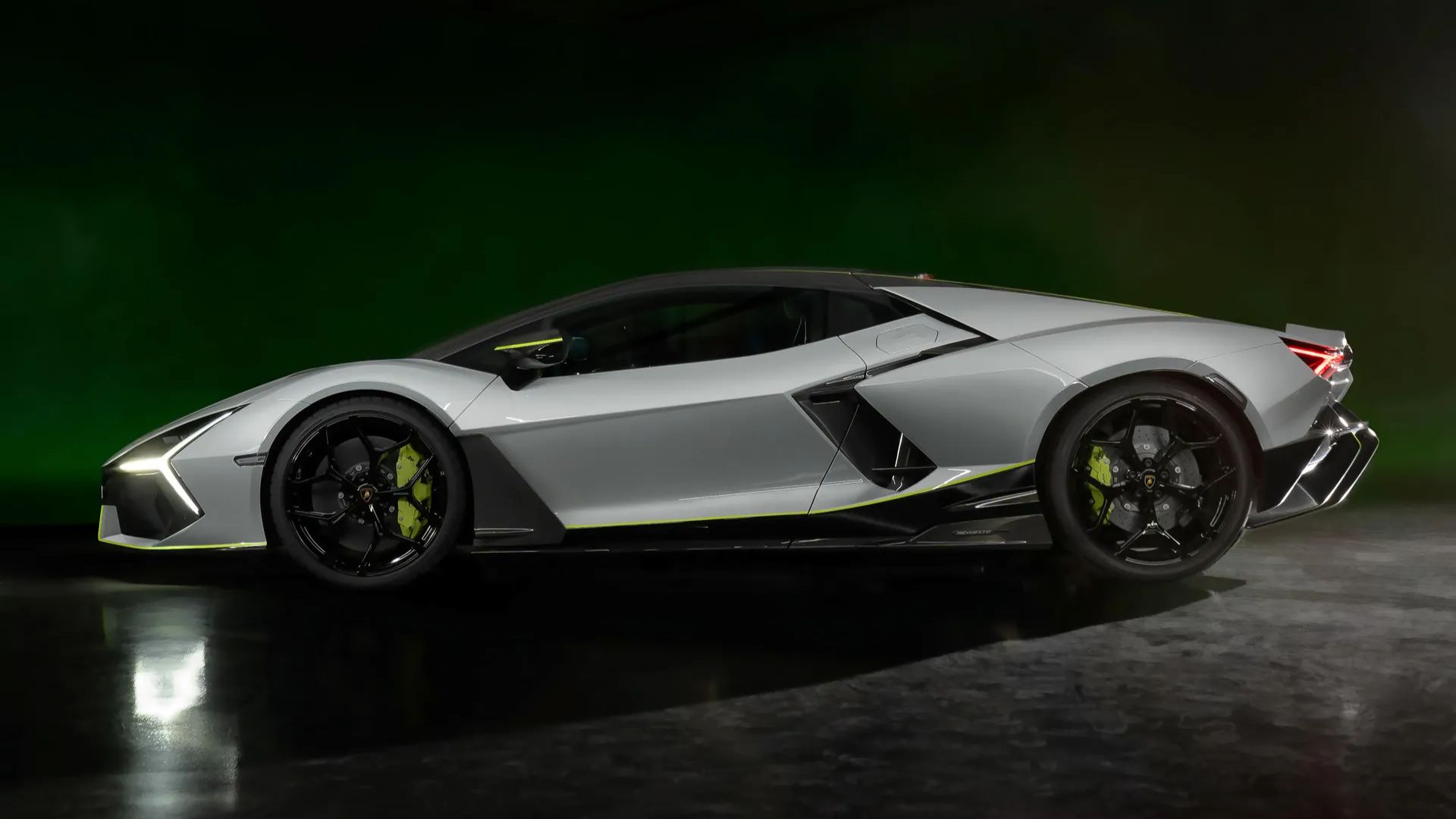
On August 6, a heavily camouflaged Lamborghini Revuelto SV lapped the Hockenheimring in 1:41.6 — the fastest time Lamborghini says any production car has recorded at the German circuit. Factory driver Marco Mapelli was behind the wheel, backed by a full technical crew and a same-day highlight film. Eight days later, at The Quail during Monterey Car Week, the car will be uncovered in public for the first time.
The record itself is real. It is also, on its own, not especially meaningful to collectors. A lap time set on a disguised prototype, without independent timing or a locked production specification, tells you a manufacturer invested in a marketing moment. It does not tell you whether the car will matter in twenty years. What is worth studying here is not the stopwatch. It is why Lamborghini chose this particular week, this particular circuit, and this particular name.
A Record Built for a Calendar, Not a Clock
Hockenheim was not chosen at random, and neither was the date. Lamborghini needed a headline heading into Monterey Car Week, the industry’s most consequential seven days, where the Revuelto SV’s August 14 debut at The Quail will share billing with the U.S. introduction of the Urus Performante and the global reveal of the Revuelto Miura 60° Homage — a tribute tied to the Miura’s 60th anniversary and the 55th anniversary of the Miura SV specifically. Three separate product stories, one branded week, and a lap record that guaranteed coverage before any of it happened. That is not a criticism. It is simply how flagship reveals work in 2026, and understanding the mechanism matters more than reacting to the headline.
What “SV” Actually Means
The Super Veloce badge did not start as a marketing suffix. It started in 1971 as a specific engineering answer to a specific set of complaints. Lamborghini’s customers and test drivers found the original Miura P400 and Miura S thrilling but occasionally unruly at speed, so the factory separated the shared engine-and-transmission oil circuit, widened the rear track, stiffened the chassis, and added ventilated disc brakes — changes that pushed output to 385 hp and made the final Miura the most planted, most capable version of a car that had, a few years earlier, invented the modern supercar. Stephan Winkelmann, Lamborghini’s chairman and CEO, has described Super Veloce as “the purest interpretation of Lamborghini performance,” and every SV since — the Diablo SV, the Aventador SVJ, now the Revuelto SV — has traded on that same premise: not a faster trim level, but the final and most extreme statement a given V12 generation has to make.
That distinction is why original Miura SVs remain some of the most closely tracked cars in the marque’s history. A record gathering of Miuras at Pebble Beach earlier this year underscored how much of Lamborghini’s current market strength still traces back to a 55-year-old flagship. Collectors do not pay a premium for two letters. They pay for what those two letters have reliably meant since before most of today’s buyers were born.
Lamborghini Has Run This Play Before
The Revuelto SV is not the first Lamborghini flagship introduced with a stopwatch story. In 2018, the Aventador SVJ set a lap record at the Nürburgring Nordschleife days ahead of its own Pebble Beach debut — a sequence that helped frame the SVJ as the definitive close to the naturally aspirated Aventador era and contributed to it becoming one of the more resilient values to come out of that generation. Lamborghini has also shown, with cars like the Sián FKP 37, that it treats production numbers as narrative rather than accounting: 63 units, a direct nod to the company’s 1963 founding, decided years before most buyers ever sat in one.
Pre-launch reporting suggests the Revuelto SV may follow a similar script, with a production run said to be capped at 1,963 units — again pointing back to 1963. Lamborghini has not confirmed that figure as of this writing, and serious buyers should treat it as reported rather than final until the company’s own configurator and allocation letters say otherwise. Numbers announced before a car exists have a way of moving.
The Hybrid Question
Where the Revuelto SV departs from its SV predecessors is under the decklid. The Aventador SVJ was a send-off for a purely naturally aspirated V12. The Revuelto SV pairs its V12 with three electric motors — a plug-in hybrid architecture the broader hypercar market is still forming an opinion on. A useful data point arrived recently when a Porsche 918 Spyder sold in Columbus, a result suggesting the first generation of hybrid hypercars is beginning to mature into legitimate blue-chip territory now that a decade of real-world ownership and service history exists to study. That matters for anyone considering a Revuelto SV as a long-term hold rather than a short-term flip: battery packs and high-voltage components age on a different curve than an aluminum block, and the market is still working out how to price that difference. Lamborghini’s leadership has been unusually candid that its approach to electrification diverges from rivals’ — the company notably shelved plans for a fully electric model even as competitors pushed forward — and the Revuelto SV, for all its hybrid hardware, is still very much being sold as a V12 car first.
What Serious Buyers Should Watch
Nothing about the Hockenheim record should move anyone to write a check. The car shown on August 14 will carry Lamborghini’s actual specification, actual pricing, and, with any luck, an actual confirmed production number. Buyers should watch whether that number holds at 1,963 or changes once demand is measured. They should watch how allocation is handled, since Lamborghini has historically rewarded existing Aventador SVJ and Sián owners with first access to its most extreme cars, a practice that shapes early ownership history and, eventually, provenance. And they should look past the paint toward the details that separate a meaningful SV from a forgettable one: colour combinations tied to the car’s launch identity, factory options that will not be repeated, and documentation that ties a given car back to this specific moment in Lamborghini’s history rather than treating it as just another fast Revuelto.
A lap record fades from memory within a season. A badge either earns its keep over decades or it does not. Lamborghini spent five decades making sure “SV” meant something before it ever attached those letters to a car equipped with a battery pack. Whether the Revuelto SV deserves to wear them will not be settled at Hockenheimring, and it will not be settled at The Quail either. It will be settled the way it always has been for Lamborghini’s most extreme cars — slowly, by the market, over the next twenty years.
That is the real headline hiding behind this week’s press release: not that Lamborghini’s newest V12 is fast, but that Lamborghini is once again betting its most collectible nameplate on a car it has not finished revealing yet.
The collector car market, every weekday morning.
Auction results, price moves and what’s crossing the block, read in four minutes. Free, from Modern Car Collector.
No spam, unsubscribe in one click. Or read more about the Brief.
Related Posts:
- Record Ferraris, Rare Icons and 15,000 RPM: The Week…

- Everything Modern Car Collector Covered Last Week
- Weekly Roundup: Everything Modern Car Collector…
- The Lamborghini Revuelto SV Leaked Early — and the…
- Ferrari F50 Value Nearly Tripled in Two Years.…
- The Collector Car Market Paid Up for Certainty This…

 Eve Nowell