

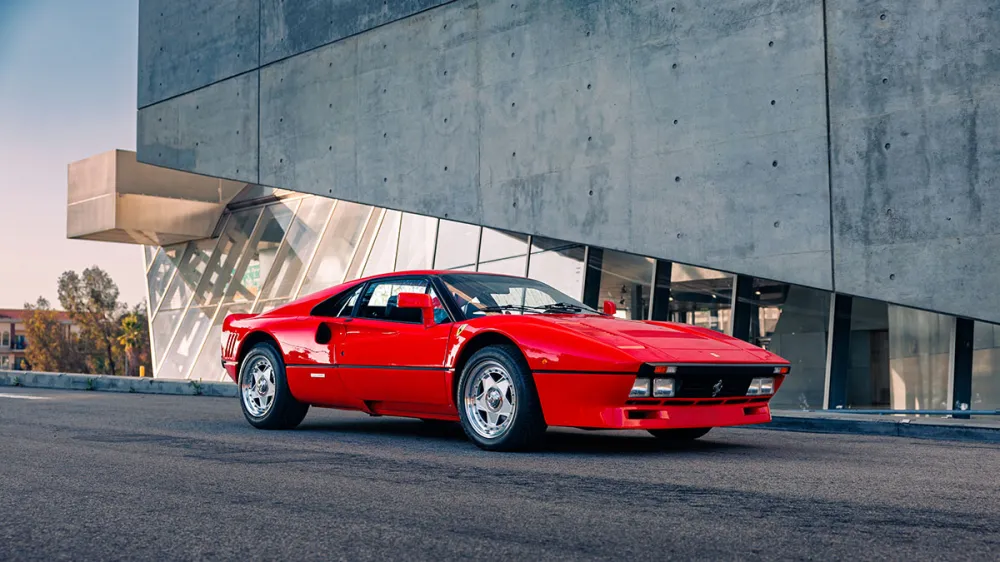
On August 13, RM Sotheby’s will open its Monterey sale with a 1985 Ferrari 288 GTO carrying an estimate of $9 million to $11 million. The car has covered 958 miles since new, among the lowest odometer readings ever recorded on a factory 288 GTO, and one of perhaps six examples worldwide believed to remain under 1,000 miles. That number will dominate the pre-sale coverage. It shouldn’t be the reason collectors pay attention.
Low mileage is not, by itself, a reason a car matters. What matters is what the mileage protects. In this case, it protects the most honest surviving record of a car Ferrari built to fight a war that was cancelled before it could report for duty.
The 288 GTO arrived in 1984 as Ferrari’s answer to the FIA’s Group B regulations, a formula that allowed manufacturers to build purpose-built monsters for rallying and circuit racing provided they produced at least 200 homologated road cars. Ferrari borrowed the GTO designation from the 250 GTO of 1962, a name it had not used in more than two decades and has used only sparingly since, and applied it to a mid-engine, twin-turbocharged V8 coupe styled by Pininfarina under Leonardo Fioravanti, the same designer responsible for the Daytona and the Berlinetta Boxer. Underneath the Kevlar hood and molded fiberglass bodywork sat a 2.9-liter V8 with IHI twin turbochargers, good for 389 horsepower and 366 lb-ft of torque, sent through a five-speed manual to the rear wheels.
None of it ever raced in the category it was built for. The FIA banned Group B at the end of 1986 following a string of fatal accidents, and Ferrari’s competition version, the five-off 288 GTO Evoluzione, never turned a wheel in anger. The road car that resulted from the homologation requirement outlived the racing program it was meant to support. Ferrari built 272 examples against a 200-unit minimum, sold every one of them to customers who would use the car as a very fast road-going trophy, and moved on. What could have been a footnote, a homologation special stranded by a regulation change, became something else entirely: the car that taught Ferrari how to build a halo car.
Every turbocharged and naturally aspirated flagship that followed carries the 288 GTO’s DNA. The formula, a limited-production, mid-engine range-topper built in far smaller numbers than Ferrari’s regular production cars, sold at a steep premium, and positioned as a technical statement rather than a volume product, became the template for the F40, the F50, the Enzo, the LaFerrari, and most recently the F80. Collectors treat the 288 GTO as the first chapter of that story, which is precisely why originality and completeness matter so much when one comes to market. A compromised or heavily used example tells you less about what Ferrari actually built in 1984. A 958-mile example tells you almost everything.
The chassis crossing the block in Monterey is the 99th of the 272 cars produced between 1984 and 1987, finished in Rosso Corsa, the only color Ferrari offered on the factory 288 GTO, over a Nero leather interior, with the factory-optional air conditioning and power windows. The matching-numbers V8 remains with the car, and it carries Ferrari Classiche certification, the factory authentication program that verifies a car’s chassis, engine, gearbox, and bodywork against Ferrari’s own build records. That certification matters more here than the mileage does. Mileage can be read on an odometer. Matching numbers and factory-verified originality have to be proven against paperwork, and paperwork is where the real due diligence, and the real risk, lives for anyone bidding at this level.
Context helps explain the estimate. A 288 GTO with roughly 16,000 miles sold for more than $6.8 million earlier this summer, a healthy result for a well-used example, but one that leaves several million dollars of daylight between it and what RM Sotheby’s expects this nearly untouched car to bring. That spread is the clearest evidence available of how this market actually prices condition and originality: not as a modest premium, but as a structural difference in what buyers consider a fundamentally different asset. It is the same dynamic behind the Ferrari Daytona SP3 that came to Monterey with 227 miles on the clock and a $12 million estimate. Modern collectors are increasingly bidding on preservation itself, not merely on the badge.
Serious buyers evaluating a car like this should look past the odometer to the questions that actually determine long-term value. Has the Classiche file been reviewed independently, and does it match the physical car down to stampings and casting numbers? What is the full chain of ownership, and are there gaps that a casual description glosses over? Low-mileage exotics carry their own maintenance liabilities: perished seals, degraded fuel lines, and hardened rubber are common on cars that have spent decades in climate-controlled storage rather than being driven, so a pre-purchase inspection focused on service history matters as much as the paint and interior. None of this diminishes the car. It simply reflects what buying a blue-chip collector car actually requires: treating a beautiful object as a documented historical artifact, not just a beautiful object.
The headline number from Monterey will be whatever the hammer says on the night. It won’t be the real story. The real story is that Ferrari’s first halo car was built for a fight it never got to have, and the most valuable surviving examples are the ones that never went looking for one either. Collectors are not really paying $9 million to $11 million for 958 miles. They’re paying for the closest thing left to the day Maranello stopped believing this car would ever see a start line, and for a nearly unbroken record of what Ferrari built before anyone knew what the 288 GTO would become.
Via Mikey Noga/RM Sotheby’s
The collector car market, every weekday morning.
Auction results, price moves and what’s crossing the block, read in four minutes. Free, from Modern Car Collector.
No spam, unsubscribe in one click. Or read more about the Brief.
Related Posts:
- Ferrari F50 Value Nearly Tripled in Two Years.…
- Record Ferraris, Rare Icons and 15,000 RPM: The Week…

- Collector Car Market Brief: A One-of-Three Veyron…
- The Collector Car Market Paid Up for Certainty This…

- The Porsche Carrera GT Doubled in 2026. The $6.7…
- Everything Modern Car Collector Covered Last Week
 John Lloyd
  Kyle Matthews