

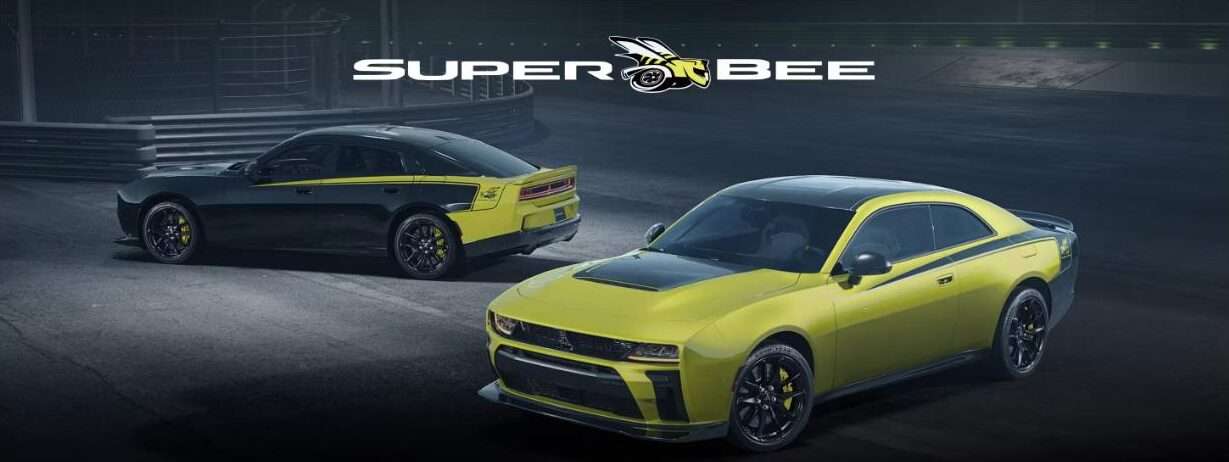
Dodge confirmed on August 7 that the Super Bee nameplate is returning for 2027, arriving as a Launch Edition version of the twin-turbocharged Charger. The headline number is easy: a SAE-certified 600 horsepower, a 3.6-second run to 60 mph, and an 11.8-second quarter-mile, making it, in Dodge’s own words, “the quickest, fastest and most powerful Super Bee ever built.” That number will dominate the coverage this week. It is not, however, the detail collectors should be paying attention to.
The detail that matters is what’s missing. There is no V8 under the hood, and there isn’t an option for one. Every Super Bee built since 1968 — the original Coronet-based budget muscle car, the Charger-based versions of the early 1970s, the 2007 SRT8 revival, and the 485-horsepower 2023 “Last Call” Charger — was built around a V8. The 2027 car is powered exclusively by a 3.0-liter twin-turbo inline-six, sends power through standard all-wheel drive, and offers a switch to rear-wheel drive at the push of a button. That is not a spec-sheet footnote. It is the end of a fifty-nine-year mechanical lineage.
A Nameplate With a Long Memory
Dodge introduced the Super Bee in 1968 as a value-priced performance Coronet, built to undercut the Plymouth Road Runner while offering the same 383 Magnum standard and optional 426 Hemi hardware. The name moved to the Charger body in 1971, then went dormant for more than three decades before Dodge revived it in 2007 as a limited-production, Hemi-powered Charger SRT8. It returned once more in 2023 as part of the “Last Call” send-off that closed out the previous-generation Hemi Charger — a car built, at the time, specifically to mark an ending. Readers who followed our coverage of the 1970 Dodge Charger HEMI restomod and the 1968 Plymouth Hemi GTX barn find already understand how much collector weight a documented Hemi Mopar carries. The Super Bee name has always traded on that same currency.
The Irony Buried in “Six Pack”
There’s a detail here that Dodge’s own marketing team clearly appreciates, even if casual readers will miss it. “Six Pack” didn’t originally have anything to do with a six-cylinder engine. In 1969, Dodge and Plymouth used the name — stylized as “6-Pack” — to describe a 440-cubic-inch V8 fed by three two-barrel Holley carburetors, the ultimate expression of big-block excess on a Super Bee or Road Runner. Half a century later, Dodge has revived that badge for an engine defined by exactly the cylinder count the name used to contradict. It’s a clever piece of brand archaeology, and it’s also a useful reminder for collectors: nameplates get recycled, but engineering does not. A “Sixpack” badge on a fender means something entirely different in 2027 than it did in 1969, and documentation — not nostalgia — is what will keep that distinction clear for future buyers.
What This Confirms About the Last V8 Cars
The more consequential story is what this launch settles, retroactively, about the 2023 Last Call Charger. For nearly three years, that car’s collector status has carried a quiet asterisk: was it truly the end of the naturally aspirated and supercharged Hemi era, or just a pause before Dodge found its way back to eight cylinders? The 2027 Super Bee answers that question. There is no V8 comeback. The nameplate that once represented the loudest possible statement of Mopar V8 performance now represents something else entirely, and that makes the 2023 cars’ ending permanent rather than provisional. Markets tend to reward that kind of certainty. Our earlier analysis of the Morgan Supersport 400 made a similar point about a very different manufacturer: a car’s significance often has less to do with what it achieves than with what it closes out. The same logic applies here.
Does the New Super Bee Have Its Own Future?
None of this means the 2027 Super Bee is irrelevant to collectors — it simply means its case has to be made on different terms. Dodge has confirmed limited production for the Launch Edition, along with three exclusive colors, unique badging, embroidered seats and a Charger 60th-anniversary tie-in — the same boxes that typically matter for future collectability. But rarity and factory-correct options have never been sufficient on their own. As we noted in covering the 1969 Yenko Camaro that crossed the block earlier this year, it’s documentation and originality — not scarcity alone — that ultimately separates a genuinely significant car from an expensive one. Whether this generation of Super Bee earns that status will depend on whether buyers eventually value it on its own terms, the way the once-maligned water-cooled Porsche 911 was reassessed decades after air-cooling disappeared. That kind of reassessment, if it comes, is a decade away at minimum.
What Serious Buyers Should Watch
For collectors weighing where to put money today, the more actionable opportunity is behind us, not ahead. Documented, unmolested 2023 Last Call Hellcat and Super Bee Chargers — cars sold with paperwork tied explicitly to Dodge’s send-off program — now carry a confirmed historical bookend that this week’s announcement only reinforces. Anyone considering a 2027 Super Bee Launch Edition on its own merits should apply the same discipline used for any limited-production modern car: complete build documentation, honest mileage, and an unmodified factory specification. A horsepower record is a marketing achievement. It is not, by itself, a collector-market thesis.
Horsepower records get broken regularly — Dodge itself has bettered its own numbers repeatedly since the Hellcat arrived in 2015. Endings, on the other hand, only happen once. Whether or not that was the intention in Auburn Hills this week, Dodge just told the market, quite clearly, which V8 Chargers were the last of their kind.
The collector car market, every weekday morning.
Auction results, price moves and what’s crossing the block, read in four minutes. Free, from Modern Car Collector.
No spam, unsubscribe in one click. Or read more about the Brief.


 John Lloyd
  Kyle Matthews