

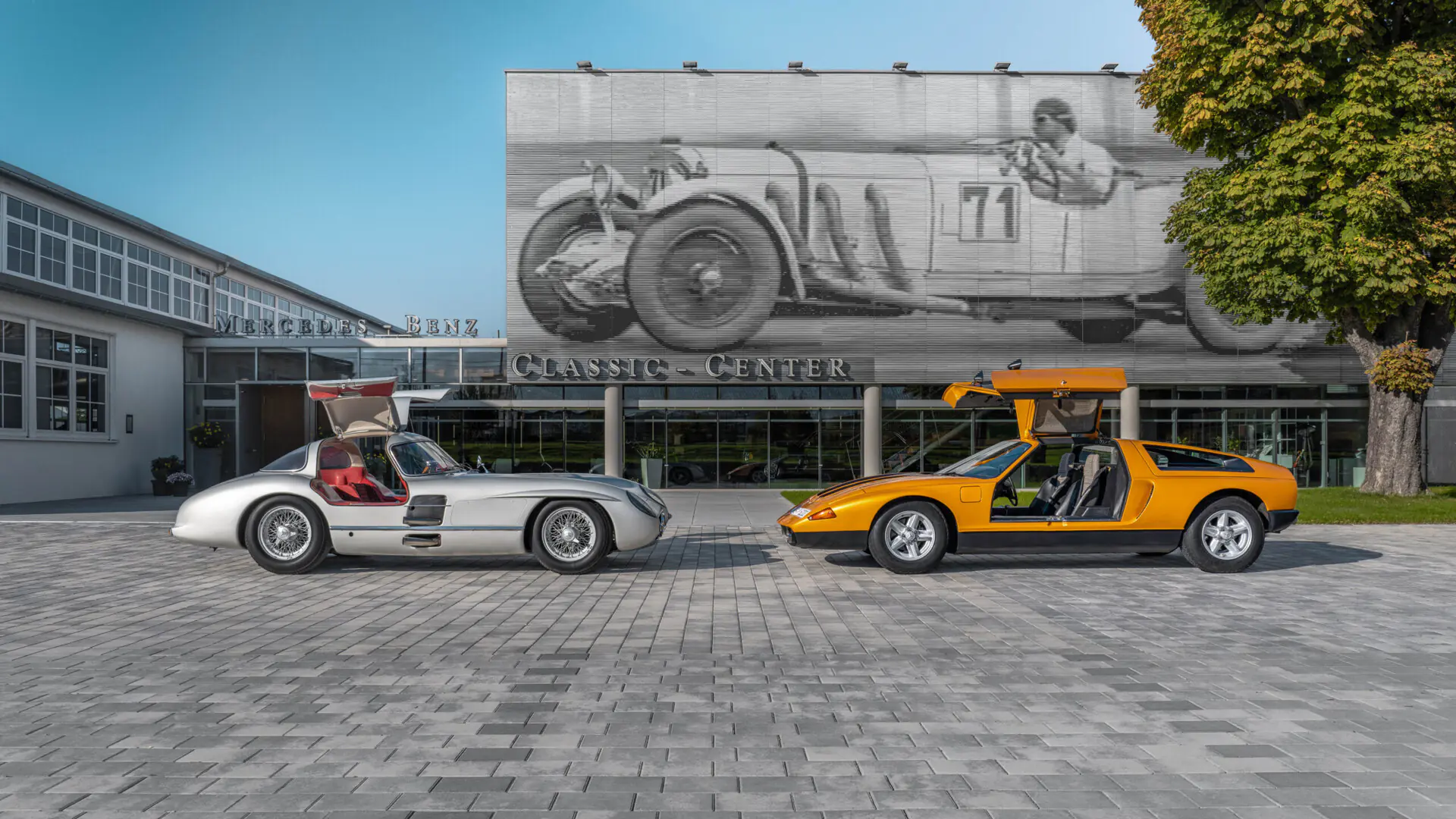
For 57 years the Mercedes-Benz C 111 has lived in a strange condition: one of the most coveted cars of its era, and one that no amount of money could buy. That ends on 3 February 2027, when RM Sotheby’s offers C 111-II “Wagen 33” in the Salles du Carrousel at the Palais du Louvre during Rétromobile week. It is the first C 111 Mercedes-Benz has ever put up for sale.
The obvious story is the number. Mercedes’ recent appearances at the very top of the market, the 300 SLR Uhlenhaut Coupé that remains the most expensive car ever sold at auction at €135 million in 2022 and the W 196 R streamliner at €51,155,000 in 2025, have taught everyone to ask how many tens of millions. The more consequential detail sits in the contract. Mercedes has committed not to sell another C 111 for at least 25 years. Whoever buys Wagen 33 is not simply buying a prototype. They are buying a generation-long monopoly on private C 111 ownership, guaranteed by the only party that could break it.
A car that never had a market
Seventeen C 111s were built between 1969 and 1978. One was crash-tested and three were dismantled in the 1970s. The remaining 13 are all in the company collection, and until now not one has ever left Mercedes-Benz ownership.
That last fact matters more than the production figure. Plenty of cars exist in tiny numbers. Very few have never once changed hands. The C 111 has no auction history, no private-sale comparables and no chain of owners whose stewardship has to be audited. Wagen 33 arrives with the cleanest provenance a collector car can have: a single owner, its manufacturer, for more than half a century.
It was never meant to be sold. Shown at the 1969 Frankfurt IAA with a mid-mounted Wankel, a glass-fibre-reinforced plastic body and gullwing doors that deliberately recalled the 300 SL, the C 111 became a rolling laboratory instead. Tightening emissions rules, high production costs and the 1973 oil crisis ended any thought of series production. The cars then went on to harder work: the five-cylinder diesel C 111-II D set 16 records at Nardò in 1976, and the twin-turbo V8 C 111-IV reached 403.978 km/h there in 1979.
Why this C 111
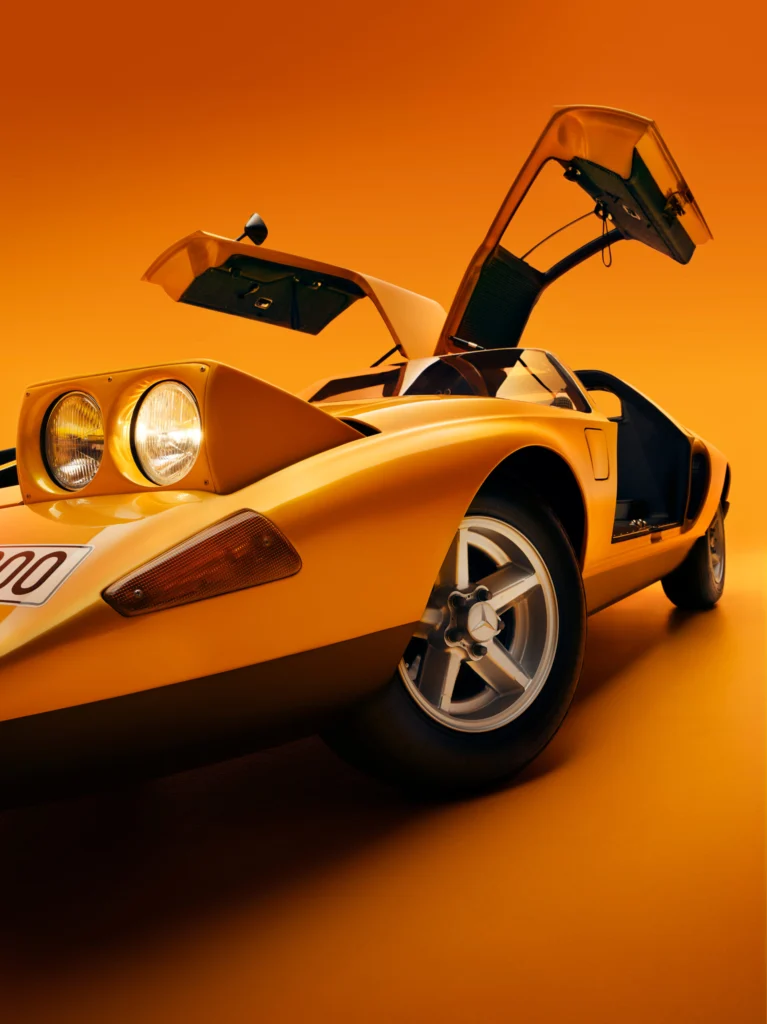
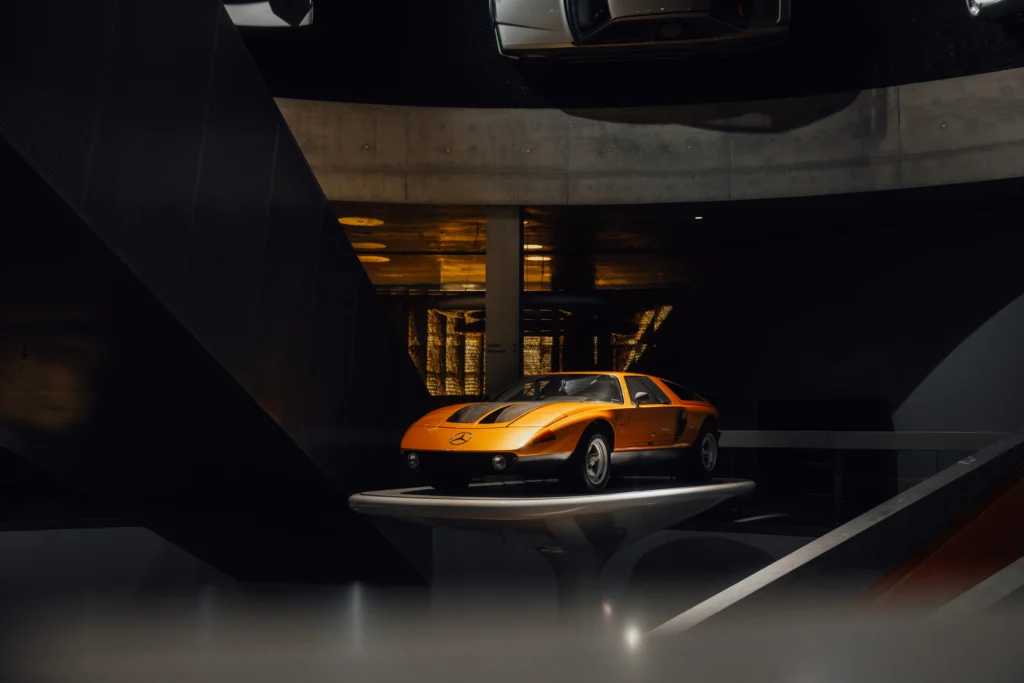
If Mercedes was going to sell one, the choice of car is revealing. Wagen 33 was the third C 111-II built, begun in March 1970 and completed that August with the four-rotor M 950 W 48: 2.4 litres of chamber volume, 350 PS (257 kW) at 7,700 rpm, 392 Nm, 1,240 kg and a claimed 300 km/h. It served in the test fleet on the registration S-Y 6200, trialling a fluidics system that drew evenly from the two side tanks, measuring temperatures in the rear luggage compartment, running at Hockenheim and carrying an ABS installation that is no longer active. It still wears its original Weißherbst paint, a shade named for a German rosé, over grey-white houndstooth sport seats and a vertically mounted Becker Europa radio.
Engineering alone does not separate it from its siblings. History does. In 1971 Herbert von Karajan was introduced to the C 111 project in this car on the Stuttgart test track. In 1972 it was the centrepiece of the first German edition of Playboy. It entered the company collection in 1975 and has been on display in the Mercedes-Benz Museum since 2006. In 2024 the Classic Center in Fellbach made it roadworthy again, overhauling the drivetrain and fitting an engine-bay fire-suppression system while deliberately leaving the exterior and interior patina untouched. That August it stood on the lawn at Pebble Beach in the class for wedge-shaped concepts and prototypes. Mercedes says it is now the only running C 111 with a four-rotor Wankel.
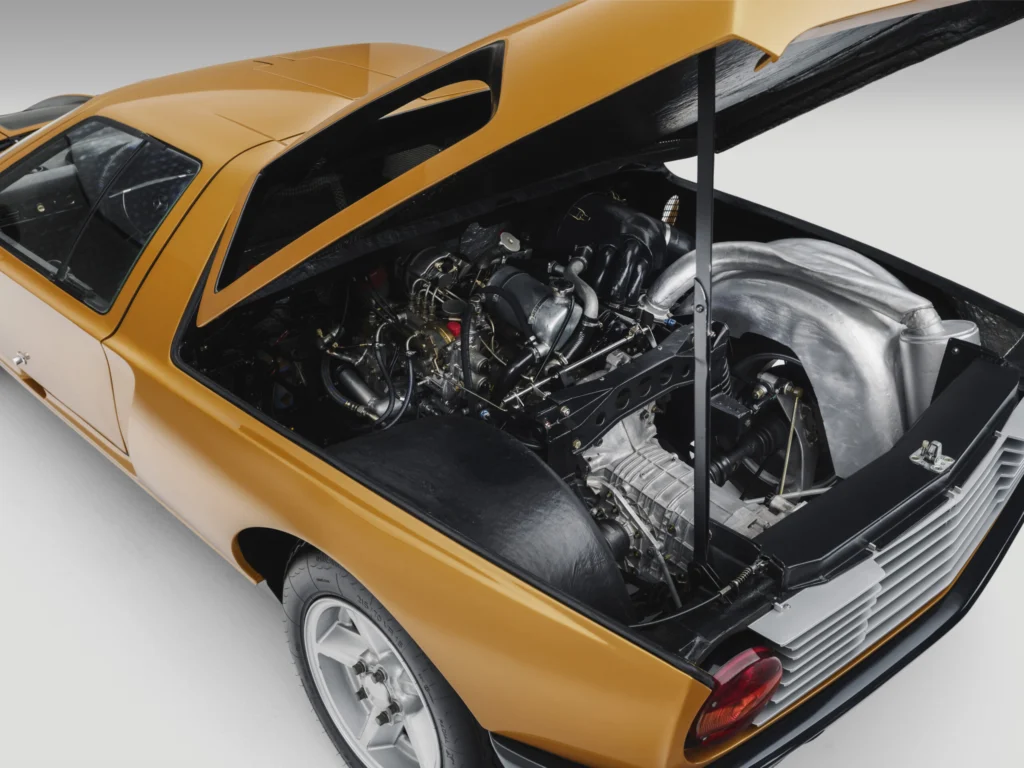
That is a deliberate selection. Mercedes is not selling a spare. It is selling the C 111 with the most cultural mileage (the conductor, the magazine, the museum years, the concours) and pairing it with an engine story no other surviving example can tell in running form. For a marque that never sold a rotary car, the four-rotor engine is also the most tangible link to the moment when Felix Wankel’s invention looked like the future of the performance car, a promise Mazda would eventually keep with cars such as the Eunos Cosmo 20B.
Collectors rarely pay for engineering in isolation. They pay for the moment a piece of engineering entered the culture, and Wagen 33 can document several.
The 25-year clause is the real product
The three big Stuttgart-connected sales are often grouped together, but they are different transactions. The 300 SLR Uhlenhaut Coupé was Mercedes’ own car, and its proceeds established a worldwide Mercedes-Benz Fund for scholarships. The W 196 R sold in 2025 belonged to the Indianapolis Motor Speedway Museum; Mercedes hosted and supported the sale rather than consigning it. Wagen 33 is the first time the company has sold one of its icons to reinvest in its own heritage operation.
The money goes to “Mercedes-Benz Museum 2.0,” a plan to make the Stuttgart museum more engaging, extend it to new themes from youngtimers to current innovation and make it accessible worldwide. Its centrepiece is a digital twin of the museum developed with The Classic Car Trust and its Roarington platform. Museum head Bettina Haussmann says the first results will be visible in 2027.
The moratorium is what turns a museum deaccession into a market event. Twelve C 111s will remain in Stuttgart. Without a contractual promise, every bidder would have to price the risk that a second car appears in three years, perhaps at a lower figure, and dilutes the first. The clause removes that risk for a quarter-century, longer than most serious collectors’ active buying lives. Mercedes is, in effect, selling exclusivity with an expiry date.
Here is the overlooked detail: scarcity is usually something the market discovers over decades. In Paris it has been written into the terms of sale. That structure protects the buyer, protects the value of the 12 cars Mercedes keeps and gives the factory a clean public narrative about why it is selling at all. Expect other manufacturers’ heritage departments to study it closely.
What serious bidders should weigh
The open question is value without competition. The C 111 has no race wins and no famous driver, none of the motorsport pedigree that underpinned the Uhlenhaut and W 196 R results. It is a research vehicle that became a pop-culture object. Paris will test whether a factory prototype with that kind of fame can command blue-chip money on its own merits. The evidence suggests it can, because the C 111 occupies a place no other car does: the supercar Mercedes refused to build, at the moment when the wedge and the rotary engine both looked like tomorrow. The factory announcement does not publish an estimate, which leaves the room to find that number for the first time.
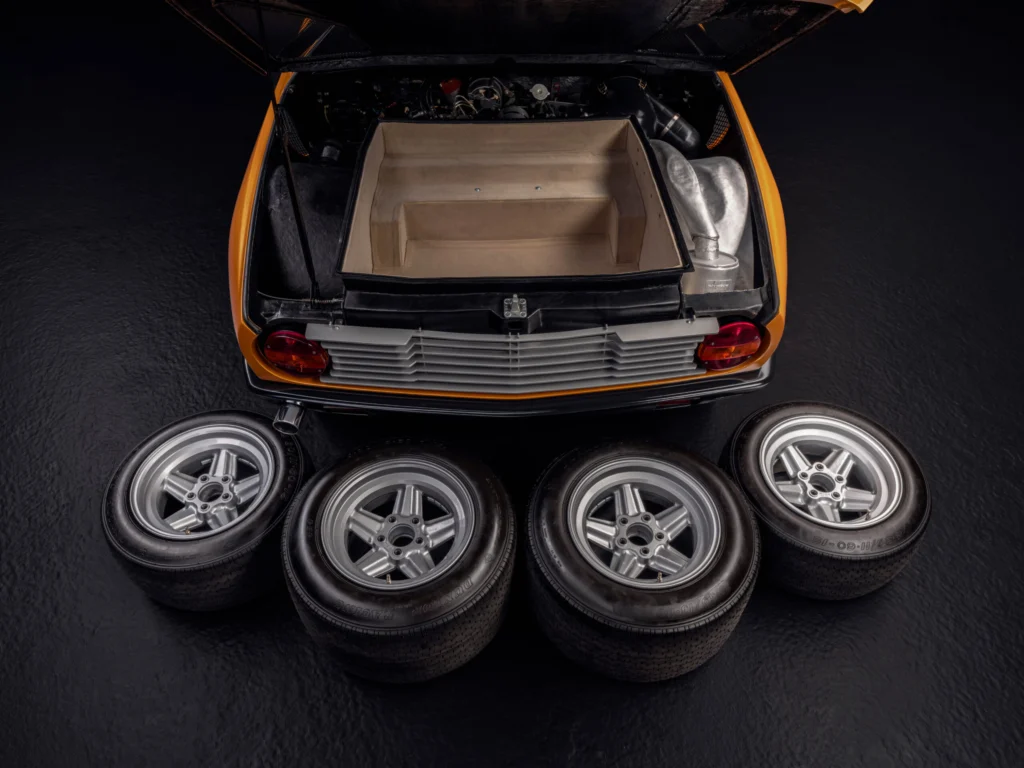
The practical questions are just as important. This is an experimental vehicle, not a production car with a homologation trail, so how it can be registered and used will depend on where it goes. Expertise in the M 950 four-rotor sits largely inside Mercedes-Benz Classic, which keeps the other surviving cars, so the buyer’s relationship with the factory will matter for long-term mechanical care. The lot includes the removable trunk tray, the standard 8×15-inch road wheels, 10×15- and 13×15-inch magnesium racing wheels that are suitable for display only, and a set of magnesium wheels on racing tyres. Buyers based outside the EU should take advice on export formalities, duty and VAT well before the sale.
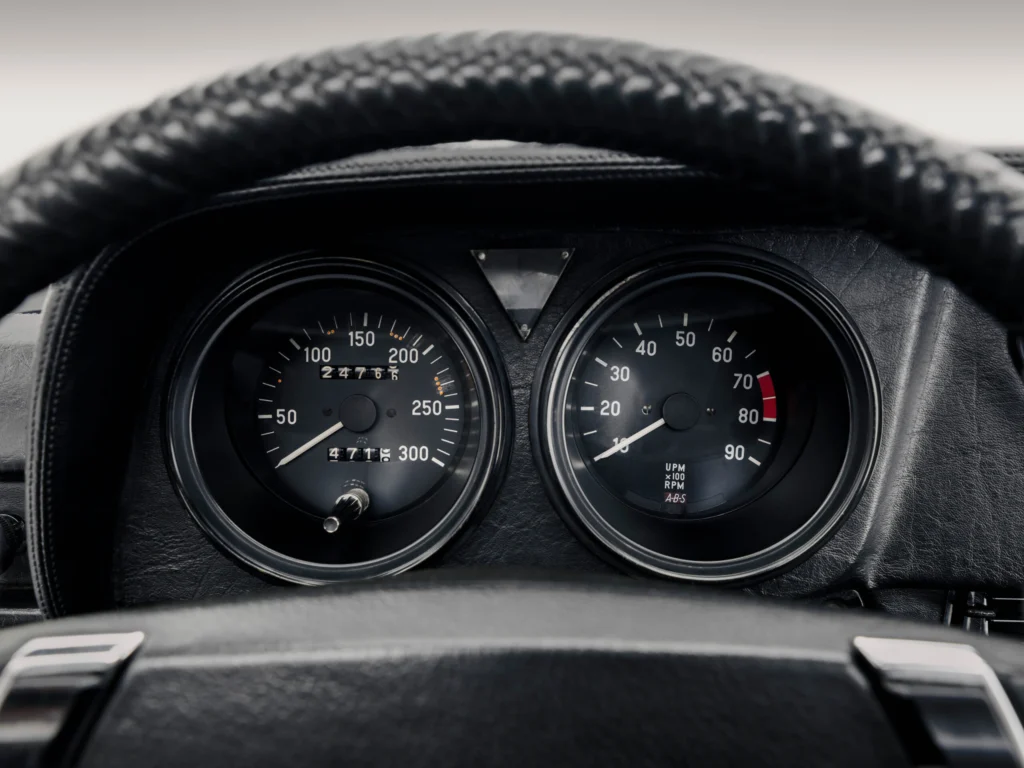
Finally, the patina is an asset. The 2024 recommissioning was mechanical, not cosmetic, and the 24,766 km on the odometer were largely accumulated by a working test car in Mercedes’ own hands. A future owner who “freshens” Wagen 33 would be spending money to erase part of what they bought.
What it says about the market
Mercedes has a long habit of keeping its most important cars and letting the market chase the rest; even its museum-adjacent trading, as with the last SLR McLaren Stirling Moss offered by RM Sotheby’s, has involved cars that were built to be sold. The C 111 never was, which is why even the Fangio family’s experience with the 300 SLR they could not buy feels relevant: some Mercedes icons have only ever been available on the factory’s terms. Paris confirms that those terms are now negotiable, but only through a structure the factory controls completely.
Wagen 33 is not valuable because only 17 C 111s were made. It is valuable because for more than five decades the answer to “can I buy one?” was no. On 3 February the answer becomes yes, once, for one bidder, and then no again until the early 2050s. The hammer price will make the headlines. The 25 years that follow it are what is actually being sold.
Sources
- Mercedes-Benz Classic press release on the C 111-II Wagen 33 sale, with technical data and production list (republished by Mercedes-Benz Oldtimer-Ticker)
- RM Sotheby’s: 1955 Mercedes-Benz 300 SLR Uhlenhaut Coupé sold for €135,000,000
- RM Sotheby’s, Paris 2027 auction information
The collector car market, every weekday morning.
Auction results, price moves and what’s crossing the block, read in four minutes. Free, from Modern Car Collector.
No spam, unsubscribe in one click. Or read more about the Brief.
Related Posts:
- A First-Owner SLR McLaren Stirling Moss Is Selling…

- The 10 Most Expensive Classic Cars Ever Sold at Auction
- The $402,000 Corvette ZR1X Isn't a Collector-Car…

- Record Ferraris, Rare Icons and 15,000 RPM: The Week…

- The Fangio Family Couldn't Buy a 300 SLR. So They Built One.
- Six of the Rarest Classic Cars Ever Made
 Kyle Matthews