

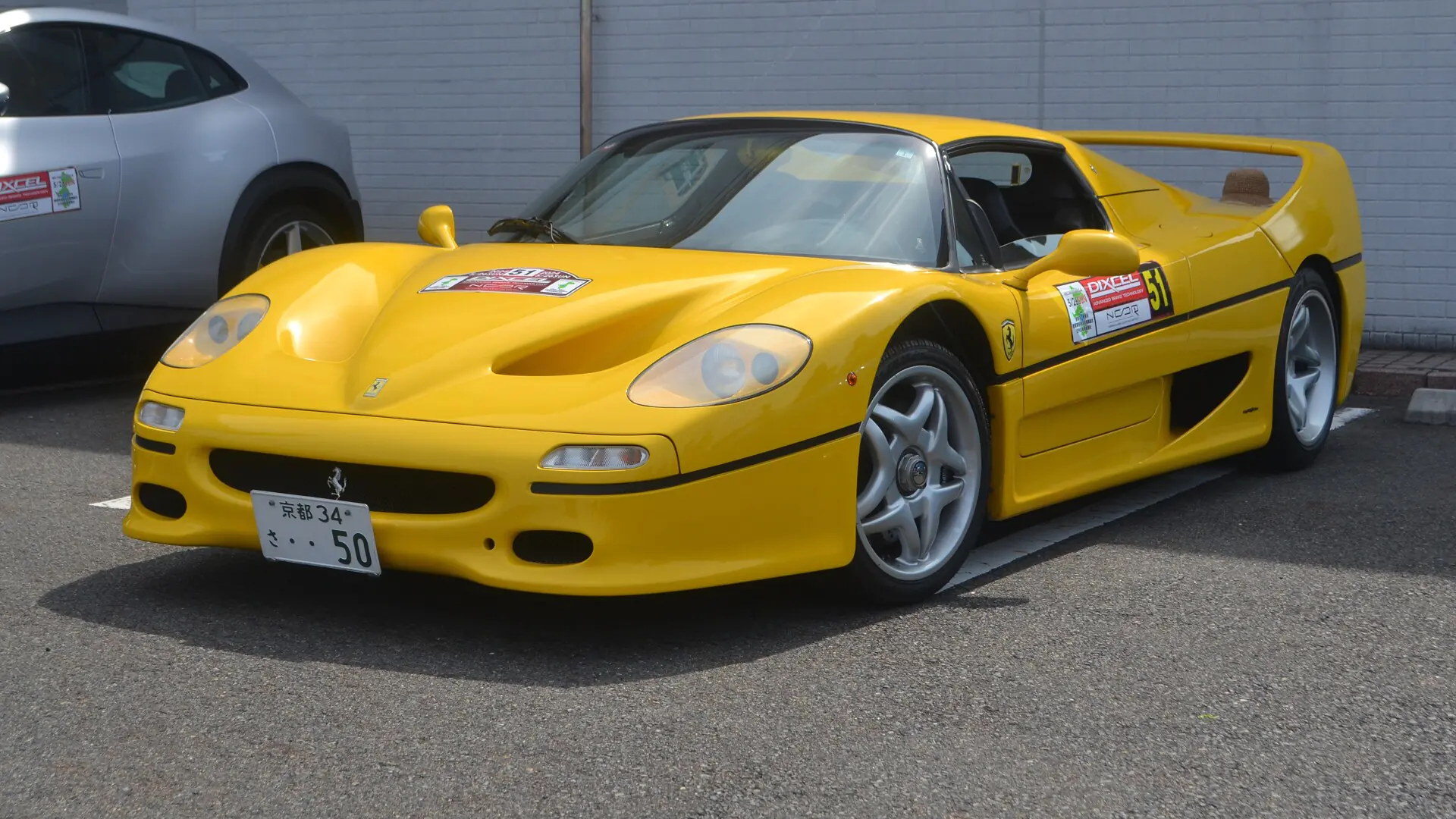
A yellow 1996 Ferrari F50 sold for $14,575,000 at Mecum’s Monterey sale on August 15, 2026, the third public-auction F50 record in roughly a year. The price is the headline. The more useful question for collectors is how much of that number belongs to the model and how much belongs to this particular car.
What the evidence shows
These are the reported facts, drawn from Italpassion’s report on the sale and Dupont Registry’s Mecum Monterey top-10 results:
- The car: a Giallo Modena F50, reported as the 239th of 349 built and one of only 31 finished in that color, delivered new in Switzerland. It showed 7,248 km (about 4,500 miles) and came with Ferrari Classiche certification and its Red Book. Mecum offered it as Lot S123.
- The record run: the ex-Ralph Lauren yellow F50 brought $9,245,000 at Monterey in August 2025. A red, 252-mile car then made $12.21 million at Mecum Kissimmee in January 2026. Italpassion puts F50 prices at roughly $4 million around 2021.
- The same-week comparison: at RM Sotheby’s, a red 1995 U.S.-market F50, one of 55 delivered to America and first owned by Mike Tyson, sold for $12,105,000 with 6,196 miles.
The arithmetic is simple. Yellow car to yellow car, the F50 is up about 58 percent in twelve months ($9.245 million to $14.575 million). Against January’s Kissimmee result it is up about 19 percent in seven months, and it beat the Tyson car by about 20 percent in the same week and the same town.
Comparables, and why none of them is clean
No two of these sales are the same car. Color, mileage, provenance, Classiche status and market of delivery all differ, so the percentages above describe a trend in headline results, not a clean like-for-like appreciation rate. The Enzo shows how wide the spread inside one model can be. At Monterey a 595-mile Enzo made $12.1 million at Mecum, another sold for $10.675 million at Broad Arrow, and a third brought $9.41 million at RM Sotheby’s, a gap of about $2.7 million among cars of the same nameplate in the same week, according to Motorious’s Monterey results roundup and Dupont Registry.
The wider room matters too. Motorious reports that five auction houses sold $747.9 million at Monterey this August, up 73 percent from 2025, while noting that mid-tier classics and prewar cars sold softly. Hagerty’s own 2026 market commentary frames the year the same way: a strong top end over a soft underbelly. The F50 sits firmly in the strong part.
Possible causes (interpretation, not fact)
Everything below is our reading of the evidence, not a reported finding.
- Fixed, small supply. At 349 cars, there is no mechanism for more F50s to appear. Each sale is a visible proxy for the whole population.
- Spec premium. Rare color, low mileage and Classiche paperwork are exactly the attributes that Monterey bidders pay for. This car had all three.
- The character trade. The F50 outsold the newer, faster Enzo at the same auction, $14.575 million to $12.1 million. That suggests that at the very top, buyers are paying for scarcity and analog character, a manual-gearbox, F1-derived V12 flagship, rather than for performance.
- Rising tide at the top. When the best cars across the market reprice together, the cars next to them tend to follow. Collectors who watched the Porsche Carrera GT double in 2026 and the Corvette Grand Sport leave the old record behind have seen this pattern before.
Durable or temporary?
Our view: the model-level move looks durable, but $14.575 million looks like a ceiling for the best-specified car rather than a new baseline for every F50.
The case for durability is depth. Within one week, two different houses sold F50s for $12.1 million and $14.6 million, which is two buyers at that level rather than one, and the January result was already in that neighborhood. Supply cannot expand.
The case for caution is momentum. Three records in a year is the kind of run that resets expectations faster than it resets the number of qualified buyers, and a sample this small can be moved by a single determined bidder. A market that has risen 58 percent in a year can also give some of it back without anything being wrong with the cars.
What would change this view: a Classiche-certified, low-mileage F50 that fails to find $12 million in the next six to nine months, or a cluster of high-estimate no-sales. What would strengthen it: a standard-spec red car clearing $12 million without a celebrity name attached.
What collectors should take from it
The memorable detail is the ranking, not the number. The F50 now trades above the Enzo, in the same sale, at the same house. If you hold or follow 1990s Ferrari flagships, the useful comparison is not last year’s F50 price. It is the ladder: where the F50 sits against the F40, whose originality questions already move values, the 550 Maranello that sold at $2.7 million on the strength of its owner, and the most expensive classic cars ever sold at auction. For a contrast with a market that is not rising, see our look at a no-reserve 458 Speciale A.
If you could hold only one 1990s Ferrari flagship through the next cycle, would it be the F50 on its record run, or the F40 with all its paperwork arguments?
Figures are as reported by the sources linked above; confirm final results with Mecum before relying on them. Nothing here is investment advice.
The collector car market, every weekday morning.
Auction results, price moves and what’s crossing the block, read in four minutes. Free, from Modern Car Collector.
No spam, unsubscribe in one click. Or read more about the Brief.






 Eve Nowell
  Elizabeth Puckett
  Kyle Matthews