

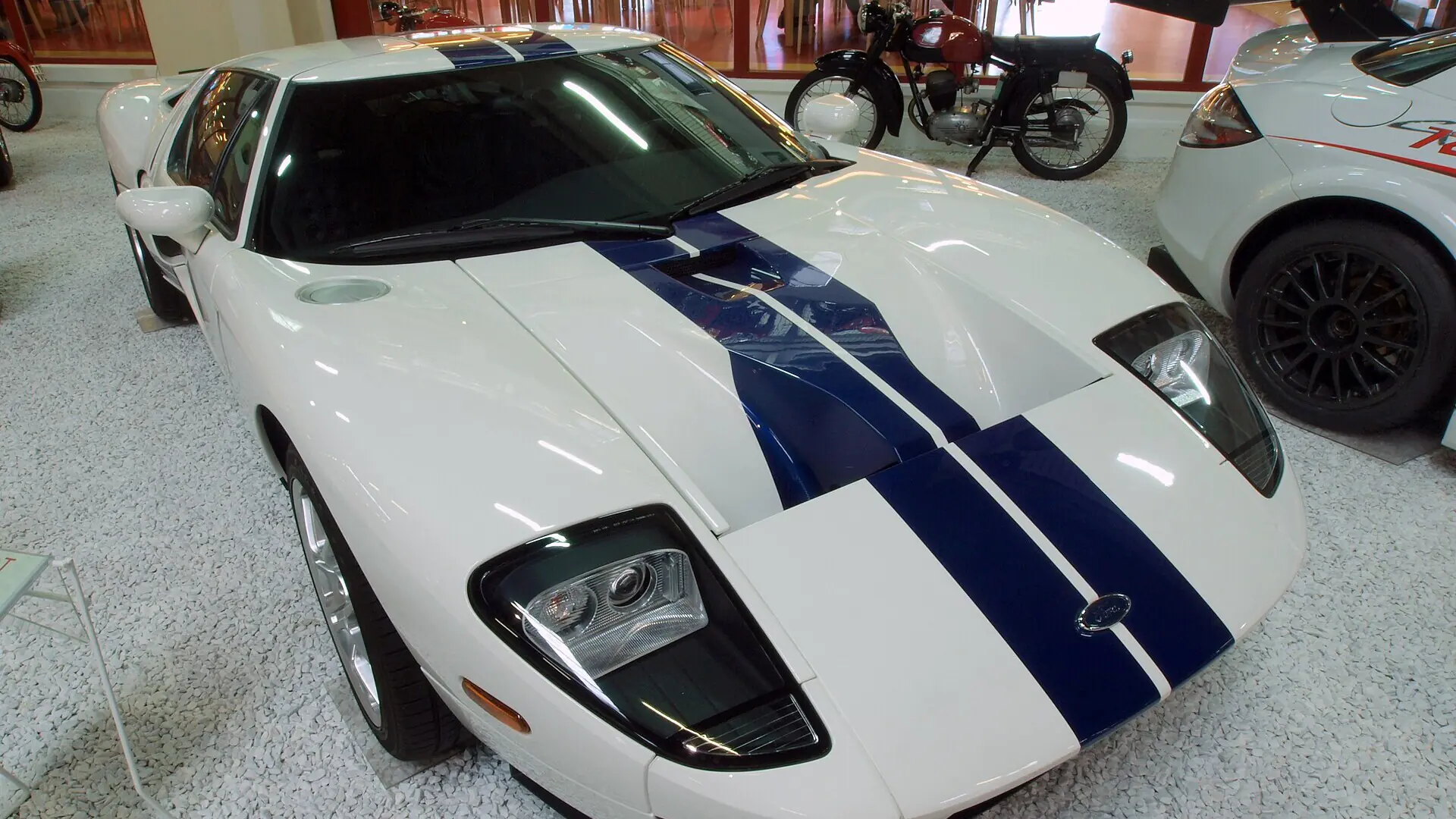
The 2005–2006 Ford GT is the rare modern supercar whose story is as important as its numbers. Ford built roughly 4,038 of them over two model years to mark its centennial and recall the GT40s that won Le Mans four straight times from 1966 to 1969. Every one has the same supercharged V8 and six-speed manual, and the option sheet is short, so what separates one GT from another is mileage, livery, originality and paperwork. This Ford GT spec sheet covers the verified production numbers, drivetrain, options, identifying details, known weak points and where values stand as of October 8, 2026.
Ford GT Spec Sheet at a Glance
| Item | Detail |
|---|---|
| Model | Ford GT, first generation, sold as 2005 and 2006 models |
| Total production | About 4,038 (2,027 for 2005 and 2,011 for 2006); some sources cite 4,033 |
| Assembly | Wixom, Michigan; production ended in September 2006 |
| Engine | 5.4-liter supercharged DOHC 32-valve V8, all aluminum, dry sump |
| Output | 550 hp at 6,500 rpm; 500 lb-ft of torque |
| Transmission | Ricardo six-speed manual transaxle with helical limited-slip differential |
| Layout | Mid-engine, rear-wheel drive, two-seat coupe |
| Performance | 0–60 mph in about 3.3 seconds; 205 mph top speed |
| Curb weight | About 3,485 lb |
| Price when new | $139,995 at launch; about $10,000 more for cars built after June 2005 |
| Heritage livery | 2006 only, about 343 cars, $13,000 option |
| Current value range | About $540,000 to $815,000 for standard cars; Heritage cars roughly $660,000 to $1.3 million and above |
Ford GT Spec Sheet: Production Totals
Published totals differ slightly, so this Ford GT spec sheet uses the most widely cited figures. For example, Hagerty and most references give 4,038 cars, split into 2,027 for the 2005 model year and 2,011 for 2006. RM Sotheby’s has catalogued the run as 4,033. Ford originally planned about 4,500 cars. However, the program ended in September 2006, ahead of the Wixom plant’s closure in 2007. Even so, dealers still sold some cars new in 2007.
| Group | Approximate number | Notes |
|---|---|---|
| 2005 model year | 2,027 | Six colors; Quicksilver was 2005 only |
| 2006 model year | 2,011 | Added Tungsten Gray and the Heritage livery |
| Heritage livery | 343 | Some sources say 346; 2006 only |
| Tungsten Gray | 541 | 2006 only |
| Europe (official) | About 100 | Imported through Ford’s European network |
| Canada | About 200 | Hagerty notes U.S. import restrictions on these cars |
| Pre-production cars sold | At least 3 | Including a Nardo test car |
| GTX1 roadster conversions | About 40 | Aftermarket conversion by Genaddi Design Group |
Ford GT Spec Sheet: Engine and Drivetrain
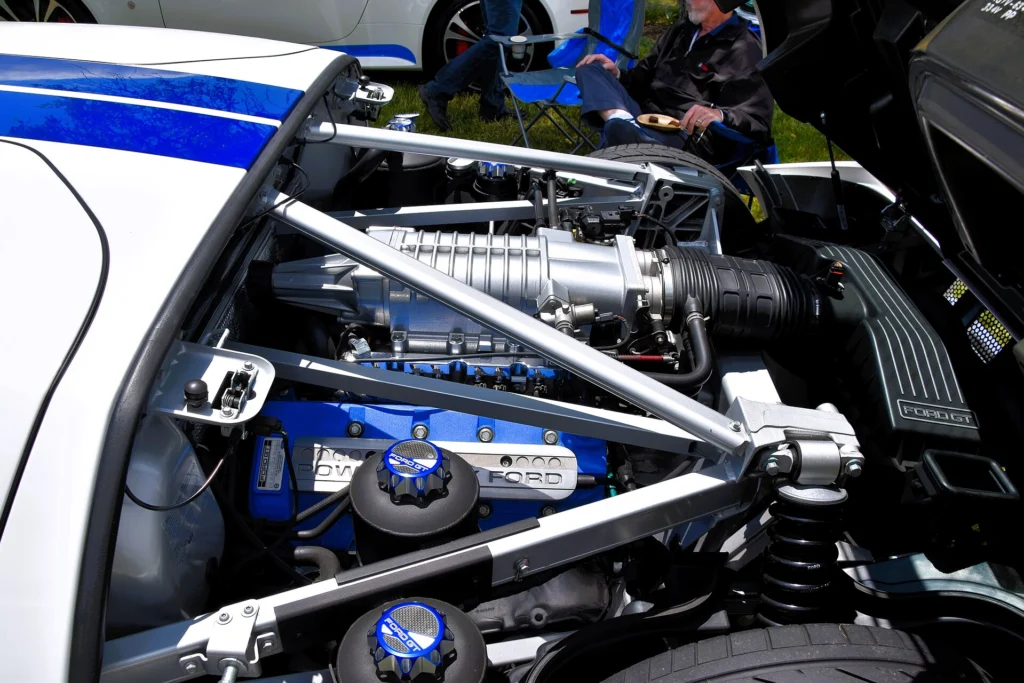
First, every first-generation GT uses the same powertrain. The 5.4-liter Modular V8 is all aluminum, with four valves per cylinder, an Eaton 2300 Lysholm screw-type supercharger and dry-sump lubrication so it could sit low in the chassis. It sends 550 hp and 500 lb-ft through a Ricardo six-speed manual transaxle with a helical limited-slip differential. In addition, Ford offered no automatic, paddle-shift or traction-control system.
| Component | Specification |
|---|---|
| Displacement | 5.4 liters (330 cubic inches) |
| Configuration | 90-degree V8, DOHC, 32 valves, aluminum block and heads |
| Induction | Eaton 2300 Lysholm screw-type supercharger with intercooler |
| Lubrication | Dry sump |
| Horsepower | 550 hp at 6,500 rpm |
| Torque | 500 lb-ft |
| Transmission | Ricardo six-speed manual transaxle |
| Differential | Helical limited-slip |
| Chassis | Aluminum space frame with superplastic-formed aluminum body panels and a friction-stir-welded center tunnel |
| Brakes | Brembo four-piston aluminum calipers with cross-drilled, vented rotors at all four corners |
| Performance | 0–60 mph in 3.3 seconds (Car and Driver); 205 mph top speed |
Colors and Special Options
Because the GT’s option list was short, each box on a Ford GT spec sheet is worth checking against the build paperwork. Hagerty lists the following factory options and prices.
| Option | Price new | Notes |
|---|---|---|
| McIntosh stereo with subwoofer | $4,000 | Adds roughly $2,500 to value today, per Hagerty |
| BBS forged wheels | $4,000 | The most valued option; worth about $4,000 today |
| Painted center racing stripes | $5,400 | Worth about $3,000 today |
| Red or gray painted brake calipers | $750 | Worth about $900 today |
| Side stripe delete | No charge | Uncommon; confirm with documentation |
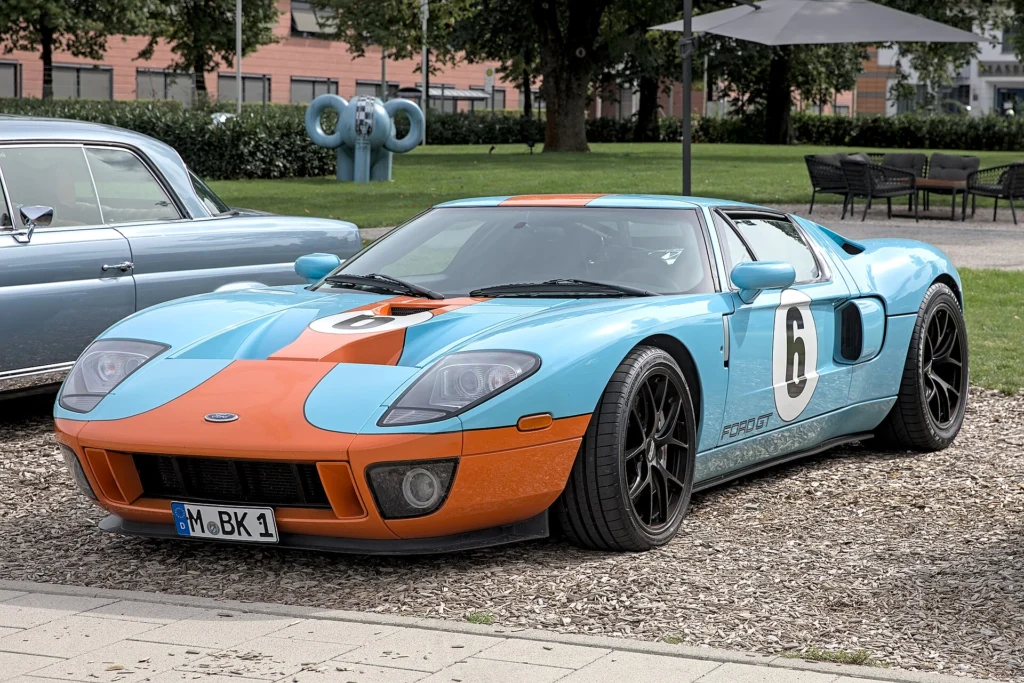
| Heritage livery (2006) | $13,000 | Light blue with orange stripe, recalling the Gulf GT40 |
For 2005 the GT was offered in Centennial White, Mark II Black, Mark IV Red, Midnight Blue Metallic, Speed Yellow and Quicksilver Metallic, the last available only that year. For 2006 Ford added Tungsten Gray and the Heritage livery, which echoes the Gulf-sponsored GT40 that won Le Mans in 1968 and 1969. Also, a handful of one-offs exist, including a Sonic Blue car. Therefore, treat any unusual color as a claim to prove with factory records.
Identifying a First-Generation Ford GT
- VIN: U.S.-market cars begin 1FAFP90S. The 10th character is 5 for 2005 or 6 for 2006, and the 11th is Y for Wixom.
- Paperwork: Strong cars come with the owner’s manuals and pouch, the Ford GT certificate, the window sticker and, ideally, a Marti Report confirming color, options and dealer.
- Early 2005 cars: Cars covered by the 2005 control-arm recall received billet aluminum arms in place of the original castings. Later cars returned to cast arms once the casting problem was fixed.
- Running changes: Similarly, mid-2005 changes deleted a radiator screen, added helper springs to the rear clamshell release and replaced solid transaxle oil-pump lines with stainless flex hoses.
- 2006 tells: Engine oil reservoir brackets changed from silver to black, and Ford deleted a painted clip over the clamshell edge.
- Heritage cars: Factory cars are 2006 models with the livery recorded in the build data. A paint scheme or wrap alone does not make a Heritage car.
- Shared parts: Some hardware comes from other Fords, including the steering column, door handles and vent registers. That helps with replacement parts but is no evidence of a repair.
Common Ford GT Weaknesses
The GT has a good reputation for mechanical durability. However, most cars have been driven very little, and storage brings its own problems. These are the issues to check on any first-generation car.
| Area | What to check |
|---|---|
| Control arms | Ford recalled 2005 cars (NHTSA 04V604000) for control arms with possible casting flaws. Confirm the recall work was done. |
| Airbags | 2006 cars appear in Takata inflator recall campaigns. Confirm that the driver and passenger inflators have been replaced. |
| Half shafts | A recall addressed half-shaft bolt failures. As a result, ask for proof of the repair. |
| Tires | Low-mileage cars often still have old, dry-rotted tires. Since the car has no traction control, replace tires older than about seven years and factor the cost into the price. |
| Dry-sump belt | The dry-sump oil pump belt has a service interval in the owner’s manual. Look for records. |
| Transaxle | Shifts are notchy until the gearbox oil is warm. Grinding or reluctance once it is warm is a concern. |
| Interior | Look for scuffed lower door cards, worn seat bolsters and corrosion on the magnesium center console, which may return after refinishing. |
| Electrics and trim | Gauge faults and fuel filler door problems are known. For that reason, avoid resting the fuel nozzle on the door. |
| Body | Check the aluminum panels for collision repair, especially on rear bumper-delete cars, and look for scrapes near the battery. |
| Modifications | Smaller supercharger pulleys, tunes, Whipple superchargers and twin-turbo kits are common. Keep or obtain the original parts. |
Ford GT Value Range, October 2026
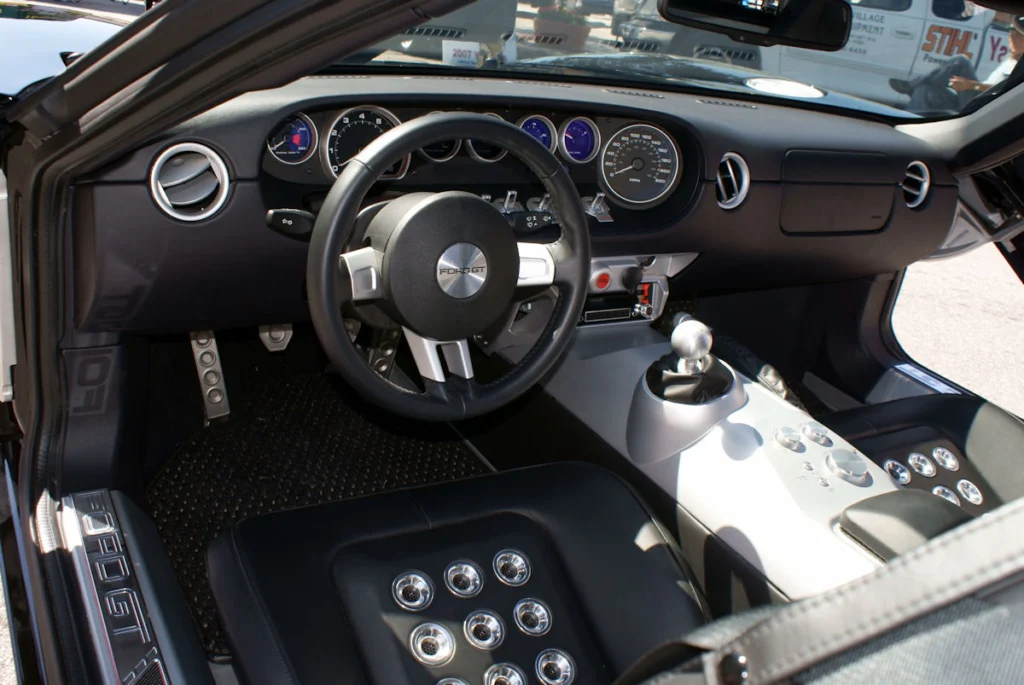
First-generation GT values have risen sharply, and this Ford GT spec sheet uses recent results rather than older guides. Hagerty once put the five-year average auction price near $330,000. In confirmed sales from August through early October 2026 tracked by CLASSIC.COM, standard cars sold for $540,000 to $815,000. Heritage cars sold for $660,000 to $2.1 million in 2026, with a median near $967,500. CLASSIC.COM’s published market benchmarks ($484,189 for standard cars and $815,303 for Heritage cars) trail these recent results, so use current sales as your guide.
| Example | Recent result | Venue and date |
|---|---|---|
| 2006, about 18,000 miles | $540,000 | Saratoga Motorcar Auctions, Sept. 2026 |
| 2006, about 12,000 miles | $600,000 | Bring a Trailer, Aug. 2026 |
| 2006, about 1,000 miles | $613,000 to $737,000 | Bring a Trailer and Mecum, Sept.–Oct. 2026 |
| 2005, about 2,000 to 4,000 miles | $685,000 to $690,000 | Bring a Trailer, Aug. 2026 |
| 2005, under 200 miles | $770,000 to $802,000 | Mecum and Bring a Trailer, Sept. 2026 |
| 2006, about 6,000 miles | $815,000 | Bring a Trailer, Sept. 2026 |
| 2006 Heritage, 662 miles | $967,500 | RM Sotheby’s Miami, Feb. 2026 |
| 2006 Heritage, top 2026 result | $2,101,000 | Bring a Trailer, Aug. 2026 |
Mileage matters, but it does not set the price on its own. For example, a 1,000-mile car sold for $613,000 while a 6,000-mile car brought $815,000 a month earlier. In other words, options, color, condition, records and provenance account for the rest. Meanwhile, dealer asking prices run from about $550,000 to $1.5 million, so treat them as asking prices, not results.
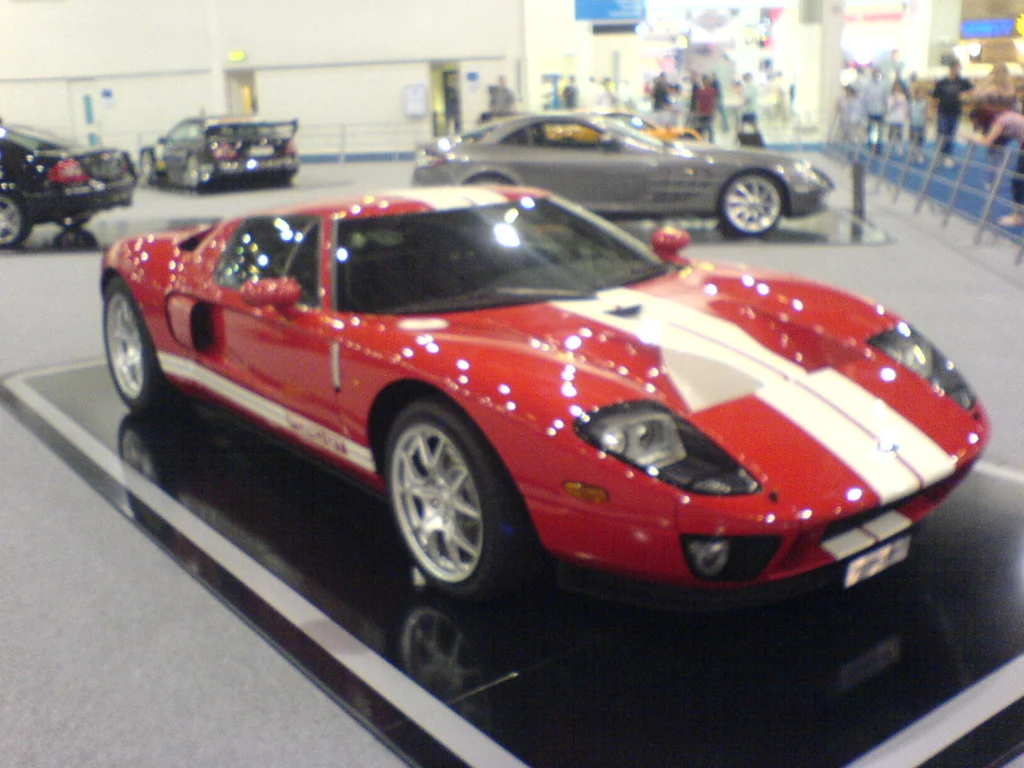
What Separates a Good Ford GT From an Average One
- Complete documentation: A Marti Report, window sticker, owner’s manuals, the GT certificate and a continuous service history. Records showing recall work and dry-sump belt service are worth paying for.
- Desirable options: BBS forged wheels, McIntosh audio, center stripes and painted calipers. A car with all four is easier to sell than a bare one.
- Livery and color: Factory Heritage cars carry the largest premium. Among standard cars, color counts vary, so confirm original paint with paint-depth readings and factory records.
- Originality: Stock engine, exhaust and wheels, or original parts that come with the car. Modified cars sell at a discount unless the work is reversible and documented.
- Sensible mileage with fresh service: For instance, a low-mileage car on 15-year-old tires and old fluids is not ready to drive. A car with modest miles and current service can be the better buy.
- Clean structure and history: No aluminum panel repair, no salvage history and a pre-purchase inspection by a GT-experienced shop.
In short, the best GTs combine an original specification, complete paperwork and evidence of proper care. The average ones have the right mileage but are missing records, carry old tires or have hidden modifications, and the market increasingly prices that difference in.
Related Reading
- Jeremy Clarkson’s Personal 2006 Ford GT Is Coming Up for Sale
- A Modern Ford GT Outbid a Genuine Boss 429 at Barrett-Jackson Las Vegas
- GAA Classic Cars’ July Auction Roars Past 80% Sell-Through, Led by a Record-Setting Ford GT
- 1990–1995 Chevrolet Corvette ZR-1 (C4): Collector Spec Sheet
- First-Generation Acura NSX (1991–2005): Collector Spec Sheet
- BMW Z8 (2000–2003): Collector Spec Sheet
- 1987 Buick GNX Collector Spec Sheet
Sources and Notes
Production, option and running-change details come from Hagerty’s 2005–06 Ford GT buyer’s guide, Wikipedia’s Ford GT entry and RM Sotheby’s catalog descriptions. Recall information is from NHTSA campaign listings. Market figures come from CLASSIC.COM, Hagerty and RM Sotheby’s, and reflect results available as of October 8, 2026. Published production counts vary by a few cars, and color and Heritage counts are approximate. Verify any car’s build data and recall history before you buy, and treat this Ford GT spec sheet as a starting point for an inspection, not a substitute for one. Photographs are from Wikimedia Commons contributors under the CC0, CC BY 2.0 and CC BY-SA 4.0 licenses, as credited in each caption.
The collector car market, every weekday morning.
Auction results, price moves and what’s crossing the block, read in four minutes. Free, from Modern Car Collector.
No spam, unsubscribe in one click. Or read more about the Brief.



 Kyle Matthews
  John Lloyd