

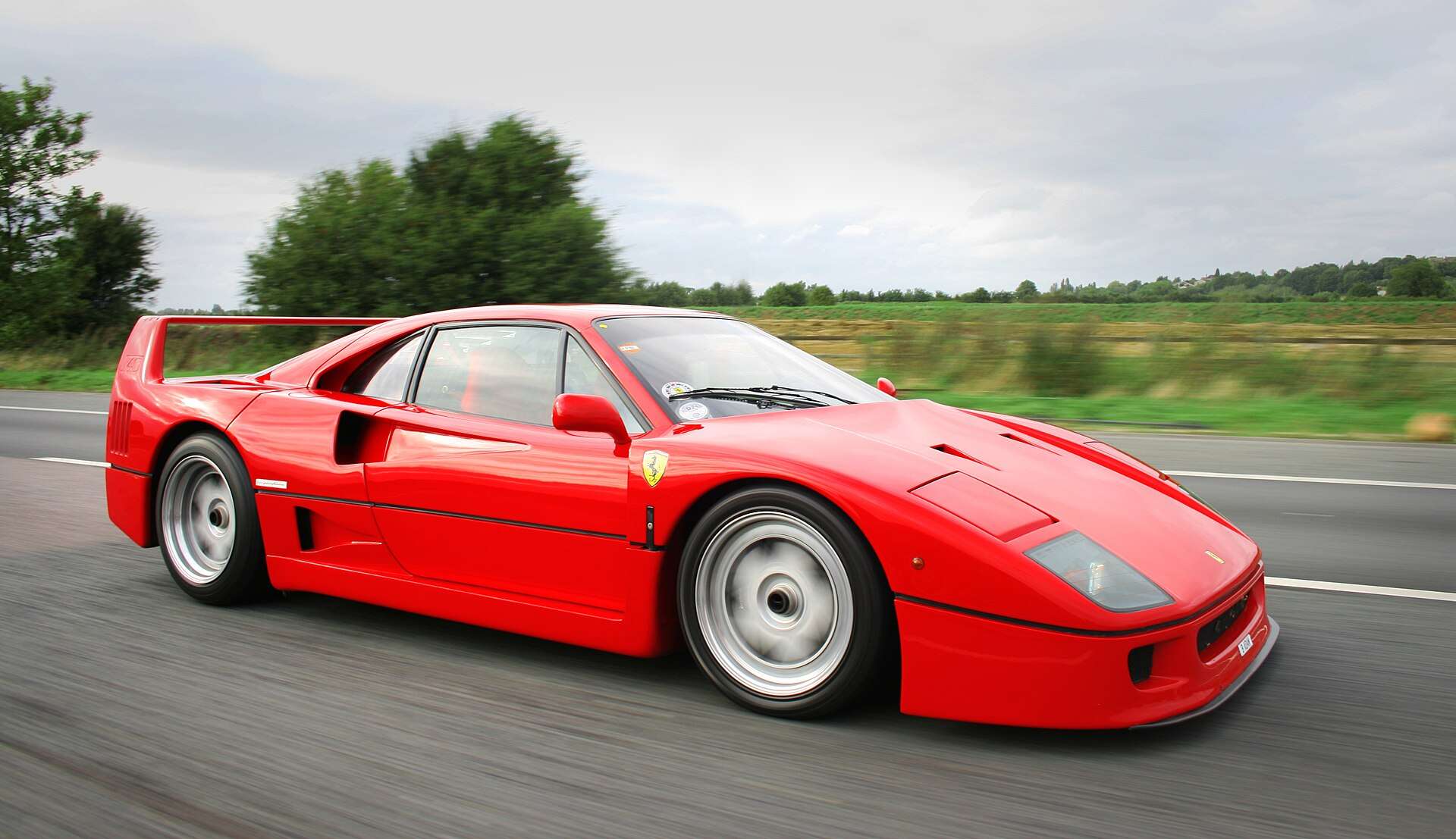
When Ferrari’s technicians lifted the twin-turbo V8 out of Lewis Hamilton’s newly acquired F40 in Maranello, they found the number 44 stamped on the engine. Hamilton has raced with No. 44 since 2014. “I was like, ‘you’ve got to be lying,'” he said. “So it feels very much fate.”
It is a wonderful detail, and it will follow this car for the rest of its life. But it is not the reason serious collectors should pay attention. The number that matters here is 69, the kilometres the car covered between the factory and its first owner’s garage, where it then sat, by Hamilton’s account, for more than three decades. The engine number is a coincidence. The 69 kilometres are a condition. What happens to that condition now, in the hands of a sitting Ferrari works driver, is the real story.
He Went Looking for Authenticity, Not an F40
Hamilton made his intentions clear long before the car surfaced. In September 2025 he said he had sold every car he owned: “I got rid of all my cars, I’m more into art nowadays.” In the same breath he left one door open. “If I was going to get a car, it would be the F40. But that’s a nice piece of art.”
That framing explains everything that followed. When he went shopping, he did not look for the best-driving F40 or the cleanest restoration. “I wanted to find the most authentic one,” he said. The car he found had been bought new, driven from Maranello to its owner’s home, “and then parked it and never started it again.” He announced it on Instagram on September 2, then brought it to the Italian Grand Prix at Monza, where it was photographed on the old banking.
Hamilton has already floated the idea of an analog Ferrari supercar he’d call the “F44”, so his attachment to this era of Maranello thinking is not new. What is new is that he now owns its purest surviving expression.
Why the F40 Is the Right Car for This Kind of Purchase
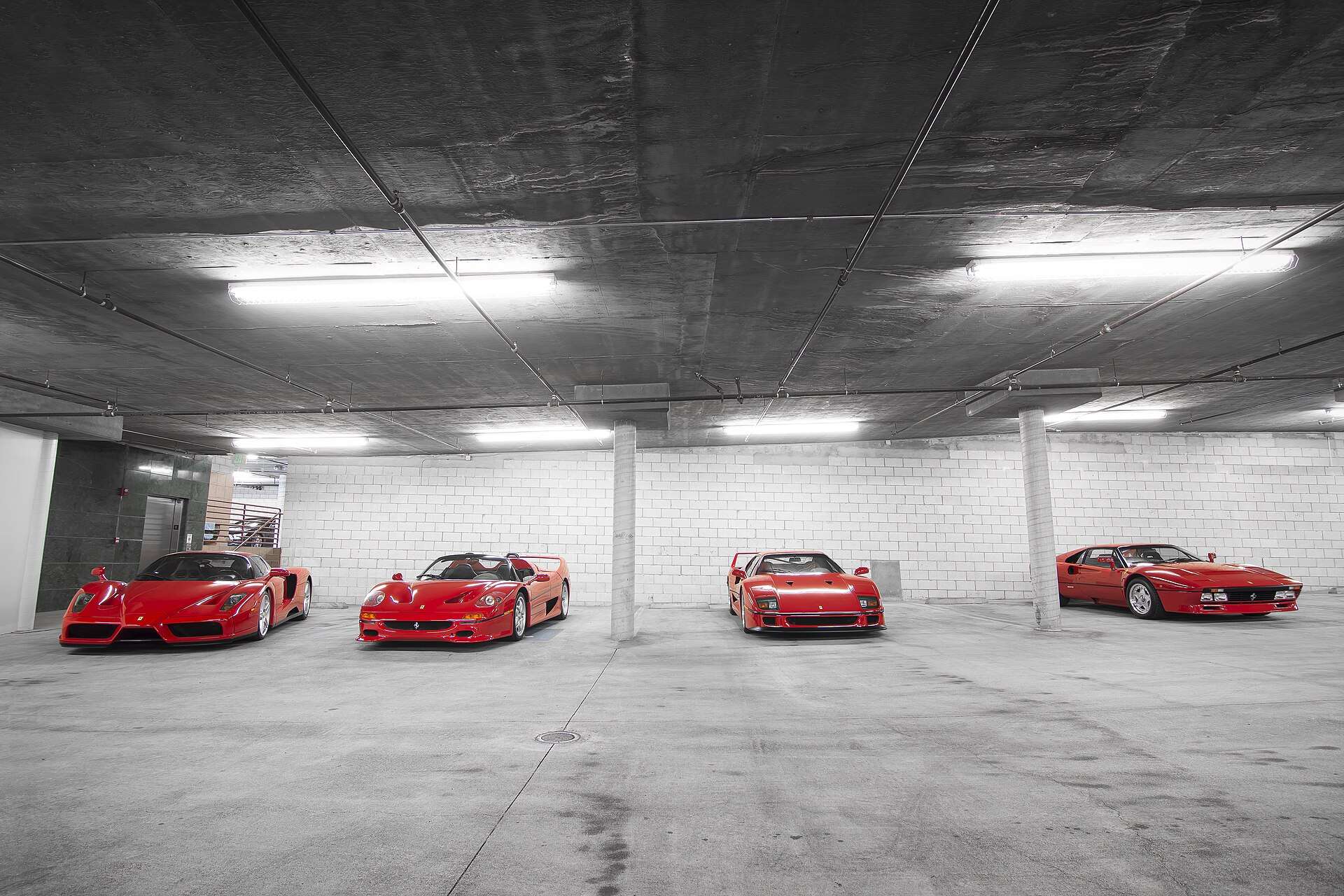
Plenty of Ferraris are rarer. Ferrari’s own records put F40 production at 1,311 cars between 1987 and 1992, a large number next to the 288 GTO or the F50. Rarity is not what makes the F40 blue-chip. Three things do.
The first is timing. The F40 was built to mark Ferrari’s 40th anniversary, and Ferrari notes it was the last new-car presentation Enzo Ferrari attended before his death in August 1988. Every later Ferrari supercar was developed in a company Enzo no longer ran.
The second is engineering philosophy. The 2,936cc V8, with twin IHI turbochargers and 478 bhp, sat in a car that brought composite body construction into Ferrari series production. There is no power steering, no ABS, and no driver aids. The F40 is the last time Ferrari built its flagship as a road-legal competition car with almost no concession to comfort.
The third is cultural. For the generation now at the top of the collector market, the F40 was the poster. Hamilton’s own words, “As a kid I dreamt of having one,” describe a large share of today’s buyers. Buyers at this level are not paying for performance figures. They are paying for the car that defined what they wanted when they were young.
A Time Capsule Is Not the Same as a Barn Find
Early coverage called the car a barn find. That is the wrong label, and the difference matters. A barn find is usually a car that was used, neglected, and abandoned. This is a time capsule: a car that was barely used and then stored. Hamilton described it as having “the dust on the paint, the dirt in the grille” and said it was “still exactly as it was when it left the factory floor.”
Time capsules are not free of problems. They simply have different ones. An F40 that has sat for 30 years has components that age with time, not use: the rubber fuel bladders, the cam belts, seals, hoses, fluids, and tyres. None of these care about the odometer. A 69-kilometre F40 cannot be safely driven until those parts are dealt with, and how they are dealt with decides whether the car keeps its originality.
That is why the choice of Maranello is the most important decision Hamilton has made so far. Hamilton said Ferrari’s engineers and mechanics “worked for weeks to bring her back to life.” For a car like this the right word is recommissioning, not restoration. Recommissioning replaces what has to be replaced for safety and keeps everything else. Restoration, done wrong, refinishes the very surfaces that prove a car’s history. The Ferrari Classiche department was set up in 2006 to certify and care for older Ferraris against the factory’s own production records. Having that work documented in-house gives this car paperwork no independent shop can provide.
Those Classiche records will matter more to a future buyer than the photographs from Monza. A time-capsule car is a promise of originality. Recommissioning is where that promise is either kept or spent.
What the Market Says About Low-Use F40s
The F40 market has moved dramatically in a decade. In August 2015, Coys sold a single-family 1992 F40 at the Nürburgring for €1.12 million, then reported as an auction record for the model. In 2026, RM Sotheby’s sold a 1,418-kilometre, numbers-matching 1992 example from the Drift Capital Collection at its ModaMiami sale for $5,230,000. That was above its $4 million to $5 million estimate. The car had won a Cavallino Platinum Award, and the catalogue stressed its factory witness marks and exposed carbon weave.
The lesson in that result is not that F40s are expensive. It is that the market now pays a separate premium for evidence of originality, on top of the premium for the model. The same thing has happened across the modern-classic segment, from a 958-mile 288 GTO to the sharp movement in F50 values. Our coverage of a “non-cat, non-adjust” F40 made the same point: in this model, specification and condition now separate cars by millions. At the other end of the spectrum, a crashed and rebuilt F40 LM still sold for $11 million, which shows how much competition history can outweigh condition.
Collectors who study engine numbers will recognise the logic. As with Porsche 911 engine numbers, what moves money is not the digits themselves but what they prove. Engine No. 44 is a charming footnote. A documented original engine, in a car with 69 kilometres, recommissioned by the factory, is the asset.
The Name on the Registration Changes the Asset
Celebrity ownership usually adds less than headlines suggest. When Michael Jordan’s Ferrari 550 Maranello sold for $2.7 million, the car itself was never the main asset; the name was. Hamilton’s F40 sits in a different category. He is not simply a famous owner. He is a seven-time world champion driving for Scuderia Ferrari, and the car was recommissioned by the factory while he was on its payroll. That is provenance tied to the marque itself, not to fame in general. Add the engine number, and the car has a story no other F40 can claim.
That creates the dilemma Hamilton now faces, and he seems aware of it. He called the F40 “a nice piece of art” before he owned one. Each kilometre he adds is a kilometre a future custodian will not get back. Yet an F40 that is never driven fails at what Enzo Ferrari built it to do. There is no right answer, only a choice about which kind of car this will become: a preserved reference example or a driven icon with a remarkable owner. Both are legitimate. They are not the same asset.
What Serious Buyers Should Take From This
For anyone shopping for an F40, Hamilton’s process is a useful model. He started with authenticity and worked backwards to the car. He used the factory for the mechanical work. He has kept the car’s history visible. Buyers should ask the same questions of any low-mileage example: when were the fuel cells and belts last replaced, and by whom? Is there Classiche certification? What has been refinished, and why? Low mileage on a car that has never been recommissioned is a cost, not a credential.
The engine number will make this F40 famous. Its originality, and the care taken to preserve it, will decide what it is worth to the next owner. Mileage is only a number. Originality is a decision, and every owner makes it again each time the key turns.
Lead image: Will Ainsworth / Wikimedia Commons (CC BY-SA 3.0)
The collector car market, every weekday morning.
Auction results, price moves and what’s crossing the block, read in four minutes. Free, from Modern Car Collector.
No spam, unsubscribe in one click. Or read more about the Brief.
 Shawn Henry
  Kyle Matthews