

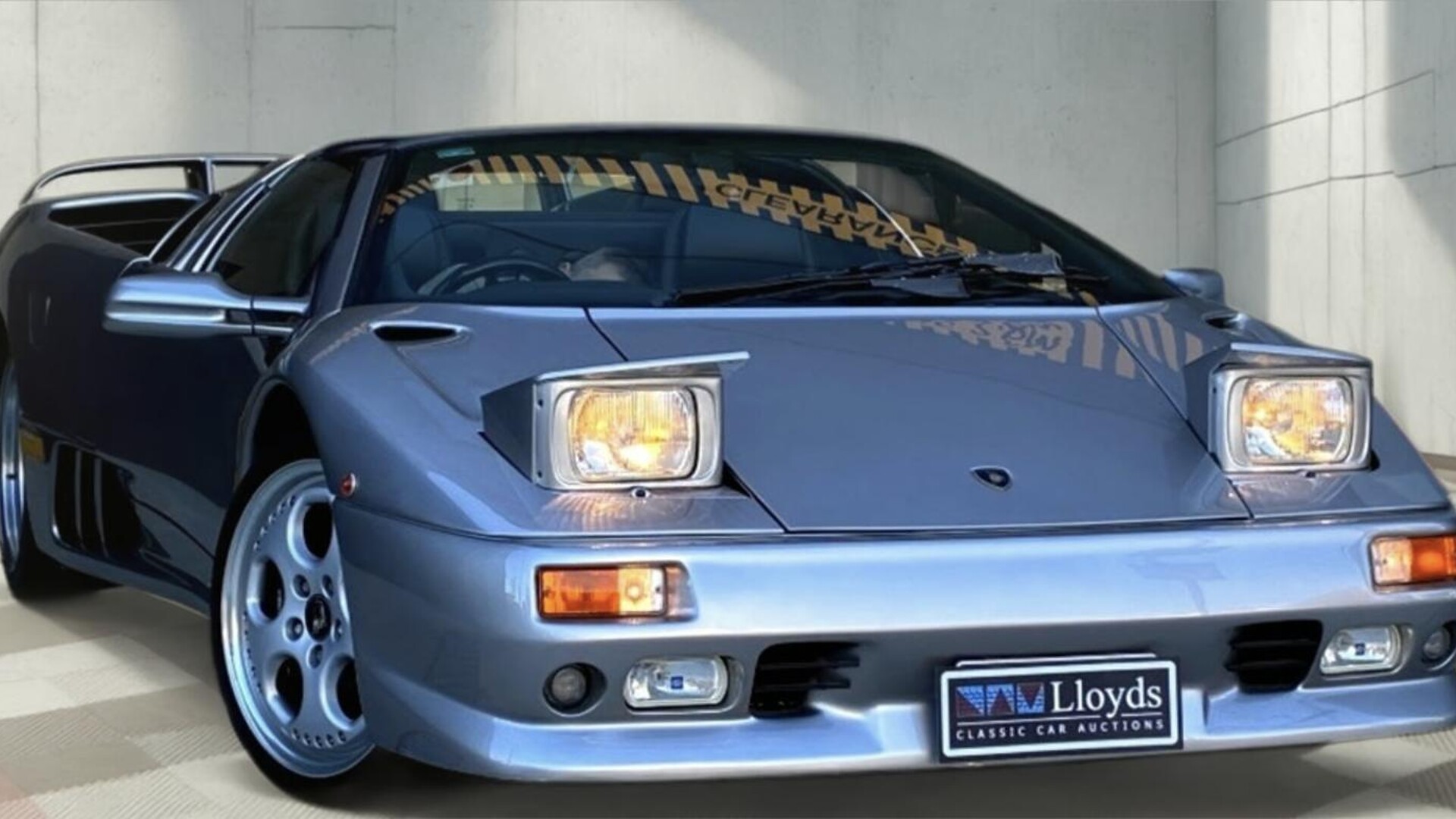
There are two small plates in the engine bay of Lot 10 at Lloyds Auctions, and between them they say more about this 1998 Lamborghini Diablo VT Roadster than the odometer, the paint, or the famous name attached to the sale.
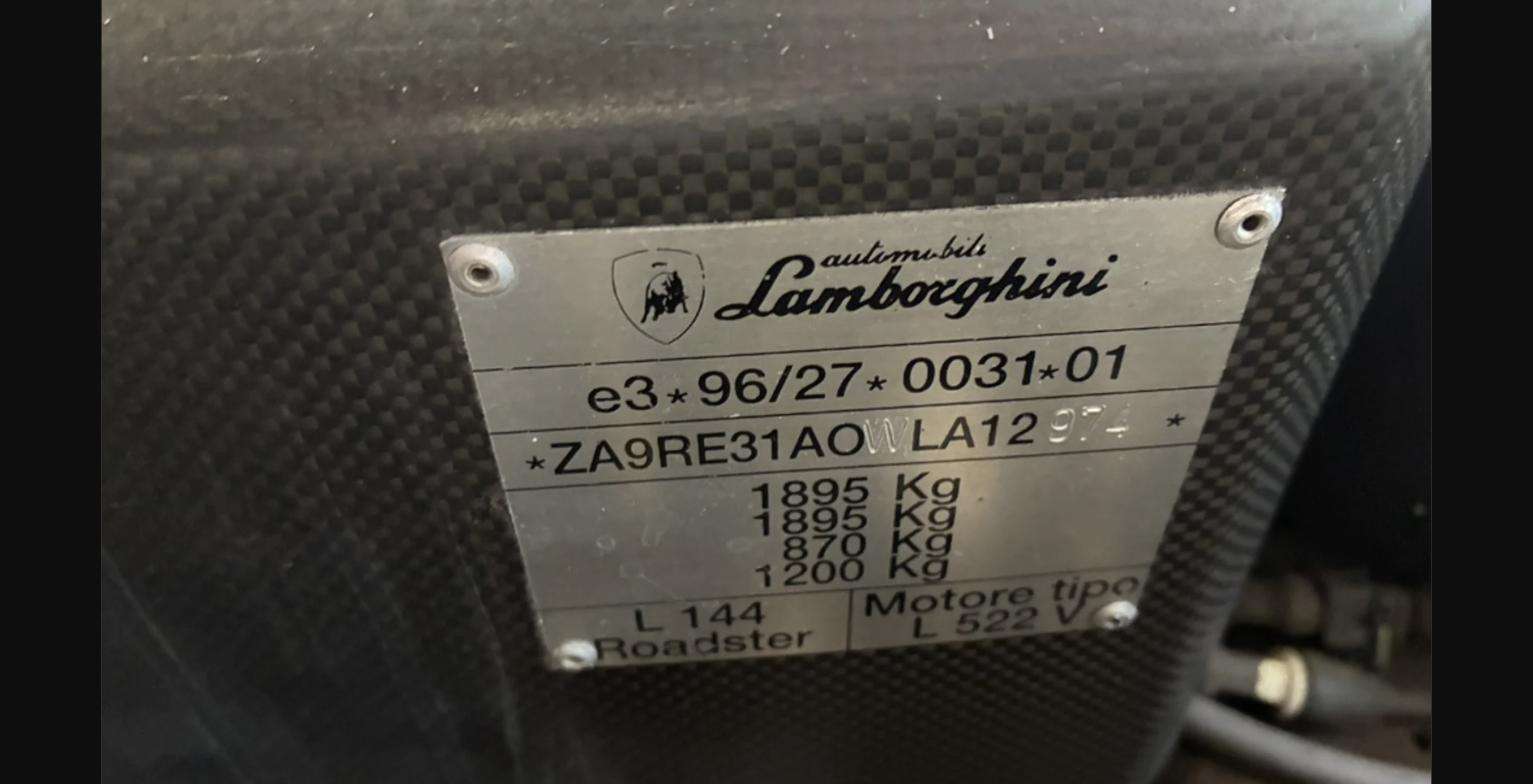
The first is riveted to a carbon panel behind the cabin. It carries European type-approval markings, the chassis number ZA9RE31A0WLA12974, four axle and gross mass figures, and then the two entries that matter most: the factory’s internal type designation, L 144 Roadster, and the engine type, L 522 V. That plate is the car’s birth certificate, and it settles the most basic question a buyer can ask. Lamborghini built this car as an open Diablo. It is not a coupe with its roof cut off, and it is not a later car wearing earlier badges.
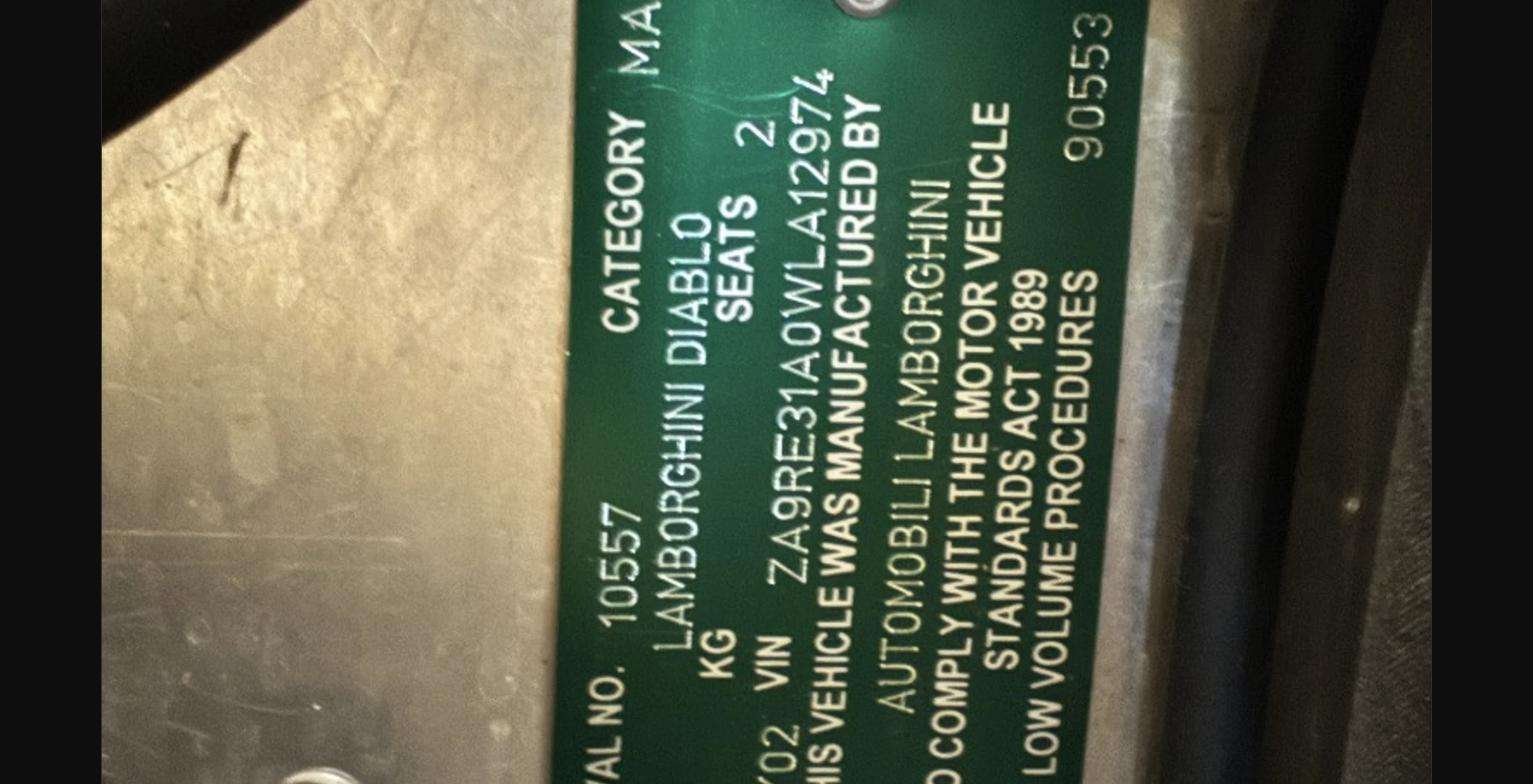
The second plate is green, and it is the one experienced buyers should read twice. Approval No. 10557. LAMBORGHINI DIABLO. CATEGORY MA. SEATS 2. The same chassis number. LOW VOLUME PROCEDURES. And, stamped into the corner, a date: 09/02.
September 2002. Four years after the car was built. That single stamp is the most valuable piece of information in the entire listing, and the catalogue never mentions it.
What Lamborghini actually built
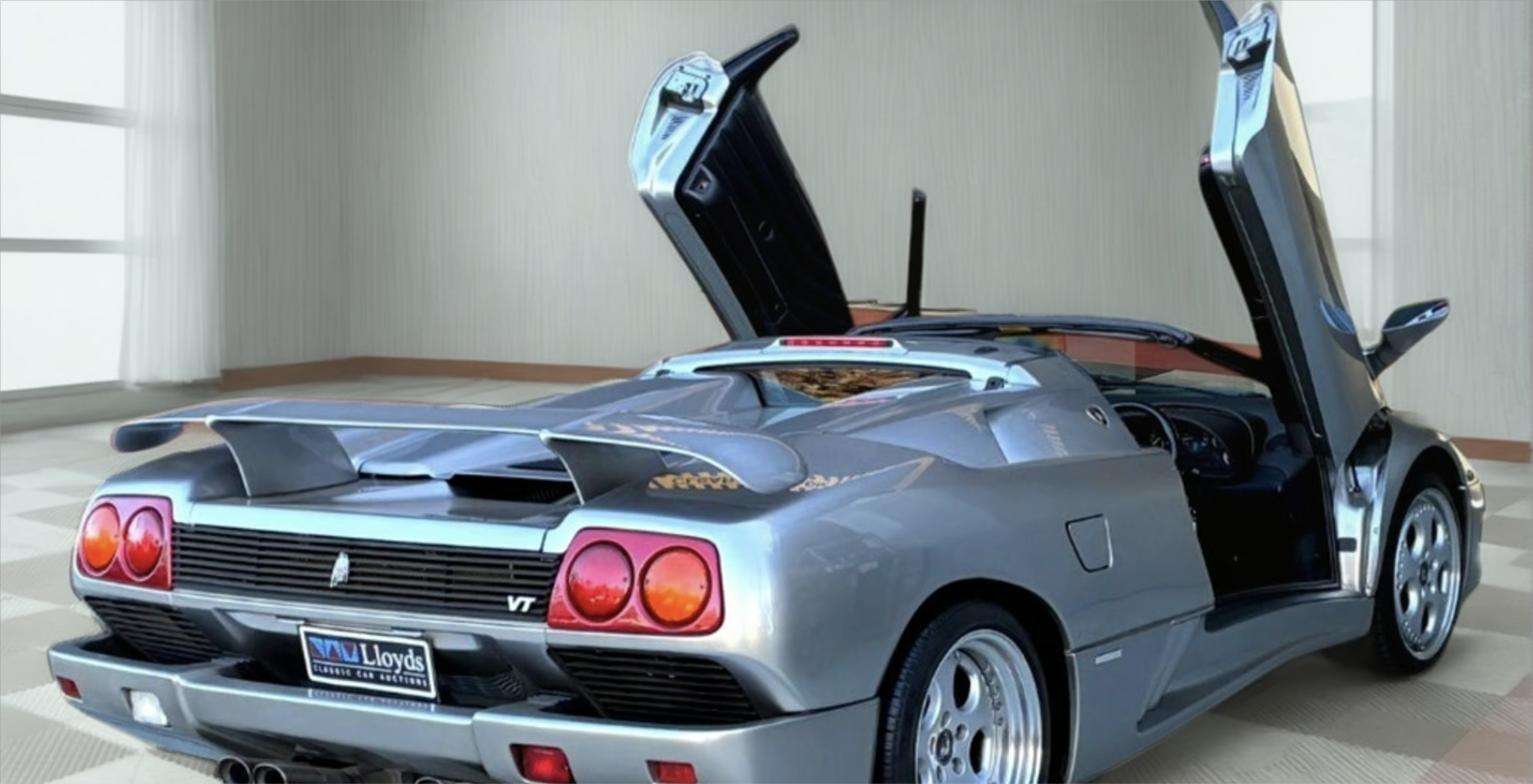
The VT Roadster arrived in 1995 and did something no production Lamborghini had managed before: it took the roof off. The Miura, the Countach and the early Diablo were all closed cars. The Roadster’s answer was a carbon panel that lifts out and clamps to the engine cover, a solution that is half engineering and half theatre, and which explains the strange, buttressed rear deck that has become the model’s signature.
VT stands for viscosa trazione. A viscous coupling sends a modest share of torque forward when the rear axle gives up, which in a 1990s mid-engined V12 wearing 335-section rear tyres is less a performance feature than an insurance policy. The plate’s axle ratings quantify the car’s character better than any brochure ever did: 870 kg permitted at the front, 1,200 kg at the rear.
The tenth character of the chassis number, W, denotes the 1998 model year, and 1998 is the hinge point of the entire Diablo story. It was the last full season of the 5.7-litre engine before the Audi-era 6.0 arrived for 1999. It was the last year of the pop-up headlights, which the 6.0 replaced with fixed units. And it was the year Audi took control of Sant’Agata. Every Diablo built after this one was signed off under different ownership. That is the argument for a 1998 car over a 2000 car, and it is a far better argument than horsepower.
It is also why the Diablo occupies the position it does. As we argued when the model passed its 35th birthday, this is the last Lamborghini drawn from Marcello Gandini’s hand, the last one you steer rather than negotiate with, and the last before the marque became an engineering department inside a German group. Collectors are not paying for the V12. They are paying for the last car built before the adults arrived.
Where the catalogue and the factory disagree
Three details in the Lloyds description do not survive contact with the car. The specification table lists the body as a coupe, while the factory plate and the engine-cover badge both read Roadster. The description credits a six-speed manual, but the Diablo used a five-speed gearbox throughout its production life; Lamborghini’s first six-speed road car was the Murcielago in 2001. And the quoted 492 horsepower is the pre-1996 output. From the 1996 model year, the 5.7-litre VT and VT Roadster were rated at 530 horsepower after revised induction and valve timing.
None of this makes the car worse. All of it makes the point that catalogue copy is marketing, not documentation. We have made the same argument about a Chevelle described as a survivor and about a car nobody had bothered to write down, and it applies just as forcefully at this level. The Diablo never had a sixth gear. Any description that gives it one is telling you exactly where its research stopped.
The 09/02 question
Australia never granted Lamborghini full-volume type approval, so every Diablo plated for road use here came in under Low Volume Procedures. That part of the green plate is entirely normal. The date is not.
A car sold new in Australia is complied within weeks or months of landing. A 1998 build carrying a September 2002 compliance date almost certainly did not begin life here. The instrument cluster narrows the field further: the speedometer is calibrated in kilometres per hour, which rules out a British-market car and points instead to one of the metric right-hand-drive markets. Japan and Hong Kong absorbed a substantial share of right-hand-drive Diablo production, and in the early 2000s Australia and New Zealand absorbed a great many of the supercars those markets no longer wanted.
To be clear, this is not a defect. A well-kept ex-Japan Diablo is not worth less than a well-kept ex-Australia Diablo; right-hand drive is right-hand drive. But it does mean the first four years of this car’s life, arguably the years that matter most to any odometer claim, sit in a file that is not in Victoria. The catalogue’s framing of right-hand drive as a rare specification for the Australian market invites a reader to assume local delivery. The plate does not support that assumption.
This is the whole lesson of the 1990s supercar market compressed into one stamped rectangle. When the Bugatti EB110 market matured, it did not reward the lowest mileage or the brightest paint. It rewarded the cars whose histories could be read end to end. The same has happened to the Buick GNX, to air-cooled Porsches, and to every category where supply stopped being the scarce input and certainty took its place. Rarity sets the ceiling in this market. Paperwork decides how close to it you get.
A living estate, an online-only sale and a visible floor
The Diablo leads one part of a seven-part Lloyds event drawn from the private collection of Darryn Lyons, the paparazzi agency founder, media personality and former Mayor of Geelong. The same part of the sale includes a 2002 Ferrari 360 Spider and a 2021 Range Rover Sport SVR, a grouping that tells you this is a personality’s garage rather than a curated collection. That is a description, not a criticism. There is even a Ferrari-branded sunshade folded against the Diablo’s windscreen in the catalogue photographs, which is the sort of detail that makes a garage feel lived in.
Be clear-eyed about what that name does, though. Celebrity association of this kind generates attention, registrations and bidders on the day. It very rarely generates durable value, because it does not attach to the car in any documented way. The exceptions are instructive: a Ferrari 550 that vanished for 24 years under one traceable owner, or a Rover that can be tied to Grace Kelly on paper. In both cases the provenance is a record, not an anecdote. A living estate sale buys you an audience. It does not buy you history.
Two structural features of this sale deserve attention. It is internet and absentee bidding only, with no room, which for a six-figure car shifts the entire burden onto the prepared bidder and rewards anyone who has actually inspected the lot. And there is already a single registered bidder at A$280,736 with more than five weeks left to run. A public standing bid that early functions as a visible floor, and floors anchor. Everything that follows will be measured against a number set before most serious buyers have seen the car.
The tax detail is worth reading too. Lloyds notes that the vendor is not registered for GST, so no GST applies to the asset itself, and the 8.8 per cent buyer’s premium is quoted GST-inclusive. On the standing bid that puts the all-in purchase cost near A$305,400 before Victorian transfer duty, a roadworthy certificate and registration, because the car is sold unregistered and sits in Thomastown. For a GST-registered buyer the flip side applies: no GST charged means no input tax credit to claim.
Where this sits in the Diablo market
The top of the Diablo market is not here. It belongs to the SV, the GT and the Audi-era 6.0 cars. The 5,756-mile VT 6.0 that made US$804,000 earlier this year is the relevant marker at that end of the model range, and the Diablo GT occupies a tier of its own. The 5.7-litre VT Roadster is the late Diablo’s volume model, and it trades well below both.
What it has going for it is that the two things this market now pays for are both present in principle: an unmodified drivetrain and an open body. The first is not trivial. We have covered a supercharged VT Roadster and the Eccentrica reimagining of the platform, and both make the same point from opposite directions: once a Diablo has been improved, it competes on taste rather than originality, and taste does not compound. A standard 5.7 with its five-speed intact is the harder thing to find, and increasingly the more liquid one.
Geography helps as well. Right-hand drive limits American demand, because a 1998 car has now passed the 25-year federal import threshold but US buyers still discount right-hand drive heavily. In exchange it opens Australia, New Zealand, Japan, Hong Kong, Singapore, South Africa and the United Kingdom. That is a narrower pool than a left-hand-drive car enjoys, but a genuinely international one, and it is the same dynamic that has been splitting the Australian market in two between cars whose documentation is complete and cars whose documentation is not.
Preservation, or abstinence?
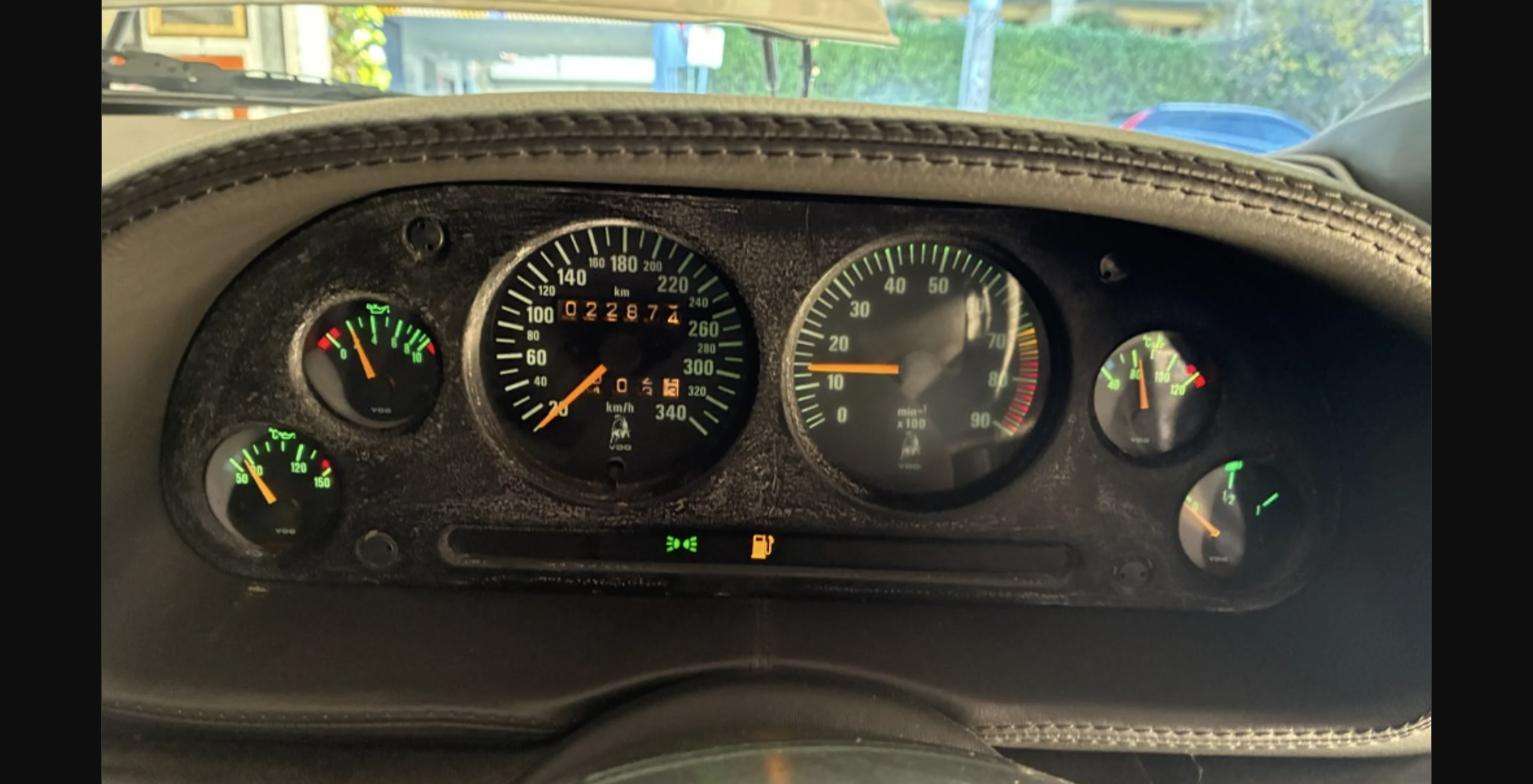
22,874 km across 28 years works out at roughly 800 km a year. That figure is presented as a virtue, and in one sense it is. But low use and good preservation are not the same condition, and they look identical on an odometer while costing very different sums to put right. A Diablo that has covered 800 km a year has spent most of its life not running. Rubber, hoses, fuel lines, seals, the air conditioning, the clutch hydraulics and the headlight lift motors all age on the calendar rather than the trip meter.
This is the point we made about a 240Z that had stayed in one family since 1975: the odometer is often the least useful number attached to a car. What matters is the shape of the use. Regular short runs preserve a supercar. Four years in a climate-controlled room does not.
What a serious buyer should do before the 38 days are up
Order a chassis research response from Lamborghini’s heritage department. A factory record will confirm original colour, trim, market of delivery, options and dates, and it will convert the compliance-plate inference above into fact. Then ask Lloyds for the import documentation and the 1998 to 2002 service history, not only the Australian books. A second Lamborghini plate in the engine bay reads 33631-SV; ask the factory what that number refers to and whether it matches the chassis record.
Physically, confirm that the targa panel photographed separately in the catalogue is the car’s own and that it fits and seals, because a Roadster missing its roof is an expensive puzzle. Check tyre date codes rather than tread depth. Have the viscous coupling and the five-speed assessed by someone who has worked on a Diablo rather than a Gallardo. Ask when the cam belts and valve clearances were last addressed, since those intervals are dictated by time and not distance. And verify that the number stamped in the block matches the engine number recorded on the listing.
The verdict
This is a genuine, standard-specification, right-hand-drive example of the last naturally aspirated, pop-up-headlight, pre-Audi Lamborghini flagship, offered from a well-publicised estate into an online-only sale with a floor already visible. Those are good ingredients, and the market’s current appetite for certainty should work in its favour. Whether it is a good buy depends almost entirely on a file nobody has published yet.
Strip the price out of this lot and the lesson survives intact, which is the test we apply to every car we write about. Originality is a claim. A plate is a fact. In a market that has spent the past decade learning to pay for certainty rather than scarcity, the cars that hold their ground are not the ones with the lowest numbers on the dial. They are the ones whose stories can be verified without taking anyone’s word for it.
The 1998 Lamborghini Diablo VT Roadster is offered as Lot 10 in The Living Estate of Mr Darryn Lyons at Lloyds Auctions, Thomastown, Victoria. Bidding is internet and absentee only. All figures cited here are drawn from the auction catalogue and from the car’s factory and compliance plates as photographed by the auction house.
The collector car market, every weekday morning.
Auction results, price moves and what’s crossing the block, read in four minutes. Free, from Modern Car Collector.
No spam, unsubscribe in one click. Or read more about the Brief.

 Kyle Matthews
  Eve Nowell