

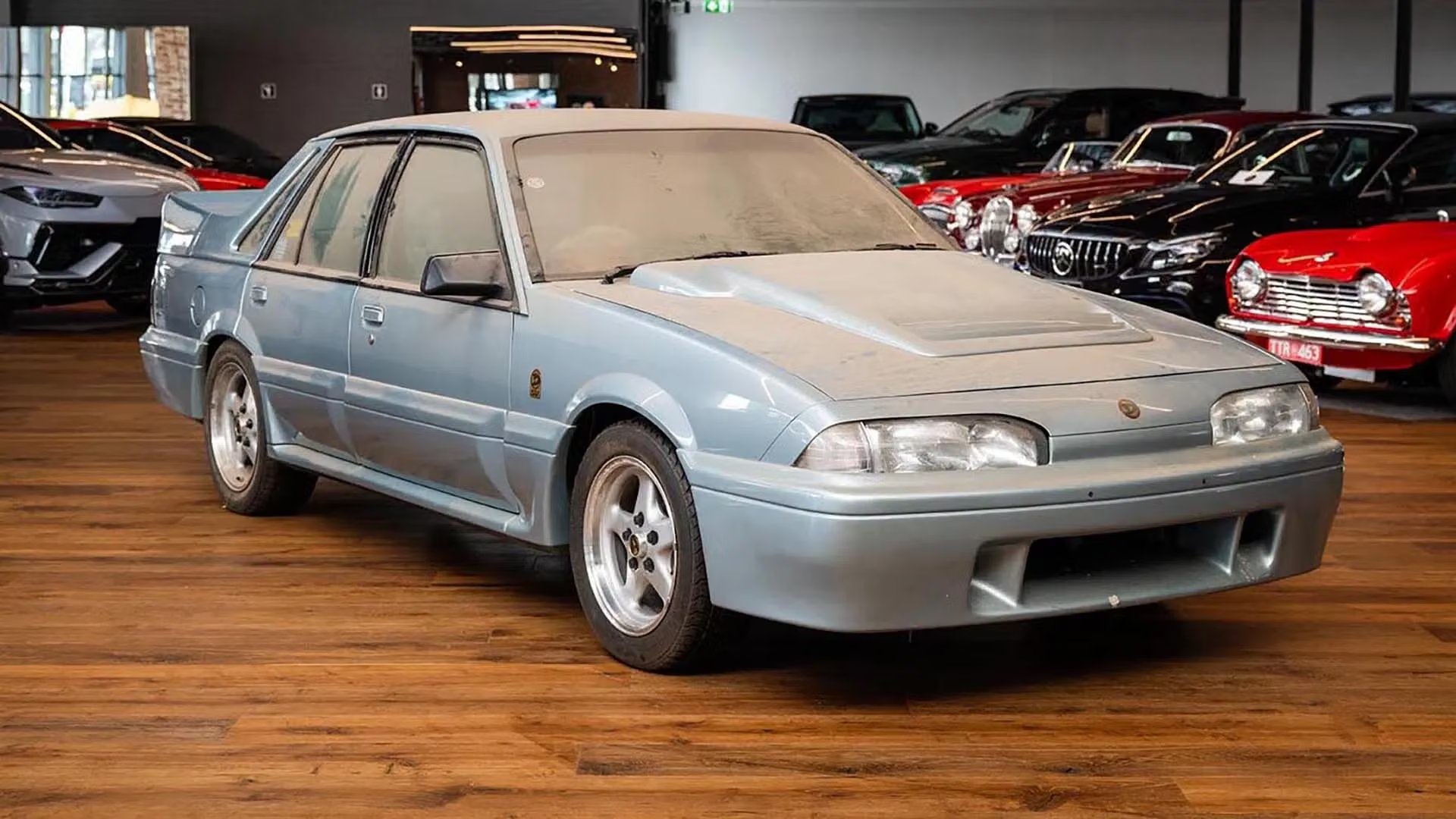
On September 30, an Adelaide dealership will close the expressions-of-interest window on a 1988 HSV Commodore VL SS Group A Walkinshaw showing twenty kilometres on its odometer. Modern Car Collector already explained why chassis 082 is less a low-mileage survivor than a car nobody ever finished delivering, its aero kit still shrink-wrapped and its seats still wearing factory plastic. What that story couldn’t answer, because the sale hadn’t closed, is the harder question: measured against what, exactly, does a car like this get valued?
Three Sales, One Season
This year alone has produced three data points that matter more than any headline record. In June, chassis 285 sold at auction for $209,000 with 45,764 kilometres showing. In July, a Walkinshaw carrying 122,679 kilometres failed to sell at all. Right now, chassis 304 is listed privately at $330,000 with 15,685 kilometres, and asking prices for presentable Group As on the open market cluster between roughly $220,000 and $355,000. Line those numbers up and a pattern appears immediately: within this model, kilometres aren’t a minor variable. They are close to the entire story.
The Record Isn’t the Benchmark Anymore
The number most often repeated for this model is $380,000, the price chassis 333 brought at a 2018 sale. But that figure has aged strangely. The same car was later offered at $575,000 without finding a buyer, and in 2021 a different Walkinshaw was listed north of $1 million with no confirmed sale ever disclosed. An asking price is a seller’s opinion. A completed sale is the market’s. By that stricter standard, the real ceiling for a driven, presentable Walkinshaw right now sits closer to $330,000 than to seven figures, which is exactly the kind of quiet correction Modern Car Collector has tracked across the wider collector market this year, where headline records at the very top increasingly coexist with a cooling middle.
Why Chassis 082 Doesn’t Fit Either Curve
Here is where chassis 082 breaks the pattern rather than confirming it. Every comparison above involves a car that was driven, registered and used as intended. Chassis 082 was not. Its bumper extensions have never been bolted on. Its interior has never been unwrapped. It was, in the fullest sense, never actually completed as a customer car, which means the mileage-based curve built from chassis 285, 304 and 333 can tell a bidder where the floor for a real Walkinshaw sits, but very little about the ceiling for one that was never allowed to become a real Walkinshaw at all. The only meaningful outer marker belongs to HSV itself: the modern GTSR W1 Maloo, which broke the million-dollar barrier for an HSV road car outright. Nobody should expect chassis 082 to reach that number. But it is the only company this car keeps.
What This Means for Bidders Before September 30
Richmonds’ decision to sell chassis 082 through expressions of interest rather than a published auction estimate is a sensible response to a genuinely unprecedented car, but it also means the final number will be shaped entirely by how many serious bidders show up believing this is a once-in-a-generation opportunity, and how many others are anchored to the softer numbers this year’s other sales produced. Buyers doing their homework should weight the realized sales, a $209,000 result and a $330,000 asking price against a higher-mileage no-sale, far more heavily than a decade-old record or the unsold seven-figure listings that never became real transactions.
A record set years ago mostly tells you what one determined bidder felt in a single room. A season of ordinary sales tells you what an entire market is willing to pay today. Chassis 082 is about to be judged by the second measure, not the first, and that is a far more demanding, and far more honest, test for any car this significant.
The collector car market, every weekday morning.
Auction results, price moves and what’s crossing the block, read in four minutes. Free, from Modern Car Collector.
No spam, unsubscribe in one click. Or read more about the Brief.

 Shawn Henry
  Kyle Matthews
  Eve Nowell