

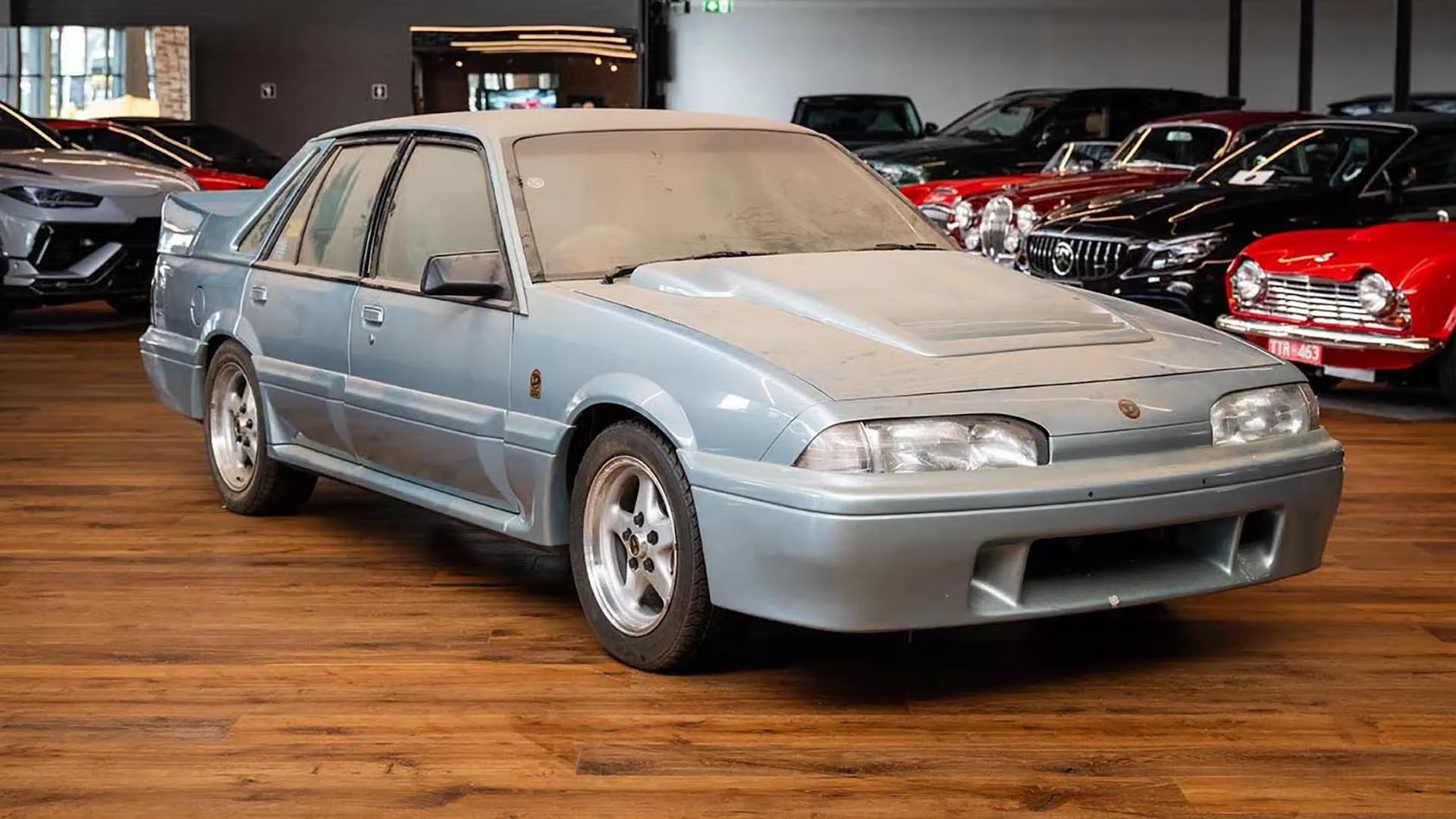
Somewhere in South Australia sits a 1988 Holden Commodore that has covered twenty kilometres in thirty-eight years. Its bumper extensions — the deep front and rear pieces that make a Walkinshaw a Walkinshaw — are still sealed in their original factory packaging, never bolted to the car. The protective plastics meant to shield the seats during transport are still on the seats. This is not a restoration, and it is not a sympathetic recommissioning. It is a car that Holden Special Vehicles built, and that a dealership simply never finished preparing for its first owner.
That distinction matters more than the odometer reading. Collectors have been trained by decades of “lowest mileage” marketing to equate small numbers with big value, but mileage alone has never been what separates a genuinely important collector car from an expensive one. What makes this particular car, chassis 082, significant isn’t that it has barely been driven. It’s that it was never allowed to finish becoming a car in the first place — and, nearly four decades later, nobody has decided to finish the job for it.
The Rule That Created a Legend
Holden Special Vehicles didn’t exist before this model. The VL SS Group A Walkinshaw, launched in 1988, was HSV’s first product — a joint venture between Holden and Tom Walkinshaw Racing built for one specific purpose: homologating a touring car under Australia’s Group A racing regulations, which required a manufacturer to build and sell a minimum production run of the road car before its racing counterpart could compete. That regulatory requirement, not a marketing plan, is the reason the Walkinshaw exists at all. It’s the same logic behind many of the era’s most collectible performance cars internationally, and it’s worth remembering whenever a “rare” homologation special comes to market: buyers aren’t really collecting a halo car. They’re collecting a compromise between motorsport rules and mass production, wrapped in a body kit. A Corvette Grand Sport that recently set a Monterey auction record tells a version of the same story — value rooted not in rarity for its own sake, but in the regulatory circumstances that forced the car into existence.
Production numbers explain why this matters within the model itself. Group A homologation rules initially required Holden to build 500 examples of the Walkinshaw before it could race. Chassis 082 falls within that first run, built specifically to satisfy the regulation before HSV added a further 250 cars once buyer demand, rather than the rulebook, took over. Collectors have long treated the original 500 as the more historically significant build, precisely because their existence depended on the racetrack rather than the showroom floor.
Sitting Unsold in 1988
The paperwork accompanying this car tells its own story. It was built by Holden in April 1988 and received its HSV modifications and compliance on 11 July 1988, then was sent to Canowindra Motors, a rural New South Wales dealership. It did not find a private owner until 1991 — three years after leaving the factory. That gap is worth sitting with: in the late 1980s, a Group A Commodore carried a steep price premium over a standard car, and dealers sometimes struggled to move them. The cars collectors fight hardest to own today are frequently the ones nobody particularly wanted when they were new.
A Paper Trail That Can’t Be Reconstructed
What survives with the car is arguably as important as the car itself: the factory release form, the dealership’s original inspection report, its first registration certificate and period NSW number plates, the original sales contract, and finance paperwork. In a collector market increasingly wary of cloned chassis numbers and reconstructed histories, an unbroken document trail from factory floor to first buyer is worth more than any styling detail. As a recent Steve McQueen-linked motorcycle sale demonstrated, documented ownership history is increasingly what separates a verifiable collector object from an expensive guess.
The Broader Pattern: Accidental Originality
This kind of survival story isn’t unique to Australian performance cars. A Mercedes-Benz 450SEL 6.9 that recently resurfaced after two decades in a garage and a seven-mile 1979 Pontiac Trans Am preserved since new both point to the same pattern playing out across the collector market: demand increasingly rewards cars preserved by circumstance — forgotten in storage, never prepped for sale — over cars preserved by intention through concours-level restoration. Accidental originality carries a credibility that no restoration, however meticulous, can fully replicate.
Built Mild, Meant to Race
Mechanically, the Walkinshaw was modest by today’s standards but pioneering by Australia’s. Its 4.9-litre V8 used the country’s first production fuel injection, producing 180kW and 380Nm, paired with a five-speed manual and a claimed 6.5-second sprint to 100km/h with a 230km/h top speed. HSV’s own follow-up, the carburetted, 136kW SV88, was noticeably slower — a reminder that the technology under the bonnet, not just the aerodynamic bodywork, is why this car needed to be homologated in the first place.
What the Market Is Already Telling Us
The clearest public benchmark for the model remains a 2018 sale of chassis 333, which brought AU$380,000 — a figure that redefined what an Australian performance sedan could be worth at the time. That record arrived only a few years before HSV’s own GTSR W1 Maloo broke the seven-figure mark at auction, evidence that the ceiling for Australian-built performance cars has been climbing steadily rather than plateauing. Whatever chassis 082 ultimately brings through Richmonds’ expressions-of-interest process — the Adelaide dealer has sensibly declined to issue a price guide for a car with no direct comparable — its emergence confirms that serious money is now chasing homegrown Australian metal with the same seriousness once reserved almost exclusively for European and American icons.
What Serious Buyers Should Watch For
For collectors evaluating this car, or any homologation special claiming this level of originality, the discipline is the same: verify the chassis number against factory and HSV records, confirm the accompanying documentation is contemporaneous rather than reconstructed, and resist the temptation to “finish” what the factory and dealer left undone. Fitting the unused bumper extensions or discarding the factory interior plastics might make the car look more complete. It would also destroy the very thing that makes it worth having in the first place.
Originality doesn’t decay in the collector market. It compounds. Chassis 082 has simply spent thirty-eight years quietly accumulating it.
Image: Richmonds
The collector car market, every weekday morning.
Auction results, price moves and what’s crossing the block, read in four minutes. Free, from Modern Car Collector.
No spam, unsubscribe in one click. Or read more about the Brief.
 Eve Nowell