

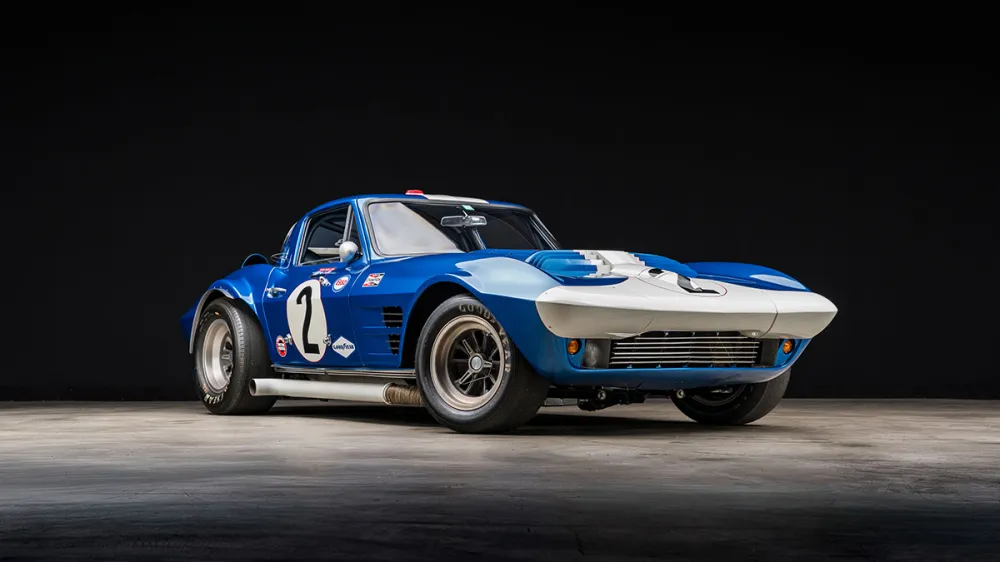
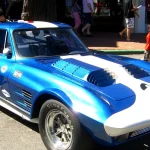
On Saturday night at RM Sotheby’s flagship Monterey sale, a 1963 Chevrolet Corvette Grand Sport sold for $18,705,000 with commission, shattering the previous record for a Corvette at auction. The headline will be the number. It shouldn’t be. Grand Sport chassis 003 did not become the most expensive Corvette ever sold because only five of these cars exist. It became the most expensive Corvette ever sold because it is one of the last unbroken pieces of evidence that General Motors, for one very short and very deliberate window, built a car explicitly to beat Ferrari and Shelby at their own game, then had to hide it from its own management to keep the program alive.
A Racing Program GM Wasn’t Supposed to Approve
The story begins with Zora Arkus-Duntov, Corvette’s chief engineer and the man most responsible for turning a styling exercise into a genuine performance car. By 1962, Duntov had watched Carroll Shelby’s Cobras embarrass production Corvettes in SCCA competition, and he set out to build a purpose-built lightweight racer capable of contending with Ferrari’s GTOs on the world stage. His plan called for 125 examples, enough to satisfy FIA homologation rules for the GT class. General Motors’ executive suite, still bound by the Automobile Manufacturers Association’s 1957 anti-racing resolution, had other ideas. When word of the program reached GM’s leadership, it was shut down after only five cars had been completed. Duntov, rather than scrapping the project, quietly moved the cars out the back door of the factory and into the hands of independent racers, a workaround that would define the Grand Sport’s identity for the next six decades.
What Chassis 003 Actually Did
Chassis 003 is one of three Grand Sports built in its original coupe configuration; the other two were later rebodied as roadsters to suit different competition classes. Wearing Blue No. 2, the livery it carried at the 1964 Sebring 12 Hour, the car is best remembered for a start assigned to A.J. Foyt, who began that race in 62nd position and famously passed nearly fifty cars on his opening lap alone. The Grand Sport finished second in class that year and returned to Sebring in 1965 to finish third in class. It has passed through a handful of long-term caretakers since, most recently 23 years in the collection of California collector Larry Bowman, and it remains active in historic racing today rather than sitting still as a static trophy.
Why This Isn’t a Matching-Numbers Story
It is worth pausing on what does not make this car valuable. Grand Sport 003 does not carry the appeal of a numbers-matching restoration returned to exact as-delivered specification, the kind of factory-correct authenticity that earns a street Corvette recognition like the NCRS Duntov Award. Race cars from this era were rebuilt, re-engined, and re-bodied constantly in period in the pursuit of finishing races, not preserving history. What collectors are paying for here is different: an unbroken competition identity, a documented chain of ownership, and a direct physical link to the exact moment Duntov tried, and failed, to make Corvette a world-class racing marque. For a car like this, originality of purpose matters more than originality of parts.
The Last Time This Market Had a Chance
The market has not had many chances to price a Grand Sport. The last one to reach public auction was chassis 002, one of the two cars later converted to roadster configuration and made famous by gentleman racer George Wintersteen. Offered by RM Auctions in Scottsdale in 2009 against a $7 million to $10 million estimate, it stalled at $5 million and failed to sell, later changing hands privately. It now resides at the Simeone Foundation Automotive Museum in Philadelphia, a fitting home for a car whose value has always been rooted in what it did on track rather than how it looks in a showroom. Seventeen years and one financial crisis later, chassis 003 more than tripled that stalled bid, a gap that says less about inflation than about how differently the market now treats verified competition history.
The Real Comparison
Context matters here, and Monterey supplied plenty of it this year. The same week that Grand Sport 003 crossed the block, Gooding & Company was offering two of the cars Duntov’s program was explicitly built to fight: a Ferrari 250 P, chassis 0810, carrying an estimate of $15 million to $20 million, and a Shelby Cobra Daytona Coupe estimated in excess of $25 million, both among the six lots we flagged as ones to watch heading into the week. An $18.7 million result places the Grand Sport squarely inside that company rather than beneath it. That is the real headline. For decades, America’s homologation-era racers have traded at a discount to their European and quasi-European rivals regardless of what they actually accomplished on track. This sale is one of the clearest signals yet that the discount is closing.
A Blue-Chip Signal in a Two-Speed Market
It is also worth noting what happened across town. A 1967 Corvette L88 coupe, the car that briefly held the Corvette auction record after selling for $3.85 million at Barrett-Jackson Scottsdale in 2014, was offered that same Saturday at Mecum’s Monterey sale and failed to sell against a high bid of $2.5 million. Two Corvettes, same weekend, same peninsula, wildly different outcomes. That split is not a coincidence; it is the two-speed market we have been tracking all year, in which blue-chip, well-documented cars keep setting records while everything below that tier competes for a shrinking pool of buyers. Monterey Car Week overall was forecast to approach half a billion dollars in total sales for the first time, and results like this explain why: the growth is concentrated almost entirely at the top.
What This Means for Collectors
What should serious buyers take from this? Rarity alone was never going to get a Corvette to $18.7 million; plenty of one-of-five and one-of-one cars sell for a fraction of that number every season. What moved this result was the combination of an authentic, undiluted factory skunkworks story, a race history that can be verified rather than assumed, and a chain of ownership documented well enough to withstand scrutiny. Collectors increasingly are not paying for horsepower, or even for scarcity. They are paying for a verified, unrepeatable moment when a manufacturer broke its own rules and got away with it. Chassis 003 is now the benchmark that every other Grand Sport, and every other Corvette with genuine factory racing pedigree, will be measured against for years to come. Readers curious about how Corvette got from that skunkworks program to today’s ZR1 can trace the fuller arc in our complete history of the Chevrolet Corvette.
Image via RM Sotheby’s
The collector car market, every weekday morning.
Auction results, price moves and what’s crossing the block, read in four minutes. Free, from Modern Car Collector.
No spam, unsubscribe in one click. Or read more about the Brief.

 Eve Nowell