
Ferrari’s first electric car sold for $40 million at RM Sotheby’s Monterey auction on August 15, thirty-six times its $1.1 million estimate and roughly sixty times what the car costs on Ferrari’s own price list. Every dollar goes to charity. Stop reading there, and you would walk away having learned almost nothing about the Ferrari Luce, the collector market, or what serious buyers should actually be watching this week.
The headline number belongs to a philanthropic transaction, not a market transaction, and collectors who have watched Ferrari run this exact playbook before know the difference. The more useful figure sits one line up in the catalog, in the pre-sale estimate. And the most useful detail of all is who was on the phone bidding.
What Actually Crossed the Block
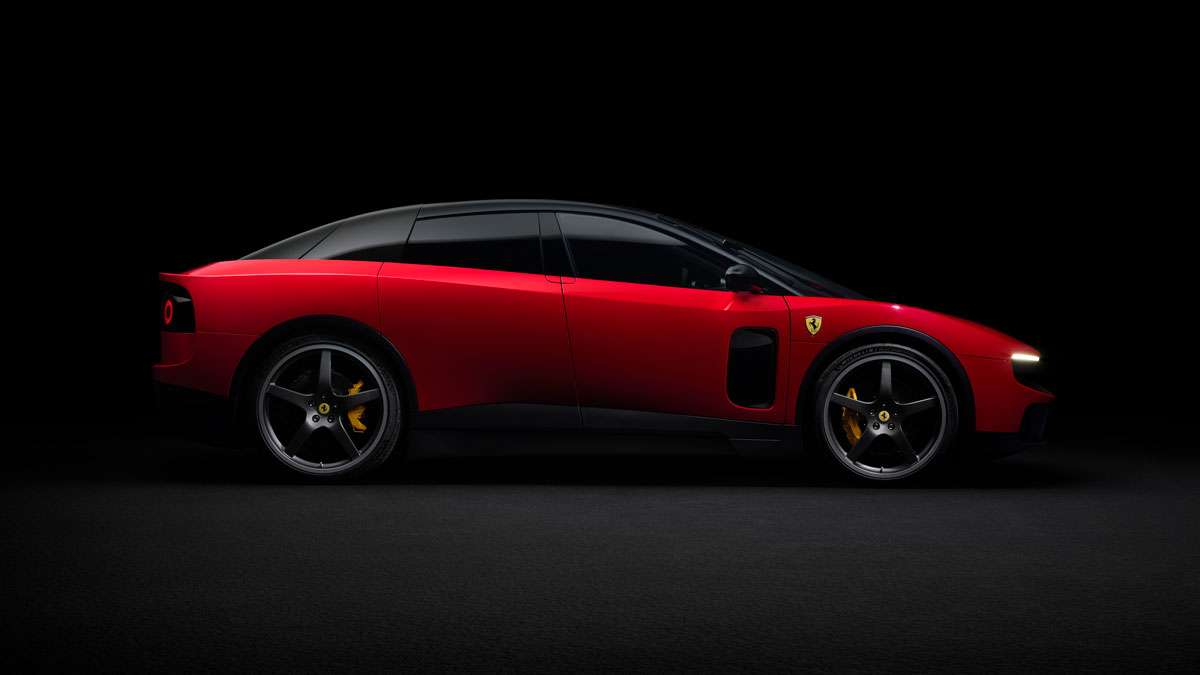
The car is chassis ZFF21BUA8T0338000, designated “Chassis 0,” the first production chassis of the Luce program, Ferrari’s first series-production battery-electric model. RM Sotheby’s sold it without reserve and waived the buyer’s premium, which means the $40 million hammer price and the charitable gift are the same number. Every dollar benefits the Ferrari Foundation, a 501(c)(3) that funds educational programs, and Ferrari has confirmed the car will return to Maranello for final assembly before delivery in the first quarter of 2027. The buyer does not have the car yet.
It is a Tailor Made commission, Ferrari’s bespoke-configuration program, built around a single theme: light. The paintwork is a one-off Madreperla Semi-Gloss finish that shifts from green to violet depending on the angle of the light, paired with Le Mans metallic leather in Perla and, for the first time on a Luce interior, Grigio Corvara trim in place of black. Dedicated wheels, bespoke brake calipers, and a prancing horse set against an optical white background complete a specification that exists nowhere else. A standard Luce, by comparison, lists at roughly $640,000.
Ferrari Has Run This Play Before
None of this is new. At the same Monterey sale a year earlier, Ferrari sold a one-off Daytona SP3, built beyond the model’s 599-car production run, for $26 million, also for the Ferrari Foundation. Go back further and a unique LaFerrari Aperta sold for $10 million at Ferrari’s own Maranello sale in 2017, raised for earthquake relief in central Italy.
Each of these cars shares the same structure: a one-off or extremely limited Tailor Made commission, no reserve, a charitable beneficiary, and a result that briefly becomes the most expensive new car ever sold at auction. It is a mechanism, not a coincidence, and it has become as reliable a fixture of Monterey Car Week as the concours lawns themselves.
The Detail That Changes the Story
Here is the part of the story that got buried under the headline figure: the buyer of this year’s Luce Chassis 0 is Dr. Herbert “Herbie” Wertheim, the Florida optics-and-investment billionaire who also placed the winning bid on last year’s Daytona SP3 for $26 million. This is not two separate corners of the ultra-wealthy independently deciding that Ferrari’s charity commissions deserve record sums. It is one collector, two years running, extending a personal relationship with Ferrari through its foundation.
That distinction matters for how collectors should read this result. A single repeat patron setting sequential records is not price discovery in any meaningful sense. It has more in common with a naming-rights gift than with a transaction tested by a competitive field of underbidders. Ferrari and RM Sotheby’s are both entitled to celebrate the headline. Collectors should recognize it for what it is.
The Number That Actually Tells You Something
RM Sotheby’s specialists estimated Chassis 0 at $1.1 million before the sale, a figure built from real comparables: Tailor Made commissions, first-chassis provenance, and the car’s place at the start of a new production line. That estimate, not the hammer price, is the market’s genuine read on what a bespoke, first-of-type Luce is worth to a collector operating outside a charity spotlight. It already represents roughly 1.7 times the retail price of a standard car, a legitimate premium for chassis-zero status and a one-off specification.
Set that $1.1 million against the real market for expensive electric cars. The Rimac Nevera and Pininfarina Battista, the two most expensive series-production EVs in the world, sit in the $2.2 to $2.5 million range, despite being built in far smaller numbers than Ferrari’s roughly 500-unit Luce allocation. Even the professional pre-sale estimate for a one-off Luce sits comfortably inside that company. The $40 million hammer price does not; it lands within $8.4 million of the $48.4 million RM Sotheby’s achieved for a 1962 Ferrari 250 GTO in 2018, one of the highest prices ever paid for a car at public auction. A brand-new electric model with zero delivered customer examples came close to a genuine blue-chip result set by one of the rarest, most historically significant automobiles in existence. That proximity says nothing about the Luce’s engineering or its long-term collectability. It says a great deal about what a determined patron and a compelling cause can do to a single evening of bidding.
The Actual Product Story
The Luce’s road to Monterey was not smooth. It drew heavy criticism at its Rome launch in May 2026, Ferrari’s stock dipped on the reveal, former chairman Luca di Montezemolo publicly questioned whether the badge belonged on the car, and Ferrari replaced its marketing chief the following month. And yet the entire 2026 allocation, just under 500 cars, sold out within two months, before a single customer example had been delivered.
That sellout, not the charity auction, is the real test of demand for the Luce as a product, and it deserves to be read alongside how other legacy marques are managing the same transition. Similar tension is playing out at Bentley, where the first electric Torcal arrives this September carrying its own version of the same reputational risk.
It also fits a broader shift in who is buying at the top of the market. The same Monterey week that produced this sale highlighted a hypercar collector scene increasingly shaped by celebrity ownership and spectacle, where reputation and mechanical significance now compete for the same buyer’s attention.
What Serious Buyers Should Take From This
None of this makes Chassis 0 unimportant. First-of-type chassis numbers carry genuine historical weight, and Ferrari’s decision to build its inaugural EV commission around a Tailor Made livery keyed to light is a legitimate piece of design history, worth documenting for whoever owns the car long after Wertheim. But collectors evaluating what this sale means for the broader market, or for the eventual resale value of a standard Luce, should separate the charitable premium from the collector premium, the same discipline we have argued for with a heavily customized Ferrari F355 elsewhere on this site: distinguishing what a car is actually worth from what a single moment, a single motive, or a single bidder made it briefly cost.
The car did not earn $40 million on Saturday night. The Ferrari Foundation did, and a longtime patron got to do it for the second year running, in public, at the most photographed auction week in the collector calendar. That is a fine outcome for education funding and for Ferrari’s press coverage alike. It is simply not the same thing as a market deciding what Ferrari’s electric future is worth, and collectors who confuse the two will be the ones surprised when the first standard-allocation Luce eventually resells for a small fraction of what Chassis 0 brought in Monterey.
The collector car market, every weekday morning.
Auction results, price moves and what’s crossing the block, read in four minutes. Free, from Modern Car Collector.
No spam, unsubscribe in one click. Or read more about the Brief.
Related Posts:
- Ferrari Daytona SP3 Value Jumped 168% in Ten Months.…
- Record Ferraris, Rare Icons and 15,000 RPM: The Week…

- Everything Modern Car Collector Covered Last Week
- The Collector Car Market Paid Up for Certainty This…

- Most Expensive Cars Ever Made (By Launch Price)

- Monterey Car Week 2026 Results: Why a Record Week…
 Eve Nowell