

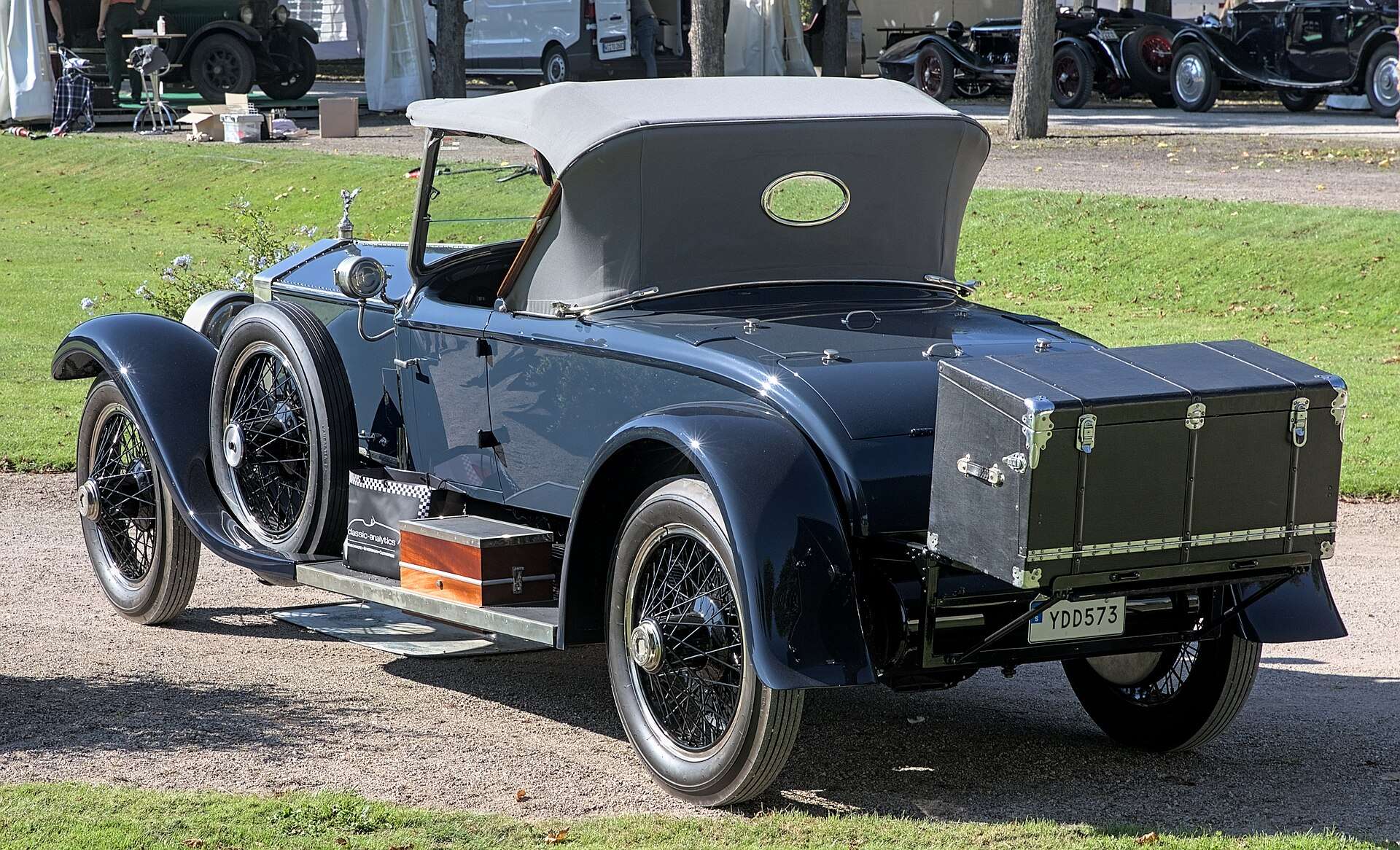
Rolls-Royce is marking 120 years of the 40/50 H.P., introduced at London’s Olympia Motor Show in November 1906, with chassis 1701 on display at the Home of Rolls-Royce at Goodwood. It is a fine choice. It is also a revealing one, because the car that gave the model its name, chassis 60551, registered AX 201, is not the car on the floor. It was released to a private collector in England in 2019.
That is the real story. A marque can own its name, its trademarks and its mythology without owning the object at the center of them. Heritage is not what a company says about itself. It is what the company can put in front of an audience.
The car that was a nickname first
Chassis 60551 was the twelfth 40/50 chassis built. Rolls-Royce’s own account says Claude Johnson had it painted silver, with silver-plated fittings, and named it the Silver Ghost for its quietness and smooth running. The name stuck so completely that it was later applied to every 40/50, some 8,000 of them by the time production ended in 1925, 6,173 in Britain and 1,703 at Springfield, Massachusetts.
The car earned the name in 1907. It covered roughly 2,000 miles of the Scottish Reliability Trial with a single one-minute stop, to reopen a closed fuel tap, and then went straight into a day-and-night endurance run under Royal Automobile Club observation. Rolls-Royce rounds that run to 15,000 miles. The Concours of Elegance, which later exhibited the car, puts it at 14,371, about double the contemporary record. The discrepancy is small. The significance is not: this is the car that made “the best car in the world” a claim the company could document.
How a founding car leaves the family
AX 201’s later history is the kind of provenance collectors should study, because it was never a straight line. After a long period in private ownership it returned to the factory for repairs between 1948 and 1951 and was then used for publicity. A full restoration followed in 1989, ahead of the 1990 Silver Ghost Charity Tour from John O’Groats to Land’s End.
Then came 1998. When Vickers sold Rolls-Royce Motor Cars, the name and the cars were separated: the Rolls-Royce marque went one way and the Bentley business, with the Crewe factory, went another. AX 201 came under Bentley ownership. For two decades the car that defined Rolls-Royce sat on the other side of that divide. In 2019 it was released to a private collector in England. The buyer has not been named and the price was not disclosed.
The sequence afterward is instructive. When the Concours of Elegance announced the car for its 2021 show at Hampton Court Palace, it described the appearance as the car’s first public showing in more than 20 years. Whatever one thinks of the sale, a car that had not been seen publicly in more than 20 years was in front of an audience at Hampton Court within two years of leaving corporate hands.
Why 1701 is the right stand-in
If AX 201 is the myth of silence and reliability, chassis 1701 is the engineering behind it. Built at Derby for the 1911 London to Edinburgh Trial, it was nicknamed the “Sluggard” by Claude Johnson and driven by Ernest Hives, then an experimental test driver. It completed the trial with its gearbox locked in top gear, averaging 19.59 mph and returning better than 24 mpg, a figure that beat the numbers Napier had set. In a half-mile speed test it reached 78.2 mph. Later that year, fitted with streamlined coachwork, it reached 101.8 mph at Brooklands and became the first Rolls-Royce to exceed 100 mph.
There is a case that 1701 is the better artifact for a company that sells engineering credibility. It is a working document. It retraced the 1913 Alpine Trial route in 2013 among 47 Silver Ghosts, and in 2021 repeated the London to Edinburgh run in top gear, 110 years after the original. Its provenance is refreshed every time it is driven. AX 201’s, by contrast, now depends on the goodwill and calendar of a private owner.
That distinction matters to anyone who follows the brass-era market. It is the thread running through our coverage of the world’s oldest Rolls-Royce, which won Pebble Beach and now faces the run to Brighton, and of the Somerset hoard, where the paperwork matters as much as the cars. Even at the later end of the marque’s pre-war story, from a long-held 25/30 Sedanca de Ville to a pair of 1937 Phantom III models offered at no reserve, the same principle holds: collectors pay for what a car can prove.
What collectors should take from it
The lesson is not that corporate collections are bad custodians. It is that corporate heritage is not provenance. A manufacturer’s archive can tell a car’s story, but it does not guarantee that the car will stay in its orbit, and a trademark can change hands in a boardroom in a way a chassis plate cannot. Serious buyers should look at who holds the object, who holds the records, and whether the two remain connected.
Rarity is not what makes AX 201 remarkable either. Roughly 8,000 Silver Ghosts were built, and plenty survive. What is unique is that it is the car from which the name itself derives, and no amount of production history can duplicate a moment of naming. Collectors rarely pay a premium for the model. They pay for the moment the model became a legend.
Rolls-Royce gets to keep the anniversary, the name and a deeply credible car in 1701. The silver one belongs to someone else. A marque can inherit a name in a boardroom, but it cannot inherit the object.
The collector car market, every weekday morning.
Auction results, price moves and what’s crossing the block, read in four minutes. Free, from Modern Car Collector.
No spam, unsubscribe in one click. Or read more about the Brief.



 Kyle Matthews
 EL Puckett