

On the morning of November 1, chassis 20154 will pull away from central London and attempt sixty miles to Brighton on tires no wider than a bicycle’s, at a pace its 1904 designers never imagined it would need to sustain for that long. That a 122-year-old Rolls-Royce can attempt this at all is the real story here. That it already carries a trophy from Pebble Beach is almost beside the point.
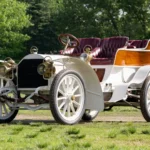
The car is chassis 20154, the oldest known surviving Rolls-Royce, and this autumn it will do something no static museum piece can: earn its keep on the road. On Saturday, October 31, it will headline the St James’s Motoring Spectacle on Pall Mall, part of a display of more than 150 cars expected to draw upward of 12,000 spectators to central London. The next morning it joins the RM Sotheby’s London to Brighton Veteran Car Run, the world’s longest-running motoring event, which this year marks the 140th anniversary of the birth of the motorcar. It is a homecoming three years in the making: owner Terry Bramall’s restoration returned the car to its original Park Phaeton coachwork, its factory primrose yellow, and its period M 612 Manchester registration, a project meticulous enough to win the Antique class at the 2026 Pebble Beach Concours d’Elegance before the car ever touched British tarmac again.
Four Survivors, One That Still Runs
Chassis 20154 was the fourth car ever built to carry the Rolls-Royce name and the third to wear the marque’s now-signature radiator, assembled at Royce’s Cooke Street works in Manchester in November 1904, just months after Charles Rolls and Henry Royce shook hands on their partnership at the city’s Midland Hotel. It was one of only 17 Type A 10 hp models built before the company decided its future lay elsewhere, and by most marque historians’ counts, only four survive today. One, chassis 20162, sits as a static exhibit in Manchester’s Museum of Science and Industry. Another, chassis 20165, belongs to Bentley, the marque with which Rolls-Royce shared a corporate roof for much of the twentieth century. A fourth is believed to remain in private hands, rarely if ever seen. Only 20154 is both roadworthy and, per Royal Automobile Club chairman Duncan Wiltshire, “the only known pre-1905 Rolls-Royce eligible to take part in the Run.”
Rarity alone doesn’t make a brass-era car significant; plenty of one-of-a-handful survivors are worth little more than curiosities. What makes eligibility the sharper credential here is what it proves that a display case cannot: that eighteen months of parts-hunting and factory-spec fabrication produced a car that actually functions as Royce built it, not merely one that photographs well. A Concours judge can confirm a restoration looks correct. Sixty miles of London traffic and Sussex hills, on a car with no windscreen wipers and a top speed measured in single digits, confirms it actually is.
Correctness Over Convenience
Bramall’s restoration is notable for what it didn’t do. Rather than build a more usable or better-optioned car, as many veteran-car owners quietly do, he chased exact factory specification. “Let’s do it just as it came out of the Cooke Street factory in Manchester,” he has said of the project, and the result includes details that add nothing to drivability or curb appeal beyond historical accuracy: the correct body configuration, the correct paint, the correct plate. That discipline matters more on a car like this than it would almost anywhere else in the collector market, because 20154 wasn’t an anonymous production unit to begin with. Built as a show car, it wore Barker’s Park Phaeton coachwork from new and was dispatched to the Salon de l’Automobile in Paris in December 1904, Rolls-Royce’s first international showing, where Charles Rolls collected a medal that still resides in the Monmouth Museum. This was a hero car from the day it left the factory floor, built to sell the idea of Rolls-Royce to the world. A restoration that treats it as anything less than a primary artifact of the company’s founding would be a restoration that missed the point.
What a Pebble Beach Trophy Signals, and What It Doesn’t
An Antique-class win at Pebble Beach usually precedes a market moment for cars this old; MCC has tracked that pattern with the 1937 Bugatti Type 57SC Atalante and the 1930 Packard 745 Sport Phaeton, both of which went to auction not long after taking home a class trophy. Chassis 20154 breaks that pattern. It has not been offered publicly since 2007, when Bonhams sold it during Pebble Beach week for roughly £3.2 million, the first time in a century the car had changed hands at all; it is not for sale now, and nothing about Bramall’s plans suggests that will change. Apply the simplest test in this business: if the sale price disappeared from this story, would collectors still learn something? Here, there was never a sale price to begin with. The story is the run, not the number, and that is precisely what makes it worth paying attention to.
It also fits a broader shift in what brass-era cars are being asked to prove. At this year’s Pebble Beach, a 1905 Mercedes quietly outshone a modern celebrity commission parked beside it, and the market has already shown it will pay real money for pre-1905 iron with the paperwork to back it up: a documented, running 1911 Oldsmobile Limited sold for $5 million last year, setting a record for the category. Collectors of this generation of automobile are no longer satisfied by rarity or a concours rosette in isolation. They want proof the thing can still do the job it was built for, and for cars built before 1905, there is no harder or more public proof available than the London to Brighton Run.
That is the standard chassis 20154 will be held to on November 1, not the standard of a show field. If it crosses the finish line in Brighton on its own power, the achievement will not be that the world’s oldest surviving Rolls-Royce looked the part at Pebble Beach. It will be that, more than a century after it debuted as Charles Rolls’s sales pitch to Paris, it is still capable of making the case for itself.
The collector car market, every weekday morning.
Auction results, price moves and what’s crossing the block, read in four minutes. Free, from Modern Car Collector.
No spam, unsubscribe in one click. Or read more about the Brief.
Related Posts:
- Record Ferraris, Rare Icons and 15,000 RPM: The Week…

- The Collector Car Market Paid Up for Certainty This…
- The Eendenmuseum’s 300 Citroën 2CVs Are Headed to…
- 6 Top Cars to Watch at the 2026 Monterey Auctions
- Project Nightingale Just Entered Testing. That Tells…
- Today in Collector Car History: The First Vanderbilt…
 Eve Nowell
  Kyle Matthews