

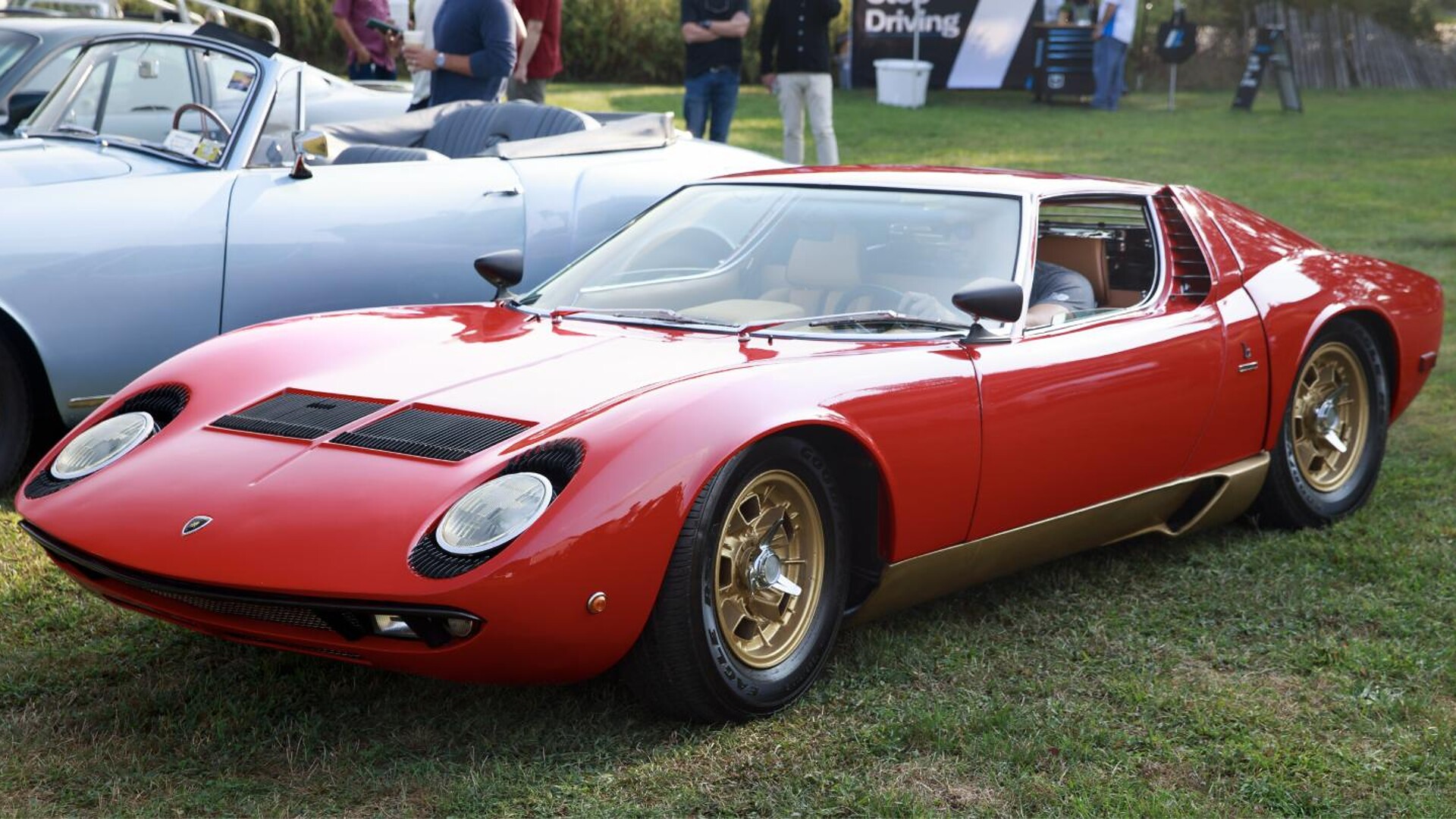
Twenty-three lots go under the hammer at RM Sotheby’s Zurich Auction on 26 September 2026, and most will be judged on spec sheet and paint code alone. Lot 114 is different. This 1969 Lamborghini Miura P400 S, chassis 4103, retains its matching-numbers engine, wears its original Rosso Corsa over Nero colour scheme, and carries documented ownership by 1980s Formula One race winner René Arnoux — the kind of file that turns a good Miura into a conversation. Estimated at CHF1,500,000–2,000,000 (roughly $1.82 million to $2.42 million at current exchange rates), it lands in the middle of a market for Lamborghini’s original supercar that has, in the past year alone, produced results ranging from $1.7 million to more than $6.6 million for cars carrying the same three letters on their decklid. What follows is what’s documented, what’s estimated, and what a bidder should actually be weighing on auction day.
The Car: Specifications and Early-Production Details
Chassis 4103 is an early-production P400 S — Bertone-bodied, mid-engine, and built during the model’s brief but consequential run. RM Sotheby’s catalog listing and supporting documentation establish the following as fact:
- Chassis No. 4103; Engine No. 30380, retained and matching to the chassis
- One of 338 examples of the Miura P400 S built between December 1968 and March 1971, out of roughly 763 Miuras of all variants (P400, P400 S, P400 SV) produced in total
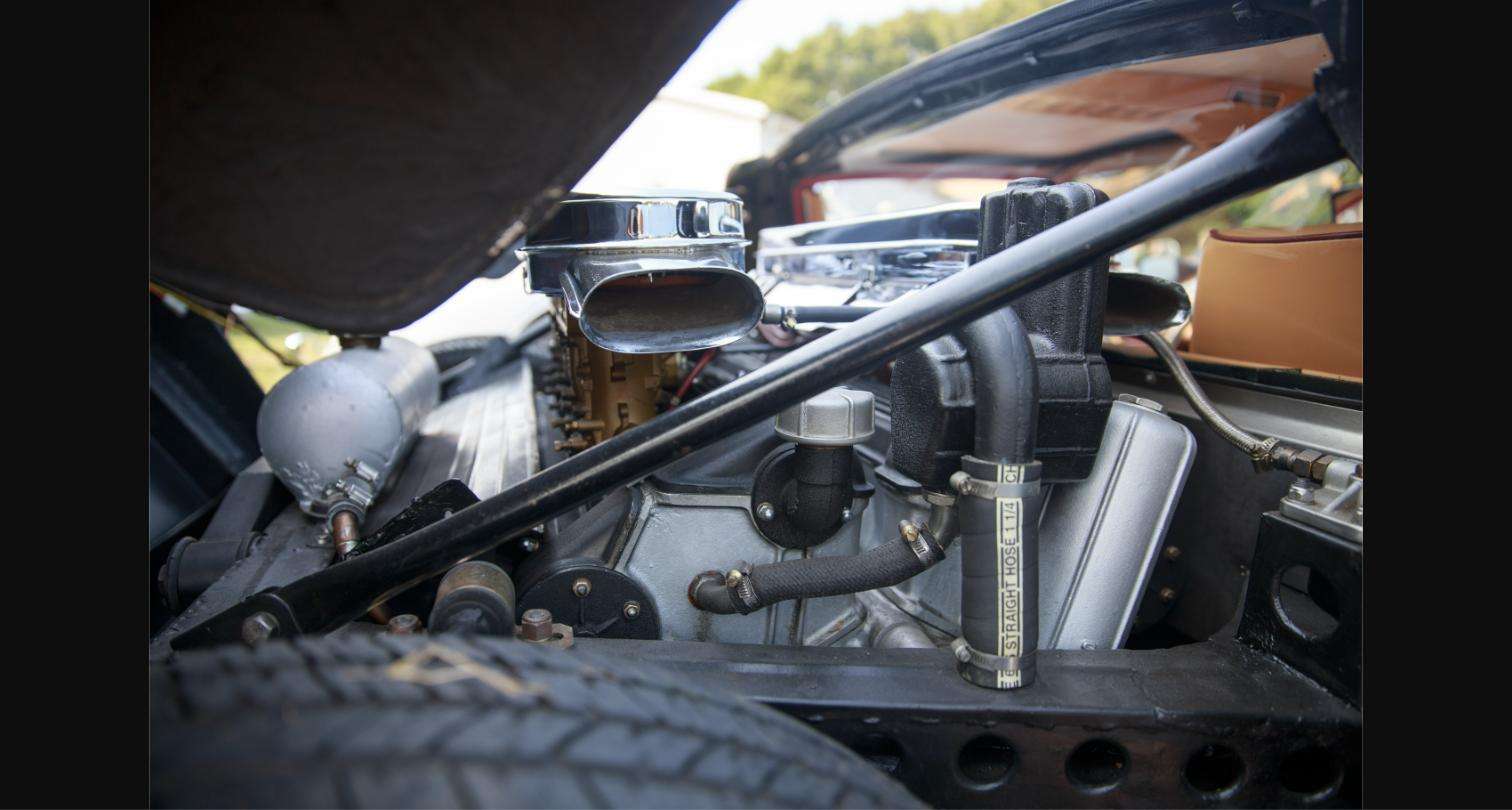
- Engine: 3.9-liter (3,929cc) transverse V-12, developed from Giotto Bizzarrini’s original design, updated for the P400 S with reshaped combustion chambers, four Weber 40IDL-3L carburetors, higher-lift camshafts, and a rerouted exhaust — output rose from 345 to 365 horsepower over the original P400
- Early-specification details unique to this build: solid (non-vented) disc brakes, chrome — rather than black — wiper arms and window surrounds, stainless-steel headlight bezels, and the Miura’s signature front “eyelash” trim
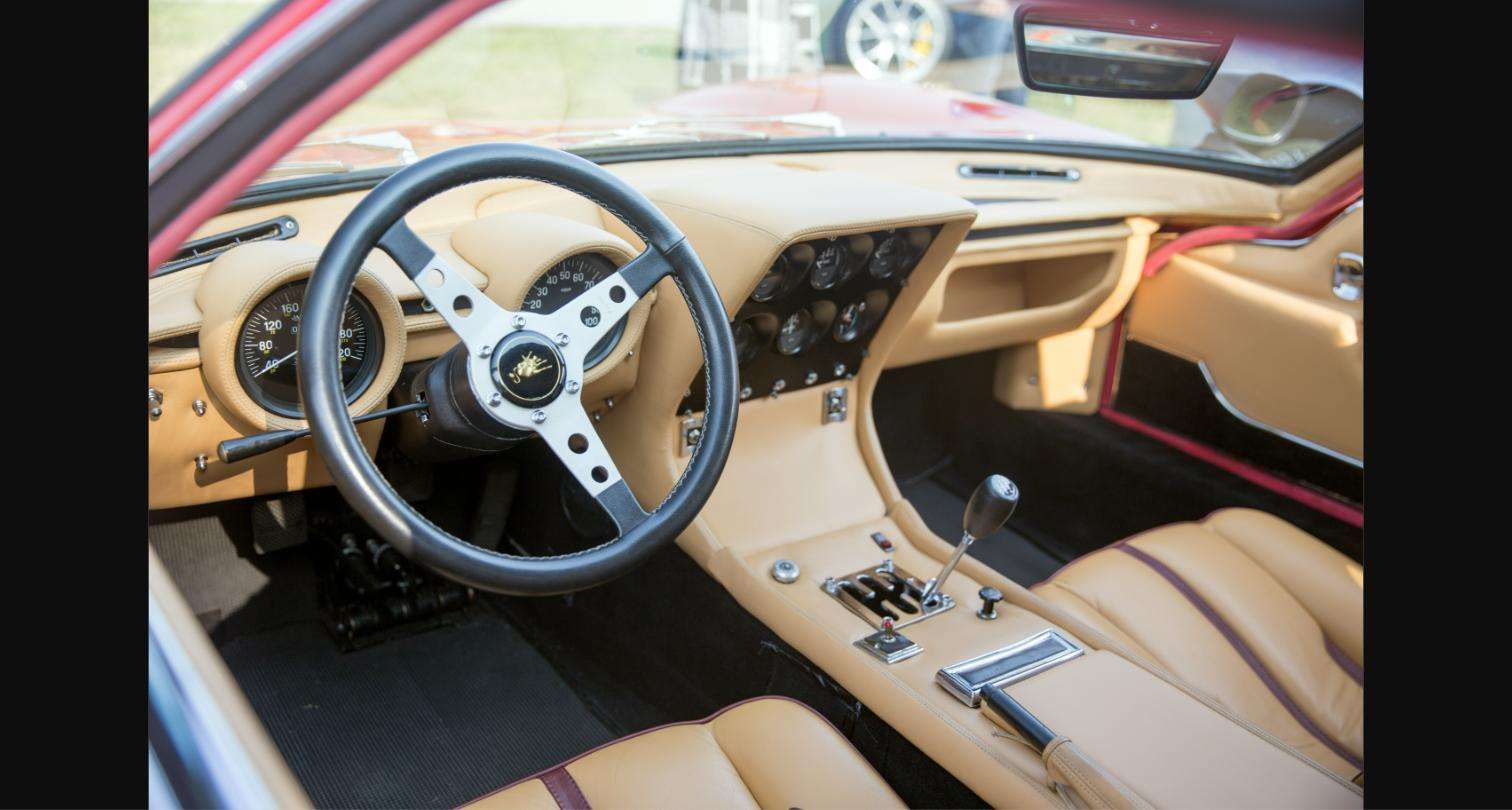
- Exterior/interior: Rosso Corsa over Nero vinyl with a Beige headliner, the colour scheme it left the Bertone works wearing — Bertone’s own records show the order was originally written for Bianco Miura over a Gobi and Beige interior before being amended
- Delivered new on 29 May 1969, via the Paris dealership Voitures Paris Monceau
For a car often credited — with real justification — as the template for every mid-engine supercar that followed, the specification sheet alone would interest a serious collector. The ownership history is what separates this particular chassis from the field.
History and Provenance: What the Documentation Shows
RM Sotheby’s account of chassis 4103’s history draws on period French registration documents (on file with the sale) and the Lamborghini Miura Register, the marque’s long-running ownership archive. The verified chain of custody:
First owner Paul Ferrandi of Paris took delivery in mid-1969, registering the car for road use on 17 June. The Miura returned to Voitures Paris Monceau after fourteen months before being sold to Maurice Dembiermont & Cie, an industrial manufacturer based in Neuilly-sur-Seine, registered on 4 September 1970. It went back to the selling dealer a third time in May 1971 and was deregistered the following month.
From there, the car passed to René Arnoux. Arnoux graduated to Formula One in 1978, driving non-championship rounds for Martini before six Grands Prix with John Surtees’ eponymous team. He moved to Renault for 1979 as the French manufacturer expanded to a two-car effort, took four wins across four seasons, and earned a Ferrari seat for 1983 — a year in which he won three races (Canada, Germany, and the Netherlands) before an engine failure at the season-ending South African Grand Prix cost him the drivers’ title. RM Sotheby’s dates Arnoux’s ownership of chassis 4103 to his Renault years, around the turn of the 1980s, based on period photographs and registration in Isère under the plate “400 VH 38.” The catalog also states — with the more careful phrasing of “reportedly,” since it isn’t described as independently documented — that Arnoux sent the car to the Lamborghini factory for a year-long restoration before selling it on, a decision RM Sotheby’s specialists speculate may not have hurt his standing with his new Ferrari team boss, Enzo Ferrari.
The car later relocated to Switzerland, where it is currently registered on a Swiss Carte Grise, and is now consigned from there to RM Sotheby’s home-market sale.
Condition Report
RM Sotheby’s describes chassis 4103 as presenting in “charmingly preserved condition” — auction-house language, not an independent third-party grading, and worth reading that way. What is specifically documented: the car retains its factory colour scheme and matching-numbers engine, and the majority of its original body panels. Following inspection, an RM Sotheby’s specialist identified only the rear engine cover panel as having been replaced at some point in the car’s life. The car is offered with its spare wheel and tool roll.
Notably absent from the listing is any claim of a recent restoration, concours-level preparation, or a documented paint-and-bare-metal history beyond the reported factory work under Arnoux’s ownership decades ago. Buyers should treat this as a well-preserved older car with an interesting past rather than a fresh, nut-and-bolt restoration — a distinction that matters considerably at this price point.
Estimate, Reserve, and Sale Details
Chassis 4103 is offered as Lot 114 at The Zurich Auction, a live sale RM Sotheby’s holds in Zurich, Switzerland on 26 September 2026. The pre-sale estimate is CHF1,500,000–2,000,000, or roughly $1.82 million to $2.42 million at the CHF/USD exchange rate as of this writing (mid-September 2026, approximately CHF1 = $1.21). As of this writing, bidding has not opened and no current bid exists; the figures above are RM Sotheby’s presale estimate only.
One detail worth flagging for prospective bidders: several lots in the same sale — the Lamborghini Espada, BMW 2002 Turbo, Fiat 131 Abarth, and Ferrari 599 GTB among them — are listed “Offered Without Reserve.” Chassis 4103 is not. That means the consignor has set an undisclosed minimum, typically positioned at or near the low estimate on a car with this kind of file, and the Miura will not necessarily change hands if bidding falls short of it.
Comparable Sales
Confirmed P400 S results from the past twelve months give a useful frame for where chassis 4103’s estimate sits:
| Car | Auction House / Sale | Date | Odometer | Result |
|---|---|---|---|---|
| 1968 Miura P400 S | Broad Arrow, Monterey | Aug 2026 | 7,000 km | $4,075,000 |
| 1969 Miura P400 S | Gooding & Co. / Christie’s, Amelia Island | Mar 2026 | 31,000 km | $2,590,000 |
| 1969 Miura P400 S | RM Sotheby’s, Miami | Feb 2026 | 37,000 km | $1,875,000 |
| 1971 Miura P400 S | Broad Arrow | Jan 2026 | 38,000 km | €1,716,000 (approx. $1,853,000) |
| 1970 Miura P400 S | Mecum, Glendale | Mar 2026 | 53,000 mi | $1,705,000 |
The average of these five results is roughly $1.83 million — almost exactly the midpoint of RM Sotheby’s estimate for chassis 4103. The Monterey result is the outlier of the group, driven by an unusually low 7,000 km on the odometer; excluding it, the range tightens to $1.7 million–$2.6 million, with price tracking mileage, originality, and paperwork more than provenance drama.
The ceiling for a Miura is considerably higher than the P400 S average suggests. In March 2026, a 1972 Miura P400 SV — the final and most powerful production Miura variant, subject of its own storage story earlier this year — sold for $6,605,000 at Broad Arrow’s Amelia Island sale, a record for any Miura at auction, on the strength of more than fifty years in a single American collection. MCC has also tracked P400 S examples with deep single-family history reach the market this year, including a largely unrestored example that spent four decades as furniture in a New York apartment — a reminder that within one model variant, condition and story can move an estimate by seven figures.
Market Interpretation: What Could Move the Price
The facts above are what RM Sotheby’s has published and what the public auction record shows. What follows is interpretation — informed judgment about how those facts are likely to be read by bidders, not verified fact.
Matching numbers and factory colour are worth more than they used to be. The five comparable sales above show a market that has moved from paying mainly for the model name to paying a real premium for originality: a retained engine and an unrepainted, factory-correct colour scheme, both of which chassis 4103 has. That should support the estimate, not just meet it.
The Arnoux ownership is a genuine story, but it is not the same kind of value driver as a factory-team competition history. Celebrity and motorsport-adjacent ownership tends to add interest and can widen the bidding pool — it is the sort of detail that makes a car memorable rather than interchangeable — but it rarely commands the outsized premiums reserved for cars with actual period racing results or unbroken documentation from new. Expect it to help chassis 4103 stand out in the room rather than to add a specific line item to the hammer price.
The single-panel disclosure cuts both ways. RM Sotheby’s noting that only the rear engine cover has been replaced is a mark of transparency and, read generously, evidence of a largely original car. Read more cautiously, it also means this is an older, lived-in Miura rather than a fresh restoration — buyers pricing in future recommissioning or cosmetic work should budget for it, and that budget will show up as downward pressure relative to the freshly presented comps in the table above.
A reserve, a home-market sale, and a currency detail all matter at the margin. Zurich draws a smaller, more regionally concentrated bidder pool than Monterey or Scottsdale, which can mean less of the competitive-bidding heat that produced results like the Miura SV record. Set against that, a CHF-denominated home sale can attract Swiss and wider European buyers for whom this Miura’s European delivery history and existing Carte Grise registration remove real friction — title transfer, import duty, and compliance costs a U.S. buyer would otherwise absorb. Where the final number lands will depend heavily on whether a European buyer with exactly that motivation is in the room.
The Bottom Line
Chassis 4103 is not the flashiest Miura going to auction this year, and it will not challenge the SV record set at Amelia Island. What it is: a documented, matching-numbers P400 S in its correct factory colours, with an ownership chain a specialist can actually verify on paper, priced by RM Sotheby’s squarely at the middle of where similar cars have traded over the past twelve months. That combination — not the headline of a Formula One driver’s name in the provenance file — is what should decide the final price. For a Miura at this level, the paperwork is the product.
The collector car market, every weekday morning.
Auction results, price moves and what’s crossing the block, read in four minutes. Free, from Modern Car Collector.
No spam, unsubscribe in one click. Or read more about the Brief.
Related Posts:
- Collector Car Market Brief: A One-of-Three Veyron…
- No-Reserve 1970 Lamborghini Miura P400S Heads to…
- Big-Block 1968 Chevelle SS Convertible With Air Ride…
- Black 1996 Dodge Viper RT/10 Roadster With a Dyno…

- Collector Car Market Brief: A Continuation, a…
- Record Ferraris, Rare Icons and 15,000 RPM: The Week…

 Kyle Matthews
  John Lloyd