

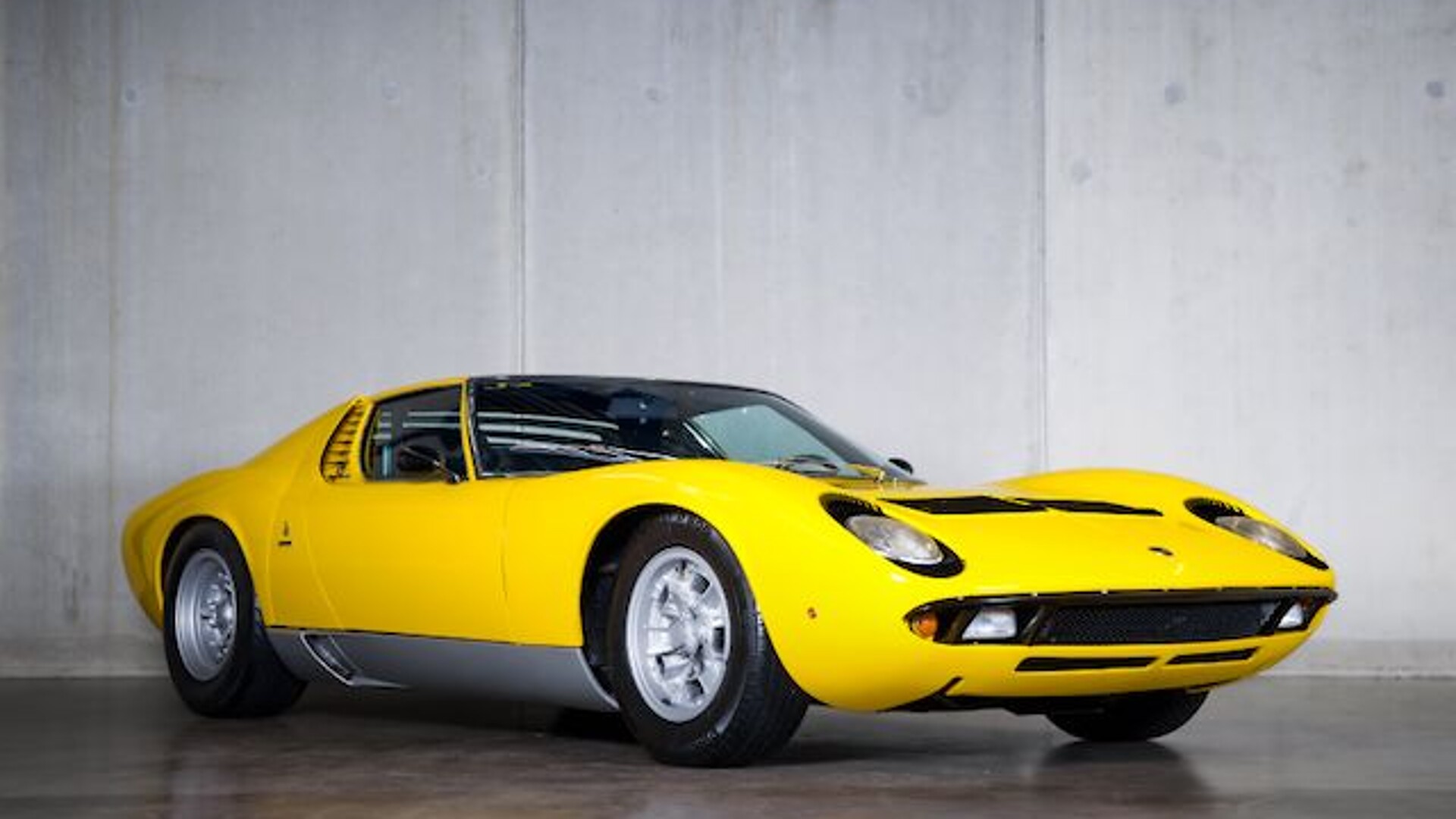
A late-specification Lamborghini Miura P400S that spent more than half a century inside a single Swiss collection, largely unseen, is about to test what the supercar-that-started-it-all is really worth when it isn’t wrapped in a six-figure restoration budget or Pebble Beach concours polish. Chassis P400-4578 headlines Bonhams’ Zoute Sale on October 11, 2026, and it’s being sold at no reserve — which means whatever the room decides on sale day is the market’s honest answer, not a number backstopped by a seller’s floor.
That’s the thesis worth sitting with before the hammer falls: no-reserve Miura sales are rare enough, and Swiss-market, single-region cars with documented factory-adjacent authentication are rarer still. Together they make this lot a genuine price-discovery moment for the P400S tier of the market, not just another catalog entry.
The Lamborghini Miura P400S: verified specifications
Some of this is simply what a Miura P400S is, independent of this particular chassis. Lamborghini built the P400S from December 1968 to March 1971, with roughly 338 units produced — the middle tier between the original 275-unit P400 and the 150-unit P400SV that closed out the model in 1973. Marcello Gandini’s Bertone-built body sits over a 3,929cc, 60-degree V12 mounted transversely amidships, rated at 365 hp (370 PS) at 7,700 rpm and 286 lb-ft at 5,500 rpm — roughly 20 horsepower over the base P400, thanks to larger intake manifolds and a revised cam profile. The S added power windows and chrome trim around the glass and headlights over the original car. It’s widely credited as the template for the rear-mid-engine road car, and Modern Car Collector has made the case before that “supercar” as a category exists because the Miura did it first.
Chassis P400-4578 itself, per Bonhams’ catalog announcement, is one of 114 late-specification, ventilated-disc-brake P400S cars — a more developed, later-production sub-group within the 338 total. It’s currently finished in Giallo Fly over its original Nero leather interior, having originally left the factory in Arancio Miura. That’s a repaint, not a restoration back to factory color, and it’s worth flagging plainly: collectors weigh original color highly on cars in this bracket, so a car that’s been resprayed away from its factory hue — even attractively — is a different proposition than a numbers-matching car still wearing its build-sheet color.
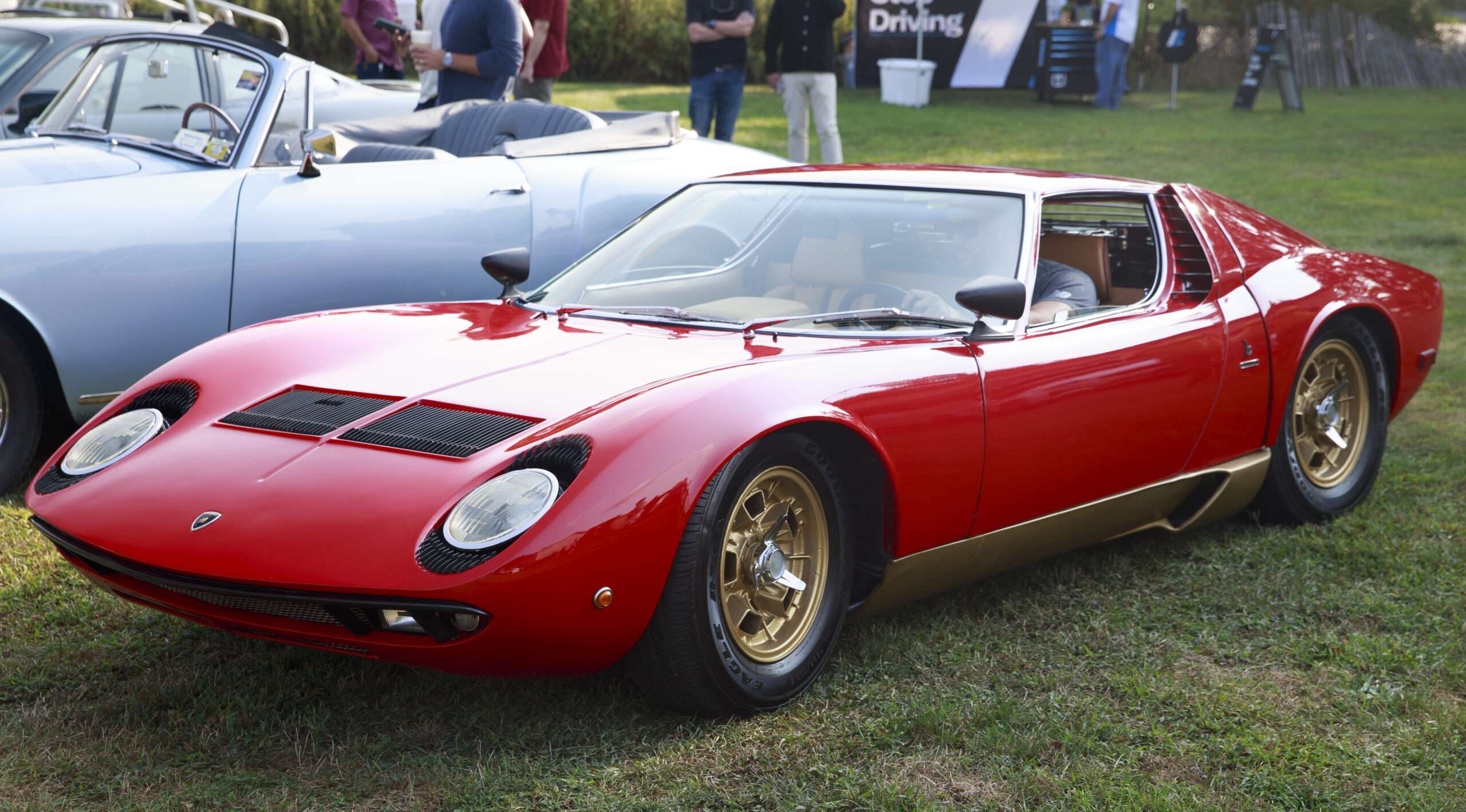
Photo: MrWalkr / Mr.choppers, Wikimedia Commons, CC BY-SA. Shown for illustration — not the actual consignment car.
History and provenance: what’s documented, and what’s believed
Here’s where the verified record and the market narrative need to be kept separate, because Bonhams’ own language does the separating for us.
Verified: The car was delivered new to Switzerland in 1970 through Garage Foitek of Zurich. It has remained in Switzerland for its entire life. It is being sold from the Keller brothers Collection, a Swiss private collection built over decades by two brothers with a stated preference for cars with “character, authenticity, and the stories they had to tell” rather than rarity for its own sake — a direct quote from current owner Christian Keller in Bonhams’ announcement. The collection is being sold following the death of Christian’s brother, which is the reason this car — along with the rest of the Italian-heavy Keller lineup — is on the market at all. The car is also being offered with a report from Valentino Balboni, Lamborghini’s factory test driver for roughly four decades and the man reputed to have personally driven about 80% of every Lamborghini built, dated December 3, 2014.
Believed, not confirmed: Bonhams describes the first owner as “believed to have been” Swiss racing driver Emmanuel “Toulo” de Graffenried — the 1949 British Grand Prix winner (pre-dating the F1 World Championship) and a fixture of 1950s European racing who later ran a Lausanne dealership handling Alfa Romeo, Rolls-Royce, and Ferrari. De Graffenried died in 2007, so this detail can’t be confirmed by the man himself, and the hedge in Bonhams’ own wording (“believed”) signals it rests on dealer or period documentation rather than an unbroken paper trail. That’s not a reason to dismiss it — Garage Foitek’s Zurich origin and the de Graffenried connection are plausible and specific, not vague marketing — but it’s a claim one step short of “verified,” and this piece is treating it that way.
The Balboni report deserves its own line of interpretation, too. A Balboni report is not a chassis-authentication document in the way a factory build sheet is; it’s a condition and identity assessment from a person with unmatched hands-on familiarity with the model. It carries real weight in the Lamborghini collector world precisely because so few people have driven as many original Miuras as Balboni has — but it is expert opinion, not a factory record, and buyers should understand it as bolstering confidence rather than serving as a chain-of-title document.
Condition
Bonhams’ public preview listing for this lot does not yet include a published condition report — the house’s own auction-information notice states that catalogs are “usually available four weeks before the auction,” which for an October 11 sale means fuller condition detail should surface roughly mid-September into early October. What is known now: the car is described as having been “largely unseen” throughout its life in Switzerland, which in auction-house language typically signals limited public and show exposure rather than limited use — it is not, on the information published so far, being marketed as a low-mileage or barn-find car in the way some Miura stories lean on. Prospective bidders should treat the condition picture as incomplete until Bonhams publishes the full report, and this piece will not speculate on paint, panel, or mechanical condition beyond what’s been stated.
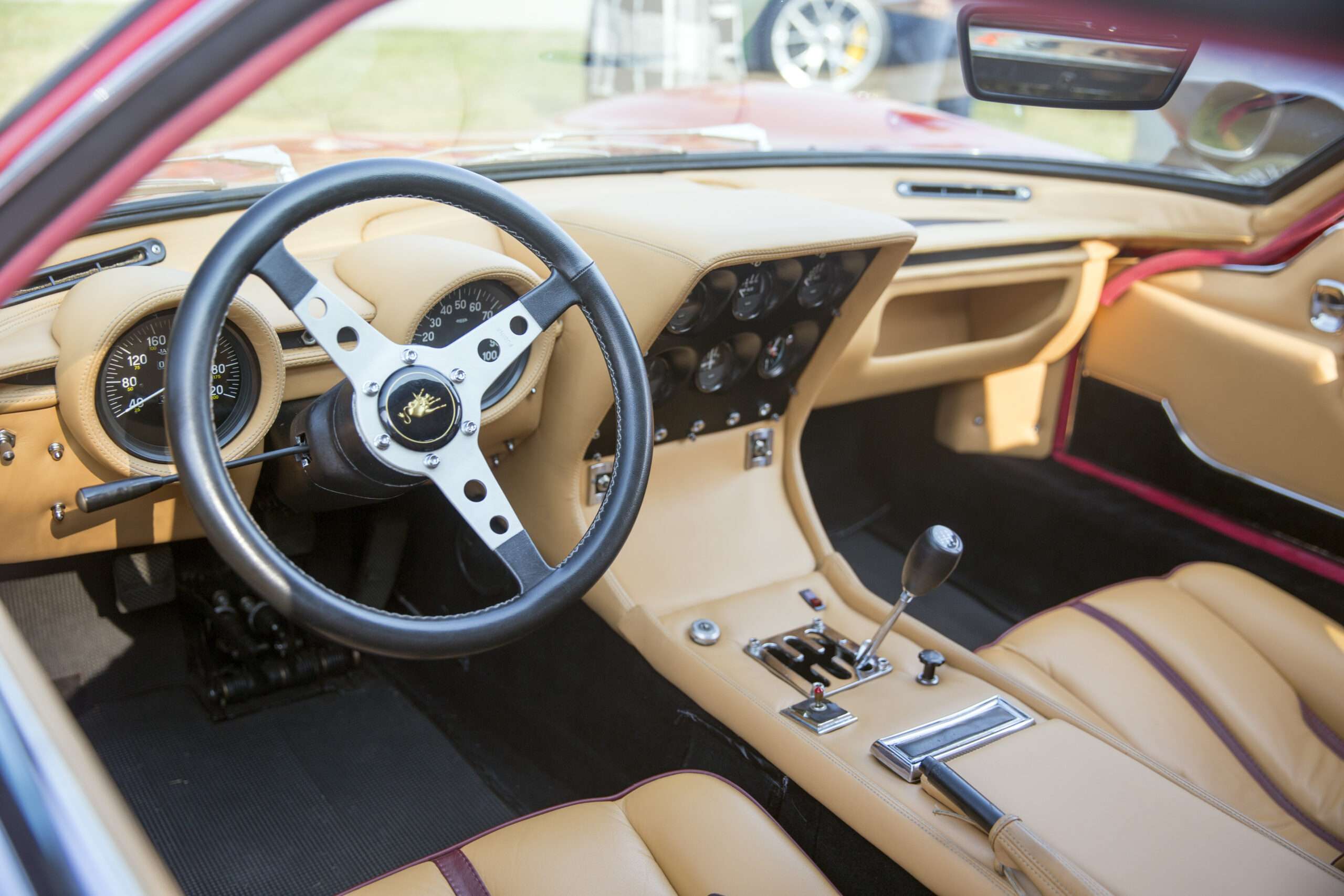
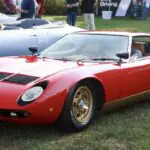
Photo: Mr.choppers, Wikimedia Commons, CC BY-SA. Shown for illustration — not the actual consignment car.
The Lamborghini Miura P400S: estimate and bidding status
Bonhams has set an estimate of €1,600,000–€2,000,000 (roughly US$1.8–2.3 million at the exchange rate quoted on Bonhams’ lot page) for this Lamborghini Miura P400S, and the car is explicitly cataloged as sold without reserve. It also carries a “Premium Lot” restriction, meaning bidding requires pre-approval from Bonhams’ client services at least 24 hours ahead of the sale — a detail more about access than value, but relevant to anyone actually planning to bid.
No-reserve status is the more interesting fact for market-watchers. It means the consignor has accepted that the room’s final number stands, for better or worse — which is a different risk profile than an estimate paired with a hidden reserve that can pull a car from sale if bidding falls short.
Comparable sales: where the P400S market actually sits
Recent P400S results give useful bracketing, though the spread is wide enough that “the market” isn’t one number — it’s a range shaped heavily by mileage, color, and collection pedigree:
- $4,075,000 — 1968 Miura P400S, Broad Arrow’s Quail Lodge Auction, August 2026. From the Apex Collection, roughly 4,870 miles, finished in Azzurro Mexico Metallizzato. This is the outlier at the top of the range, driven by exceptional low mileage and a marquee consignment, and it sold well above its $3.6 million high estimate.
- $2,590,000 — 1969 Miura P400S, Gooding & Company/Christie’s, Amelia Island area, March 2026.
- $1,875,000 — 1969 Miura P400S, RM Sotheby’s Miami, February 2026.
- $1,705,000 — 1970 Miura P400S, Mecum Glendale, March 2026 — the most recent “ordinary” (non-outlier) result at time of writing.
- €1,716,000 — 1971 Miura P400S, Broad Arrow, January 2026.
- Unsold for reference: a 1969 P400S at Mecum Monterey (August 2026) drew a high bid of $1.5 million and didn’t sell; a 1969 P400S on Bring a Trailer (January 2026) topped out at $1.76 million with no sale; a 1970 P400S at Mecum Kissimmee (January 2026) stalled at a $1.4 million high bid.
For scale, classic.com’s tracked benchmark average for the P400S sits at roughly $2,175,551 as of this writing, and a step up the model ladder, a 1971 Miura P400SV sold for €3,942,500 at RM Sotheby’s Milan on a restored, US-delivered, concours-winning car — illustrating the real gap between S and SV territory.
Set against that range, Bonhams’ €1.6–2.0 million estimate for this Lamborghini Miura P400S (chassis 4578) lands squarely in the “ordinary good example” band — below the low-mile Apex Collection outlier, roughly in line with the Gooding and RM Sotheby’s 1969 results, and above the level where recent no-sales have stalled. It is not priced as a record attempt.
What could move the price from here (market interpretation)
Everything in this section is this publication’s read of the market, not a claim about the car itself.
The Swiss single-region history and the Keller collection’s reputation for curating cars for character rather than headline rarity should help with buyers who prioritize a clean, boring-in-the-best-way ownership chain — that’s a real, if hard-to-price, premium in this segment. The de Graffenried connection, even hedged as “believed,” adds a motorsport-history hook that tends to move bidder interest at the margin, though it likely won’t move the number the way a fully documented period-competition history would. The color change away from factory Arancio Miura is a genuine headwind with originality-focused buyers, and could be the single factor most likely to cap this car below the Gooding and RM Sotheby’s comps despite the strong ownership story. The no-reserve status itself is a double-edged sword: it can spark competitive bidding precisely because buyers know there’s no hidden floor to fight through, but it can also mean a soft room simply lets the car go under estimate, since there’s no mechanism to protect the seller if the bidding is thin. Modern Car Collector recently covered how a cluster of Miuras at Pebble Beach became a market event in its own right — worth remembering that Miura demand is currently running on genuine collector enthusiasm rather than speculative momentum, which tends to make no-reserve results more reliable as price signals than hype-driven ones.
Bonhams has run Miura headliners before — a 1967 P400 anchored one of its recent sales — and the house’s specialists have specifically called this car’s rarity and no-reserve terms a highlight of the Zoute consignment, which is a sales pitch worth noting as exactly that: the seller’s advocate talking. It doesn’t make the underlying facts about mileage, ownership, and mechanical spec any less real, but readers should weigh specialist enthusiasm accordingly.
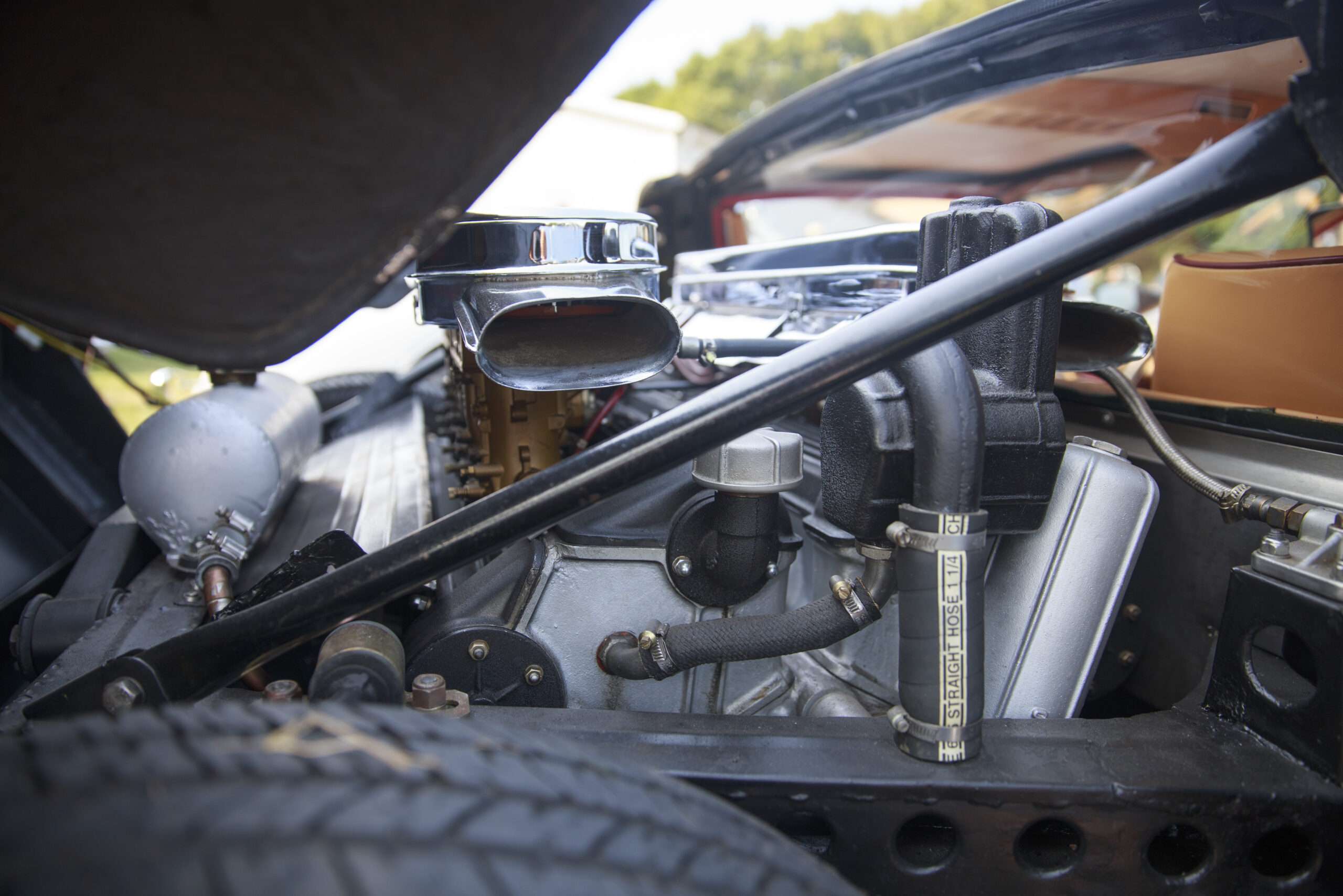
Photo: Mr.choppers, Wikimedia Commons, CC BY-SA. Shown for illustration — not the actual consignment car.
Verified facts vs. market interpretation, at a glance
Verified: P400S production run and dates; engine displacement and output; chassis 4578’s 1970 Swiss delivery through Garage Foitek; unbroken Swiss residency since; Keller brothers Collection consignment and the reason for its sale; the accompanying Valentino Balboni report and its date; the €1,600,000–€2,000,000 estimate; no-reserve terms and the pre-approval bidding restriction; the comparable sale prices cited above.
Interpretation or unconfirmed: the identity of the original owner as de Graffenried (“believed,” per Bonhams); how much the color change from Arancio Miura will actually cost the car at the podium; whether no-reserve terms produce a premium or a discount on sale day; and every forward-looking read of what this result will mean for P400S values generally.
The car goes to the block on October 11 in Knokke-Heist. Whatever it brings will say more about where genuine, no-safety-net demand for a good — not perfect, not record-setting — Lamborghini Miura P400S sits in late 2026 than almost any estimate could.
The collector car market, every weekday morning.
Auction results, price moves and what’s crossing the block, read in four minutes. Free, from Modern Car Collector.
No spam, unsubscribe in one click. Or read more about the Brief.



 Kyle Matthews
  Eve Nowell
  John Lloyd