

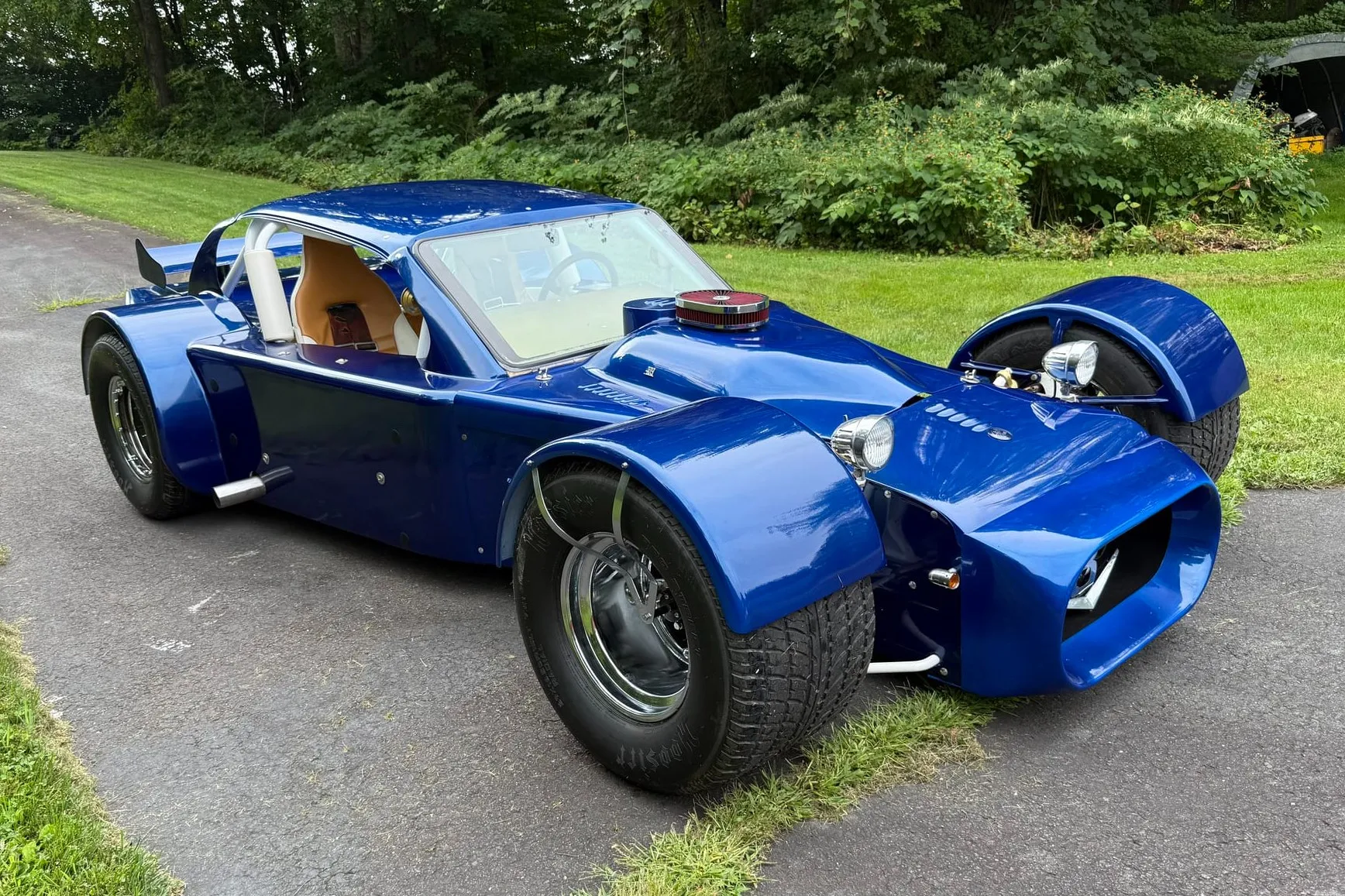
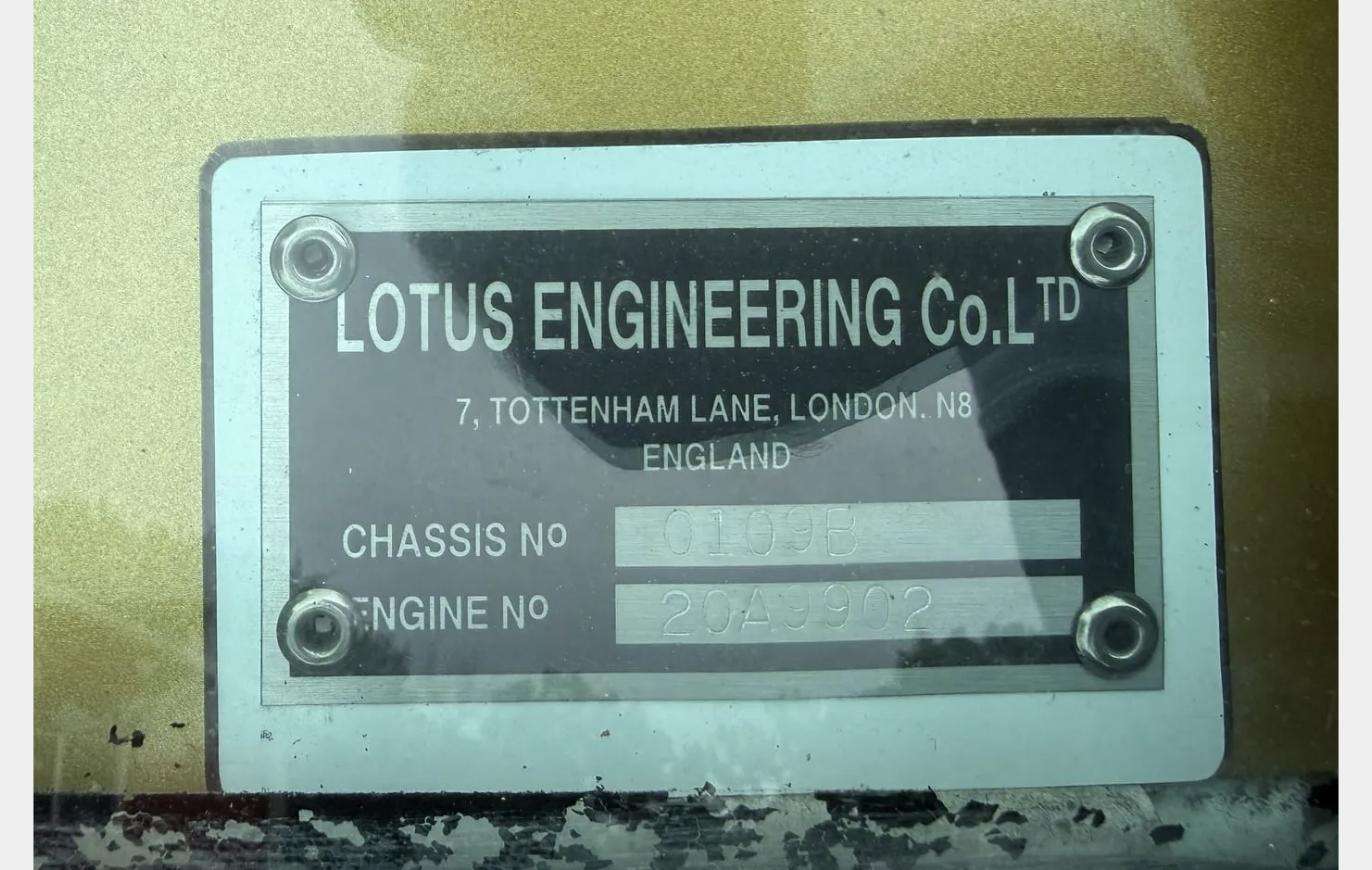
A blue tube-frame special is sitting on Bring a Trailer right now with a current bid of $1,000, no reserve, and three days left on the clock. Its rear valance spells out LOTUS in chrome script, flanked by “Elite” and “Super Eight” badges. A data plate riveted inside the tub reads “Lotus Engineering Co. Ltd, 7 Tottenham Lane, London N8, England.” Its Montana title lists it as a 1974 Lotus.
None of that makes it a Lotus.
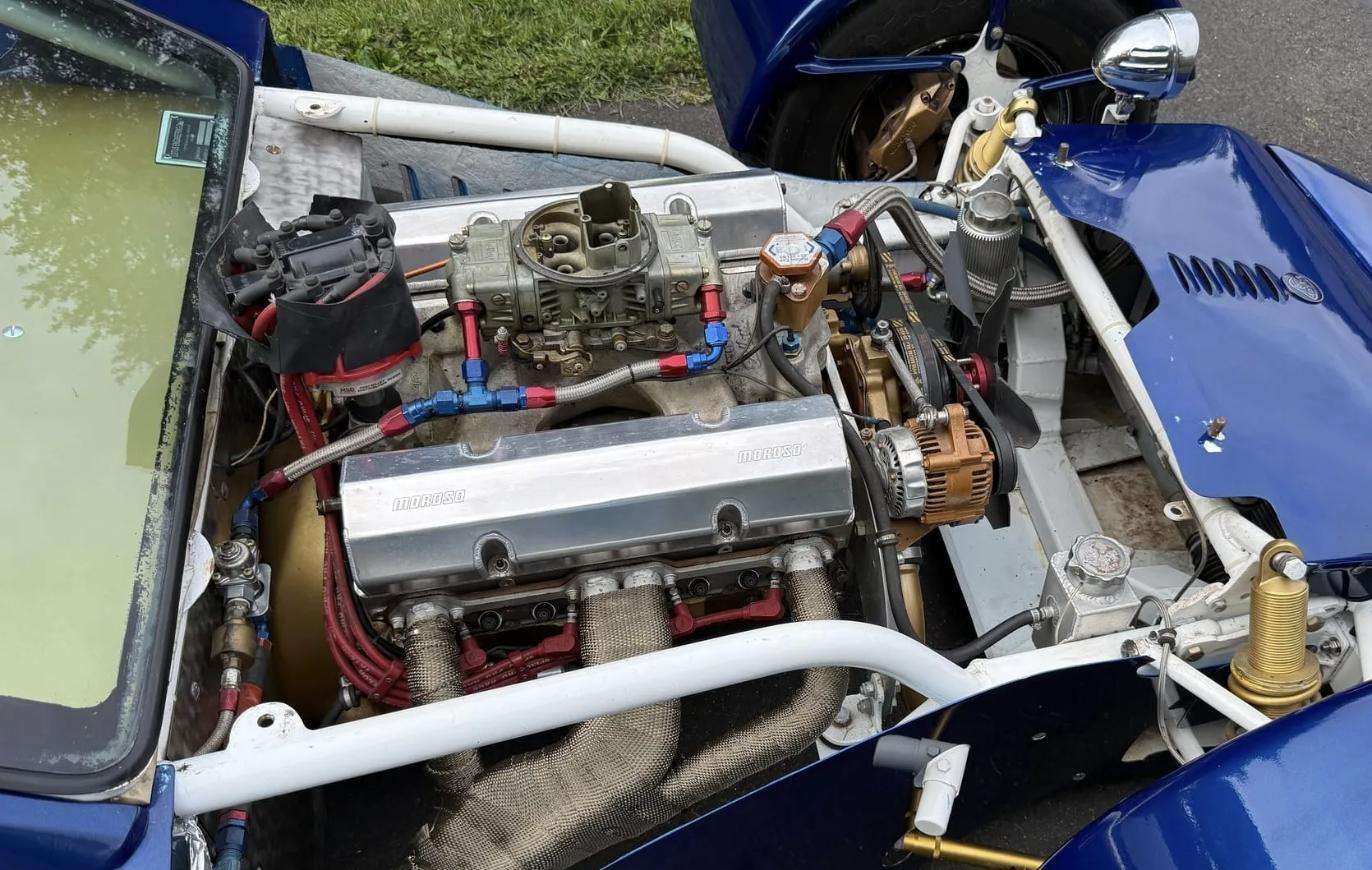
What actually sits under that fiberglass-and-steel bodywork is a fabricated tube chassis, believed to have been built sometime in the 2000s, powered by a blueprinted 409-cubic-inch Chevrolet big block breathing through a Holley four-barrel, backed by a Tremec TKO five-speed and a Winters quick-change locking differential. It rides on Wilwood hubs, adjustable coilovers, and 29×18.50 Hoosiers at all four corners. It is, in other words, a serious piece of hand-built engineering wearing the silhouette — and, more pointedly, the identity plate — of a car it has no factory relationship to whatsoever.
That contradiction is the actual story here. Not the $1,000 bid. Not the no-reserve auction format. The gap between what this car claims about itself and what it demonstrably is — and what that gap teaches serious collectors about reading documentation on specials, tribute builds, and anything wearing a badge it wasn’t born with.
A Special Built With Real Intentions
Whoever built this car — the current listing doesn’t say, and Bring a Trailer first featured it back in August 2019 under the headline “NASCAR Meets Super Seven: Street-Legal Asphalt Modified Racer” — clearly wasn’t trying to fake a restoration. They were chasing something more specific: a Lotus Seven-inspired silhouette, low and cycle-fendered, stretched over a chassis engineered more like a short-track asphalt modified than a British lightweight sports car. New England has produced that hybrid instinct for decades, and this car — offered for sale from Plymouth, Connecticut — reads like a product of it, whatever its actual competition history turns out to be.
The mechanical specification backs up that read. Wilwood hubs at all four corners, an independent front end with a sway bar and tubular linkages, a rear end built around a torque arm, a Panhard rod, and tubular trailing arms, four-wheel disc brakes with an adjustable bias — this is real chassis engineering, not kit-car dressing. A Winters quick-change differential, the same basic architecture used at Indianapolis and on short ovals for generations, is prized specifically because gear ratios can be swapped in the paddock without touching the housing. Pairing it with a Tremec TKO five-speed — a modern, overdrive-equipped gearbox with no period pretense at all — tells you this builder was solving real engineering problems, not styling a fantasy.
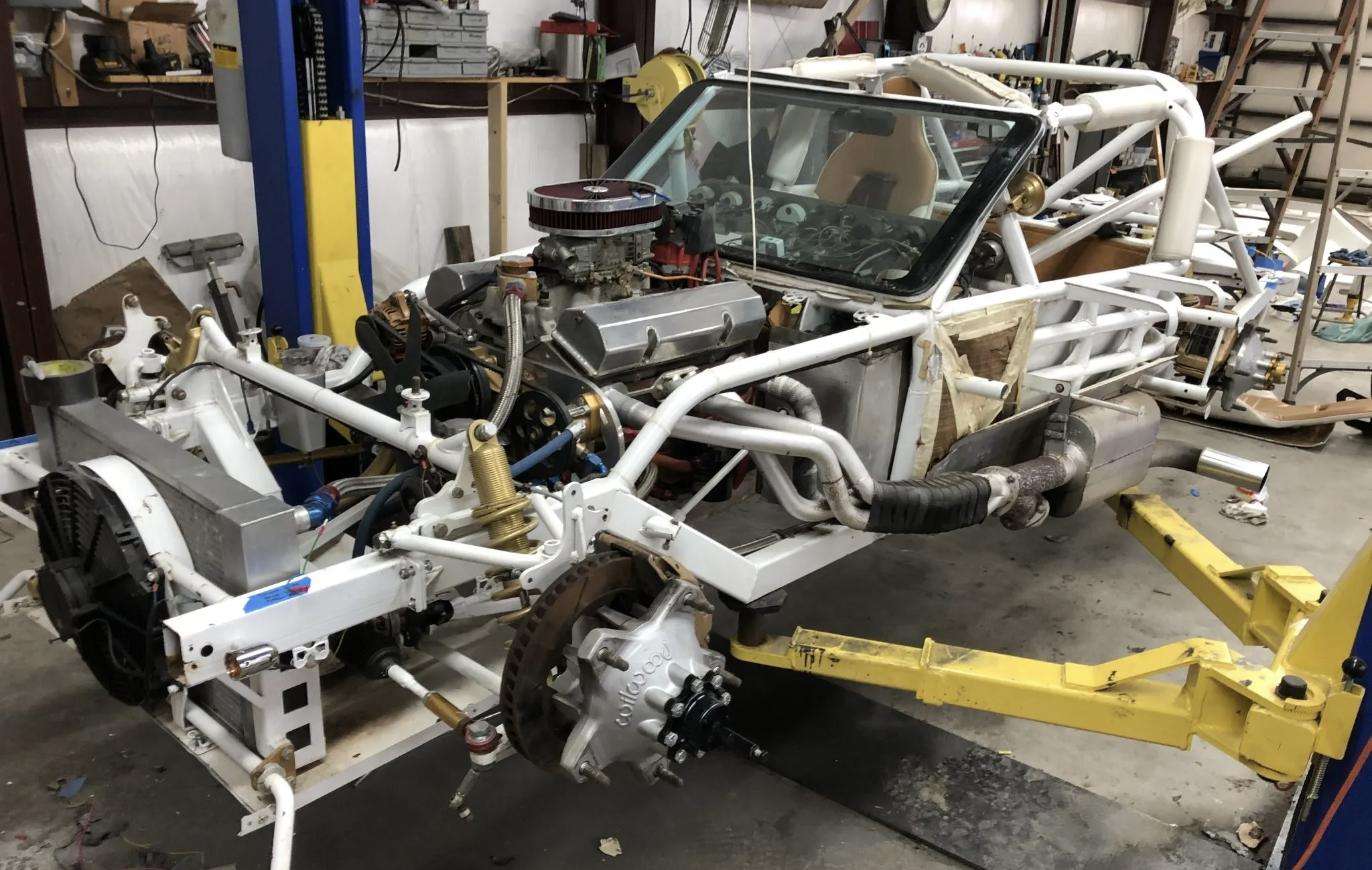
Then there’s the engine. Chevrolet’s 409-cubic-inch W-series big block arrived as a mid-1961 option, went into wider production for 1962, and was gone from the lineup by 1965 — a short run that made it a cult engine almost immediately. It became a cultural fixture via the Beach Boys’ hit of the same name, and on the strip and the street it was, for a brief window, Chevrolet’s top gun: the engine that made “409” slang for maximum output before the 396 and 427 Mark IV big blocks took over. A builder reaching for a 409 nearly six decades later isn’t chasing convenience — crate 350s and LS swaps are cheaper, lighter, and far easier to source. They’re chasing a specific, high-revving mechanical character, and pairing it with a dry-sump system, an MSD distributor, Moroso covers, and heat-wrapped long-tube headers with cutouts says this was a driver’s choice, made by somebody who understood exactly what they were building.
The Lotus Plate Problem
And yet the car is titled — via Montana, a common route for scratch-built specials that don’t fit neatly into a home-state DMV’s ordinary process — as a 1974 Lotus. It wears a convincingly aged Lotus Engineering data plate, chassis number 0109B, engine number 20A9902, riveted to the tub as though it came from the factory in Hethel. None of that is provenance. It’s decoration, or at best a paperwork convenience, and confusing the two is exactly the mistake experienced collectors are trained not to make.
We’ve made this point before with cars whose paperwork actually does hold up: a Bugatti EB110 whose market now pays a premium for documentation almost as much as for the car itself, and a Steve McQueen motocrosser whose value is inseparable from a verifiable ownership trail. Genuine provenance holds up against primary sources — factory build records, period competition history, a documented chain of custody. A Montana title reciting “1974 LOTU” verifies nothing beyond the fact that a state agency accepted whatever information it was handed. For a $1,000 no-reserve special, that distinction is close to academic. For the broader specials and tribute-build market working its way toward real money, it’s the whole ballgame — and this car is as clean an illustration of the gap as you’ll find on a single auction page this month.
What a $1,000 Bid Actually Tells You
We’ve also recently covered a customized Ferrari F355 that traded its numbers-matching identity for attention, and a modern Ford GT that outbid a genuine Boss 429 at Barrett-Jackson Las Vegas. Those stories share a theme with this one: the market for documented, matching-numbers cars and the market for well-built specials are not the same market, don’t obey the same pricing logic, and shouldn’t be judged by the same yardstick.
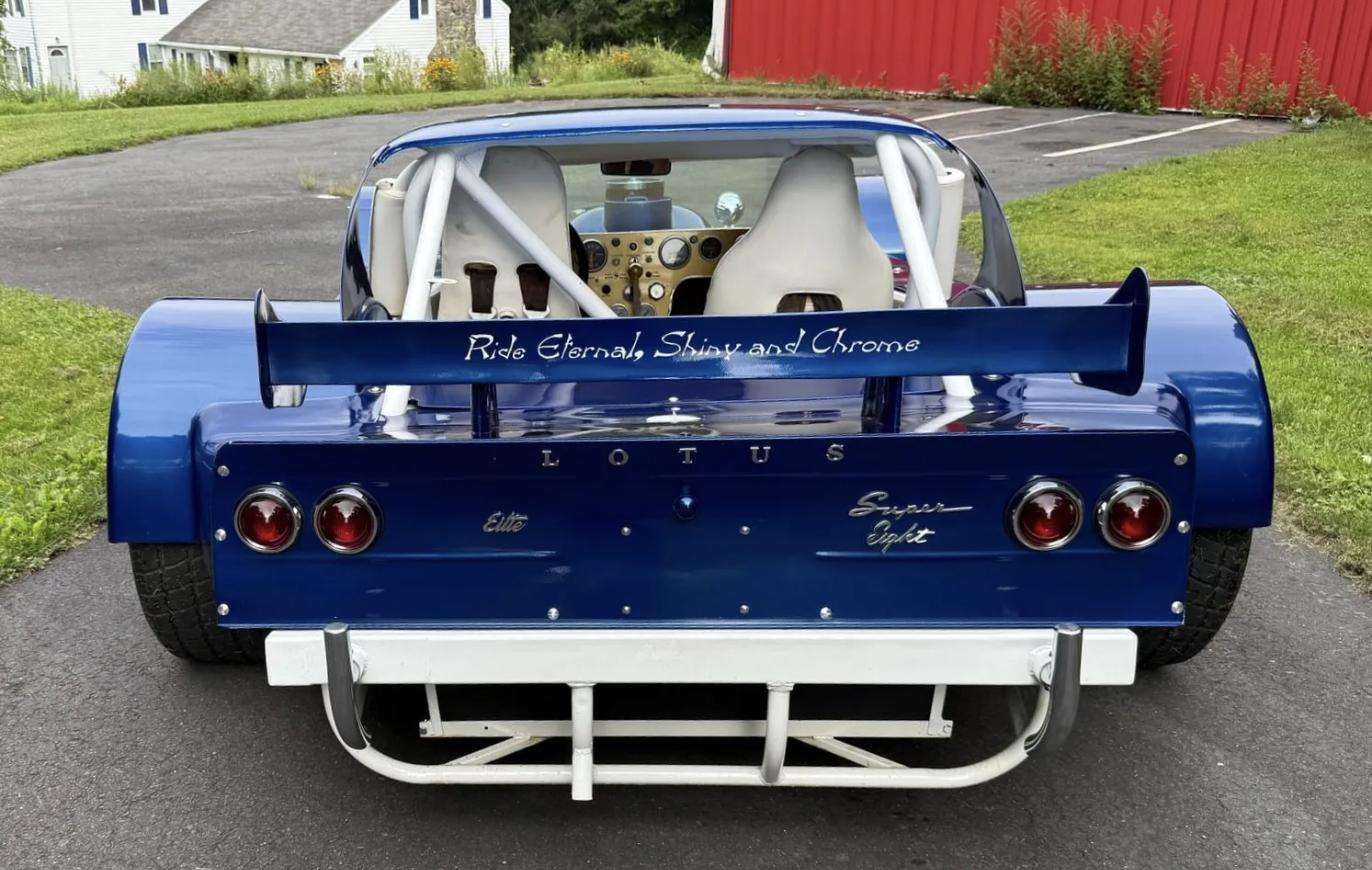
This Lotus-bodied special has drawn more than 5,000 views, 650-plus watchers, and 67 comments on Bring a Trailer — engagement that would be remarkable for a genuine, numbers-matching Series 3 Lotus Seven at ten times the money. Nobody bidding on it believes they’re buying a Lotus. They’re bidding on a hand-fabricated chassis, a genuinely characterful drivetrain, and a design exercise that succeeds on its own terms: the cycle fenders, the exposed velocity stack poking through the hood, the “Ride Eternal, Shiny and Chrome” script across the wing. Those are confident, specific choices, not derivative ones.

That’s the observation worth carrying away from a car that will likely sell for less than a good set of wheels for an actual Lotus Seven: paperwork authenticates a blue-chip collector car, but it never manufactures one. This special will find a buyer on the strength of its engineering and its nerve, not because anyone was fooled by a data plate riveted to a tube frame. In a market where documentation increasingly drives value at the top, a car this honest about what it isn’t should be a relief, not a red flag.
The auction — offered at no reserve out of Plymouth, Connecticut, with the current bid at $1,000 — runs on Bring a Trailer through September 19.
The collector car market, every weekday morning.
Auction results, price moves and what’s crossing the block, read in four minutes. Free, from Modern Car Collector.
No spam, unsubscribe in one click. Or read more about the Brief.



 Kyle Matthews