

Bring a Trailer closed dozens of lots in the past day, RM Sotheby’s added a new headline lot to its Zurich sale, and a 252-example BMW quietly went up for sale away from the podium entirely. None of it has run on this site yet. Here is what actually moved in the last 24 hours, and why each result is worth a second look.
A 1969 Miura With a Formula 1 Driver’s Name on the Title

Photo: Alexander-93 / Wikimedia Commons (CC BY-SA 4.0). Illustrative image of a Miura P400 S; not the specific chassis referenced below.
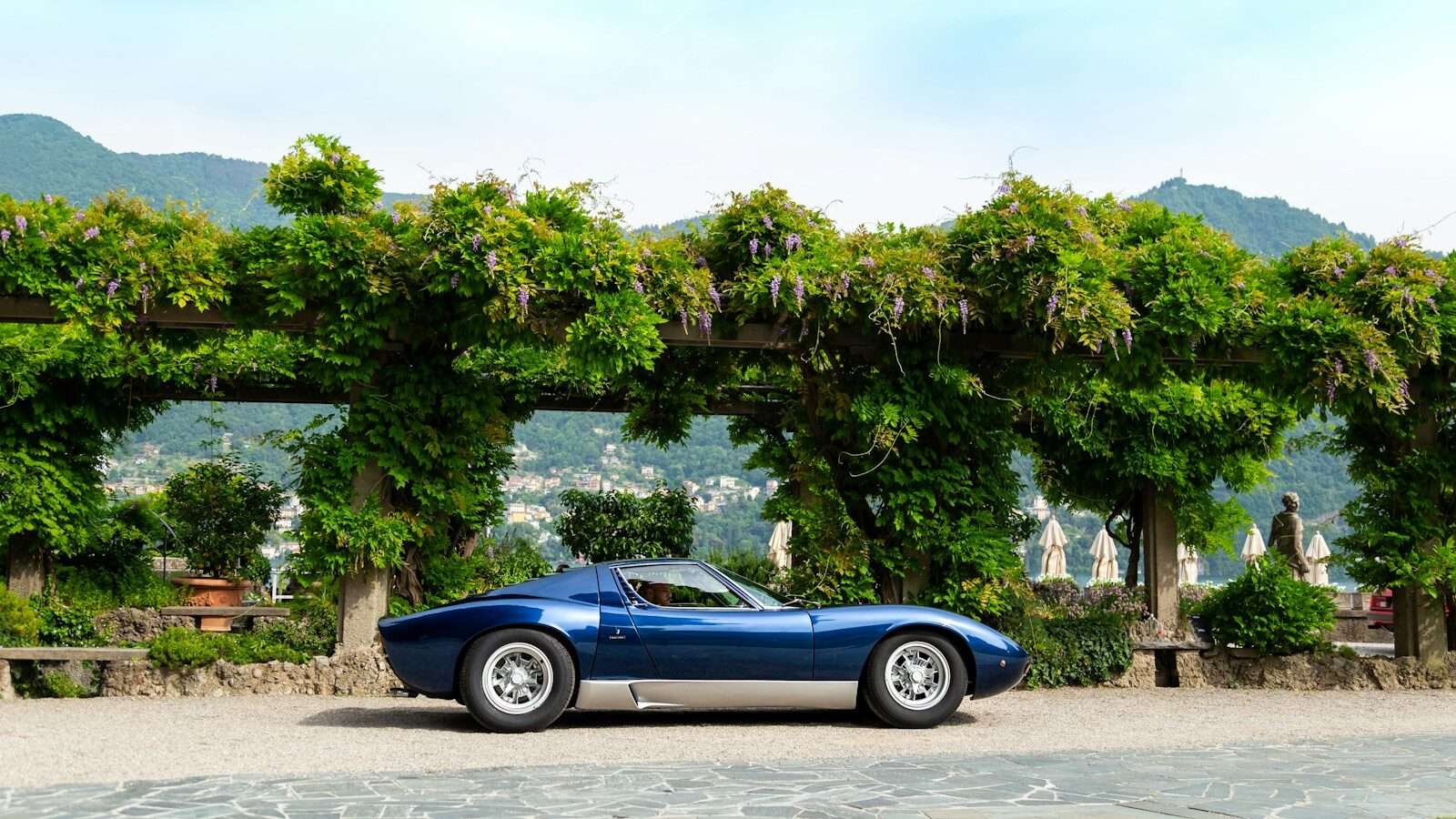
RM Sotheby’s has attached a new headline lot to its September 26 Zurich sale: a 1969 Lamborghini Miura P400 S, chassis 4103, carrying an estimate of CHF 1.5 million to CHF 2 million (roughly $1.9 million to $2.5 million). The car retains its matching-numbers 3.9-liter V-12 and wears its factory-original Rosso Corsa over Nero color scheme, and it is an early-production P400 S with solid rather than vented disc brakes.
What actually sets this Miura apart is a five-year stretch of ownership by René Arnoux, the French driver who won four Grands Prix for Renault and Ferrari in the early 1980s. Period photos place the car with Arnoux during his Renault years, and he reportedly sent it back to the Sant’Agata factory for a year-long restoration before selling it on. For a model widely credited as the world’s first mid-engine supercar, the combination of an unbroken color scheme, matching numbers, and a documented Formula 1 owner is a rare stack of boxes to check at once.
The caveat: only the rear engine cover has been replaced over the car’s life, per RM’s own inspection, which is a minor point against an otherwise clean history file. Buyers should still budget for a pre-purchase inspection focused on that panel’s fitment and paint depth, since Miura bodies are notoriously easy to reshape badly during past repairs. For context on where six-figure and seven-figure Miura money currently sits, see our earlier coverage of the model’s first million-dollar result.
A BMW That Never Needed an Auction House
.jpg)
Photo: Alexander Migl / Wikimedia Commons (CC BY-SA 4.0). Illustrative image; not the specific car referenced below.
Away from any podium, RM Sotheby’s private sales division listed a 1957 BMW 507 Series II at price upon request. Only 252 examples of the 507 were built between 1956 and 1959, and this is one of 218 Series II cars. That scarcity matters more than it might seem: Mercedes-Benz built roughly 3,258 300SL Gullwings and Roadsters combined during the same era, making the 507 the far rarer of the two period rivals, even though the 300SL was faster and became the more famous car.
This particular car was delivered new to Pennsylvania in 1958, spent time in the Netherlands starting in 1995, and underwent a documented restoration in Germany from 2014 to 2015 that reportedly cost around €350,000. It has had only two owners since that restoration and was shown once, at the 2017 Pinehurst Concours d’Elegance. A private-sale listing with no public price and no auction deadline is itself a signal: for cars at this level, sellers increasingly prefer a quiet, negotiated exit over the exposure and time pressure of a live sale.
Same Price, Very Different Paper Trail

Photo: Charles / Wikimedia Commons (CC BY 2.0). A period Aston Martin DB4 GT, shown for illustration; not the continuation car referenced below.
The single strangest data point from Bring a Trailer’s last 24 hours: two completely different cars sold for the exact same price, $1,000,999, within an hour of each other on the same afternoon.
The first is a 2018 Aston Martin DB4 GT Continuation, the 20th of just 25 examples built by Aston Martin Works in Newport Pagnell. That is a factory-sanctioned limited run with its own legitimate identity, built new by the original manufacturer using Superleggera construction methods drawn directly from the 1960s original. There is no ambiguity about what it is.
The second is a Ferrari 330 GTO re-creation, built in the early 1990s and styled after genuine chassis 4561SA. Its engine-bay and dashboard tags are stamped with the number 5807, which belonged to a real 330 GT 2+2 that was parted out in the 1980s. In the listing’s 213-comment thread, longtime marque historians spent hours debating exactly how much of chassis 5807 physically exists inside the car versus how much was newly fabricated around a resurrected number plate. Nobody in that thread reached full agreement, which is itself the point.
A factory-built continuation with an unambiguous identity and a re-creation carrying a disputed, resurrected chassis tag drew identical money on the same day. That is not proof of anything by itself, but it is a useful reminder for collectors that a good story and clean presentation can price in almost as much as paperwork right now. Re-creations simply carry a thinner resale market and a smaller pool of future buyers than a documented factory car, no matter what they hammer for today. For more on how the market treats gaps between comparable results, see our recent look at a pre-war classic that failed to sell in 2012 and then made $9.08 million.
A Single Owner Since 1981 Wasn’t Enough

Photo: Rex Gray / Wikimedia Commons (CC BY 2.0). Illustrative example of a DeLorean DMC-12, not the specific car referenced.
An original-owner 1981 DeLorean DMC-12 sold on Bring a Trailer for $55,500. The seller bought it new from Evans Pontiac-GMC in Dallas and kept it for 44 straight years, having the seats retrimmed once, in 2012. It is a genuinely rare piece of unbroken history for a car whose company famously collapsed within a year of building it.
Yet the result lands squarely in the middle of recent DMC-12 comps, not above them. In the past two months alone, BaT has sold other DeLoreans for $57,925 (37 years owned), $51,500 (9,000 miles), and $77,500 (296 miles), while a different original-owner car with a 5-speed bid to $53,500 without selling. The lesson: in this specific model, the market prices mainly on mileage and cosmetic condition, not on chain-of-title. A clean, documented single-family history is a nice detail to mention, but collectors should not expect it to command a premium on its own, at least not for the DMC-12. Read more about how the model’s ownership history shaped its reputation in our feature on the rise and fall of the DeLorean Motor Company.
A Buick Icon Couldn’t Clear Its Reserve

Photo: MercurySable99 / Wikimedia Commons (CC BY-SA 4.0). Illustrative example of a Buick Grand National, not the specific car referenced.
A 5,000-mile 1987 Buick GNX bid to $180,000 on Bring a Trailer and did not sell. That is a meaningful miss. Low-mileage GNX examples have consistently cleared $220,000 to $255,000 over the past year: an 8,000-mile car made $225,000 in July, a 2,200-mile car made $230,000 in May, and cars in similarly low mileage bands sold for $242,000, $243,096, and $255,000 between last August and this January. A separate 30-mile example is currently bidding at $201,000 with more than a week left on the clock.
A car with mileage that low landing $40,000 to $70,000 below its closest comps points to one of two things: either the reserve was set without regard for where the market actually is, or bidder depth for the GNX has cooled meaningfully in the past few weeks. Only the next handful of results will settle which explanation is correct, and it is worth tracking alongside our ongoing market-brief coverage from earlier this week.
A Heritage Package, Not a Future Collectible

Photo: Damian B Oh / Wikimedia Commons (CC BY-SA 4.0). Illustrative example of a Jeep Wrangler Rubicon JL, not the specific model referenced.
Jeep announced the 2027 Wrangler JL-2A today, an appearance and equipment package priced at $4,995 that nods to the 1946 Willys CJ-2A, the brand’s first civilian-focused model. It is the 11th special edition in a 12-month run marking the Wrangler’s 85th anniversary, following cars like the Laredo and Willys 392.
It is worth naming what this is not: a numbered, limited-production run. The JL-2A is an option package on an already high-volume model that sold nearly 166,000 units in the United States last year alone, and order books stay open with no stated cap. Nostalgic graphics and colorway callbacks make for a fun press release, but they rarely translate into a resale premium once the anniversary campaign ends and the next special edition arrives. Collectors chasing genuine future-collectible status should look for a hard production cap and a specification that actually changes the car, not just its palette.
The Takeaway
Put side by side, today’s signals point in a consistent direction. Storytelling and presentation are pricing in almost as strongly as documented authenticity, as the Ferrari and Aston Martin result shows. Ownership pedigree alone will not lift an otherwise ordinary car above its comps, as the DeLorean result shows. And even genuine, low-mileage muscle-era icons are meeting real resistance at reserve, as the Buick GNX result shows. None of that shows up in a press release, which is exactly why it is worth reading the results and not just the estimates. We will keep tracking these threads in the next installment of this market brief.
The collector car market, every weekday morning.
Auction results, price moves and what’s crossing the block, read in four minutes. Free, from Modern Car Collector.
No spam, unsubscribe in one click. Or read more about the Brief.

 Shawn Henry