

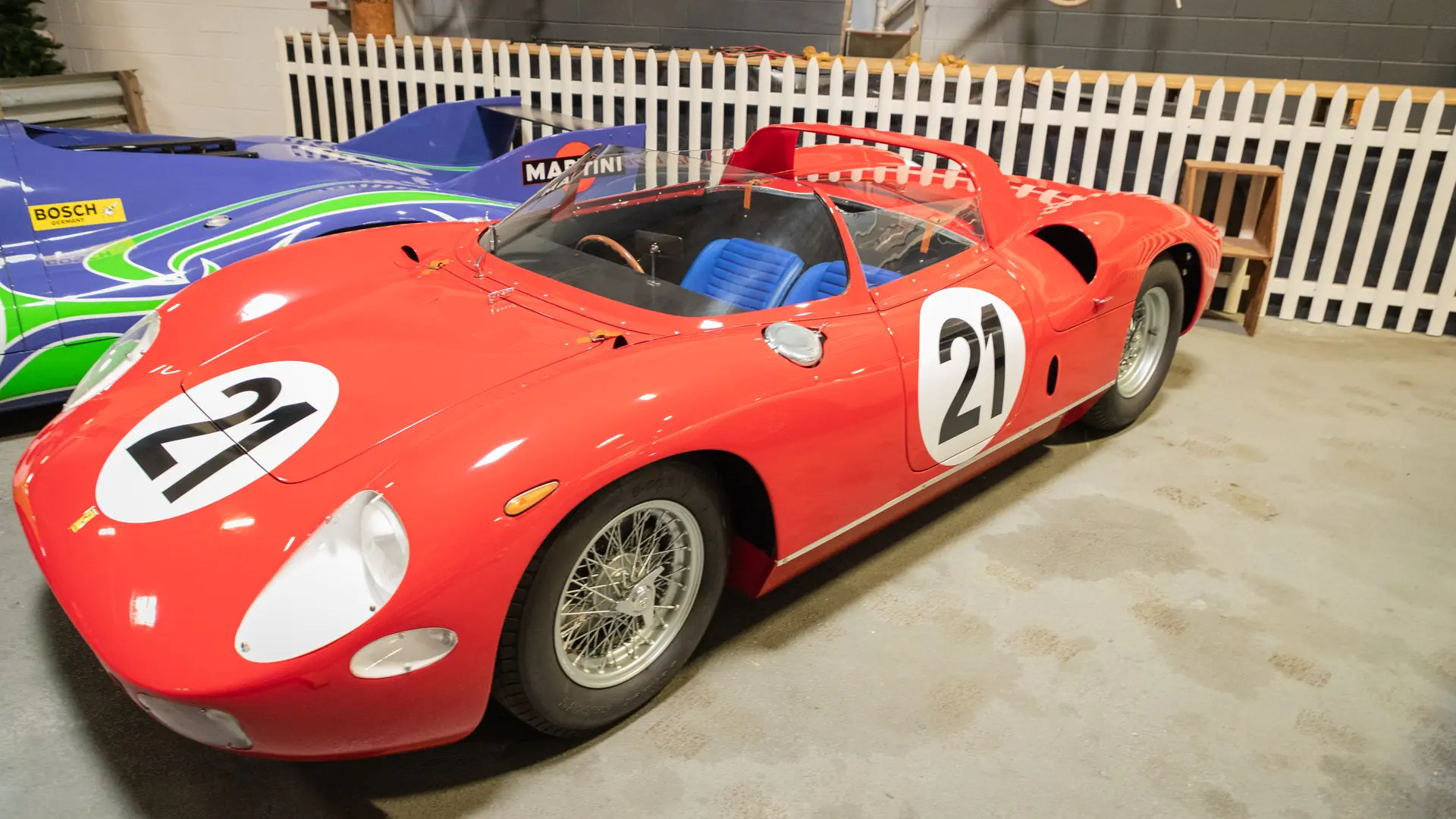
On June 13 and 14, 2026, a former engine-remanufacturing building two miles from Philadelphia International Airport ran a 24-hour program timed to the real 24 Hours of Le Mans. The Simeone Foundation Automotive Museum scheduled more than 40 driving demonstrations around the theme “The Americans at Le Mans,” from the 1920s through the 1960s. That is the clearest summary of what this collection is: a group of racing cars assembled to be understood in motion and in context, not admired as finished objects.
The thesis of this Collection Spotlight is simple. The Simeone collection matters less for any single car than for the rule that governs all of them: a competition car’s value lies in its surviving, documented, original state, worn paint and unresolved questions included. For collectors weighing a restoration against a preservation, the museum is the most consistent argument for the second option that the United States offers.
A neurosurgeon’s rule: the car must have raced
Dr. Frederick A. Simeone was born in Philadelphia on June 8, 1936, and spent more than 25 years as chairman of neurosurgery at Pennsylvania Hospital, according to the museum’s published obituary. His collecting began with family: after his father died in 1972, he inherited four cars. Classic Motorsports reports that his father had bought a 1921 Duesenberg for very little money, a car that Simeone restored after his father’s death.
Over roughly 50 years, he turned that start into a collection built around one theme, which the museum calls “The Spirit of Competition.” In 2008 he donated the cars and his automobile literature to a foundation and opened the museum in Philadelphia. Simeone died on June 11, 2022, at age 86. The museum today shows more than 70 cars, arranged chronologically in scenes that recall circuits such as Watkins Glen, Targa Florio and the Nürburgring.
The institution has drawn outside recognition: the International Historic Motoring Awards named it Museum of the Year in 2011, the Octane awards named it International Car Museum of the Year in 2017, and the Classic Car Trust ranked its collection first in 2019, according to the museum and Racer.
Preservation as policy, not slogan
Racer quotes Simeone as saying that preservation of important cars was the collection’s underlying mission, and he favored it over 100-point restorations. Classic Motorsports describes the same principle: historic authenticity ranks above cosmetic perfection. Three cars show how that works in practice.
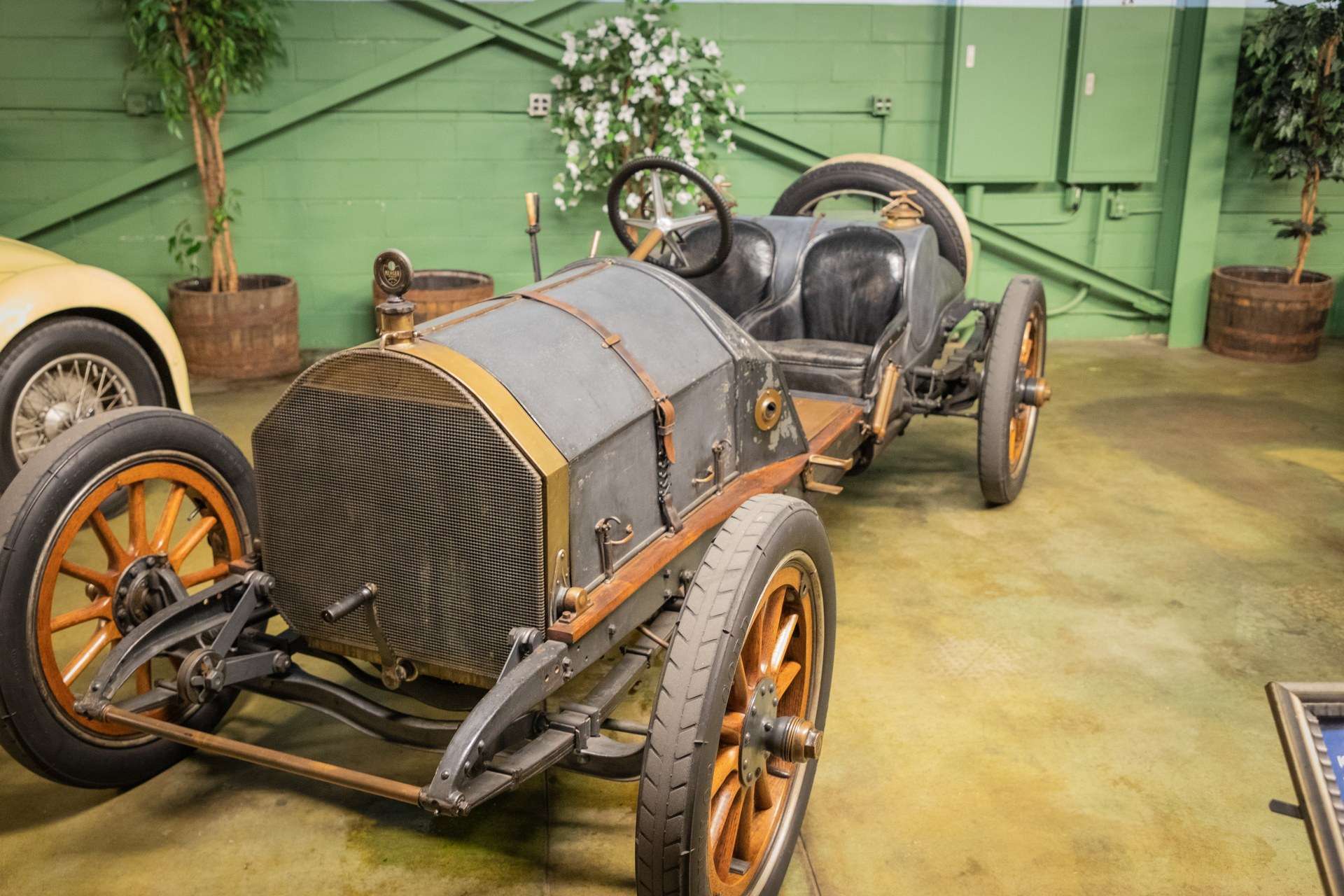
The 1913 Mercer Raceabout is the clearest case. Its chassis is stamped with a 1911 Raceabout number, yet its engine and four-speed gearbox came from a 1913 car, a combination that was not offered by the factory in 1911. Mercer historian Fred Hoch concluded that the lighter 1911 chassis was paired with the later, stronger drivetrain to make a more maneuverable racer. The museum’s own catalog entry says the car may be the only surviving Mercer Raceabout with a possible racing history, and it admits that parts of the early story rest on assumptions drawn from the hardware. The finish was probably repainted crudely long ago and has not been touched since; the car has been restored mechanically, but not cosmetically. A restorer would have been tempted to correct the paint and tidy the story. The museum documents the contradiction instead.
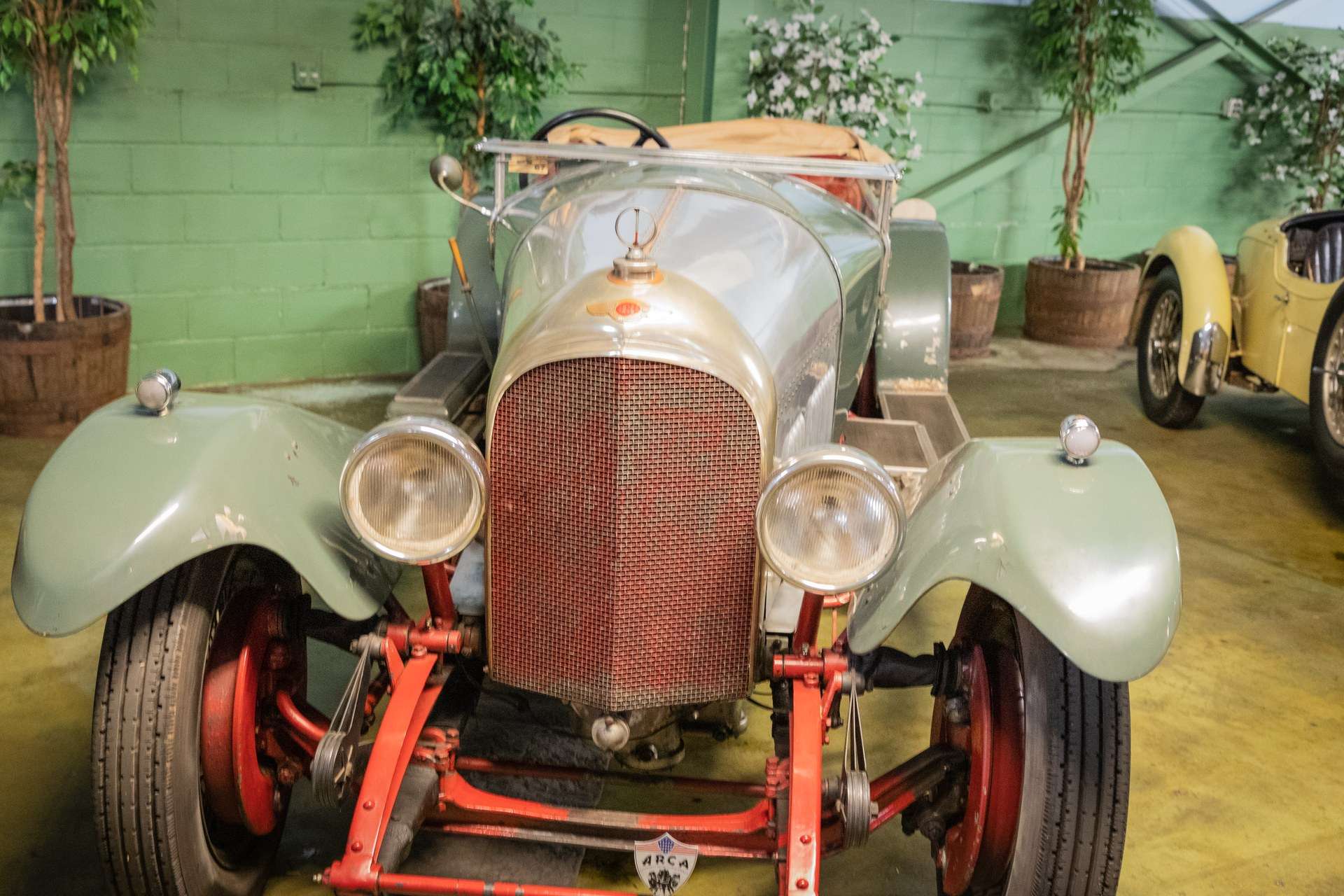
The 1927 Bentley 3 Litre Speed Model carries a human story to go with its originality. The museum describes it as unrestored apart from a post-war repaint by a later owner, and says it is likely the only vintage Bentley to race in America before World War II. Alan Bemis, a New Englander, bought it in New York in 1934, joined the Automobile Racing Club of America and finished fourth in an ARCA race at Marstons Mills on Cape Cod. In a 1990 letter, the museum notes, Bemis wrote that he had always castigated himself for selling it. The one change from original is practical: the troublesome vacuum fuel tank was replaced with electric pumps, and the original tank was kept in case it is ever reinstalled. For context on how Bentley’s racing history is valued today, see MCC’s analysis of the Blower Bentley.
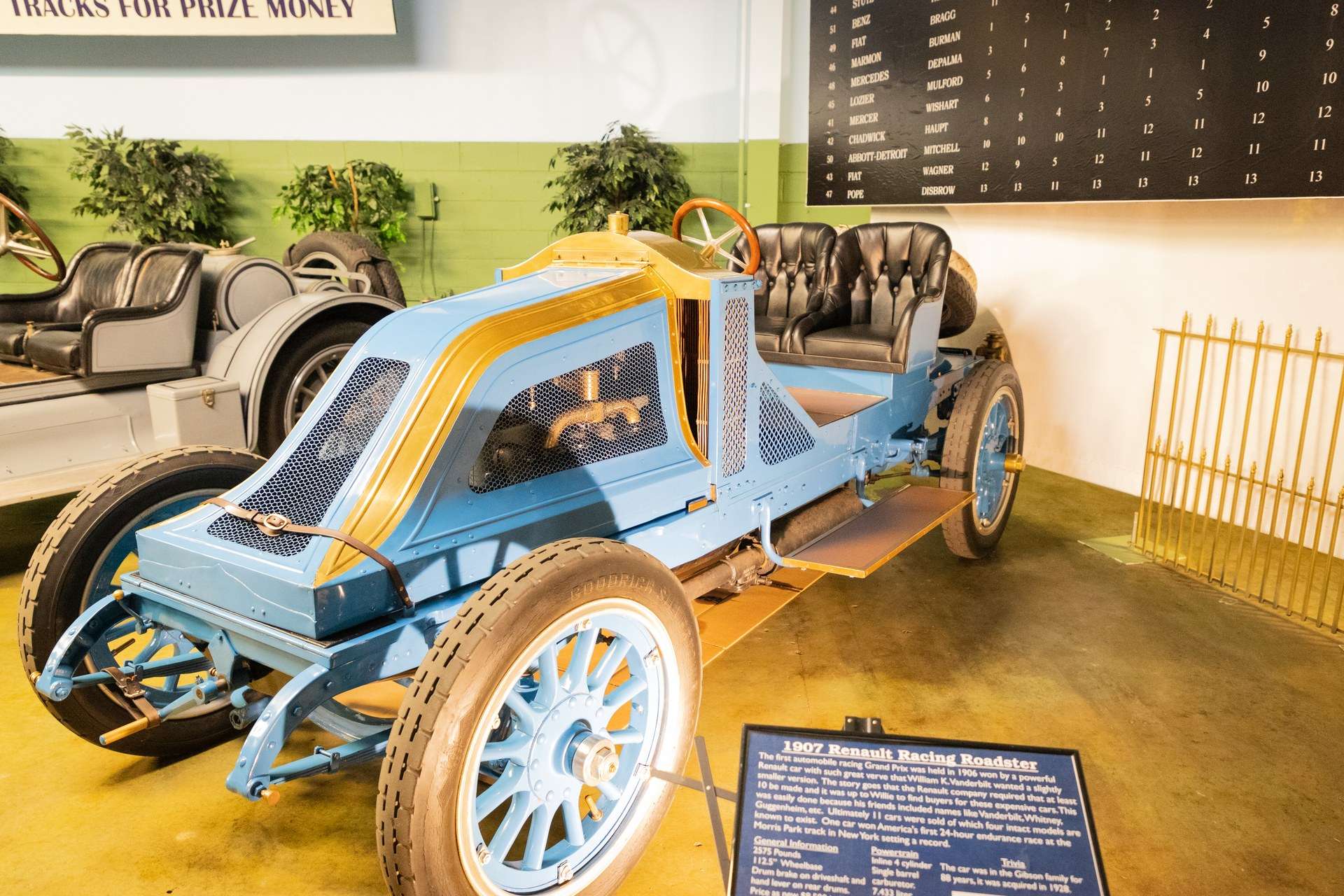
The 1907 Renault 35/45 Vanderbilt racer shows how preservation sometimes happens by accident. Renault won the first race called a Grand Prix, near Le Mans, in 1906. William K. Vanderbilt wanted to launch road racing in America and asked Renault for a car; Renault required a minimum order of ten, so he recruited friends including Guggenheim, Paine, Whitney and Dodge. Before World War II, old race cars were usually scrapped. According to the museum, this one survived because it was used to drag a large wet canvas around a dirt horse track before races. Kirk Gibson acquired it in 1928 and it stayed with his family until they gave it to the museum. The museum says only a handful of the cars built survive, though its page gives two different counts.
Cars that carry the competition story
The collection also holds cars whose histories are better documented and more widely known. The 1964 Shelby Cobra Daytona Coupe, chassis CSX2287, won its class at Sebring that year and in 2014 became the first vehicle placed on the National Historic Vehicle Register. MCC covered a record sale of a different Daytona Coupe, while the Simeone car is the example on display in Philadelphia. The museum also owns a 1963 Chevrolet Corvette Grand Sport, from the program General Motors ended after five cars were built; MCC has examined the record Grand Sport sale of a different chassis. And the 1921 Duesenberg 183 raced in the 1921 French Grand Prix and finished second at Indianapolis in 1922, according to Classic Motorsports.
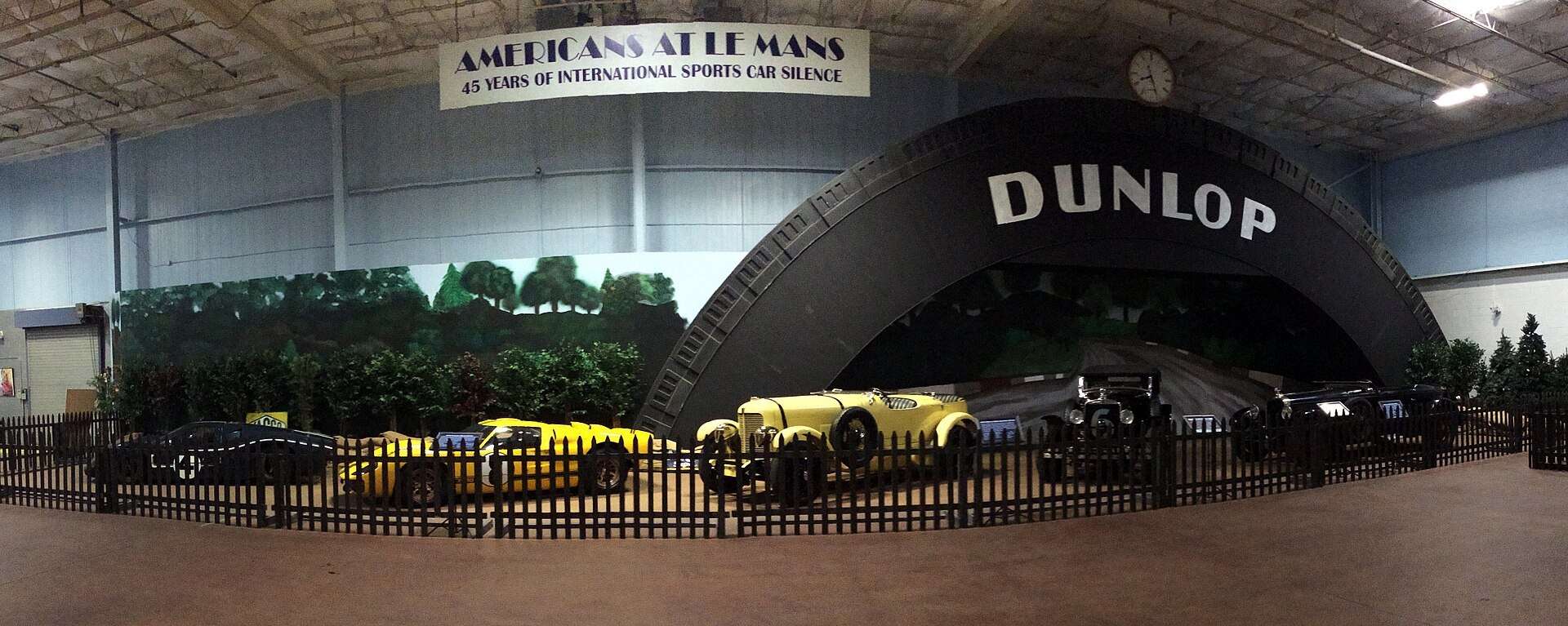
The museum’s Le Mans exhibit compresses four decades of design into one room. Its listed cars include a 1933 Alfa Romeo 8C 2300 Le Mans, a 1938 Peugeot Darl’mat, a 1954 Ferrari 375 MM Spider, a 1956 Maserati 300 S, a 1958 Ferrari 250 Testa Rossa, a 1963 Ferrari 250 P and a 1970 Porsche 917 LH. The museum uses the sequence to show how aerodynamics took over as speeds rose; the 917 LH, with its long tail and fins, is the endpoint. Arranged this way, the cars read as a design argument rather than a price list.
The newest addition: a Group 44 Jaguar XJR-7
The collection is still growing. In a July 2, 2026 release, the museum announced that Jim and Mary Rogers of Vero Beach, Florida, donated Jaguar XJR-7 chassis 001, the first chassis of the XJR-7, the IMSA GT car built by Group 44, the team led by Bob Tullius. The museum lists a 7.0-liter V12 rated at 720 horsepower. Ultimate Car Page records that the chassis finished fourth on its debut at the Daytona 3 Hours in late 1985 and was driven by Hurley Haywood, Brian Redman and John Morton. It won the West Palm Beach 3 Hours in 1987, the last victory for Group 44, and made its final start at the 1988 Daytona 24 Hours, where it retired with overheating.
The ownership story is what makes it a Simeone car. Tullius kept the XJR-7 in running order after its racing career and, according to the museum’s director of programs, Harry Hurst, sold it reluctantly to the Rogers family in 1992. It then spent more than three decades with one family before moving to a museum that drives its cars. (The museum’s release dates the car inconsistently, so this account relies on the documented race record rather than a model year.) A donation, rather than a purchase, is also how many collections of this kind actually grow: continuity of care becomes the reason to give.
What collectors should take from it
First, a discrepancy documented honestly is worth more than a story smoothed over; the Mercer’s mismatched chassis number is the museum’s evidence, not its embarrassment. Second, the survivors in this collection owe their condition to specific people (a family that held a Renault for decades, an owner who kept a Bentley in near-original form, a team principal who kept his own prototype running). Provenance of care matters as much as provenance of racing. Third, running cars and original cars are not opposites: the museum maintains and demonstrates its cars while keeping their finishes.
This spotlight deliberately carries no valuation. The cars are held by a foundation and are not for sale, and public figures for individual examples would say little about why the collection matters. For comparison with other institutions that shaped what collectors value, see MCC’s coverage of the Nethercutt Collection, the Harrah Collection’s deaccession and the National Corvette Museum’s collections facility, along with our guide to the best car museums in the United States.
Visiting: The museum is at 6825 Norwitch Drive in Philadelphia. In its July 2026 release it listed hours of 10 a.m. to 6 p.m. Tuesday through Friday and 10 a.m. to 4 p.m. on weekends, with adult admission at $15; confirm current details with the museum before traveling.
Sources: the Simeone Foundation Automotive Museum’s collection entries for the 1913 Mercer Raceabout, 1907 Renault 35/45 and 1927 Bentley 3 Litre; the museum’s Le Mans exhibit page; its XJR-7 donation release and 24 Heures du Simeone release; Racer; Classic Motorsports; and Ultimate Car Page.
The collector car market, every weekday morning.
Auction results, price moves and what’s crossing the block, read in four minutes. Free, from Modern Car Collector.
No spam, unsubscribe in one click. Or read more about the Brief.

 Eve Nowell
 Shawn Henry