

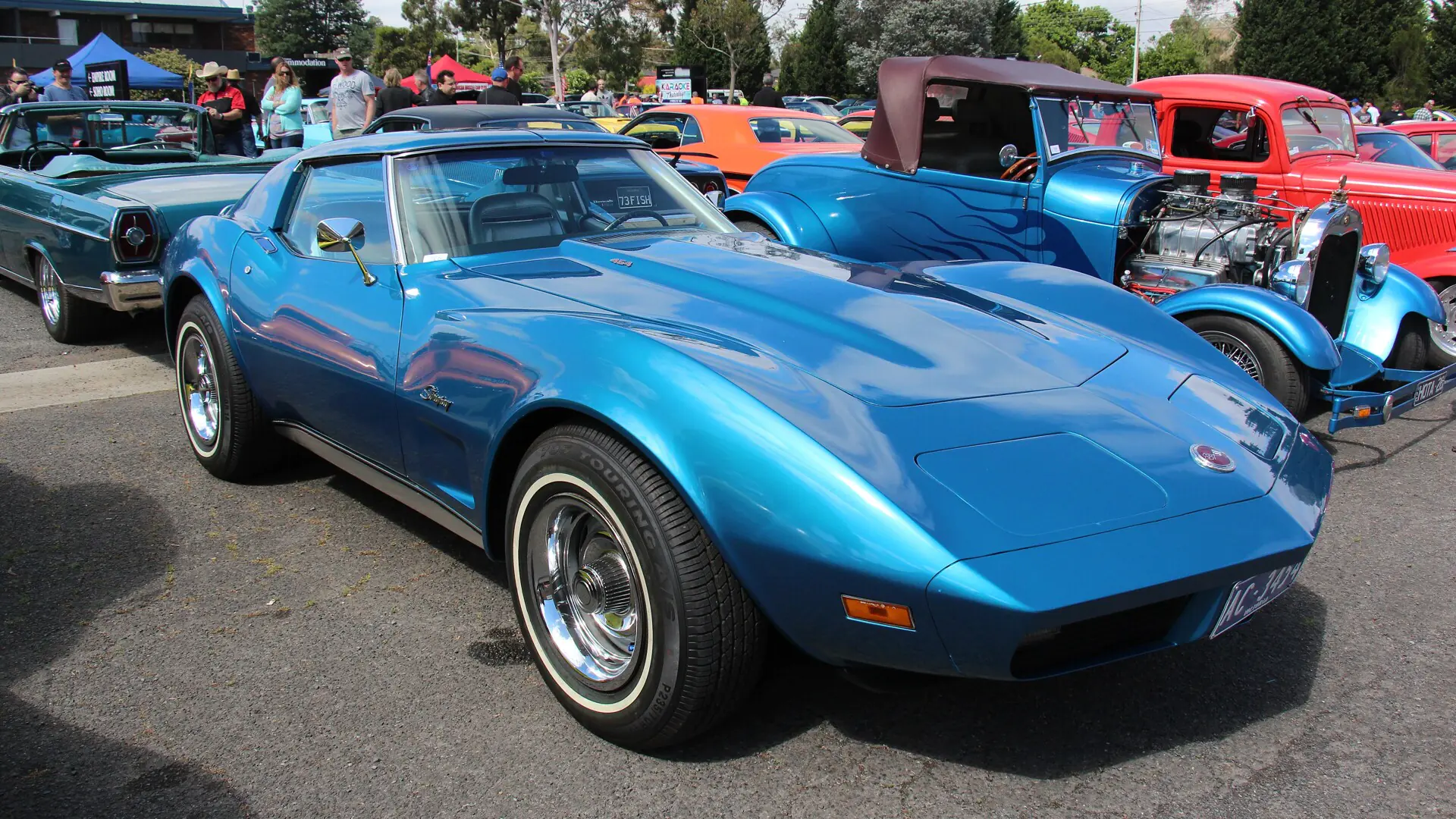
On Friday, January 15, 2027, nine Chevrolets will cross the block at Mecum Kissimmee after roughly 25 years in one man’s care. Dan McMichael’s Baldwin-Motion collection is six Corvettes and three Camaros, lots R601 through R609 on Mecum’s site, and most of them trace to a single Long Island shop. The cars are rare enough to be worth the attention on their own. The better reason to pay attention is the shape of the group: it holds a stock baseline, several cars bought from the builder himself, two prototypes, a barn find, and the last car the shop built before the EPA ended the business.
That makes it less a set of expensive cars than a worked argument about how a dealer-tuner era began and how it stopped. It is also about to be dispersed in a single session, which is the preservation question hiding inside the sale.
Nine cars, one custodian, one day
Mecum’s collection page lists the nine lots for Friday, January 15, within a Kissimmee sale that runs January 5 to 17 at Osceola Heritage Park. According to Mecum’s lot pages, McMichael bought three of the cars (the Maco Shark, the Baldwin-Motion GT and the final L88 coupe) directly from Motion founder Joel Rosen in 2001. He has had the 1971 Camaro Z28 since 2005, and the red Can-Am Spyder prototype came to him from the Mike Guarise collection. Mecum had not published estimates for any of the lots when this was written, so this piece sticks to what is documented rather than what the cars might bring.
How Baldwin and Motion built the cars
Rosen opened a Brooklyn shop in the early 1960s, added a chassis dynamometer in 1963 and moved to Baldwin, New York, in 1966, according to RM Sotheby’s cataloging of a Phase III Corvette. Around 1966 he partnered with Baldwin Chevrolet, a family-run Long Island dealer with no performance background of its own. Hagerty’s history of the brand describes the arrangement simply: customers ordered new Camaros, Chevelles or Corvettes through Baldwin, and Motion converted them into turn-key street cars, with GMAC financing available.
The top-tier Phase III cars carried a guarantee of a quarter-mile in 11.50 seconds or better at 120 mph or more. Rosen said nobody ever claimed the money back. Estimates of total Motion output run to roughly 500 cars between 1967 and 1974, and the Phase III Corvettes were a tiny slice of that. The Baldwin dealership itself did not last as long as the shop: accounts date its end anywhere from 1972 to 1974. Motion kept building cars under its own name, which matters for the two latest cars in this group.
The baseline: two stock Chevrolets
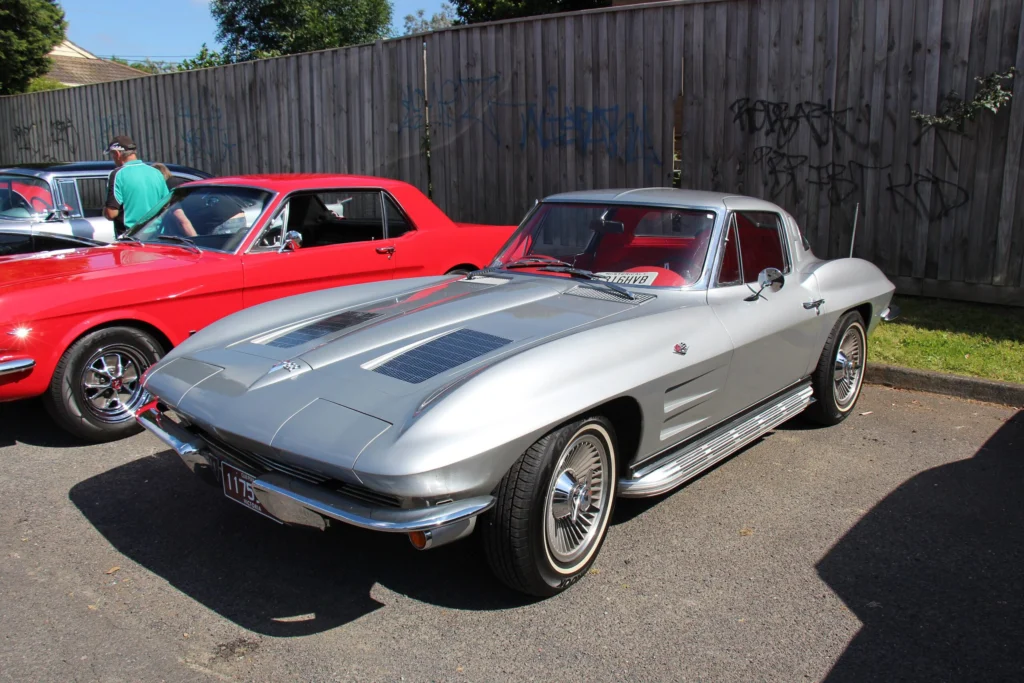
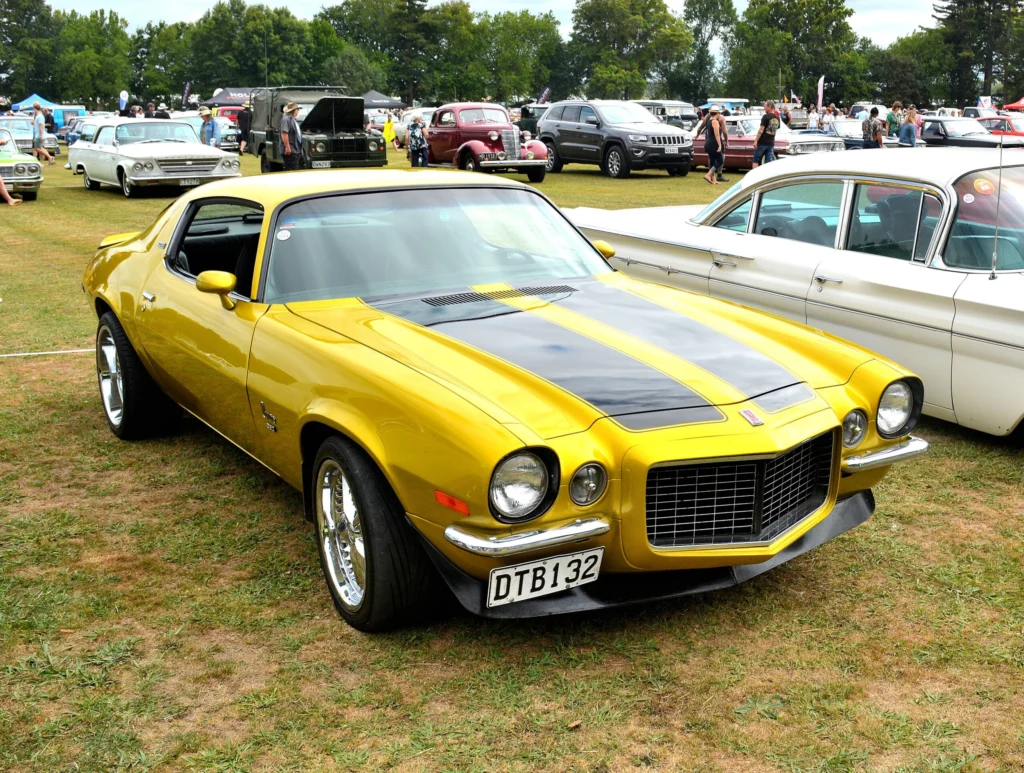
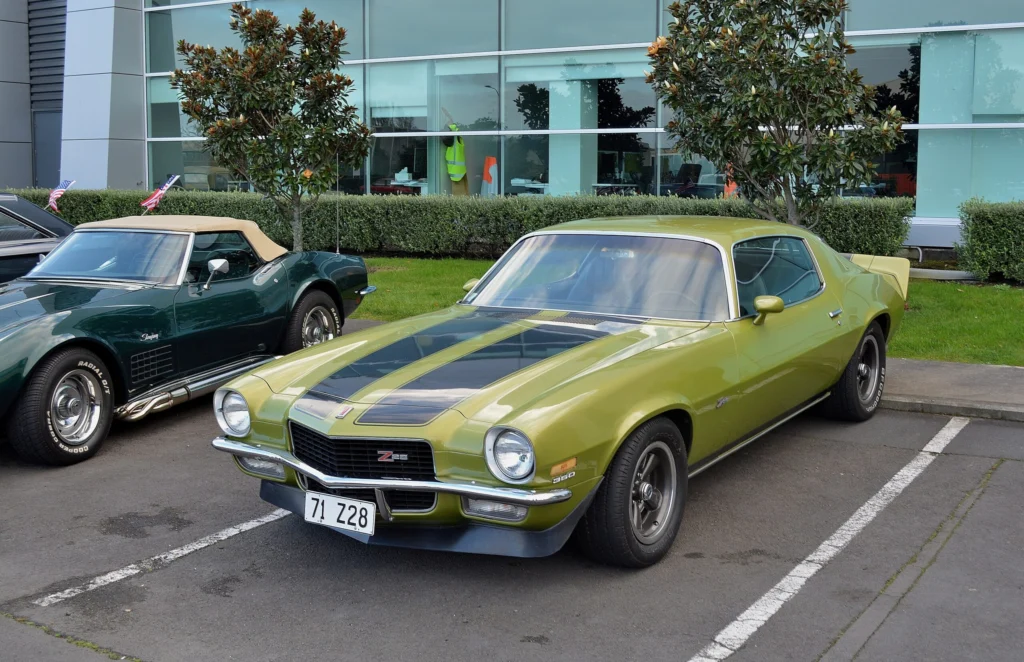
The quietest lots in the group may be the most useful. The 1963 Corvette split-window coupe (R607) is described by Mecum as frame-off restored to factory specification, in Sebring Silver over a dark blue interior, with its original matching-numbers RD-suffix 327/300 hp V8, a four-speed and finned knock-off wheels. Mecum notes that 1963 was the only year for the split-window body. The 1971 Camaro Z28 (R606) is a professionally restored car with its matching-numbers 350/330 hp LT1, an M22 four-speed and a Protect-O-Plate.
Neither car is a Motion product. Read alongside the rest of the group, though, they work as a control: this is what Chevrolet sold, and the other cars show what Rosen did to it. There is a small historical echo as well. Rosen’s obituary says his early race car was a fuel-injected 1963 split-window coupe. Mecum does not connect that car to this one, and nothing here suggests it.
The Phase III cars
The 1970 Baldwin-Motion GT coupe (R602) is the collection’s centerpiece in documentation terms. Mecum describes it as one of 10 Baldwin-Motion GTs built from 1969 to 1971 and one of three known to survive. Rosen nicknamed it “The Golden Egg.” Its first owner, Los Angeles estate broker Thomas Squires, paid close to $13,000 for it in 1970 including delivery. Rosen later spent years tracking the car down in Minnesota, commissioned a restoration by Palm Beach Motors in Alpine, New Jersey, and showed it at the 1993 New York Auto Show. It carries a blueprinted 454/535 hp Phase III engine with a solid-lifter cam, aluminum heads, a Winters intake and a Turbo 400 with Hone-O-Matic overdrive, which let the driver switch between 4.88 and 3.42 gearing.
The 1973 Camaro Motion Phase III (R605) shows the other side of the paperwork. Its 454/513 hp engine uses an Edelbrock C427X intake and an 850-cfm Holley, and the car shows 5,361 miles. The listing says the total cost with modifications came to $9,073.33, which was $5,232.33 above the $3,841 MSRP. The original purchase order is from Park Chevrolet in Asbury Park, New Jersey, so this was a Motion conversion of a car bought elsewhere, not a Baldwin dealership sale. It was restored in the 1990s under Rosen’s supervision, and he signed the roof above the driver’s door.
The show cars and prototypes
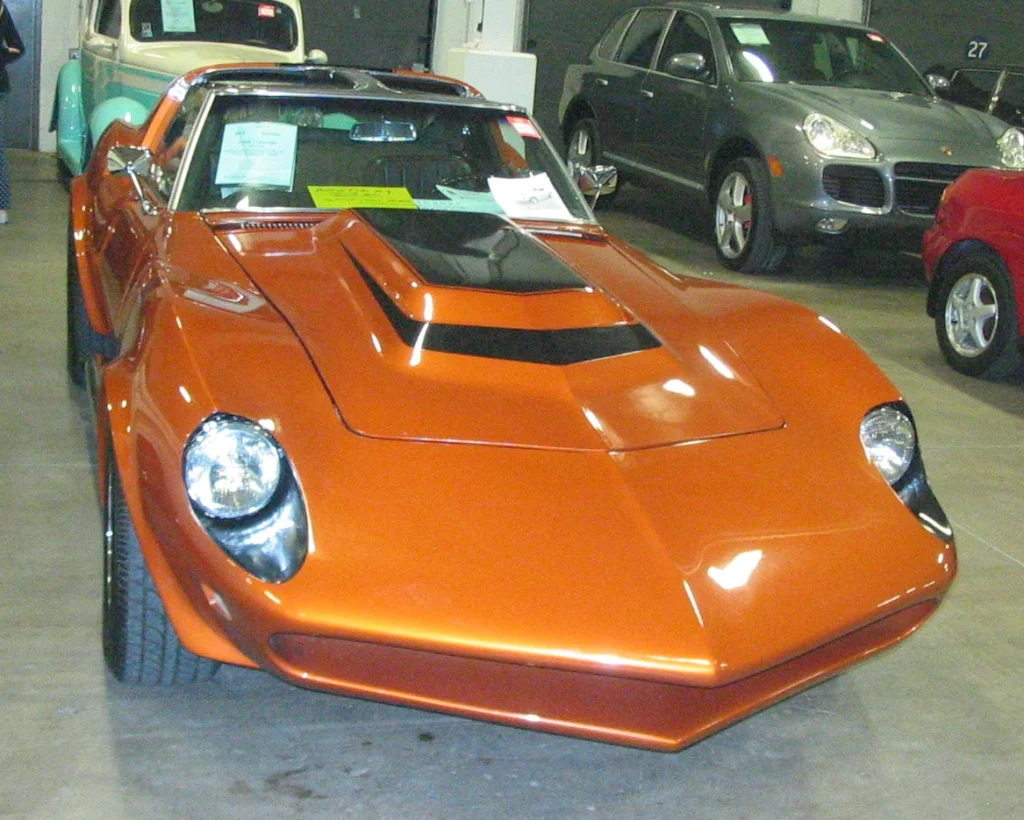
The 1970 Motion Performance Maco Shark (R601) was inspired by the Mako Shark II concept and is described as the last of six built and one of three known to exist. Its original owner brought in a 1970 Corvette and spent $17,039.75 turning it into a show-circuit car, completed in 1974. Mecum lists a Phase III LT1 350 dyno-tested at 460 hp, airbrushed scale paint by Gary Kupfer, and a Judge’s Choice Best of Show award at the 2025 Muscle Car and Corvette Nationals.
The two Can-Am Spyder cars carry the most interesting provenance claim. The 1974 prototype (R604) is serialized 0001, finished in red, and Mecum calls it the only example with a big-block engine (a 466/550 hp V8) and red paint. It was built as a cafe racer in the spirit of the Can-Am circuit, with IMSA-style flares. Corvette Report says only four Can-Am Spyders were built. The 1971 barn-find car (R609) is described by Mecum as purportedly one of those original four, believed to be the one that once carried a turbocharged small block. It has no drivetrain and needs a complete restoration. If both attributions hold, McMichael has held two of a four-car run, and the sale puts both in front of buyers at once.
The 1983 Camaro Motion IROC-Z prototype (R608) pushes the story past the 1970s. Rosen bought it new, and it was built for B&M Transmissions to show at the 1983 SEMA show, with a body kit that replaced every exterior panel except the roof and nose cap. It is unrestored and is being sold on a historic title, which means the buyer receives a bill of sale and must surrender the historic title to register it. That is a practical detail serious buyers should read before bidding.
The final Motion car, and the fine that explains the era
The 1974 Corvette Phase III/L88 coupe (R603) is billed by Mecum as the last Baldwin-Motion car built. According to the lot description, it was on the showroom floor when the EPA cited Motion for violating five new environmental regulations. After months of negotiation Rosen settled for a $500 fine, and the car was sold for off-road use only. Rosen said it carried an authentic L88 427 he had left over. It was frame-off restored from 2003 to 2005 and comes with a Letter of Authenticity from Motion. Autoevolution notes the car was publicly offered at $250,000 in 2014 and $225,000 in 2015, though those were asking prices, not sales.
The label deserves one caveat. If the Baldwin dealership ended before 1974, as several sources say, “Baldwin-Motion” on this car reflects Motion’s brand as it has come to be used, not a dealer sale. That does not change the car’s significance, but it is the kind of detail that affects how a Motion car is described in a catalog.
What collectors should weigh
Paperwork carries the value. Every Motion car in this group leans on a Letter of Authenticity, copies of shop orders and Rosen’s signature. Corvette Blogger reports that Rosen’s archives were acquired by Kasey Alford, who continues Motion’s documentation service. Copies and continuation cars exist as well. Mecum Kissimmee 2026 offered a 1969 Camaro listed as a Baldwin Motion Continuation Series car, which Classic.com recorded as an unofficial $192,500 result.
The comparables are thin and mixed. A 1969 Phase III Corvette sold for $136,400 at RM Sotheby’s Fort Lauderdale in 2013. Hagerty reports a 1969 Phase III Corvette at Mecum Kissimmee in January 2014 brought $140,000 against a $225,000 to $275,000 estimate. At Mecum Harrisburg in August 2019, Sports Car Market recorded $115,500 for another 1969 Phase III Corvette and $90,200 for a different 1973 Phase III Camaro. At the far end, a one-off 1969 Camaro SS with an LS7 454 ordered through Baldwin Chevrolet was reported sold for $1.1 million in January 2026, as covered in MCC’s list of the most expensive Camaros sold at auction. Those results span more than a decade and very different cars, so they bracket the market without setting a price for any lot in this sale.
Condition varies on purpose. The group includes restored cars (R601, R603, R605, R606, R607), an unrestored prototype (R608), and a complete project (R609). Buyers will want to decide which of those they are actually bidding on: documentation, restoration quality, or the chance to finish a car the shop started.
Why the Baldwin-Motion collection matters
Motion’s story is often told through its fastest cars. This group tells it through its range: a Corvette as Chevrolet built it, the Phase III cars that carried the guarantee, show cars from the years when demand was shifting, and a final car tied to the enforcement action that, by most accounts, ended the shop’s high-performance work. For context on the factory-built end of the same dealer-performance culture, MCC has looked at the 1969 Camaro ZL1 COPO 9560 and at the GMMG Dick Harrell Camaro, another tuner-built Camaro from the same period.
The group will not stay together. Mecum is selling the nine cars as separate lots on one day, and each will go to whoever bids highest. The documentation travels with the cars, but the context of having stock, modified and prototype cars side by side does not. That is the real cost of a collection sale, and it is one reason institutions such as the National Corvette Museum build facilities to keep teaching collections intact, as MCC covered in its look at the museum’s collections facility.
Sources: Mecum Kissimmee 2027 lot pages (R601 to R609); Corvette Blogger; Hagerty; RM Sotheby’s; Sports Car Market; Corvette Report; Autoevolution.
The collector car market, every weekday morning.
Auction results, price moves and what’s crossing the block, read in four minutes. Free, from Modern Car Collector.
No spam, unsubscribe in one click. Or read more about the Brief.



 Eve Nowell