
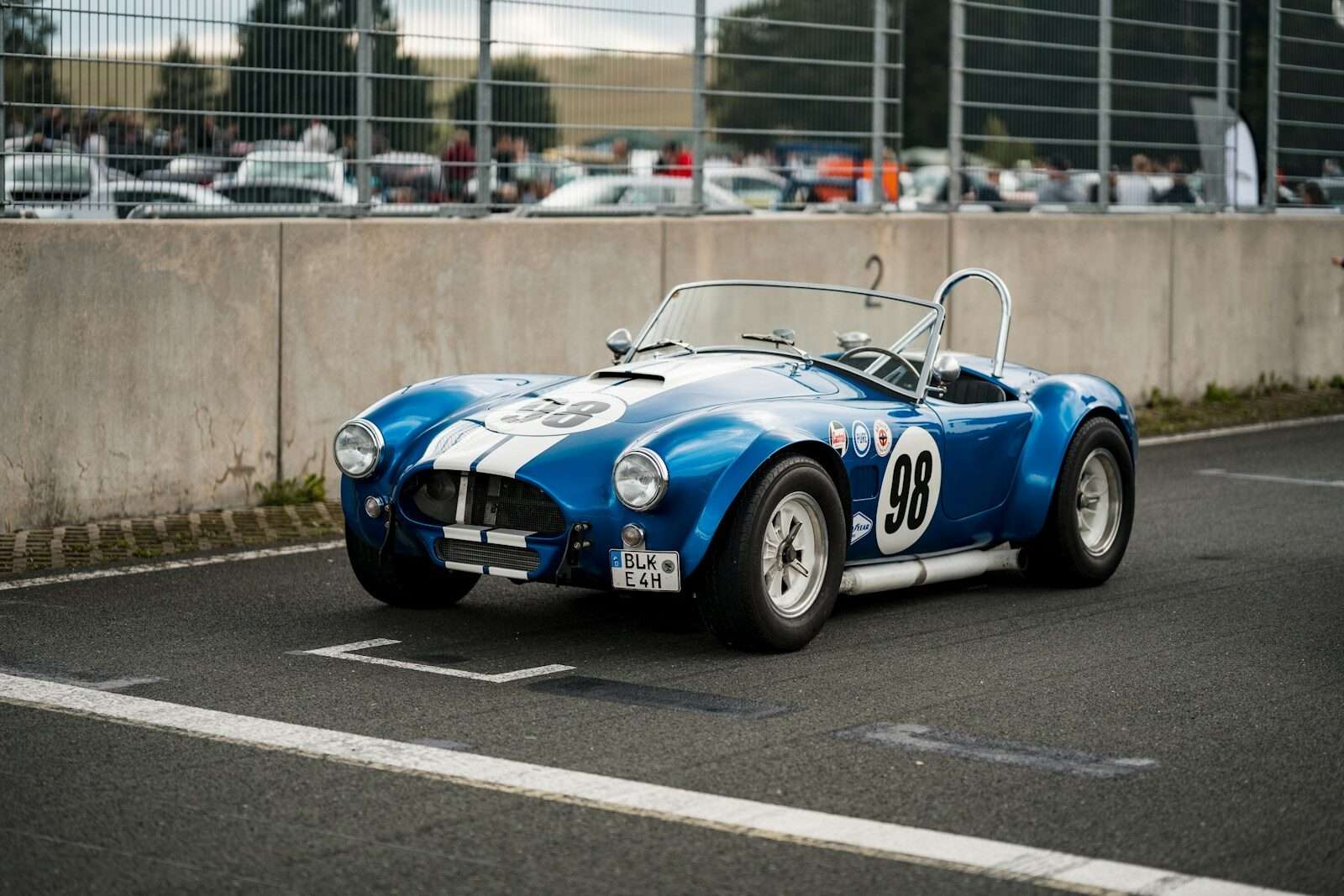
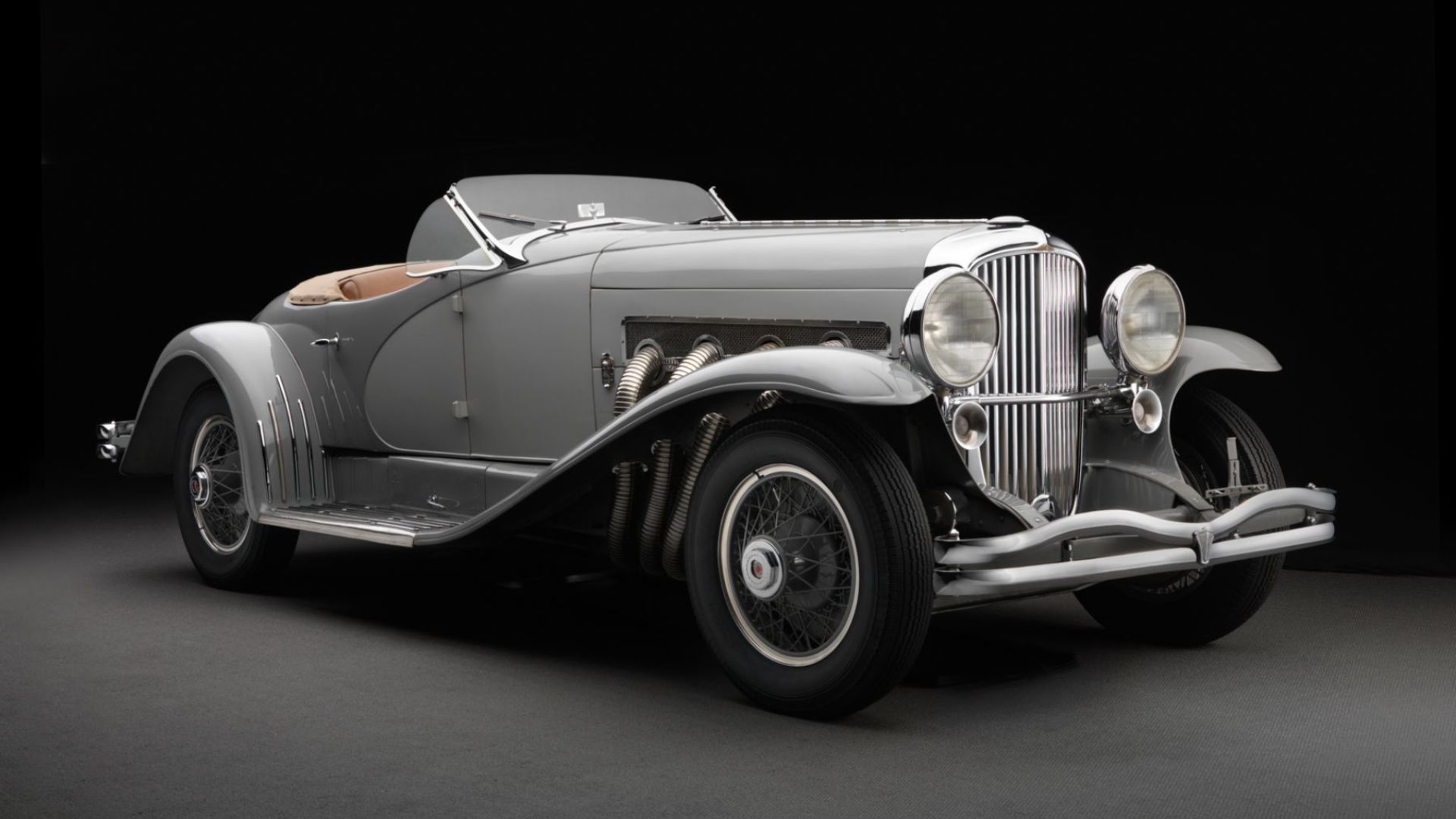
At Gooding Christie’s Pebble Beach Auctions this month, a 1964 Shelby Cobra Daytona Coupe crossed the block and did something no American car has ever done. It sold for $42,905,000, making it the most expensive American automobile ever sold at auction. The hammer fell at $39 million against an estimate of “in excess of $25,000,000,” nearly doubling the previous American record of $22 million, set by a 1935 Duesenberg SSJ in 2018.
It is tempting to lead with that number. Resist it. The price is the least interesting part of this story. What matters is which Daytona Coupe just sold, why it had effectively never been for sale until now, and what the result says about how the collector market has come to weigh documented history above rarity, horsepower, or badge.
Six Cars, One Championship, and a Very Uneven Market
The Cobra Daytona Coupe exists because Carroll Shelby’s open Cobra roadster, however dominant on short circuits, could not turn the speeds needed to beat Ferrari’s 250 GTO at Le Mans and Daytona. Designer Peter Brock’s solution was a slippery, Kamm-tailed coupe body grafted onto Cobra mechanicals, built in a run of exactly six chassis between 1964 and 1965. The gamble worked. In 1965, Shelby American’s Daytona Coupes won the FIA GT Manufacturers’ Championship, the only time an American manufacturer has ever claimed that title outright.
If rarity alone drove value, those six chassis would trade as more or less interchangeable relics of that championship season. They do not. The last Daytona Coupe to reach public auction, CSX2601, sold for $7,685,000 at Mecum’s Monterey sale in 2009. That was seventeen years ago, and even accounting for a much stronger market today, this month’s result for CSX2300 represents a different order of magnitude entirely. Something beyond chassis count was being bid on.
The Only Daytona Coupe Carroll Shelby Ever Owned
CSX2300 was the third Daytona Coupe completed, bodied in Modena by Carrozzeria Grandsport and pressed into service almost immediately. It debuted at the 1964 Tour de France Automobile with Bob Bondurant and Jochen Neerpasch sharing the wheel, then carried the championship fight through the 1965 season under Alan Mann Racing’s colors at Daytona, Sebring, the Nurburgring, and finally Reims, where a ninth-place finish helped seal Shelby American’s title.
What happened next is the part of the story collectors actually paid for. Once the championship was won and FIA rules changed, the Daytona Coupes became obsolete almost overnight. CSX2300 was sold through Shelby American’s 1966 “Garage Sale” and eventually made its way to Japan, where it raced successfully through 1968 before becoming, improbably, a street car in Tokyo running a substitute engine. It is the only Daytona Coupe to have raced seriously beyond Shelby’s factory program, and it survived a period when almost nobody outside a small circle of Cobra historians understood what it was. Historian Michael Shoen eventually tracked the car down and helped broker its return to the United States, where in 1975 it was sold to Carroll Shelby himself. Of the six Daytona Coupes built, this is the only one its creator ever personally owned, placing it alongside the small handful of competition Cobras Shelby kept close to himself throughout his life.
Restoration as Documentation, Not Disguise
Shelby kept CSX2300 for more than two decades, restoring it to 1965 racing specification with its correct 289 engine and gearbox. After it left his ownership in the late 1990s, a second, more comprehensive restoration under owner Larry Bowman was completed in 2003. That restoration made a deliberate choice worth noting for any serious buyer: rather than erase the evidence of the car’s hard life, it preserved the collision damage from the 1965 Sebring 12 Hours and the registration markings from its years in Japan. The car still competes today at events such as the Goodwood Revival and Tour Auto.
That choice is the clearest lesson in this sale. A restoration can return a car’s mechanical correctness. It cannot manufacture the evidence of having actually been there. Cosmetic perfection is easy to buy. An honest, documented, uninterrupted chain of ownership and competition history is not, and that scarcity is worth more to serious collectors than a fresh coat of paint ever will be.
Ferrari Money for a Ford-Powered Underdog
There is a reason auction-goers kept invoking Ferrari’s name as CSX2300 climbed past $30 million. A hand-built, aluminum-bodied coupe powered by a Ford small-block V8 has now sold for money that, until recently, only Ferrari 250 GTOs commanded. That comparison is not incidental. It signals that sophisticated buyers are willing to price authentic, fully documented American competition history in the same tier as Europe’s most revered racing marques, provided the story behind the chassis is complete and independently verifiable.
What Serious Collectors Should Take From This
The supply side of this market is essentially fixed. All six Daytona Coupes are accounted for, held by careful owners unlikely to sell soon, which is exactly why seventeen years passed between the last two auction appearances of the model. Results this rare become de facto benchmarks, not just for Daytona Coupes but for the entire tier of blue-chip American competition cars trading alongside them at events like Monterey Car Week.
That does not mean every Cobra, or every car with a thin paper trail, should expect a similar premium. CSX2300 earned its number through an unbroken record of racing results, ownership, and a restoration philosophy that valued truth over polish. Chassis number alone never built this price. Documentation did.
Every generation produces one car that resets what an American original is worth. For years that role belonged to the Duesenberg SSJ. It now belongs to a small blue race car that Carroll Shelby built to beat Ferrari, and later could not bring himself to part with. That is not, in the end, a story about rarity. It is a story about the difference between owning a rare car and owning the one that mattered most to the man who built it.
The collector car market, every weekday morning.
Auction results, price moves and what’s crossing the block, read in four minutes. Free, from Modern Car Collector.
No spam, unsubscribe in one click. Or read more about the Brief.
Related Posts:
- Record Ferraris, Rare Icons and 15,000 RPM: The Week…

- The First Auburn 851 Speedster Heads to Hershey. Its…
- The Legendary Duesenberg SSJ: America’s Depression…
- This Murphy Duesenberg's Provenance Is First-Rate.…
- 6 Top Cars to Watch at the 2026 Monterey Auctions
- The Collector Car Market Paid Up for Certainty This…
 Shawn Henry
  Shawn Henry