
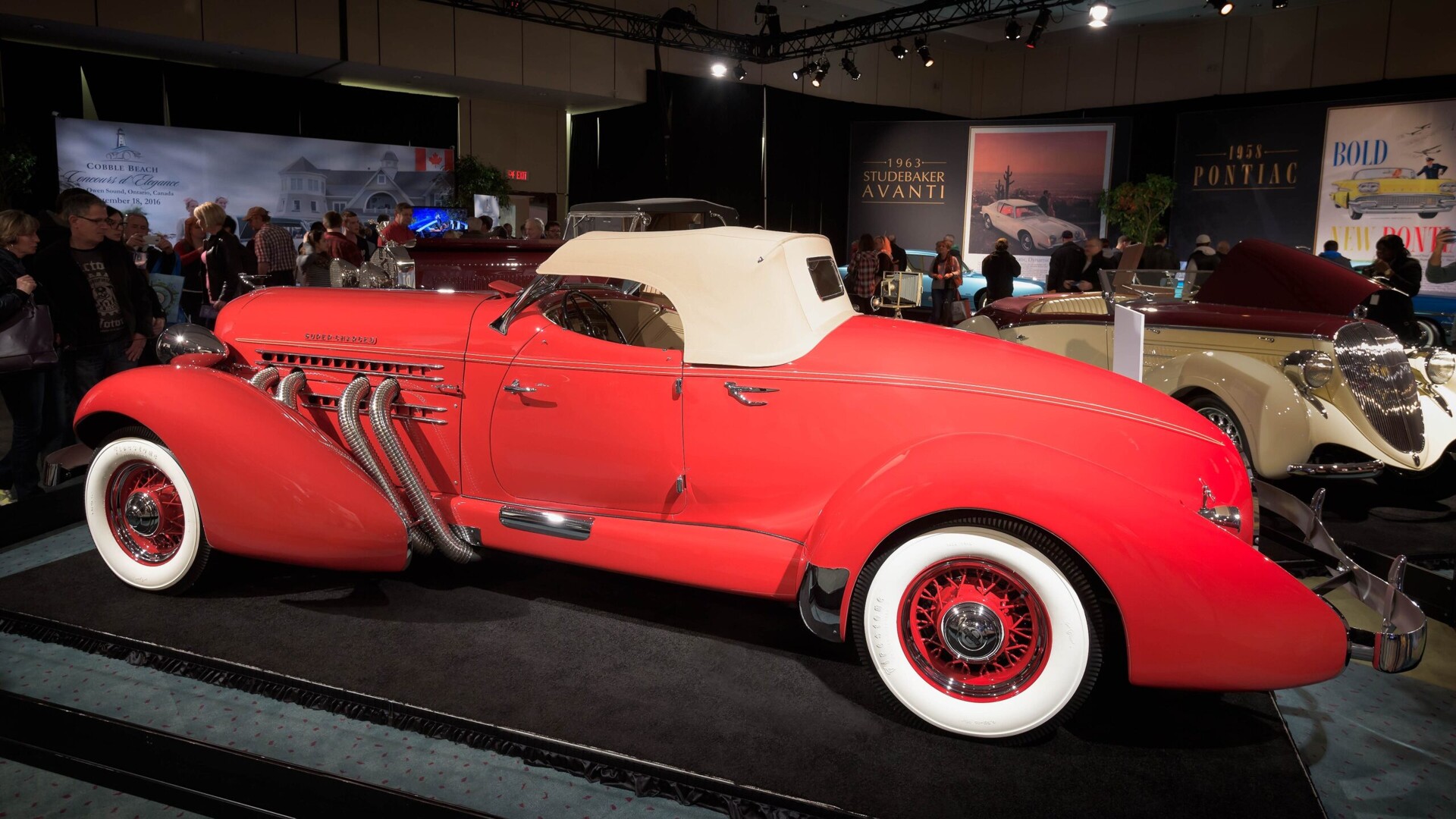
The 1935 Auburn 851 Supercharged Speedster offered as Lot 226 at RM Sotheby’s Hershey sale has the kind of claim most collector cars never get: according to RM and the Auburn Cord Duesenberg Club’s 1986 certification notes, it is the first 851 Speedster Auburn built. What makes the lot interesting is the estimate. RM has put it at $850,000 to $950,000. Recent public results for well-restored but otherwise ordinary supercharged speedsters fall in that same range. In other words, the estimate treats being first as worth close to nothing. The explanation is in the car’s history. Somewhere between a 1950s accident and a 1994 restoration, this speedster got a new frame.
This analysis keeps what RM’s catalog and the public record show separate from Modern Car Collector’s reading of the market. Everything under a “Verified” heading comes from the auction house’s lot description or another named source. The interpretation comes later, and it’s labeled.
The Lot at a Glance (Verified)
- Car: 1935 Auburn 851 Supercharged Speedster (RM’s addendum notes the car is titled as a 1934)
- Serial number: 851 32050 E
- Engine number: GH 3341
- Body number: U47-200
- Supercharger number: 1001
- Frame number (per catalog): 1050
- ACD Club certification: Category 1, number A-101
- Sale: RM Sotheby’s Hershey Auction 2026, Lot 226, Hershey Lodge, Hershey, Pennsylvania
- Crosses the block: Wednesday, October 7, 2026 (the evening session starts at 5 p.m. ET)
- Estimate: $850,000–$950,000
- Buyer’s premium: 12% on the first $250,000 and 10% above that. A hammer price of $850,000 comes to $940,000 with premium. A hammer price of $950,000 comes to $1,050,000.
Specifications (Verified)
The 851 Supercharged Speedster uses Auburn’s Lycoming straight-eight of about 280 cubic inches. A Schwitzer-Cummins centrifugal supercharger raises output to 150 horsepower. Power goes through a three-speed gearbox to a Columbia dual-ratio rear axle, which was standard on supercharged Auburns. A switch on the steering wheel selects between the two axle ratios, so each gear has a low and a high setting. RM’s description covers the drivetrain. Old Cars Weekly gives the speedster’s original price as $2,245 f.o.b. Auburn and its weight as 3,765 pounds.
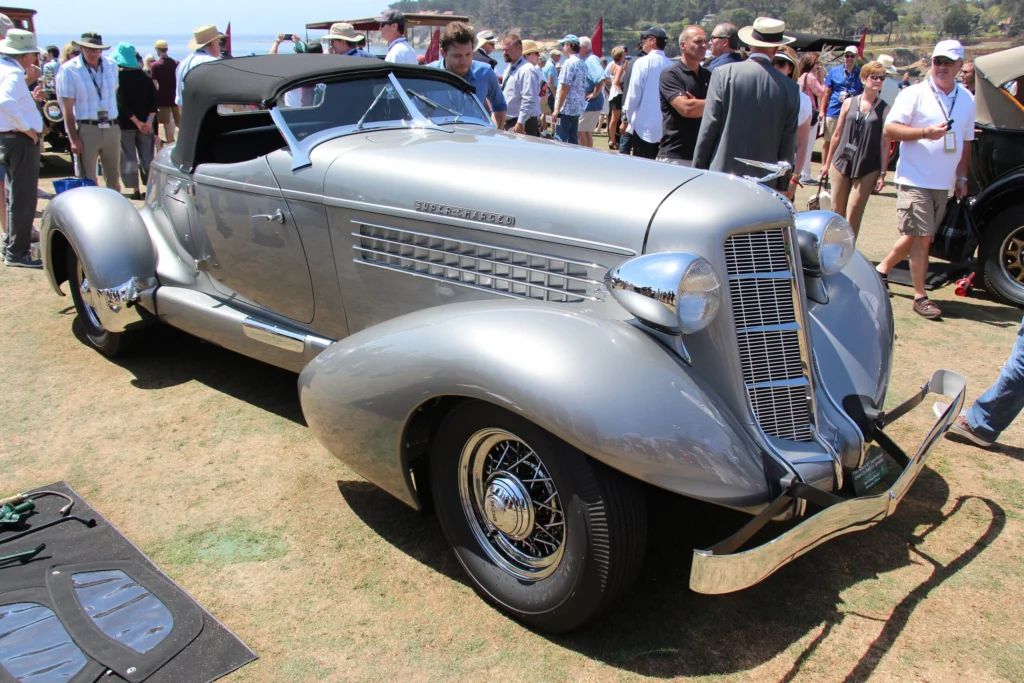
Gordon Buehrig designed the body. It has a straight hood line, a sharply vee’d windshield, pontoon fenders, and a tapering boattail. Each car’s dash carried a plaque with Ab Jenkins’s engraved signature, stating the car had been driven more than 100 mph before shipment. RM calls the claim “fanciful” but grounded in fact, because Jenkins did top 100 mph in a stock speedster at Bonneville. Jenkins had built that reputation three years earlier at the wheel of a Pierce-Arrow. MCC covered that run in the 1932 Pierce-Arrow Twelve’s 24-hour Bonneville record.
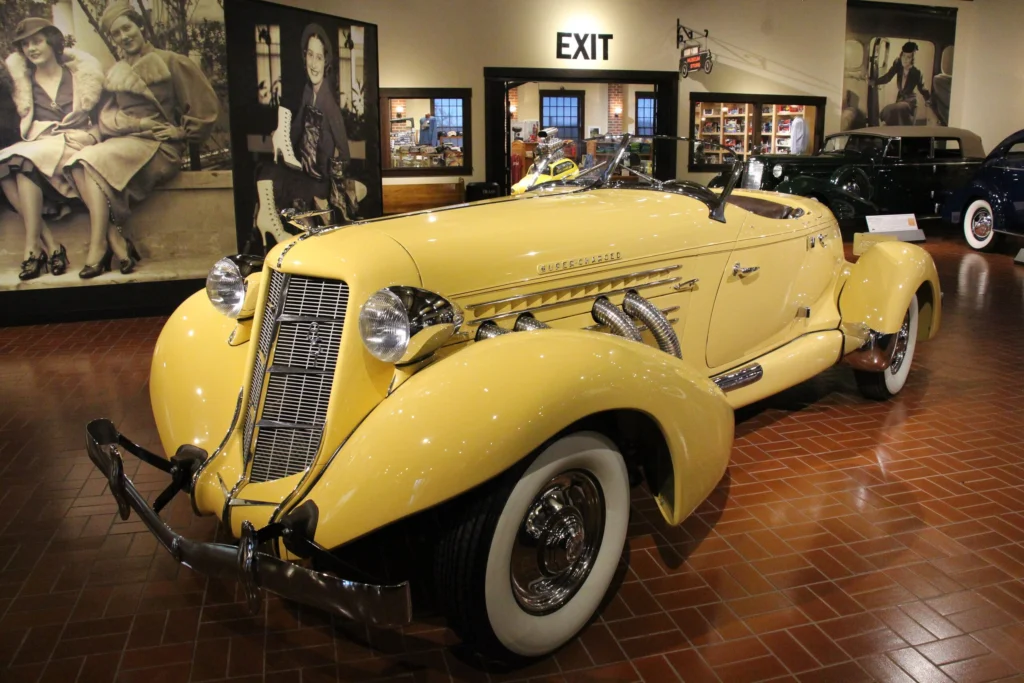
Production was small. Ab Jenkins once claimed Auburn built 500 speedsters, but Old Cars Weekly reports that experts believe about 150 were actually made. Wikipedia’s entry on the model puts 851/852 supercharged boattail production at 143. The exact number is disputed, so MCC treats it as roughly 150 across both model years.
Why “First” Is Documented Here, Not Just Claimed (Verified)
According to RM’s catalog, Auburn built the earliest 851 Speedsters from unused 1932–33 speedster bodies it had kept in storage, updated to Buehrig’s new design. Those bodies carry a U47 body-number prefix. This car’s body is U47-200. RM cites speedster historian and restorer John Ehresman, a former owner of this car, for two early-production details it shows:
- More enclosed, pontoon-style front fenders, which Ehresman says only the first 16 speedsters had.
- Exhaust pipes that come out through the hood louvers, which he says only the first four cars had.
RM also describes engine number GH 3341 as “reportedly a very early production block design.” The claim doesn’t rest on a seller’s opinion. When Ehresman presented the car at the 1986 ACD Club National Reunion, Certification Chief Paul Bryant noted that it “shows several unique features, which indicate that it was built as the first 1935 851 model speedster,” according to the catalog.
History and Provenance (Verified, as Reported by RM)
- Early years: Believed to have been in New York and Rhode Island, then Massachusetts.
- Early 1950s: Martin S. Papazian of Worcester, Massachusetts, bought the car after an accident, paying $200 to David R. Revolti of Milford.
- 1956: Papazian traded it to Paul Walker of New Braintree as payment for work on the “Cordster,” Papazian’s trophy-winning custom built from a 1936 Cord front end and a Jeepster body. Walker owned the Auburn for 30 years. He did an amateur restoration, installed a new frame to replace the damaged original, and later loaned the car to the Sturbridge Auto Museum.
- 1986: John Ehresman of Feeding Hills, Massachusetts, bought it and had it certified by the ACD Club.
- Later owners: Johnny Pascucci of Connecticut, then Bob Levine of West Orange, New Jersey.
- 1994: Full restoration by RM Auto Restoration in Blenheim, Ontario, finished in ivory with a correct leather interior. It won the Roy Faulkner Award for Best Auburn at the ACD Club National Reunion, then a CCCA Primary First Prize in 1995.
- February 2001–2025: Held in a collection of Full Classics and rarely shown.
- 2025–present: The current consignor bought it in 2025 and sent it back to RM Auto Restoration. Invoices show more than $15,000 of work on the steering, brakes, fuel system and suspension, plus detailing and refinishing.
There is one more public record. RM Sotheby’s offered this same car, serial 851 32050 E, as Lot 158 at its Monterey sale in August 2025. RM’s results page marks it “Sold” but does not publish a price. The Hershey catalog says the consignor acquired the car in 2025. It doesn’t say where.
Condition (Verified)
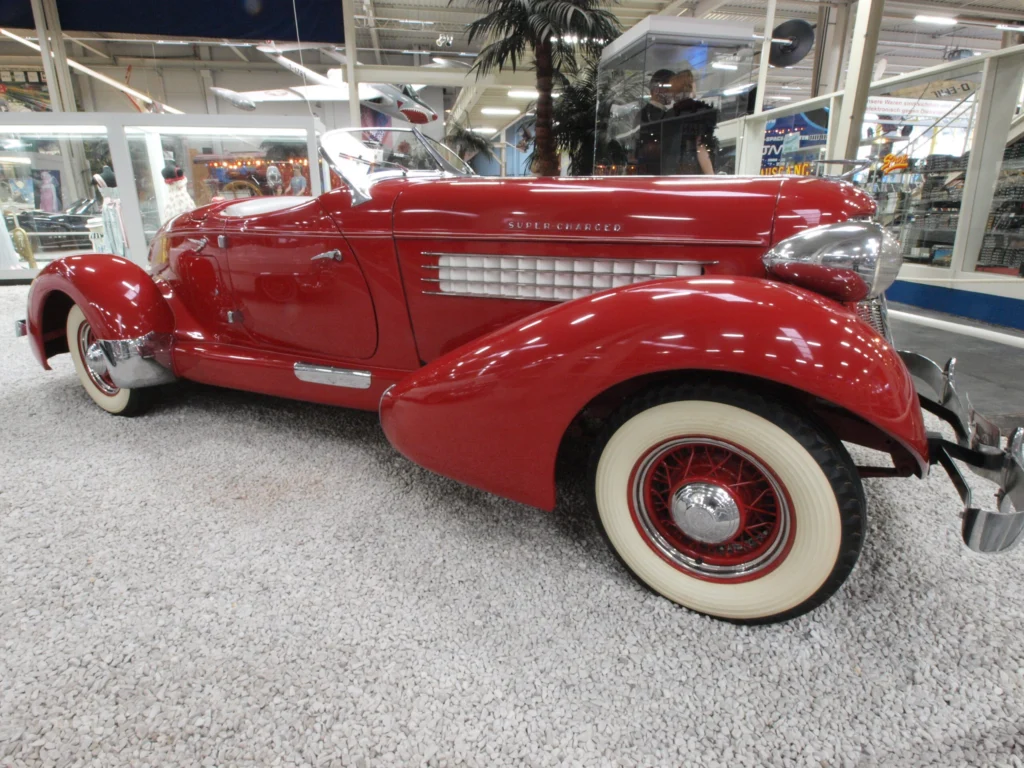
RM calls the car a “well-preserved restoration.” That restoration was finished in 1994, which makes it 32 years old. It won top honors from both the ACD Club and the CCCA in the mid-1990s. The car was then kept for about 24 years in a collection where, according to RM, it was “seldom shown but well-kept.” The 2025–26 work was a freshening, not a restoration, and the invoices on file total a little over $15,000. RM’s Monterey 2025 listing used the same “well-preserved restoration” wording, before that work was done.
Where the Record Needs a Closer Look
The same catalog makes two statements that don’t obviously fit together. It lists “the very early frame number 1050,” and it also says Paul Walker “installed a new frame to replace the damaged original.” The catalog doesn’t explain whether 1050 was carried over to the replacement frame, whether it refers to parts saved from the original, or whether the replacement is itself an early Auburn frame. For a car whose value rests on its identity, that is the first thing a serious bidder should settle with RM’s specialists and the documents RM has posted for the lot.
Two smaller points: the title reads 1934, not 1935, which is common for early production Auburns but worth noting on paper. And the dash plaque’s exact wording varies by source (RM says 100.1 mph, Old Cars Weekly says 100.6 mph). Neither affects the car’s authenticity.
Estimate and Comparable Sales (Verified Figures)
These are recent RM Sotheby’s results for supercharged 851 Speedsters, taken from RM’s own lot pages. All prices include buyer’s premium.
| Sale | Serial | Key facts | Result |
|---|---|---|---|
| RM Monterey, Aug. 2024 | 851 33216 E | Original frame and engine; ACD Cat. 1; 2018 Pebble Beach class winner; two-time Roy Faulkner winner | $1,270,000 |
| RM Miami, Feb. 2025 | 851 33833 E | Original frame and engine confirmed; ACD Cat. 1; 2009 concours restoration | Not sold (est. $900K–$1M) |
| RM Miami, Feb. 2026 | 851 32369 E | Mark Clayton restoration; kept in a private museum since completion | $852,000 |
| RM Amelia Island, Mar. 2023 | 851 32724E | One of the first 50, built on a stored earlier body; concours restoration; ACD Cat. 1 | $791,500 |
| RM Hershey, Oct. 2024 | 851 33108 E | Older restoration; ACD Cat. 1; ex-Jerry J. Moore and Chuck Spielman | $781,000 |
| RM Monterey, Aug. 2025 | 851 32050 E (this car) | Same car, before the 2025–26 freshening | Sold, price not published |
CLASSIC.COM’s market data also lists 1935 851 Speedster sales at Broad Arrow ($527,500, March 2026) and Mecum ($550,000, August 2026). MCC hasn’t independently confirmed the specification or authenticity of those cars, so they’re shown as context and not used as direct comparables.
For more of this season’s Hershey consignments, see our market brief on the sale’s Duesenberg Model J and its other headline lots, and our analysis of the 1956 Cadillac Eldorado Brougham Town Car in the same auction.
Market Interpretation: What We Think Moves the Number
Everything in this section is Modern Car Collector’s analysis, not verified fact.
The estimate prices “first” at almost nothing
The low estimate is essentially the $852,000 paid in Miami this year for a well-restored speedster with no special history. The high estimate sits about $320,000 below the 2024 Monterey result for a Pebble Beach class winner. Measured against those two cars, RM is estimating the first 851 Speedster as a good, older-restoration example. We think the main reason is the frame. The market has shown repeatedly that it pays for original frames and engines. The two cars on the list with a confirmed original frame and engine brought the highest result ($1.27 million) and the highest estimate ($900,000 to $1 million). The engine and body on this car are right. Its frame, by the catalog’s own account, is a replacement.
What could push it past the high estimate
- A different kind of buyer. Serial-number-one cars appeal to museums and to collectors building a definitive ACD collection, not just to people shopping for a speedster. Two bidders like that can ignore the comps table.
- Clear frame documentation. If the file shows the replacement frame is a period Auburn speedster frame, or that 1050 carried over for a documented reason, the main objection weakens.
- A path back to concours. RM makes a point of the car’s “return to both ACD circles and to the modern concours world.” A first-production car with a 1994 restoration is a strong candidate for a new restoration and a Pebble Beach class entry. Some bidders will value that option.
What could hold it under the low estimate
- The frame, if questions stay unanswered. Buyers at this level usually discount uncertainty more heavily than a known flaw.
- A quick return to auction. The same car sold at RM Monterey 14 months ago at a price that wasn’t published. Collectors notice when a car comes back this soon, especially when the new estimate can’t be checked against the last sale.
- The age of the restoration. A 32-year-old restoration, however well kept, competes against 2009-and-later concours restorations. A buyer who plans to show it may budget for a full restoration, and that comes out of the bid.
- The venue. Hershey buyers are serious about early American cars, but the sale draws fewer high-end bidders than Monterey, where the $1.27 million result happened.
What Collectors Should Ask Before Bidding
- How does “frame number 1050” fit with the replacement frame Walker installed? Where did that frame come from?
- Does the 1986 ACD certification file record the frame’s status, and has the car been re-inspected since 1994?
- What was the Monterey 2025 result? RM may share it with registered bidders even though it isn’t posted publicly.
- What did the 2025–26 invoices find beyond the work itemized in the catalog?
- Do photographs or ACD records document the early-production features (fenders, hood-louver exhaust) as they were before 1994?
The Bottom Line
The body number, the certification notes and the early-production details all support the claim that this is the first Auburn 851 Speedster. What’s uncertain is its frame. RM’s estimate reflects that uncertainty honestly, which gives Lot 226 a real chance of beating it. Once the frame question is answered, this becomes a very different kind of car. Whatever it brings on October 7 will show how much the collector market values “first” when originality is incomplete. Follow our RM Sotheby’s coverage and auction analysis for the result.
Photos in this article show other Auburn 851/852 Speedsters, not the Lot 226 car. For photos of the car being offered, see RM Sotheby’s lot listing.
The collector car market, every weekday morning.
Auction results, price moves and what’s crossing the block, read in four minutes. Free, from Modern Car Collector.
No spam, unsubscribe in one click. Or read more about the Brief.
Related Posts:
- Restored 1937 Cord 812 Supercharged Phaeton For Sale…
- Supercharged 1936 Auburn 852 Boattail Speedster For…
- This Murphy Duesenberg's Provenance Is First-Rate.…
- Ends 8/9: Award-Winning 1967 Corvette Convertible,…
- Cadillac's Junkyard Dream Car Returns to Auction.…
- Collector Car Market Brief: A Hershey Duesenberg and…
 Kyle Matthews
  John Lloyd