
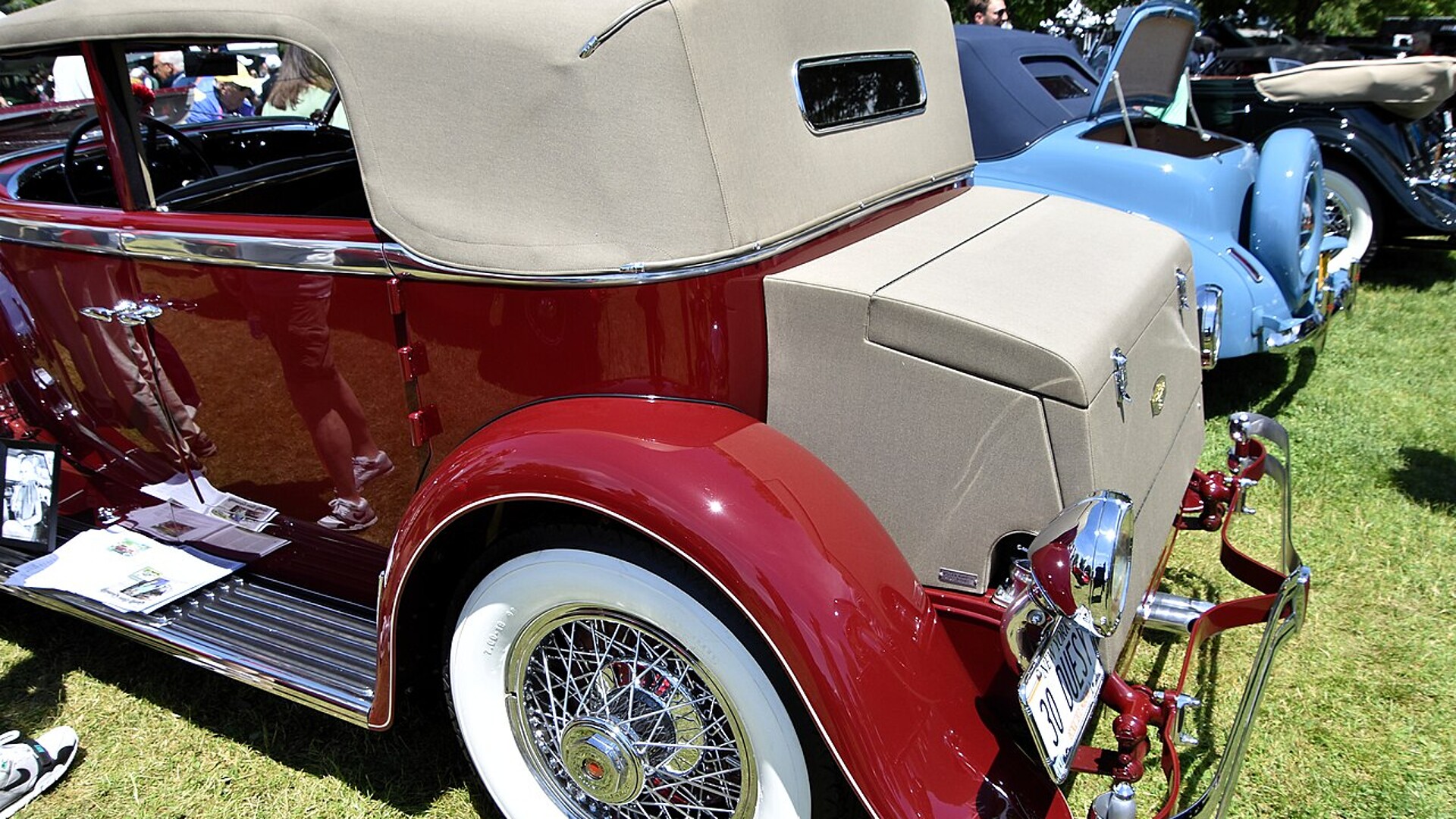
When RM Sotheby’s brings chassis 2434 to the stage at the Hershey Lodge on October 8, the room will see one of the scarcer shapes Walter M. Murphy’s Pasadena shop ever built on a Duesenberg Model J: a close-coupled convertible berline with a raked windshield, a strong beltline molding and softly rounded rear quarters. RM’s catalog for Lot 389 says only about five convertible berlines built to this design still exist.
It is a rare car. That is not the most interesting thing about it.
The more interesting thing is how plainly the catalog lays out what this Duesenberg is and what it isn’t. Its ownership chain is long, named and continuous, and it runs through several of the people who built the postwar Duesenberg hobby. Its engine, however, is a composite put together by one of those owners decades ago, and the car is titled on a combination of its chassis and engine numbers. The $900,000 to $1.2 million estimate is the market’s price for both facts at once. We flagged the car in Tuesday’s market brief; it deserves a closer read.
Every Model J Is Valued One Chassis at a Time
Duesenberg unveiled the Model J at the New York Salon in December 1928 with a Lycoming-built, 420-cubic-inch straight-eight carrying twin overhead camshafts and four valves per cylinder. The company claimed 265 horsepower at a time when most of its rivals in the American luxury arms race were making roughly half that. Fewer than 500 were built before the company closed in 1937.
Duesenberg sold the Model J as a rolling chassis. The body came from an outside coachbuilder, and Murphy bodied more of them than anyone else. That is why the market doesn’t value Model Js as a model. It values them chassis by chassis, and three things do most of the work: the coachwork, the provenance, and the integrity of the chassis-and-engine pairing. Chassis 2434 scores very differently on each.

The Coachwork: Rare, and Rare for a Good Reason
A convertible berline is, in plain terms, a four-door convertible sedan with roll-up glass. On a Model J chassis that recipe could easily look heavy. Murphy’s answer, as RM’s own catalog for an earlier example sold in 2011 describes it, was a set of slim “clear vision” pillars that gave the body a lighter, sportier look than its size suggested. The close-coupled version offered at Hershey pushes that idea further, with a shorter cabin and the rakish windshield that gives the car its stance.
So the rarity here matters because the design is good, not simply because few survive. Collectors rarely pay a premium for scarcity on its own. They pay for scarce things that are also right.
There’s a documentation bonus, too. During the ownership of Charles Markle Knipe, the car was photographed by Jim Hoe wearing late-production “JN”-style skirted fenders, and those images were later published in the Auburn Cord Duesenberg Club newsletter. Period photographs like these are a gift to any future restorer. They show what the car actually looked like at a documented moment, not what someone later decided it should look like.
One small point of dating: RM catalogs the car as a 1934, but it was delivered on August 13, 1933, after serving as a demonstrator at Duesenberg’s Chicago factory branch. That’s a routine wrinkle with Model Js. Chassis were often built well ahead of their bodies and buyers, and the model year on paper can trail the build by months or more.
The Provenance: A Roll Call of the Duesenberg Hobby
According to Duesenberg historian Ray Wolff, as cited in the catalog, chassis 2434 was first supplied as a bare chassis with engine J-416 before it received its Murphy body. Its first private owner was William Boal Wood of Piqua, Ohio, a young heir to his family’s shovel and tool business. From there the car passed through several New York City owners, then William Dymond of New Orleans and Harry Mounce, before Knipe, an industrialist and Duesenberg enthusiast, acquired it in 1958.
The names that follow read like a history of the marque’s afterlife. Glenn Pray, who owned the car from August 1961, is the man who acquired the remaining assets of the Auburn-Cord-Duesenberg Company around 1960 and kept the ACD name alive for decades after. Later came J.F. Epley, James E. Anthony (1968 to 1976), George Walthers, filmmaker James Packer, and Lorin Tryon, the longtime co-chairman of the Pebble Beach Concours d’Elegance, the concours where prewar cars still set the standard. During this stretch the car was restored in its current two-tone blue and appeared in advertising for Dayton Wire Wheels. Jack Finden bought it in the late 1970s, followed by Charles Goodman and Dr. Greg Mieckowski. The consignor bought it from Mieckowski in 2005 and has kept it largely out of sight since.
An unbroken chain like this matters for two reasons. It lets a buyer check the car against historians’ records and period photographs instead of taking the story on faith. And because the owners were insiders, the car’s changes happened in plain view of the people who knew these cars best. That brings us to the engine.

The Engine: The Footnote That Sets the Estimate
While he owned the car, Knipe removed the original engine and installed the current unit. In the catalog’s words, it combines “bell-housing J-416 with the balance of engine J-405” from Knipe’s own Murphy Convertible Coupe. So the number that identifies the car’s original engine survives on the bell housing, but the rest of the engine came from another Duesenberg. RM also notes that the car is titled on a combination of the chassis and engine numbers.
Context matters here. In the 1950s and ’60s, Model Js were used cars owned by enthusiasts who drove them, and interchanging major parts was ordinary mechanical pragmatism. Knipe’s swap is documented, disclosed and nearly seventy years old. That is the difference between a car with a story and a car with a problem.
Still, the market won’t treat it as a matching car, and it shouldn’t. With Model Js, the engine is the car’s heart and much of its paperwork identity. A buyer here is paying for a superb history attached to a hybrid powertrain, and should bid with that clearly in mind.
Reading the Estimate
The most useful comparison is recent and close to home. At Amelia Island in 2023, RM sold chassis 2377, a 1930 long-wheelbase Model J convertible berline by Murphy with a one-off body delivered new to Lew Wallace Jr., for $1,490,000. Further back, at St. John’s in 2011, chassis 2307, another long-wheelbase Murphy convertible berline, sold for $704,000.
Chassis 2434’s estimate sits below the Amelia result, and the reasons are easy to find in the catalog. The engine is a composite. The cosmetic restoration dates from before Finden’s late-1970s purchase, so its paint and trim are more than four decades old. And the recent work is a mechanical recommissioning, not a restoration. RM itself pitches the car two ways: as a significant touring car to use, or as the starting point for a restoration to modern concours standard.
That second path is where buyers should do their math carefully. A concours-level Model J restoration costs a great deal and takes longer than almost anyone plans for. A buyer who takes that route is betting that coachwork and provenance will carry the car into top-tier company despite the engine. The buyer who keeps it as a well-documented, older-restoration touring Duesenberg is making a very different, and arguably more honest, purchase.

Why Hershey, and What to Watch
Hershey is not Monterey. RM’s sale there, now in its 20th year, is the official auction of the AACA’s National Fall Meet, and the room is dense with prewar specialists who know exactly what they’re looking at. That’s the right audience for a car that has been out of view for two decades and needs judgment more than glamour. The same sale also includes GM’s surviving 1956 Eldorado Brougham Town Car, another car whose appeal depends on how well its history is understood.
The most useful comparison, though, sits in the same catalog. RM is also offering the first 1935 Auburn 851 Supercharged Speedster built, carrying Category 1 certification from the Auburn Cord Duesenberg Club. That gives the sale two cars from the same corporate family: one with gold-standard certification, one with a fully disclosed hybrid engine. How bidders price each will be a clean read on something we’ve seen all season: the market pays up for certainty.
What Serious Bidders Should Ask
- The engine, in detail. Have a Duesenberg specialist confirm the J-416 bell-housing stamping and identify the J-405 components before the sale, not after.
- The other car. Knipe’s Murphy Convertible Coupe supplied the balance of J-405. What powers that car today is a fair question, and the answer adds to the full picture.
- The title. A title issued on a combination of chassis and engine numbers deserves a look from anyone planning to register the car in another state or export it.
- The photographs. The Jim Hoe images and the ACD Club newsletter coverage are the best evidence of the car’s mid-century configuration. Get copies.
- The plan. Decide before bidding whether this is a touring car or a restoration project. The right price is very different for each.
Rarity got chassis 2434 into the catalog. Its owner list will get it bid. Its engine will decide where the bidding stops. For a collector who values history they can check over numbers that match, that may make this the most interesting Duesenberg of the fall season. The full lot description and gallery are on RM Sotheby’s website, and if you’re weighing a prewar purchase of your own, our valuation guide explains how condition and documentation move value.
The collector car market, every weekday morning.
Auction results, price moves and what’s crossing the block, read in four minutes. Free, from Modern Car Collector.
No spam, unsubscribe in one click. Or read more about the Brief.
 John Lloyd
  Shawn Henry
  Kyle Matthews