

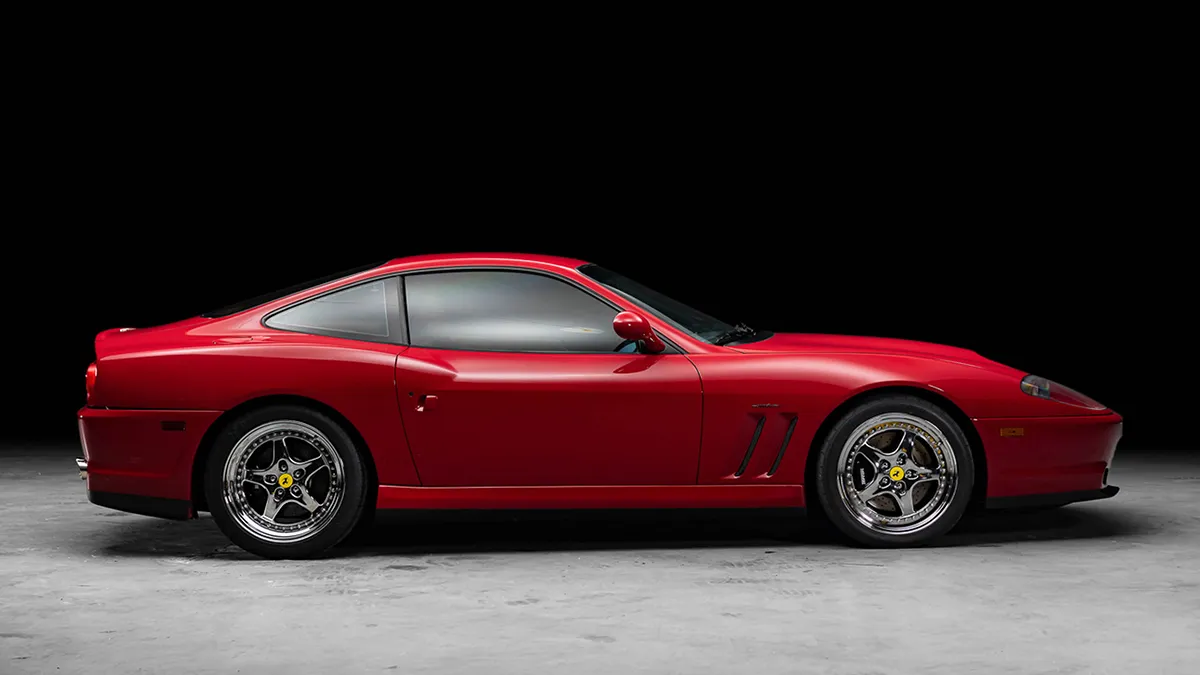
On the night of June 13, 1997, Michael Jordan won his fifth NBA championship, walked out of the United Center, and drove home in a new Ferrari. That much is well documented. What happened to that car over the next twenty-nine years is the part of this story that actually matters to collectors.
Chassis 108712, a 1997 Ferrari 550 Maranello finished in Rosso Barchetta over tan leather, goes to auction this week through Joopiter, the auction platform founded by Pharrell Williams, with an estimate of $700,000 to $1.3 million. If it reaches the top of that range, it would roughly double the previous auction record for a 550 Maranello. That number will generate headlines. It is not, however, the reason this car belongs in a serious conversation about provenance.
The real story is what had to happen before this Ferrari could be offered for sale at all: a decade-long research effort to prove, beyond dispute, that a car nobody had seen in public since 2002 was the same car Michael Jordan drove out of the United Center on the best night of his professional life.
The Car Ferrari Built to Prove a Point
The 550 Maranello wasn’t just another V12 Ferrari. When it debuted for the 1997 model year, it marked Maranello’s return to a front-engine, rear-wheel-drive grand tourer layout after roughly two decades of mid-engine flagships, a lineage running back through the Daytona. Ferrari built 3,083 examples between 1996 and 2001, each powered by a naturally aspirated 5.5-liter V12 (Tipo F133A) producing 485 horsepower, paired exclusively with a six-speed gated manual gearbox. No automated option existed. You drove a 550 the way Ferrari intended a grand tourer to be driven, or you didn’t drive one at all.
Rarity of production alone rarely creates lasting value, a point Modern Car Collector has made about far more expensive Ferraris than this one. What matters here is specification. Jordan’s car wears Rosso Barchetta over tan leather, a combination Ferrari offered but few original buyers chose in period; most 550s left the factory in solid red over black or tan over black interiors. It’s a restrained, correct pairing for a car built before personalization programs made bespoke specification the norm among high-profile buyers.
Documentation, Not Legend
Chassis 108712 was delivered new on May 29, 1997, through Foreign Cars Italia in Greensboro, North Carolina, sold to Jordan roughly two weeks before he closed out that season’s championship run. The factory warranty card, still with the car, carries his signature and his Durham, North Carolina address. Because Jordan stood 6-foot-6, the driver’s seat was fitted with extended rails and thinner-than-standard padding, a factory-period modification made specifically to accommodate him, and one that remains part of the car today.
This is the detail serious collectors should focus on, more than the estimate. A signed warranty card, a documented factory seat modification, an Illinois title in Jordan’s name, and dealer repair orders from 2000 and 2001 still showing his vanity plate each close off a way this story could have been fabricated. Modern Car Collector has written before about how quickly celebrity ownership claims can outrun the paperwork that actually supports them. This one doesn’t have that problem, and it’s worth understanding why.
According to the auction house’s own specification sheet, the car’s odometer currently reads 18,501 miles, with roughly 6,400 of those accumulated during Jordan’s ownership between May 1997 and December 2002, call it 1,150 miles a year. That’s not a garage-kept trophy rolled out for photographs. It’s a car that was actually used, across five and a half years, by an owner who happened to be the most famous athlete on the planet. The remaining mileage accrued during a single California ownership that ran from 2002 until this year, at roughly half that annual pace, evidence of a car enjoyed carefully rather than preserved under glass.
How You Find a Car That Doesn’t Want to Be Found
Jordan sold the Maranello on December 4, 2002, through Lake Forest Sportscars in Illinois. It then disappeared from public view for close to a quarter of a century, no auction appearances, no magazine features, no confirmed sightings. Among Ferrari collectors, it became one of those cars people asked about at Cavallino and Amelia Island without ever getting a real answer.
The car was eventually traced by John Temerian, co-founder of CURATED, after a partial chassis number surfaced in an old online forum post. That fragment allowed his research team to reconstruct the full VIN and cross-reference it against Ferrari’s historical dealer records, which still listed chassis 108712 under Jordan’s name with the MJ 5 plate attached. That record led to a long-term owner in California who had never publicly offered the car for sale. Temerian bought it sight unseen. It returned to Chicago on May 29, 2026, twenty-nine years to the day after Foreign Cars Italia first delivered it.
This is the part of the story that should interest collectors more than the hammer price. Authenticating a race car with a documented competition history is difficult enough; authenticating a road car whose only distinguishing history is who sat in the driver’s seat requires an entirely different kind of paper trail, built from dealer archives, title assignments, and service records rather than lap charts and entry lists. The same standard applies whether the object in question is a Ferrari or, as Modern Car Collector has reported elsewhere, a motorcycle once owned by Steve McQueen. Fame creates a story. Documentation is what turns that story into provenance a serious buyer can actually rely on.
One Week, Three Objects
The 550’s cultural footprint extends past the car itself. Nike designer Tinker Hatfield used it as the direct visual reference for the Air Jordan XIV, translating the Maranello’s cabin into quilted leather panels, its bodywork into sculpted vents, and the prancing-horse badge into the shoe’s Jumpman shield. Jordan debuted the XIV on June 14, 1998, in Game 6 of the NBA Finals against Utah, the game in which he hit the title-winning jumper over Bryon Russell, remembered today as the Last Shot, his final basket as a Chicago Bull. Joopiter is also offering the game-worn jersey from that same series in a companion sale. Three objects, a car, a shoe, and a jersey, trace back to a single week in June 1998. Only one of them is a Ferrari most collectors have never seen sold at auction before.
What the Estimate Actually Tells Collectors
A standard 1997 to 2001 Ferrari 550 Maranello with an unremarkable ownership history trades today somewhere in the low-to-mid six figures. An estimate of $700,000 to $1.3 million for this particular chassis isn’t a statement about the model. It’s a statement about what buyers are now willing to pay for a documented convergence of factory-period originality, a two-decade disappearance, and a direct line to one of the most photographed nights in American sports history.
It also says something about who is bidding. Modern Car Collector has noted that the collector base for culturally significant cars increasingly overlaps with buyers who came up through sneakers, streetwear, and sports memorabilia rather than through traditional marque clubs and concours circuits. Joopiter, built around Pharrell Williams’s own collecting network, exists because that overlap is now large enough to support its own auction platform. Ferrari’s own recent moves suggest the factory understands exactly who its next generation of buyers will be, and it isn’t only the collectors who grew up idolizing the Daytona.
The Takeaway
Run the Modern Car Collector test on this one: if the sale price disappeared from every headline tomorrow, would collectors still learn something worth knowing? Yes. They would learn how a single forum post can crack open a decade-long search. They would learn what a factory-documented seat modification is worth to an authentication file. They would learn that a car driven 6,400 real miles by its famous first owner is a fundamentally different object than one merely photographed next to him. Handled poorly, celebrity provenance becomes exactly the kind of unverifiable lore that erodes a car’s value the moment an estate settles or a story can’t be confirmed. Handled the way CURATED and Joopiter have handled chassis 108712, it becomes the opposite: a file thick enough to survive scrutiny for another twenty-nine years.
Collectors have always paid for proximity to greatness. What’s changing is how much proof that proximity now requires, and this Ferrari, whatever it ultimately brings on the block, is a useful lesson in what that proof actually looks like.
The collector car market, every weekday morning.
Auction results, price moves and what’s crossing the block, read in four minutes. Free, from Modern Car Collector.
No spam, unsubscribe in one click. Or read more about the Brief.
Related Posts:
- Jordan's Ferrari 550 Brought $2.7 Million. The Car…
- The Collector Car Market Paid Up for Certainty This…
- Record Ferraris, Rare Icons and 15,000 RPM: The Week…

- Collector Car Market Brief: A One-of-Three Veyron…
- Dan Gurney's Eagle Chassis 103 Didn't Win at Spa.…
- Kim Basinger’s Defender 90 Stalled at $91,000. The…

 Eve Nowell
  John Lloyd