

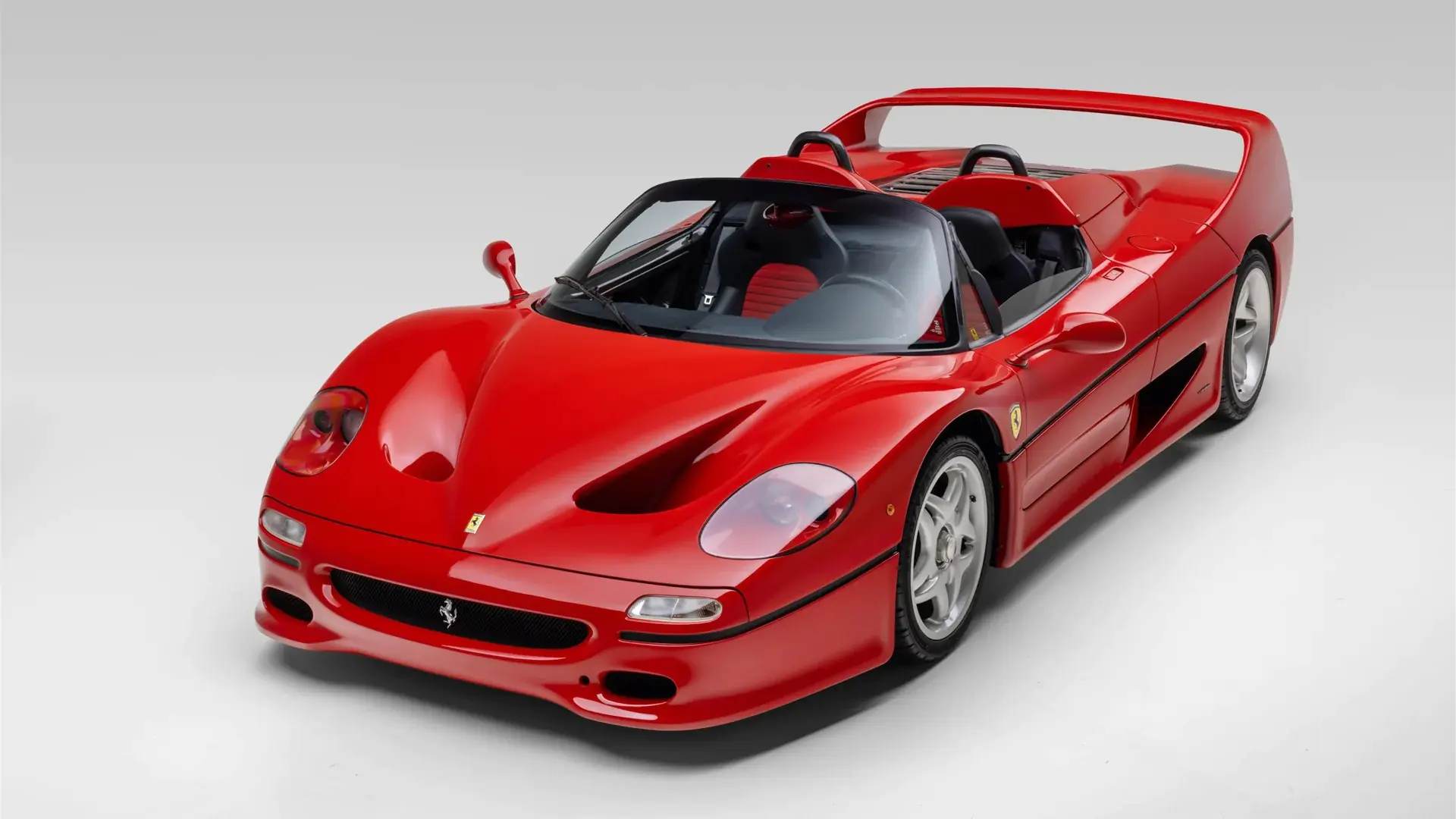
Broad Arrow has attached a number to chassis 107165: “in excess of $20,000,000,” according to the lot listing for its Las Vegas Auction on Saturday, October 31. If the car delivers, it would sit roughly 37 percent above the $14.575 million paid for a Ferrari F50 at Mecum Monterey in August, the highest public-auction price recorded for the model. But the number is the least interesting thing about this car. The more useful question is what the sale will tell us about how the market treats mileage once it approaches zero.
Our view is that a 1997 F50 showing 106 miles is not really competing with other F50s at all. It is competing with the idea of a new one.
The ladder, and why it doesn’t climb the way you’d expect
Recent public results give the estimate some context. Ralph Lauren’s car, with roughly 5,400 miles, made $9.2 million in August 2025. Mike Tyson’s former car, at 6,196 miles, brought $12.1 million at RM Sotheby’s Monterey this August. Ian Poulter’s, with just 252 miles, made $12.2 million in January. And the Mecum car, at 7,253 km (about 4,500 miles), reached $14.575 million.
Read the sequence carefully. The 252-mile car did not out-earn the 4,500-mile car that followed it; it sold for less. The ladder climbs with the calendar more than with the odometer, which is consistent with a model being repriced across the board, the same pattern we examined in the Ferrari F40’s move from $3.58 million to $8.365 million. These are not identical cars, and four sales do not make a curve. Color, history, options and bidder appetite on the day all matter. But they suggest the market has so far paid for F50s as a class rising, not for mileage as a premium. Chassis 107165 is the first car in a long while that asks bidders to pay for mileage specifically.
What 106 miles actually is
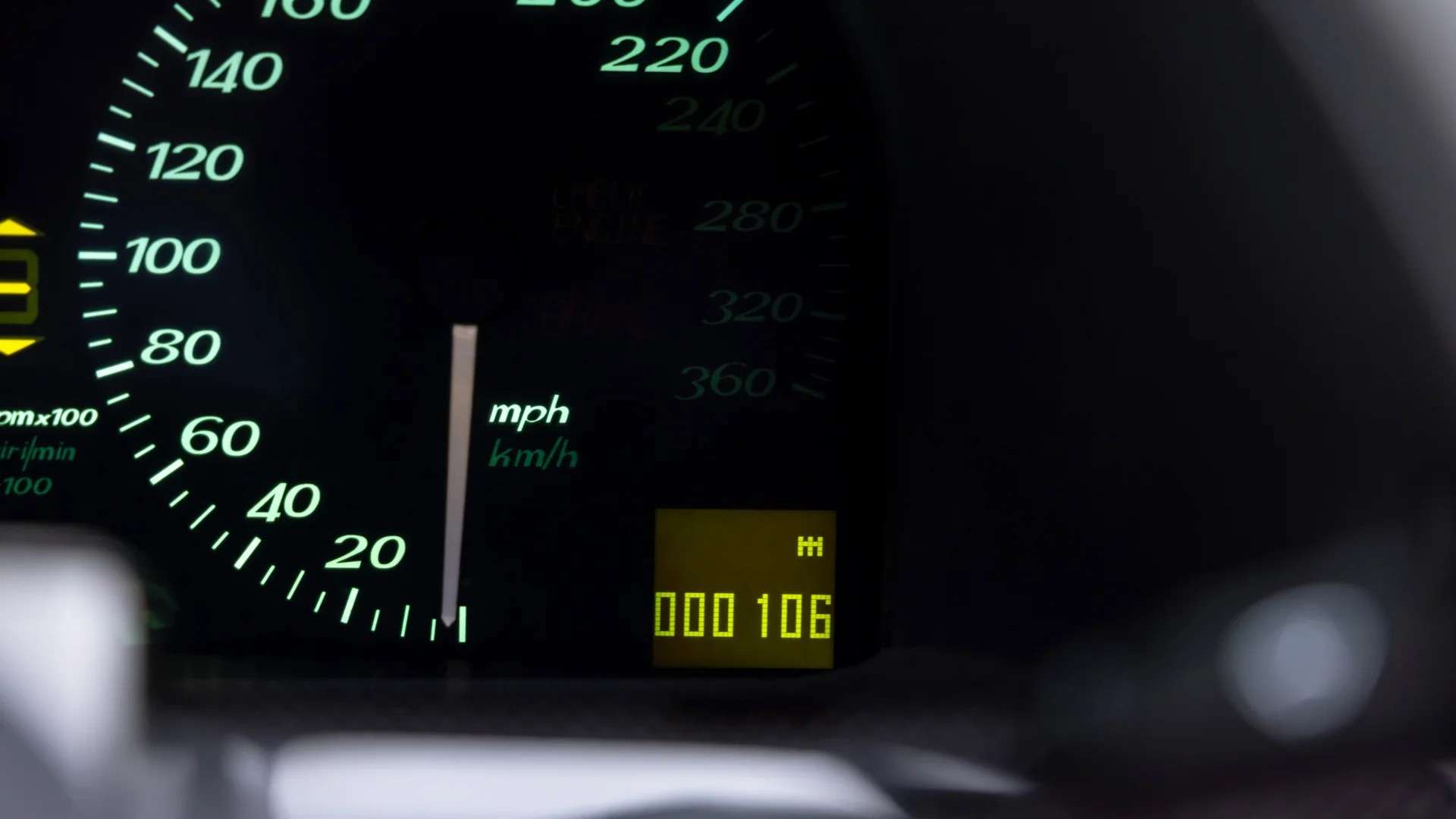
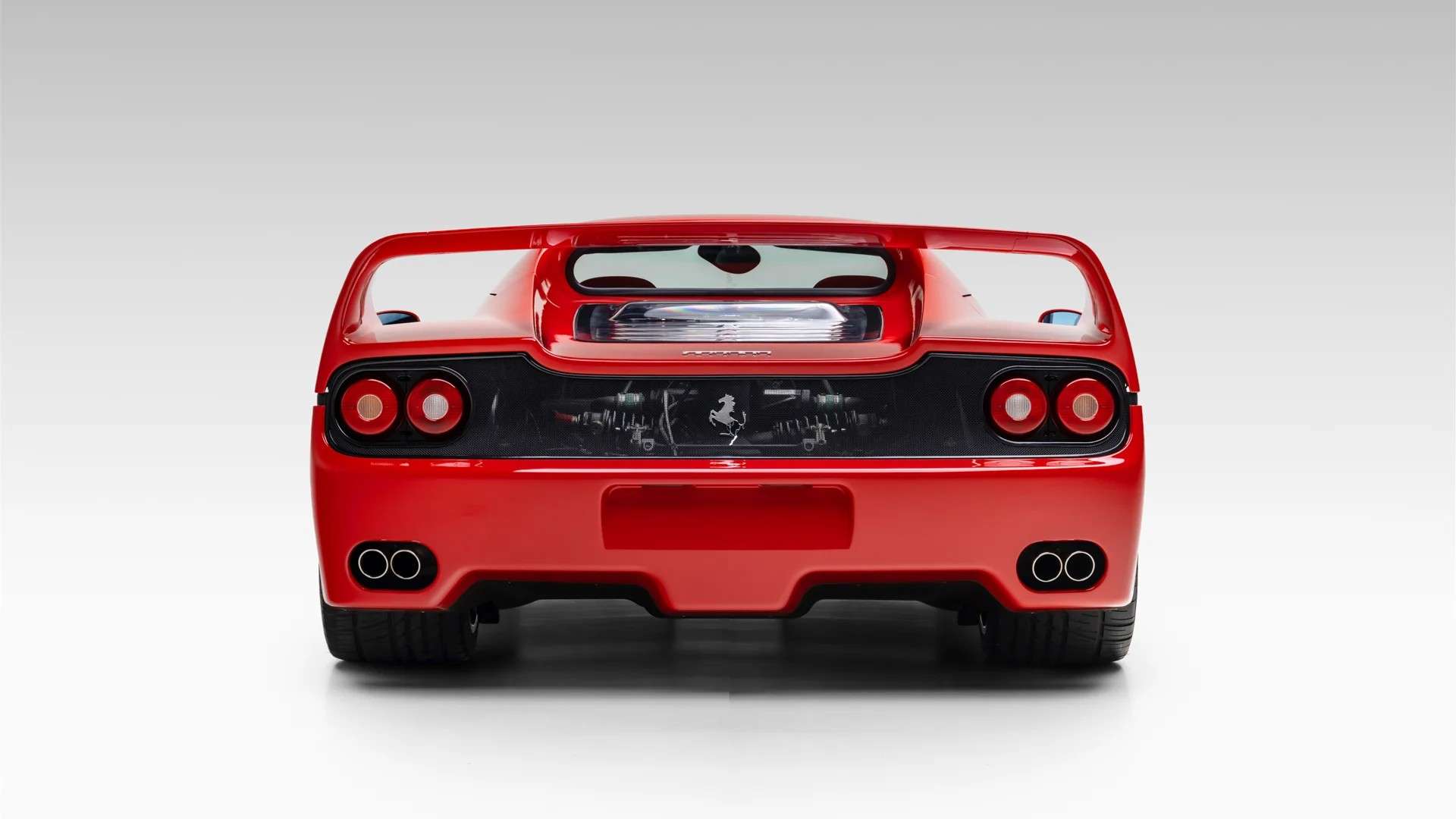
Mileage is a measurement until it gets small enough. Then it becomes a category. A car with a few thousand miles has been used, carefully; a car with 252 has been enjoyed briefly. A car with 106 has, in practical terms, been delivered and then left alone. Broad Arrow calls it “as close as one can come today to taking delivery of a new F50,” and for once the sales language is a fair description of the evidence. The catalog notes that its paint, carbon-fiber cabin, leather and switchgear show none of the fading or handling marks even careful use leaves behind.
Scarcity helps, but it is not the argument. Ferrari built 349 F50s between 1995 and 1997 to avoid repeating the F40, of which it made 1,311. This is number 334, a late car, and one of approximately 25 delivered new in the United Kingdom through Maranello Sales Ltd. of Egham, Surrey, whose decal remains on the windshield. Plenty of F50s are rare. What is genuinely unusual is a rare one with its factory identity intact.
The kit matters as much as the car
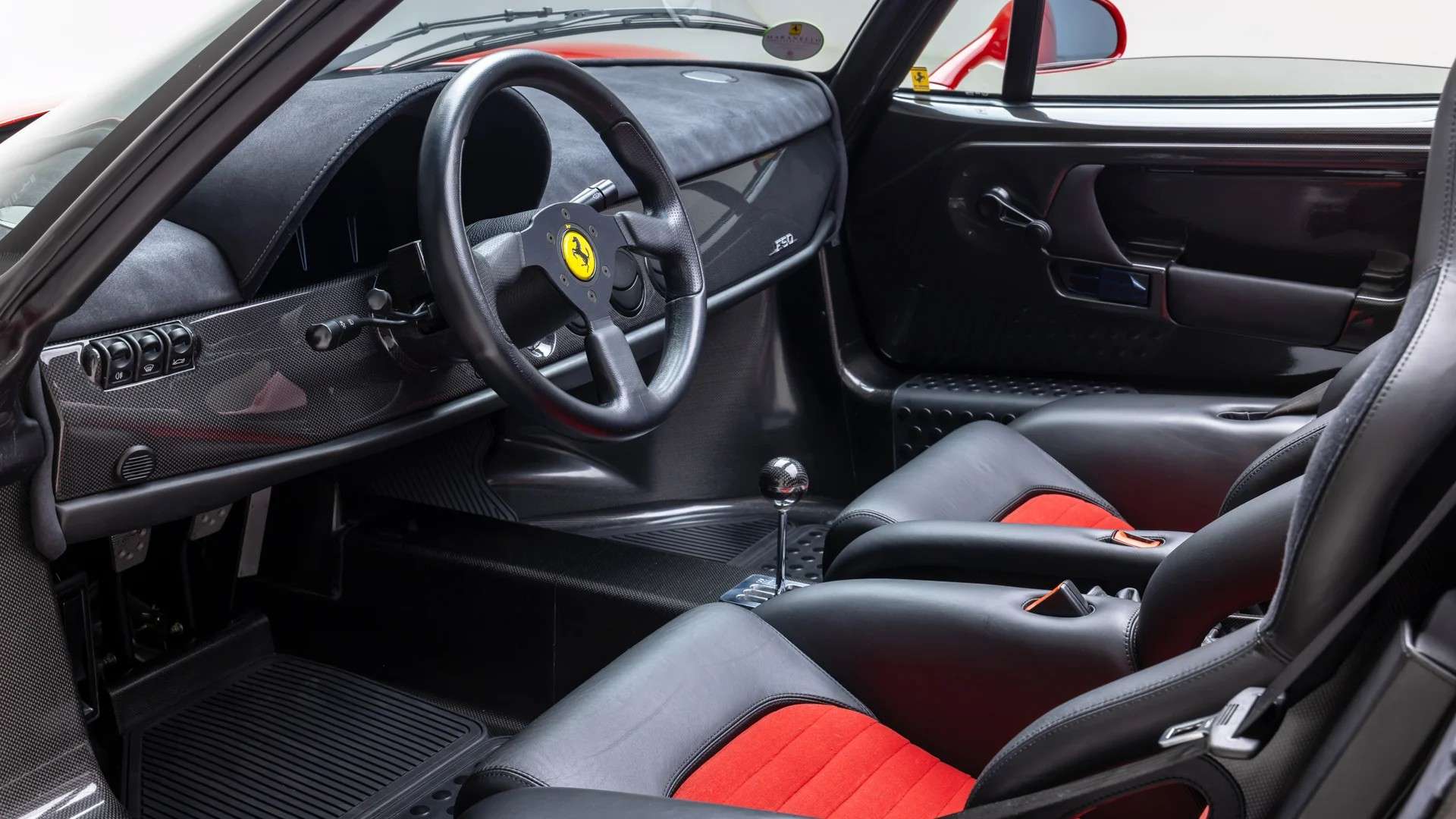
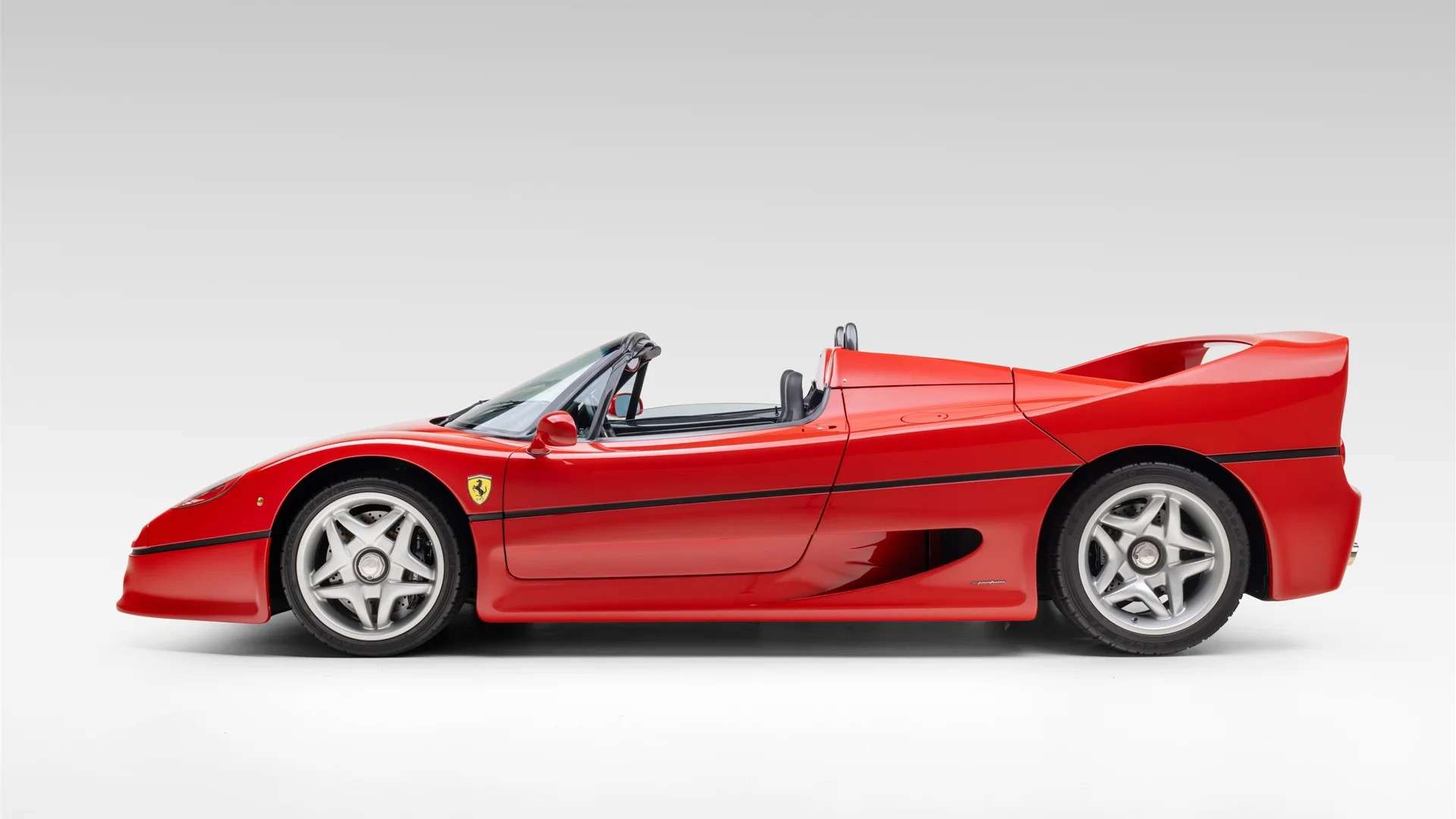
Rosso Corsa over Nero leather with Rosso inserts is, in Broad Arrow’s words, the combination most closely identified with the model, and it is correct here. More telling is what travels with the car: the removable hardtop and the original flight case that houses it when the F50 runs as a barchetta, J.P. Tod’s driving shoes, a three-piece Schedoni luggage set with dust covers, the tool kit, wheel socket, fuse, bulb and belt kit, and the car, seat and steering wheel covers in their Ferrari bag. As the lot description observes, items like these were routinely separated from their cars, lost between owners or simply used. Completeness is a form of provenance. It shows an owner who treated the entire delivery, not just the car, as something to preserve.
The history is more complicated than “parked for 30 years”
The headline version of this story is a time capsule. The documented version is more interesting and, for a buyer, more important. Research by Ferrari historian Marcel Massini shows chassis 107165 began assembly in Maranello on June 27, 1997, was invoiced on August 6, and was dispatched that December to Maranello Concessionaires, the official U.K. importer, with its factory warranty starting December 31, 1997. It later went to Japan, where it was part of a significant private collection in Kashiwa, Chiba Prefecture, and was still recorded there in 2008. By 2015 it was with a Chinese supercar collector who stored his cars in Düsseldorf; Rosso Scuderia serviced it in June of that year, and Eberlein Automobile of Kassel followed in March 2021 and February 2025. It has since been imported to the United States, where it received a fresh service and a Ferrari Classiche inspection at Ferrari of Newport Beach, according to the listing.
That is a chain of custodians across at least four countries, and on the evidence of the odometer, none of them drove it. It also means the 106 miles is a documentary claim as much as a physical one. At this level the odometer is supported by Massini’s research and the service record, and serious bidders will want to examine all of it.
What a $20 million bidder should be asking
Three things. First, the mechanical reality of a car that has barely moved: fluids, seals, elastomers and belts age with time, not distance, which is presumably why the recent service matters. Second, the Classiche inspection. The listing describes an inspection, and buyers will want to know exactly what it found and what documentation, if any, followed. Third, depth. At this price the field of capable bidders is small, and a result at or above the estimate would need more than one of them to want the same car on the same afternoon.
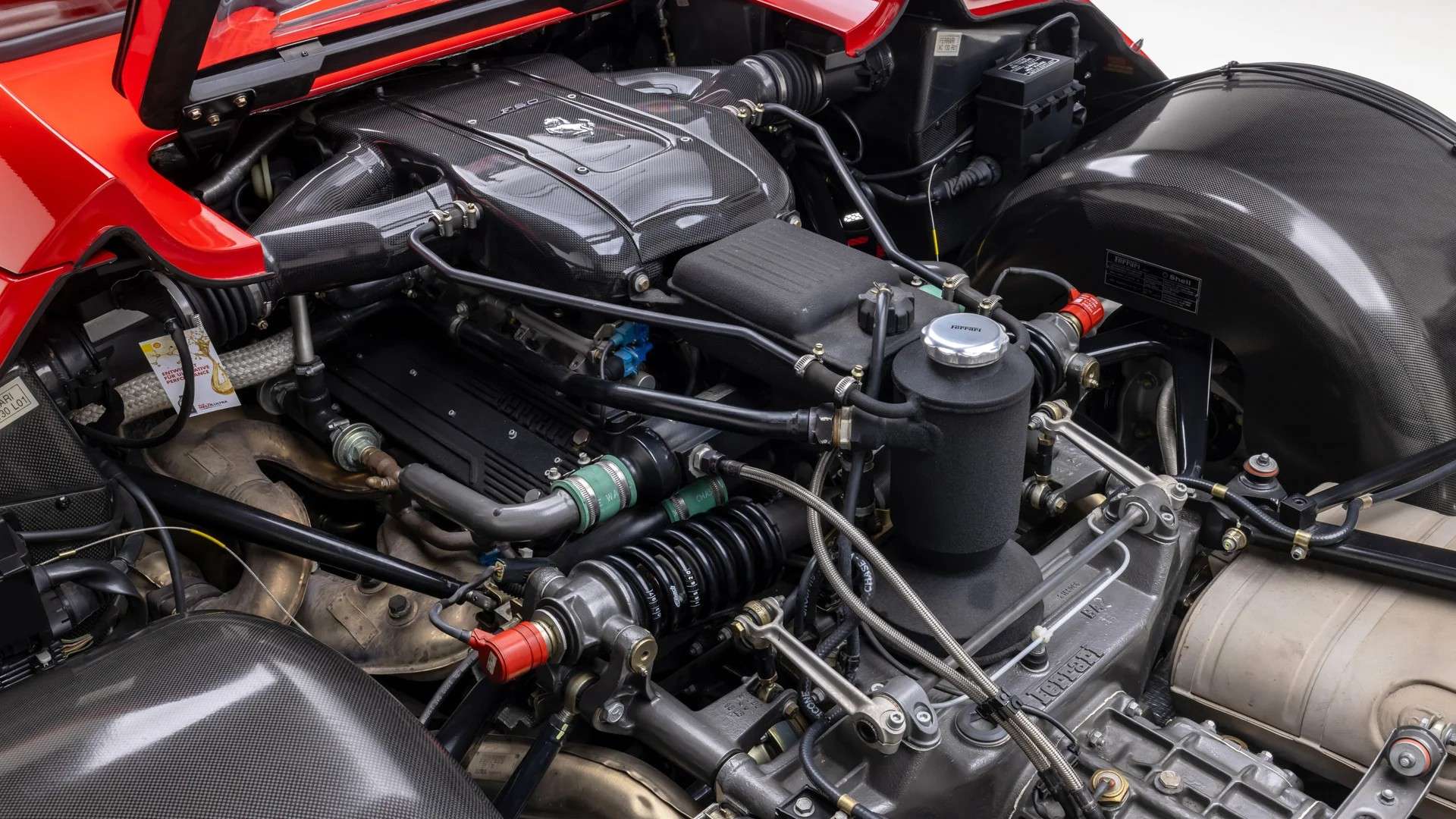
There is also a tension worth naming. Ferrari’s own pitch for the F50 was that the driver should feel as though he or she was piloting a Grand Prix car: a 4.7-liter V12 derived from the company’s 1990 Formula 1 engine, 513 horsepower, a carbon-fiber tub, unassisted steering, and a six-speed manual in an open gate, the last of the company’s halo cars to be offered that way, per the catalog. The market has now optimized a car engineered to be driven hard for the opposite treatment. Every mile the next owner adds is, in pricing terms, a subtraction. That is the real price of ultra-low mileage: the right to own the car is also a commitment not to use it.
Why this matters beyond one lot
If chassis 107165 sells near its estimate, it will not simply set a record. It will establish that delivery-state originality is priced separately from the model, in a step rather than a slope, and every other low-mileage modern Ferrari will be measured against it. The same questions are already being asked of the LaFerrari, where a 13,000 km car made €5.18 million at Zoute, and of the Daytona SP3’s rapid repricing. It is also a reminder of how much a famous name can matter on the ladder above, from Mike Tyson’s car to the one once owned by Ralph Lauren, whose collection we profiled earlier this month. Here, the car’s condition is the celebrity.
If it falls short, the lesson is just as valuable: that the F50 market’s recent strength belonged to the model, and that bidders are not yet willing to pay for the final hundred miles. Either answer will be useful. Collectors rarely pay a premium for horsepower alone; they pay for the moment a car stops being a vehicle and becomes a reference. We will report the result after the hammer falls on October 31.
The collector car market, every weekday morning.
Auction results, price moves and what’s crossing the block, read in four minutes. Free, from Modern Car Collector.
No spam, unsubscribe in one click. Or read more about the Brief.


 Eve Nowell
 Kyle Matthews