

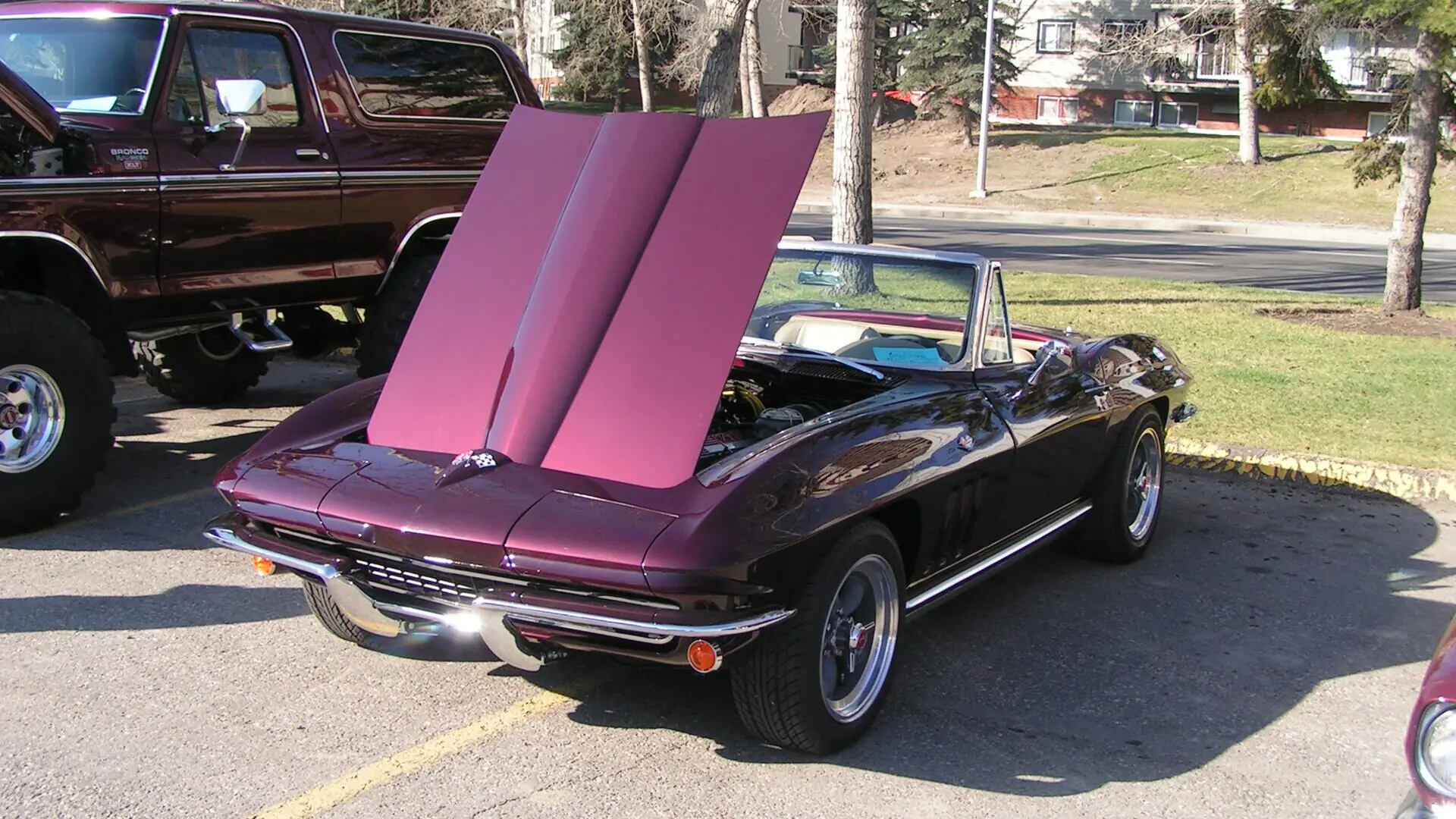
On March 22, 2025, a satin-blue 1965 Corvette convertible crossed the block at Mecum Glendale as Lot S234 and posted a result of $77,000. Nineteen months later, the same car, carrying VIN 194675S116375 in both catalogs, is on Hagerty Marketplace with a high bid of $23,000, eleven bids, and the auction closing October 26 at 2:10 p.m. Eastern.
Nobody should read that as a verdict yet. A high bid nine days out is not a sale price, and online auctions rarely show their hand early. The more useful question is what the first number was paying for. Our view: in March 2025, a good share of the $77,000 was paying for a story. This time the car has to carry the sale on its own merits, and those merits are more specific, and more debatable, than the Downey name suggests.
What the Corvette Actually Is
The donor is a good one but not a rare one. The 1965 model year brought four-wheel disc brakes to the Corvette, and the convertible accounted for nearly two-thirds of that year’s production, so there is no scarcity story in the body style. Mecum’s catalog says the original 327 V-8 was removed. Reporting around the Glendale sale described the factory car as a 327/300-horsepower Powerglide, the sort of Corvette that sits in the strong middle of the C2 market rather than at the top of it. The big-block cars and fuel-injected cars are where the blue-chip money lives.
That leaves the electric powertrain and the provenance to explain the price. The Mecum catalog credits Rich Benoit and his Electrified Garage team with the conversion, which uses two Netgain Hyper 9 motors, a Torque Solutions gear-reduction box, and seven Tesla Model S modules totaling 37.1 kWh. The interior was retrimmed in a mushroom-based leather from Ecovative. The catalog quotes Downey: “We changed the heart of an American classic, but we left the soul intact.” It is a good line, and it is also the question a buyer has to answer for himself.
The Car Came From a Television Show, and a Sweepstakes
The Corvette was one of six vehicles built for Downey’s Dream Cars, which were given away in a sweepstakes benefiting Robert Downey Jr.’s Footprint Coalition. Mecum notes that the consignor won the car through the RDJ Dream Cars program, and that the presentation was filmed. Another of the six was a 1981 Chevrolet El Camino, a nameplate whose roots we traced in our look at the day Chevrolet unveiled the original El Camino.
This is real provenance, with documentation attached. It is also a type of provenance that tends to be worth most at the moment it is freshest. The first buyer in a celebrity chain pays for proximity to the story. The second seller has to find a buyer who values the story and the engineering independently of the excitement. The current Hagerty listing still names Downey and the show, but it leads with the hardware and the known imperfections, and it does not mention the sweepstakes at all.
What a Careful Bidder Will Compare
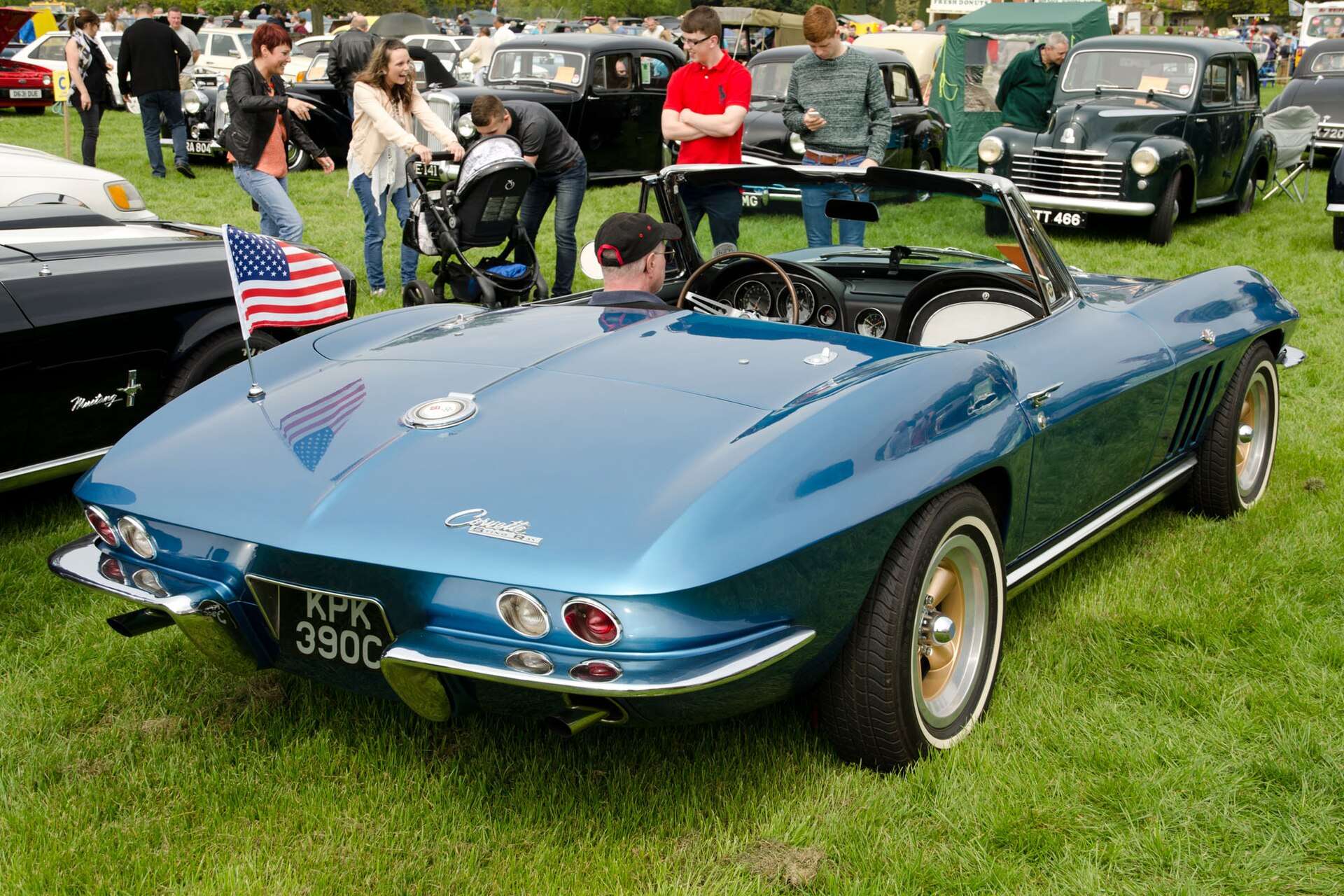
The two catalogs do not describe the car identically, and the differences are the sort a serious buyer reconciles before bidding. Mecum listed color-keyed knock-off style wheels and a beige mushroom-leather interior with rack-and-pinion steering; Hagerty’s listing describes 15-inch satin-blue painted steel wheels, a tan interior, EZ electric power steering and an aftermarket steering wheel. Some of this may be wording, and some may be changes made by the current owner. The listing also discloses an intermittent driver’s-side headlight mechanism and a windshield wiper system that has been “parked.” The odometer has moved from 4,128 miles at Glendale to 4,500 today, roughly 370 miles over nineteen months, which suggests occasional use.
The question we would ask first is the one neither catalog answers: what became of the original 327 and its Powerglide? Reporting at the time said the conversion uses the factory engine mounts and could be returned to gasoline power. That reversibility only has value if the original drivetrain exists and can be traced to the car. We have written before about how a replacement engine reshapes a Corvette’s value and how a single casting pad can define a Z/28. An electric car built on a numbers-matching Corvette whose original engine is still in a crate sits in one market. One whose engine is gone sits in another.
The Range Is the Real Constraint
Mecum’s catalog gives a typical charge time of four to six hours and an average driving distance of about 60 miles, with a J1772 port in the original fuel-filler location. The Hagerty listing includes a Level 1 charger and a battery tender. A 37.1 kWh pack is modest beside a modern production EV. This is a car for a coastal run to dinner and back, which suits Florida, where it sits now, but it is not a touring Corvette in the sense that matters to many C2 owners.
That is not a flaw; it is a definition. Collectors of purpose-built restomods, a market we examined in our look at the JAS Tensei, tend to separate the commissioned, documented builds from the one-offs, and ask whether the build can be serviced, repaired and sold again. Here the answer is yes in principle, because the Netgain and Tesla components are well known, and the car comes with an Electrified Garage user manual.
What the Final Number Will Tell Us
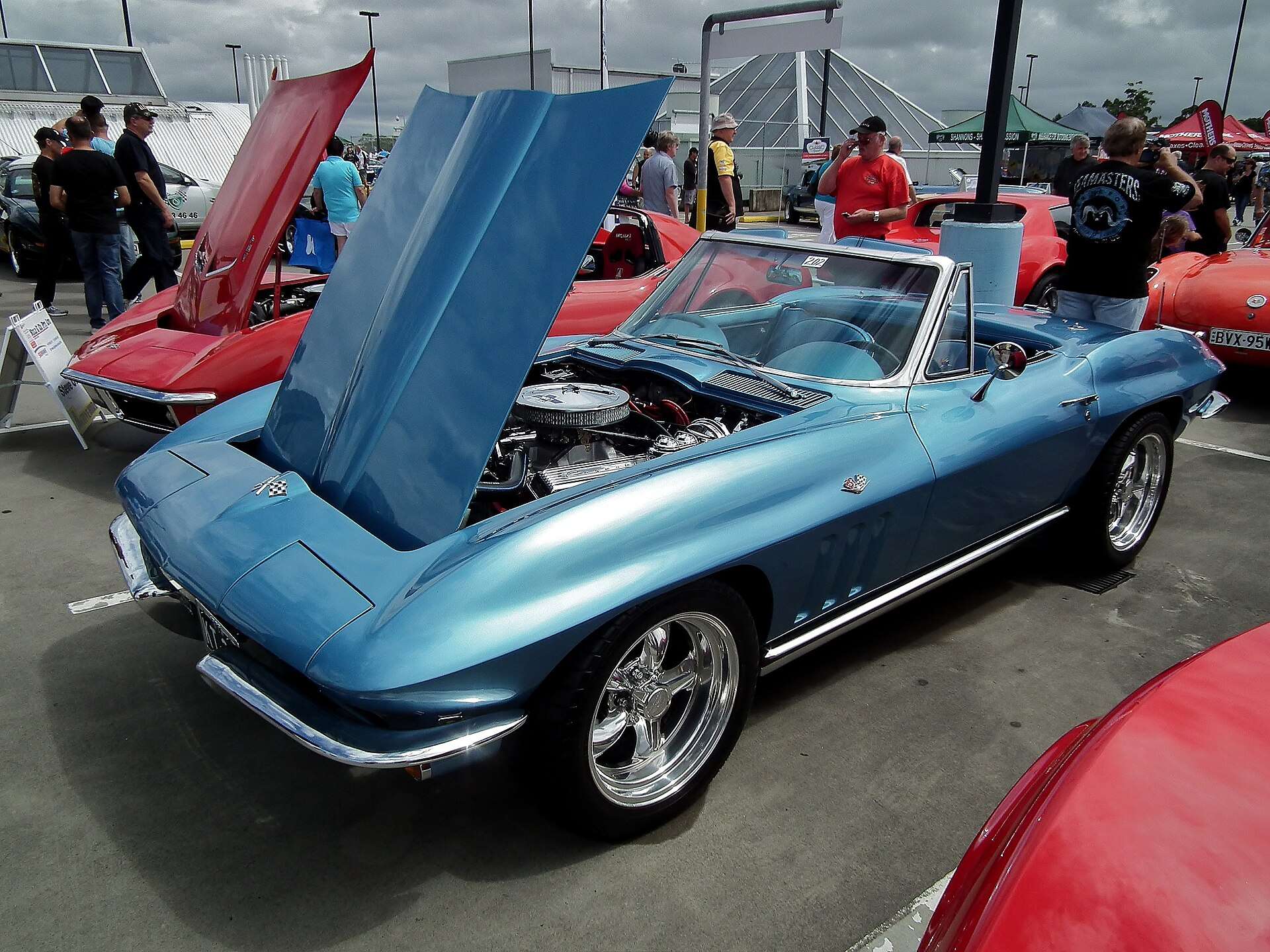
Bidding opened with $1,000 on October 11 and reached $23,000 by the night of October 15, with the Hagerty page showing close to 8,000 views. Early bids on a Marketplace listing are poor predictors of the finish. What matters is where the car lands relative to two reference points. If it ends near the $77,000 posted at Glendale, the celebrity premium transferred to a second owner, which would be unusual and worth noting. If it ends well below, it suggests the first sale priced the moment, and the market now prices a tidy, reversible EV Corvette on its own engineering. Neither outcome makes the car a bad one. It would simply tell us how much of a celebrity restomod’s value is portable.
Collectors rarely pay twice for a story. They pay once for the moment, and after that they are buying the car.
Details are drawn from the Mecum Glendale 2025 catalog and the seller-provided Hagerty Marketplace listing. Hagerty notes that bidders are responsible for their own due diligence; we recommend a pre-purchase inspection and a review of the build documentation for any car of this kind.
The collector car market, every weekday morning.
Auction results, price moves and what’s crossing the block, read in four minutes. Free, from Modern Car Collector.
No spam, unsubscribe in one click. Or read more about the Brief.
Related Posts:
- Record Ferraris, Rare Icons and 15,000 RPM: The Week…

- The Porsche Carrera GT Doubled in 2026. The $6.7…

- A 1969 Corvette L88 Convertible Is at $160,000. The…
- For Sale at Freije & Freije Auctioneers: 2017…
- The Collector Car Market Paid Up for Certainty This…

- Restored 1937 Cord 812 Supercharged Phaeton For Sale…
 Eve Nowell
 John Lloyd