

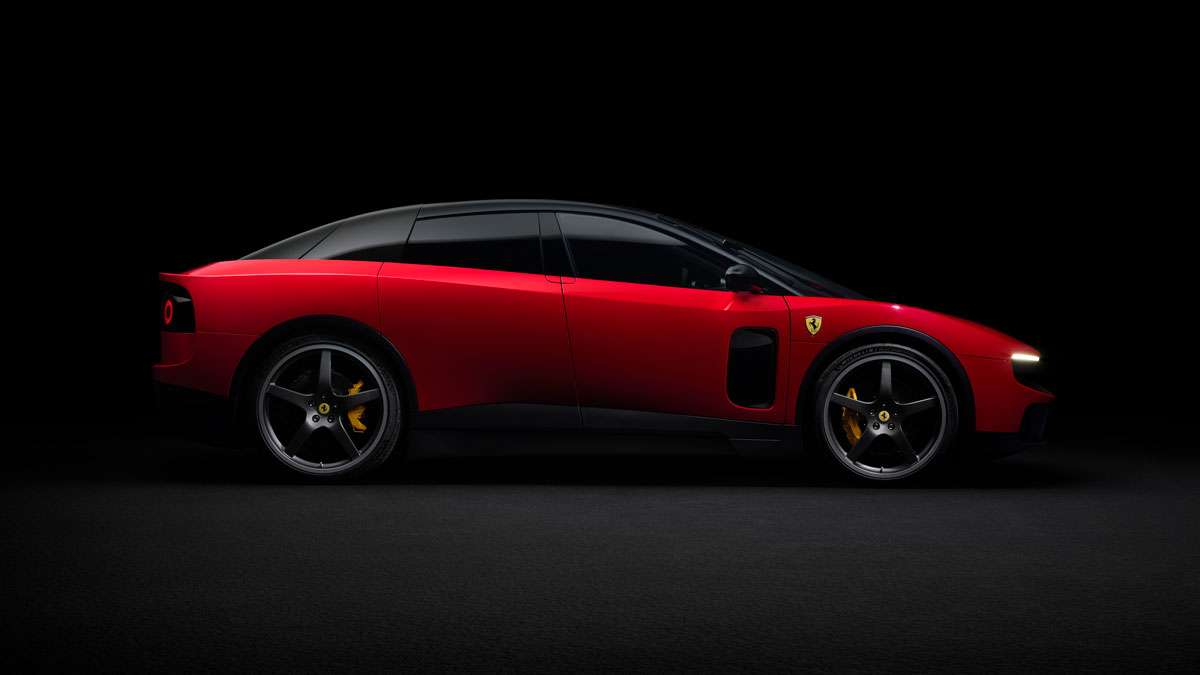
Ferrari confirmed this week what its own dealer network already suspected: the Luce, the marque’s first series-production electric car, has cleared its full 2026 allocation of just under 500 units. Ferrari has not disclosed the figure itself, but people close to the matter say the target was reached barely two months after the car’s contentious May unveiling, according to the Financial Times. On paper, that is a fast result for a car that was mocked on social media, cost Ferrari more than eight percent of its share price in a single trading session, and prompted a former chairman to suggest it be stripped of its prancing horse badge. But the speed of the sellout is not, by itself, evidence that the Luce succeeded. It is evidence of who Ferrari sold it to, and that distinction matters far more to collectors than the headline number.
The backlash was real and well documented. Jony Ive’s exterior treatment drew comparisons to considerably cheaper mass-market cars, former chairman Luca Cordero di Montezemolo called publicly for the badge to be removed, and Ferrari’s longtime chief marketing and commercial officer departed the company within a month of launch, a move Ferrari has maintained was planned before the Luce ever reached showrooms. Whatever the timing, the exit of the executive who had shaped Ferrari’s client relationships for years landed at an uncomfortable moment.
What the controversy obscured is where the Luce actually found its buyers. Ferrari allotted only 88 units to China, and the entire allocation sold before most Western critics had finished writing about the design. Interest has also been building in Thailand ahead of deliveries not expected until late 2027. In the United States and parts of Europe, by contrast, Ferrari sales consultants have reported a noticeably cooler reception among the marque’s existing client base. That split is not incidental. It is the plan.
Ferrari has been fairly explicit that the Luce is built for a different buyer than the one who waits years for an allocation on a limited-run V12. Executives have described the car as a way to reach newly wealthy clients in China and in technology hubs such as Silicon Valley, buyers who already drive electric cars and do not carry the loyalty of a third-generation Ferrari household. Just as tellingly, the company has instructed dealers not to pressure existing petrol-loving collectors into the Luce, and has said Luce ownership will not open the door to future limited-edition allocations the way ownership of a 12Cilindri or an SF90 typically does. Ferrari, in other words, built a second client book rather than trying to convert its first one.
Lamborghini reached the opposite conclusion. Rather than push into series-production EVs, Sant’Agata scrapped its fully electric program and doubled down on combustion and hybrid architecture, a decision its chief executive has defended publicly even as Ferrari absorbed criticism for doing the opposite. Two Italian marques, the same market, the same moment, two entirely different bets on what a modern collector-grade supercar client actually wants. That divergence, not the Luce’s styling, is the more useful signal for anyone trying to read where this segment of the market is heading. As one independent analyst of luxury car brands told the Financial Times, Ferrari’s reading of its customer base is “on another level versus a lot of their competitors.”
None of this, though, is the reason serious collectors should actually be paying attention to the Luce right now. That reason is heading to a stage in Monterey next month wearing a chassis plate that reads zero. Ferrari’s first production Luce, VIN ZFF21BUA8T0338000, is crossing the block at RM Sotheby’s without reserve, with every dollar earmarked for the Ferrari Foundation rather than the company itself. The specification is a Tailor Made commission finished in a bespoke pearlescent white-family paint called Madreperla, with a Le Mans metallic leather cabin sourced from Swiss hides and Grigio Corvara secondary trim in place of Ferrari’s usual black, a first for the marque. An estimate in excess of $1.1 million has been attached to a car that, mechanically, is identical to every other Luce Ferrari built this year.
That gap between the estimate and the transaction price of an ordinary Luce is the entire lesson. Chassis 0 is not valuable because it is an electric Ferrari. It is valuable because it is the first one, because its specification was built through Ferrari’s own design studio rather than pulled off an options list, and because its ownership history begins with a charitable transaction that is a matter of public auction record before the car has covered a single mile in private hands. Those are the ingredients that have always mattered to Ferrari collectors: first-of-type production, documented commissioning, an unrepeatable configuration. They apply here regardless of whether the Luce ever wins over the traditionalists.
Sales targets measure appetite in a given year. They say nothing about which specific cars will matter in twenty. Ferrari has already sold nearly 500 Luce examples in 2026, and if the pace holds, that figure will look unremarkable once the company reaches its stated goal of roughly 600 units annually by 2030, hardly a scarce car in the way the collector market usually defines scarcity. What will remain scarce is the documentation: one chassis number, one commissioning file, one charity ledger entry. Collectors have never really paid a premium for the newest technology. They pay for the version of a story that cannot be repeated, and on a production EV built in the thousands, Chassis 0 may be the only Luce that qualifies.
Images Via: Ferrari, RM Sotheby’s
The collector car market, every weekday morning.
Auction results, price moves and what’s crossing the block, read in four minutes. Free, from Modern Car Collector.
No spam, unsubscribe in one click. Or read more about the Brief.
Related Posts:
- Everything Modern Car Collector Covered Last Week
- The Collector Car Market Paid Up for Certainty This…

- Record Ferraris, Rare Icons and 15,000 RPM: The Week…

- The $402,000 Corvette ZR1X Isn't a Collector-Car…

- Ferrari's $40 Million Electric First Wasn't a Market…
- Ferrari Monza SP2 Value Nearly Doubled in Three…
 Elizabeth Puckett
  John Lloyd
  Kyle Matthews